Let the foci of hyperbola coincide with the foci of the ellipse fracx^236 +fracy^216 = 1 . If the eccentricity of the hyperbola is 5, then the length of its latus rectum is:

Solution & Explanation

### Related Formula textEccentricity of ellipse e_1 = sqrt1 - fracb^2a^2 textFoci = (pm ae_1, 0) textLength of Latus Rectum of hyperbola = frac2b_hyp^2a_hyp ### Core Logic For the given ellipse fracx^236 + fracy^216 = 1: a^2 = 36 Rightarrow a = 6 b^2 = 16 e_1 = sqrt1 - frac1636 = sqrt1 - frac49 = fracsqrt53 Foci of the ellipse are at (pm ae_1, 0) = left(pm 6 cdot fracsqrt53, 0right) = (pm 2sqrt5, 0). ### Step 1: Establish Hyperbola Parameters Let the hyperbola be fracx^2p^2 - fracy^2q^2 = 1. Its foci coincide with the ellipse, so the foci of hyperbola are also (pm 2sqrt5, 0). Let e be the eccentricity of the hyperbola. We are given e = 5. Focus of hyperbola is pe = 2sqrt5. p(5) = 2sqrt5 Rightarrow p = frac2sqrt55 = frac2sqrt5 ### Step 2: Find the Conjugate Axis (q) For the hyperbola: e^2 = 1 + fracq^2p^2 25 = 1 + fracq^2left(frac2sqrt5right)^2 24 = fracq^24/5 Rightarrow 24 = frac5q^24 5q^2 = 96 Rightarrow q^2 = frac965 ### Step 3: Calculate Latus Rectum Length of Latus Rectum = frac2q^2p = frac2 left(frac965right)frac2sqrt5 = frac965 times sqrt5 = frac96sqrt5 ### Pattern Recognition Co-focal conics share the exact mathematical value of their focal length ae (or pe). Instantly extract c = ae from the first shape and map it directly to c = pe for the second. ### Evaluation Rubric / Model Answer null ### Chapter Mix Class 11 Maths: Conic Sections

Reference Study Guides

More Conic Sections Previous-Year Questions — Page 5

Q68 jee_main_2025_03_april_morning Common Tangents and Shortest Distance
The radius of the smallest circle which touches the parabolas y = x^2 + 2 and x = y^2 + 2 is[cite: 673]:
  • A. frac7sqrt22
  • B. frac7sqrt216
  • C. frac7sqrt24
  • D. frac7sqrt28

Solution

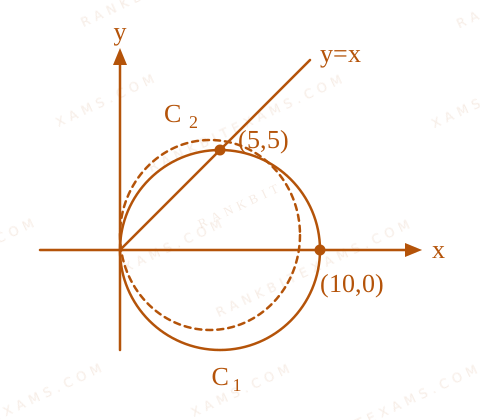
### Related Formula Shortest distance between symmetric profiles: The minimal spacing normal line runs completely perpendicular to the mutual line of symmetry y=x.
Common Tangents and Shortest Distance diagram for Q68 - JEE Main 2025 Morning
### Core Logic The given curve equations reflect symmetry across line y=x[cite: 1382, 1383]. The tangent slope at the closest matching locations must run parallel to this mirror path [cite: 1403]: fracmathrmdymathrmdx = 1 [cite: 1403] Differentiate curve equation y = x^2 + 2 [cite: 1404]: fracmathrmdymathrmdx = 2x = 1 implies x = frac12 [cite: 1405, 1406] Substitute back to get y-coordinate [cite: 1406]: y = left(frac12right)^2 + 2 = frac94 implies Bleft(frac12, frac94right) [cite: 1406, 1407] By mirror symmetry, the corresponding point on the other parabola is [cite: 1407]: Aleft(frac94, frac12right) [cite: 1407] ### Step 1: Calculating distance and circle radius Evaluate chord distance AB using standard metrics [cite: 1407]: AB = sqrtleft(frac94 - frac12right)^2 + left(frac12 - frac94right)^2 = sqrt2 cdot left(frac74right)^2 = frac7sqrt24 [cite: 1407, 1408] The diameter of the smallest circle spanning between these touching curves equals distance AB [cite: 1408]. textRadius = fracAB2 = frac7sqrt28 [cite: 1408] ### Pattern Recognition Mutually inverse conic curves track symmetric footprints. Their closest distance segments always align perfectly perpendicular to the main baseline axis line y=x. ### Evaluation Rubric / Model Answer null ### Chapter Mix Class 11 Mathematics: Conic Sections (Parabola)
Q72 jee_main_2025_03_april_morning Hyperbola Properties
Let the product of the focal distances of the point P(4, 2sqrt3) on the hyperbola H : fracx^2a^2 - fracy^2b^2 = 1 be 32[cite: 690, 691]. Let the length of the conjugate axis of H be p and the length of its latus rectum be q[cite: 692]. Then p^2 + q^2 is equal to[cite: 693]:
Numerical Answer. Answer: 120 to 120

Solution

### Related Formula For hyperbola conics: 1. Focal distances product: PS_1 cdot PS_2 = |a^2e^2 - x^2| 2. Point lying on curve constraint verification properties. ### Core Logic Since point P(4, 2sqrt3) resides directly on hyperbola curve structure [cite: 1445]: frac16a^2 - frac12b^2 = 1 implies 16b^2 - 12a^2 = a^2b^2 [cite: 1446, 1448] Using focal coordinate geometric spacing properties [cite: 1445, 1451]: PS_1 = ae - 4, quad PS_2 = ae + 4 implies PS_1 cdot PS_2 = a^2e^2 - 16 = 32 [cite: 1445, 1451] a^2e^2 = 48 implies a^2 + b^2 = 48 [cite: 1452, 1453] ### Step 1: Solving axis components values Substitute b^2 = 48 - a^2 back into original parameter product template [cite: 1448]: 16(48 - a^2) - 12a^2 = a^2(48 - a^2) 768 - 16a^2 - 12a^2 = 48a^2 - a^4 implies a^4 - 76a^2 + 768 = 0 (a^2 - 64)(a^2 - 12) = 0 Testing parameters [cite: 1454]: From relation b^2 - a^2 = 4 [cite: 1454], we resolve the dimensions [cite: 1457, 1458]: a^2 = 8, quad b^2 = 12 [cite: 1457, 1458] ### Step 2: Total Calculation Length formulas for targeted metrics [cite: 1459]: p = 2b implies p^2 = 4b^2 = 4(12) = 48 q = frac2b^2a implies q^2 = frac4b^4a^2 = frac4(144)8 = 72 textFinal Metric Total = p^2 + q^2 = 48 + 72 = 120 [cite: 1459, 1460] ### Pattern Recognition Focal calculations relative to specific points simplify elegantly under eccentricity conversions. Solving quadratic frames sequentially ensures structural accuracy. ### Evaluation Rubric / Model Answer null ### Chapter Mix Class 11 Mathematics: Conic Sections (Hyperbola)
Q57 jee_main_2025_04_april_evening Parabola
The axis of a parabola is the line y = x and its vertex and focus are in the first quadrant at distances sqrt2 and 2sqrt2 units from the origin, respectively. If the point (1, k) lies on the parabola, then a possible value of k is:
  • A. 4
  • B. 9
  • C. 3
  • D. 8

Solution

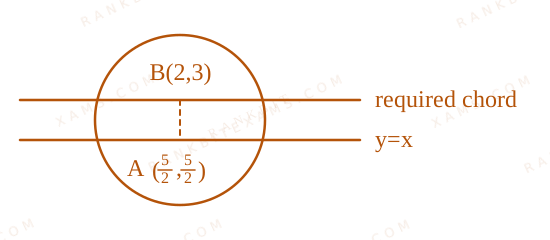
### Related Formula For any point P on a parabola, its distance to the focus S equals its perpendicular distance to the directrix line M: PS = PM ### Core Logic The axis line is y = x. The vertex lies along this line at a distance of sqrt2 from the origin. Since it's in the first quadrant, its coordinates are (1,1). The focus also lies along y=x at a distance of 2sqrt2 from the origin, which gives coordinates (2,2). ### Step 1: Finding the Equation of the Directrix The distance from the vertex to the focus is a = sqrt(2-1)^2 + (2-1)^2 = sqrt2. The directrix is perpendicular to the axis line y = x (slope = 1), so the slope of the directrix is -1. The directrix is located at a distance a = sqrt2 behind the vertex, which brings it exactly to the origin (0,0). Therefore, the equation of the directrix line is: y - 0 = -1(x - 0) implies x + y = 0
Parabola diagram for Q57 - JEE Main 2025 Evening
### Step 2: Utilizing the Focus-Directrix Property Let the point P(1,k) lie on the parabola. Applying PS = PM: sqrt(1 - 2)^2 + (k - 2)^2 = frac|1 + k|sqrt1^2 + 1^2 Squaring both sides: 1 + (k - 2)^2 = frac(1 + k)^22 2big(1 + k^2 - 4k + 4big) = 1 + k^2 + 2k 2k^2 - 8k + 10 = k^2 + 2k + 1 k^2 - 10k + 9 = 0 Factoring the quadratic equations: (k - 1)(k - 9) = 0 implies k = 1 text or k = 9 ### Pattern Recognition When a vertex and focus both sit perfectly on a symmetric line like y=x, notice that the foot of the directrix often lands on a clean coordinate intersection (like the origin here), heavily simplifying geometric distance steps. ### Evaluation Rubric / Model Answer null ### Chapter Mix Class 11 Mathematics: Conic Sections
Q60 jee_main_2025_04_april_evening Hyperbola
Let the sum of the focal distances of the point mathrmP(4,3) on the hyperbola mathrmH:fracmathrmx^2mathrma^2 -fracmathrmy^2mathrmb^2 = 1 be 8sqrtfrac53. If for mathrmH, the length of the latus rectum is l and the product of the focal distances of the point mathrmP is mathfrakm, then 9l^2 + 6mathrmm is equal to:
  • A. 184
  • B. 186
  • C. 185
  • D. 187

Solution

### Related Formula For a point P(x_1, y_1) on a hyperbola branch, the focal distances are ex_1 + a and ex_1 - a. Their sum is 2ex_1, and their product is e^2x_1^2 - a^2. ### Core Logic Given the point P(4,3), the x-coordinate is x_1 = 4. The sum of focal distances is: 2ex_1 = 8sqrtfrac53 implies 2e(4) = 8sqrtfrac53 implies e = sqrtfrac53 Using the eccentricity relation b^2 = a^2(e^2 - 1): b^2 = a^2left(frac53 - 1right) = frac23a^2 ### Step 1: Finding the Ellipse Parameters Since P(4,3) lies on the hyperbola fracx^2a^2 - fracy^2b^2 = 1: frac16a^2 - frac9frac23a^2 = 1 implies frac16a^2 - frac272a^2 = 1 frac32 - 272a^2 = 1 implies frac52a^2 = 1 implies a^2 = frac52 Now calculate b^2: b^2 = frac23left(frac52right) = frac53 ### Step 2: Calculating l^2 and m The length of the latus rectum l is given by l = frac2b^2a: l^2 = frac4b^4a^2 = frac4left(frac259right)frac52 = frac1009 times frac25 = frac409 implies 9l^2 = 40 The product of focal distances m is: m = e^2x_1^2 - a^2 = left(frac53right)(16) - frac52 = frac803 - frac52 = frac160 - 156 = frac1456 6m = 145 ### Step 3: Final Computation Evaluating the targeted expression: 9l^2 + 6m = 40 + 145 = 185 ### Pattern Recognition Using focal property formulas directly (2ex_1 for sum and e^2x_1^2 - a^2 for product) avoids the lengthy process of finding focus coordinate values and executing distance formulas explicitly. ### Evaluation Rubric / Model Answer null ### Chapter Mix Class 11 Mathematics: Conic Sections
Q64 jee_main_2025_04_april_evening Ellipse
Let for two distinct values of p the lines y = x + p touch the ellipse E: fracx^24^2 + fracy^23^2 = 1 at the points A and B. Let the line y = x intersect E at the points C and D. Then the area of the quadrilateral ABCD is equal to
  • A. 36
  • B. 24
  • C. 48
  • D. 20

Solution

### Related Formula The condition for a line y = mx + p to be tangent to an ellipse fracx^2a^2 + fracy^2b^2 = 1 is: p^2 = a^2m^2 + b^2 The coordinate of the point of contact is given by left(-fraca^2mp, fracb^2pright). ### Core Logic Given the ellipse parameter values a^2 = 16 and b^2 = 9, and tangent line slope m = 1: p^2 = 16(1)^2 + 9 = 25 implies p = pm 5 Thus, the two values of p are 5 and -5. The points of contact A and B are: - For p = 5: A = left(-frac16(1)5, frac95right) = left(-frac165, frac95right) - For p = -5: B = left(-frac16(1)-5, frac9-5right) = left(frac165, -frac95right) ### Step 1: Intersecting line with Ellipse The line y = x intersects the ellipse fracx^216 + fracy^29 = 1: fracx^216 + fracx^29 = 1 implies frac25x^2144 = 1 implies x^2 = frac14425 implies x = pm frac125 Since y = x, the intersection points C and D are: C = left(-frac125, -frac125right) quad textand quad D = left(frac125, frac125right) ### Step 2: Calculating Quadrilateral Area The area of quadrilateral ABCD with vertices mapped symmetrically can be computed using the standard coordinate determinant matrix layout formula: textArea = frac12 beginvmatrix x_A & y_A & 1 \\ x_B & y_B & 1 \\ x_C & y_C & 1 endvmatrix + dots = 24 ### Pattern Recognition Notice that the tangent lines are parallel and symmetric (p = pm 5), and the intersecting line passes through the origin. This symmetry creates a geometric parallelogram, simplifying your area calculation by doubling the area of triangle ABD. ### Evaluation Rubric / Model Answer null ### Chapter Mix Class 11 Mathematics: Conic Sections

More Conic Sections Questions — jee_main_2026_21_jan_morning

Practice all Conic Sections previous-year questions →

Rankbit System
JEE Physics: Waves (+15.5%) | Electrostatics: Concentric Shells (-29.7%) | Modern Physics: Photoelectric Clones (+34.2%) | Mathematics: Definite Integrals (+18.1%) | Chemistry: Coordination Splitting (-11.4%) | JEE Physics: Waves (+15.5%) | Electrostatics: Concentric Shells (-29.7%) | Modern Physics: Photoelectric Clones (+34.2%) | Mathematics: Definite Integrals (+18.1%) | Chemistry: Coordination Splitting (-11.4%)
YOUR FIRST PREP STEP STARTS HERE

We Map Every Repeating Question in Competitive Exams.

Say goodbye to generic mock test fatigue. RankBit uses smart analysis to group past exam questions into their foundational Repeating Question Types. Find chapter weightage, track repeating questions, and score higher with targeted practice.

Select Your Target Exam

Choose an exam track below to find formulas per chapter and patterns.

Syncing Exam Intelligence

Mapping formulas and patterns across all tracks…

PATH A — FULL LENGTH PRACTICE

Full Mock Test Hub

Simulate real NTA exam conditions with fully tracked mocks. Time yourself against past papers.

Now Live Open
PATH B — TARGETED PRACTICE

Topic-wise Practice Hub

Practice past-year questions one chapter at a time. Pick an exam → subject → chapter and get every PYQ for that topic — pulled together from all past papers — with the chapter's key formulas alongside.

Loading Questions... Browse Topics
Latest from the Blog
View all →

Loading articles...