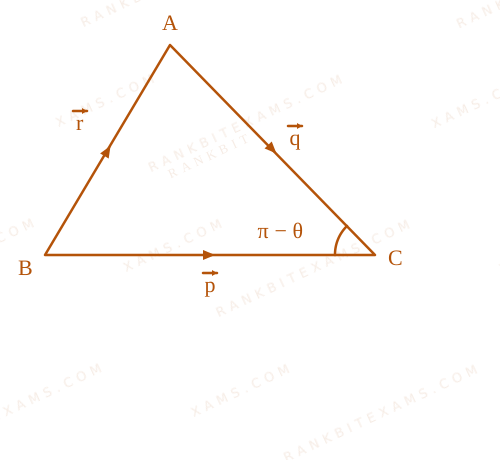
For a triangle ABC, let p= BC, q= CA$\vec{p}=\overrightarrow{BC},\vec{q}=\overrightarrow{CA}$ and r= BA$\vec{r}=\overrightarrow{BA}$. If | p|=2√(3),| q|=2$|\vec{p}|=2\sqrt{3},|\vec{q}|=2$ and θ= 1√(3)$\cos\theta=\frac{1}{\sqrt{3}}$, where θ$\theta$ is the angle between p$\vec{p}$ and q$\vec{q}$, then | p×( q-3 r)|²+3| r|²$\left|\vec{p}\times(\vec{q}-3\vec{r})\right|^{2}+3\left|\vec{r}\right|^{2}$ is equal to:
A.340$340$
B.220$220$
C.410$410$
D.200$200$
Solution & Explanation
Related Formula
Cosine Rule in triangle: (π-θ) = | p|²+| q|²-| r|²2| p|| q|$$\text{Cosine Rule in triangle: } \cos(\pi-\theta) = \frac{|\vec{p}|^2+|\vec{q}|^2-|\vec{r}|^2}{2|\vec{p}||\vec{q}|}$$Cross product identity: A × A = 0 ; | A × B| = |A||B| θ$$\text{Cross product identity: } \vec{A} \times \vec{A} = 0 \quad ; \quad |\vec{A} \times \vec{B}| = |A||B|\sin\theta$$
Core Logic
Vector triangle diagram for Q15 - JEE Main 2026 Evening
From triangle law of addition, BC + CA = BA p + q = r$\overrightarrow{BC} + \overrightarrow{CA} = \overrightarrow{BA} \implies \vec{p} + \vec{q} = \vec{r}$.
The angle between vectors p$\vec{p}$ and q$\vec{q}$ extended head-to-tail is θ$\theta$. The internal angle of the triangle is π - θ$\pi - \theta$.
Always convert secondary vectors back to base components using the triangle condition p + q = r$\vec{p} + \vec{q} = \vec{r}$. It zeroes out self-cross products instantly.
Let a$\vec{a}$ and b$\vec{b}$ be two vectors such that | a| = 1, | b| = 4$|\vec{a}| = 1, |\vec{b}| = 4$ and a · b = 2$\vec{a} \cdot \vec{b} = 2$. If c = (2 a × b) - 3 b$\vec{c} = (2\vec{a} \times \vec{b}) - 3\vec{b}$ and the angle between b$\vec{b}$ and c$\vec{c}$ is α$\alpha$, then 192 ²α$192\sin^2\alpha$ is equal to
Numerical Answer.Answer: 48 to 48
Solution
Core Logic
b · c = b · ((2 a × b) - 3 b)$$\vec{b} \cdot \vec{c} = \vec{b} \cdot ((2\vec{a} \times \vec{b}) - 3\vec{b})$$|b||c| α = 2( b · ( a × b)) - 3|b|²$$|b||c|\cos\alpha = 2(\vec{b} \cdot (\vec{a} \times \vec{b})) - 3|b|^2$$
Since b · ( a × b) = 0$\vec{b} \cdot (\vec{a} \times \vec{b}) = 0$, we have |b||c| α = -3|b|²$|b||c|\cos\alpha = -3|b|^2$.
Practice past-year questions one chapter at a time. Pick an exam → subject → chapter and get every PYQ for that topic — pulled together from all past papers — with the chapter's key formulas alongside.