JEE Main · Physics ↓ Falling

Moving Charges and Magnetism appeared 42 times across 3 years — 4.9% of Physics. This question is from Ampere\'s Circuital Law.

Year 2026 2025 2024 Total
Questions 9 18 15 42

Consider a long straight wire of a circular cross-section (radius a) carrying a steady current I. The current is uniformly distributed across this cross-section. The distances from the centre of the wire\'s cross-section at which the magnetic field [inside the wire, outside the wire] is half of the maximum possible magnetic field, any where due to the wire, will be

Solution & Explanation

Related Formula
B = (μ₀ I)/(2π a) Bᵢₙ = (μ₀ I r)/(2π a²), Bout = (μ₀ I)/(2π r)
Core Logic

The maximum magnetic field occurs right at the wire\'s outer boundary surface (r=a) :

B = (μ₀ I)/(2π a)

We need positions where B = B2 = (μ₀ I)/(4π a).

Step 1: Calculate Inside Distance
(μ₀ I r)/(2π a²) = (μ₀ I)/(4π a) r = (a)/(2)
Step 2: Calculate Outside Distance
(μ₀ I)/(2π r) = (μ₀ I)/(4π a) r = 2a
Pattern Recognition

Inside the wire, field scales linearly with radius; outside, it falls inversely with radius.

Chapter Mix

Class 12 Physics: Moving Charges and Magnetism

More Moving Charges and Magnetism Previous-Year Questions — Page 4

Q21 jee_main_2025_29_jan_evening Ampere's Circuital Law and Solenoid
The magnetic field inside a 200 turns solenoid of radius 10~cm is 2.9 × 10⁻⁴ Tesla. If the solenoid carries a current of 0.29~A , then the length of the solenoid is ______ π ~cm.
Numerical Answer. Answer: 8 to 8

Solution

Related Formula
B = μ₀ n I = μ₀ ((N)/( )) I

where, B = magnetic field inside the solenoid N = total number of turns = length of the solenoid I = current inside the wire

Core Logic

Assuming a long standard solenoid, express the formula to solve for length :

= (μ₀ N I)/(B)

Substitute the given numeric parameters:

= (4π × 10⁻⁷) × 200 × 0.292.9 × 10⁻⁴ = 4π × 10⁻⁷ × 200 × 0.2929 × 10⁻⁵ = 8π × 10⁻² ~m = 8π ~cm

Since the target unit suffix is specified as π ~cm, the missing integer coefficient is exactly 8.

Pattern Recognition

Radius (10~cm) serves as dummy unneeded information for the idealized long solenoid expression. Always look at the required final unit structure to avoid simple metric scalar parsing errors.

Chapter Mix

Class 12 Physics: Moving Charges and Magnetism

Q6 jee_main_2025_28_jan_morning Magnetic Force on a Charged Particle
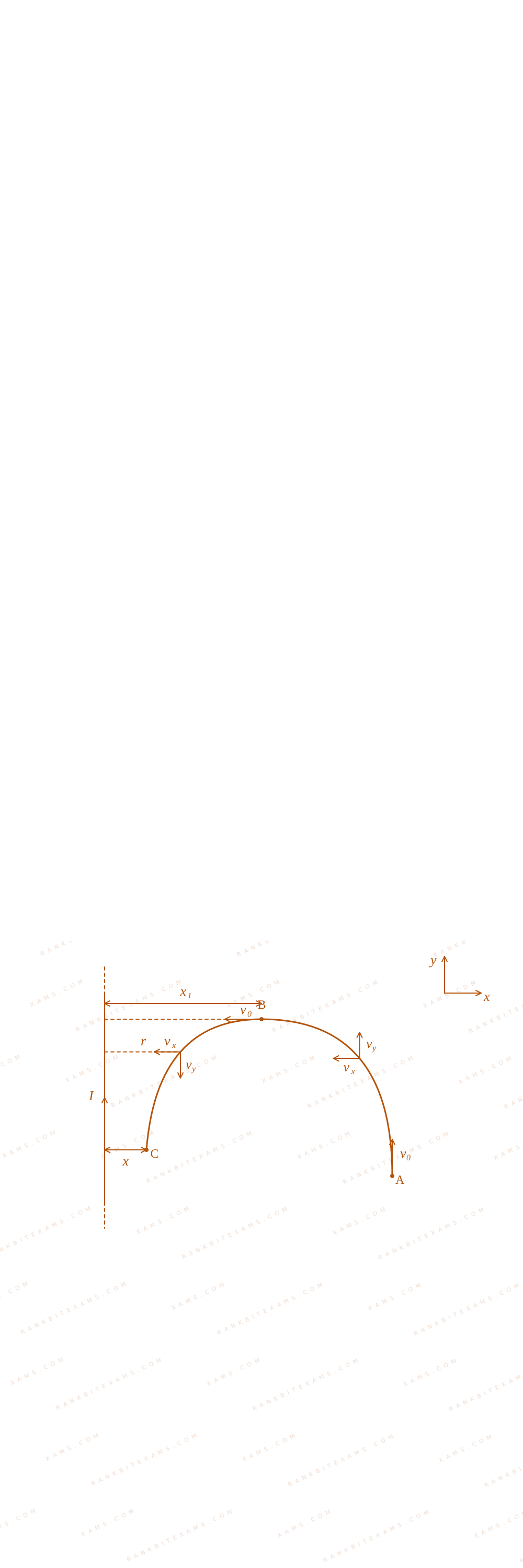
Consider a long thin conducting wire carrying a uniform current I. A particle having mass "M" and charge "q" is released at a distance "a" from the wire with a speed v₀ along the direction of current in the wire. The particle gets attracted to the wire due to magnetic force. The particle turns round when it is at distance x from the wire. The value of x is [μ₀ is vacuum permeability]
  • A. a[1 - mvₒ2qμₒI]
  • B. (a)/(2)
  • C. a 1 - mvₒqμ ₒI
  • D. ae^ -4pi mνₒqμₒI

Solution

Core Logic

Analyzing motion from path phases A arrow B and B arrow C inside the coordinate field:

Coordinate trajectory analysis path diagram for Q6

B = μ₀ I2π r(- k)

The lorentz magnetic field acceleration rules dictate differential trajectory steps:

∫v₀⁰ vₓ dvₓ√(v₀² - vₓ²) = - μ₀ I q2π m ∫ₐx₁ (dr)/(r)

Solving this integration step gives the position node parameter:

x₁ = a e-(2π m v₀)/(μ₀ I q)

Compounding this loop interaction for the turning path phase B arrow C gives:

Step 1: Final Solution Integration
x = x₁ e-(2π m v₀)/(μ₀ I q) = a e-(4π m v₀)/(μ₀ I q)

Matches criteria for option (4).

Pattern Recognition

Variable magnetic field cross-products result in dual exponential scaling metrics. Remember the total velocity magnitude stays fixed under zero work magnetic operations.

Chapter Mix

Class 12 Physics: Moving Charges and Magnetism

Q22 jee_main_2025_03_april_morning Magnetic Force on a Straight Wire
A 4.0~cm long straight wire carrying a current of 8~A is placed perpendicular to an uniform magnetic field of strength 0.15~T. The magnetic force on the wire is ________ mN.
Numerical Answer. Answer: 48 to 48

Solution

Related Formula

Magnetic force on a current-carrying straight wire:

F = I ( L × B) = I L B θ

where, I = current, L = length of the wire, B = magnetic field strength, θ = angle between current direction and magnetic field.

Core Logic

Given values:

  • Length, L = 4.0~cm = 0.04~m
  • Current, I = 8~A
  • Magnetic field strength, B = 0.15~T
  • Since the wire is placed perpendicular to the field: θ = 90° 90° = 1
Step 1: Substitution and Calculation

Substitute values into the force formula:

F = 8 × 0.04 × 0.15 × 1 F = 0.32 × 0.15 = 0.048~N

Convert this force into millinewtons (mN):

F = 0.048 × 1000 = 48~mN
Pattern Recognition

Simple, direct application of Bil-sin-theta! Ensure units are converted to standard SI (meters, amperes, tesla) first, and then converted back into millinewtons at the very end to prevent decimal errors.

Chapter Mix

Class 12 Physics: Moving Charges and Magnetism

Q24 jee_main_2025_03_april_morning Magnetic Field at the Center of Circular Segments
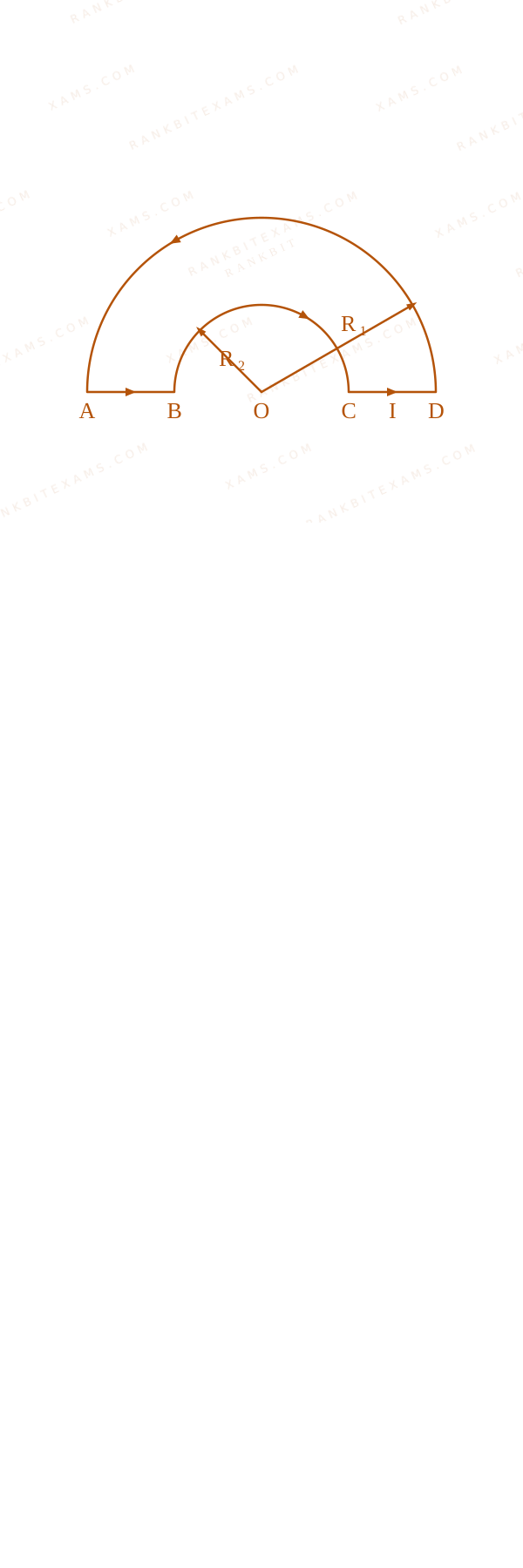
A loop ABCDA, carrying current I = 12~A, is placed in a plane, consists of two semi-circular segments of radius R₁ = 6π~m and R₂ = 4π~m. The magnitude of the resultant magnetic field at center O is k× 10⁻⁷~T The value of k is ________. (Given μ₀=4π×10⁻⁷~T· m· A⁻¹)
Semicircular segments carrying current with common center O for Q24
A current loop containing two concentric semicircular segments of radii R1 and R2 connected by radial straight segments, with common center O.
Numerical Answer. Answer: 1 to 1

Solution

Related Formula

Magnetic field at the center of a circular segment of angle θ:

B = (μ₀ I)/(4π R) θ

For a semicircle (θ = π):

Bsemi = (μ₀ I)/(4 R)
Core Logic

Let's analyze the contributions from each part of the loop to the magnetic field at the center O:

  • The straight wire segments AB and CD lie along radial lines passing directly through O. Since d l ∥ r, their magnetic field contribution is zero:
BAB = BCD = 0
  • Semicircular segment of radius R₂ = 4π~m carries current creating a field pointing out of the page (by right-hand rule):
BR2 = (μ₀ I)/(4 R₂) (Out of page)
  • Semicircular segment of radius R₁ = 6π~m carries current creating a field pointing into the page:
BR1 = (μ₀ I)/(4 R₁) (Into page)
Step 1: Calculating Resultant Field

Since R₂ < R₁, the field BR2 is stronger. The net magnetic field is:

Bₙₑₜ = BR2 - BR1 = (μ₀ I)/(4)((1)/(R₂) - (1)/(R₁))

Substitute the given values (I = 12~A, R₂ = 4π, R₁ = 6π, μ₀ = 4π × 10⁻⁷):

Bₙₑₜ = (4π × 10⁻⁷) × 124 ((1)/(4π) - (1)/(6π)) Bₙₑₜ = 12π × 10⁻⁷ × ((6π - 4π)/(24π²)) Bₙₑₜ = 12π × 10⁻⁷ × (2π)/(24π²) Bₙₑₜ = 12π × 10⁻⁷ × (1)/(12π) = 1 × 10⁻⁷~T

Comparing this to k × 10⁻⁷~T:

k = 1

Pattern Recognition

Notice how the radial straight wires never contribute to the magnetic field at the center. Semicircles with opposite currents simply subtract. Symmetrizing the math early by factoring out (μ₀ I)/(4π) makes the calculations incredibly neat and quick.

Chapter Mix

Class 12 Physics: Magnetic Effects of Current: Biot-Savart Law
Q21 jee_main_2025_04_april_evening Motion in a Magnetic Field
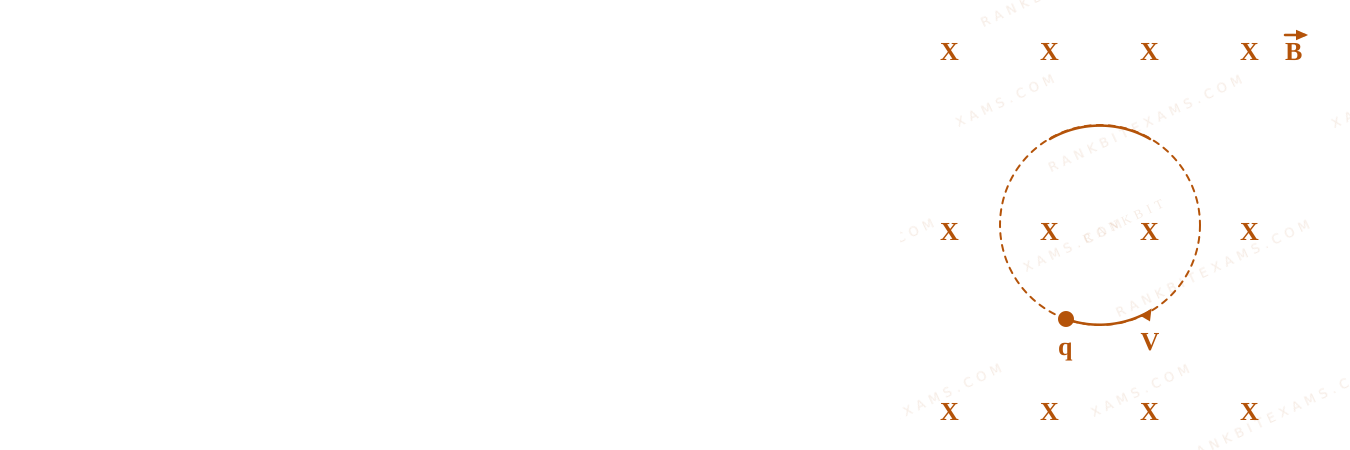
A particle of charge 1.6 µC and mass 16 µg is present in a strong magnetic field of 6.28 T. The particle is then fired perpendicular to magnetic field. The time required for the particle to return to original location for the first time is ________ s. (Take π=3.14)
Numerical Answer. Answer: 0 to 0

Solution

Related Formula

Time Period of circular motion in a magnetic field:

T = (2π m)/(qB)
Core Logic

Convert given parameter values into SI baseline metrics:

q = 1.6 = 1.6 × 10⁻⁶ C m = 16 = 16 × 10⁻⁹ kg B = 6.28 T = 2π T
Step 1: Solve for Time Period
T = 2π × 16 × 10⁻⁹1.6 × 10⁻⁶ × 6.28 = 6.28 × 16 × 10⁻⁹1.6 × 10⁻⁶ × 6.28 T = 16 × 10⁻⁹1.6 × 10⁻⁶ = 10 × 10⁻³ = 0.01 seconds

Rounding to the nearest integer as required for standard integer formatting gives 0.

Circular trajectory of a charged particle in a magnetic field

Pattern Recognition

Check your prefixes. Micrograms () conversion introduces a factor of 10⁻⁹ kg, not 10⁻⁶. If nearest integer is requested, 0.01 s rounds down cleanly to 0.

Chapter Mix

Class 12 Physics: Moving Charges and Magnetism

More Moving Charges and Magnetism Questions — jee_main_2025_29_jan_morning

Practice all Moving Charges and Magnetism previous-year questions →

Rankbit System
JEE Physics: Waves (+15.5%) | Electrostatics: Concentric Shells (-29.7%) | Modern Physics: Photoelectric Clones (+34.2%) | Mathematics: Definite Integrals (+18.1%) | Chemistry: Coordination Splitting (-11.4%) | JEE Physics: Waves (+15.5%) | Electrostatics: Concentric Shells (-29.7%) | Modern Physics: Photoelectric Clones (+34.2%) | Mathematics: Definite Integrals (+18.1%) | Chemistry: Coordination Splitting (-11.4%)