Solution
Related Formula
For a semi-infinite wire segment at distance r:
B = (μ₀ I)/(4π r)For a full circular loop at its center:
B = (μ₀ I)/(2r)Core Logic
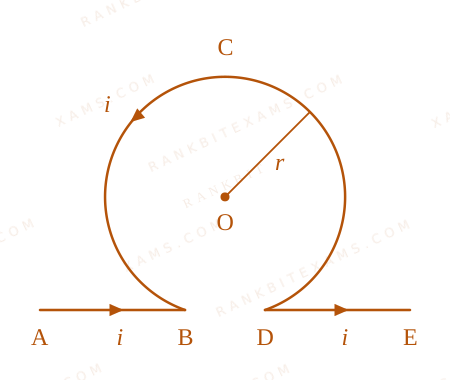
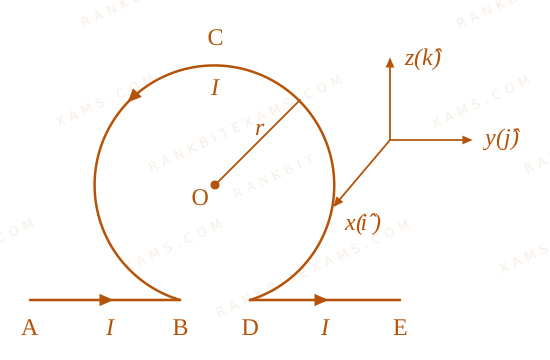
The total magnetic field at O is the vector sum of fields from three segments:
- The incoming semi-infinite wire (AB)
- The outgoing semi-infinite wire (DE)
- The nearly full circular loop (BCD)
Note: Based on the diagram, the loop is not fully closed, but geometrically it acts as a full circle subtracted by the gap. Typically this standard shape treats the circular part as a full circle and the straight wires as two semi-infinite wires.
Step 1: Adding the Vector Components
Applying the Right Hand Rule:
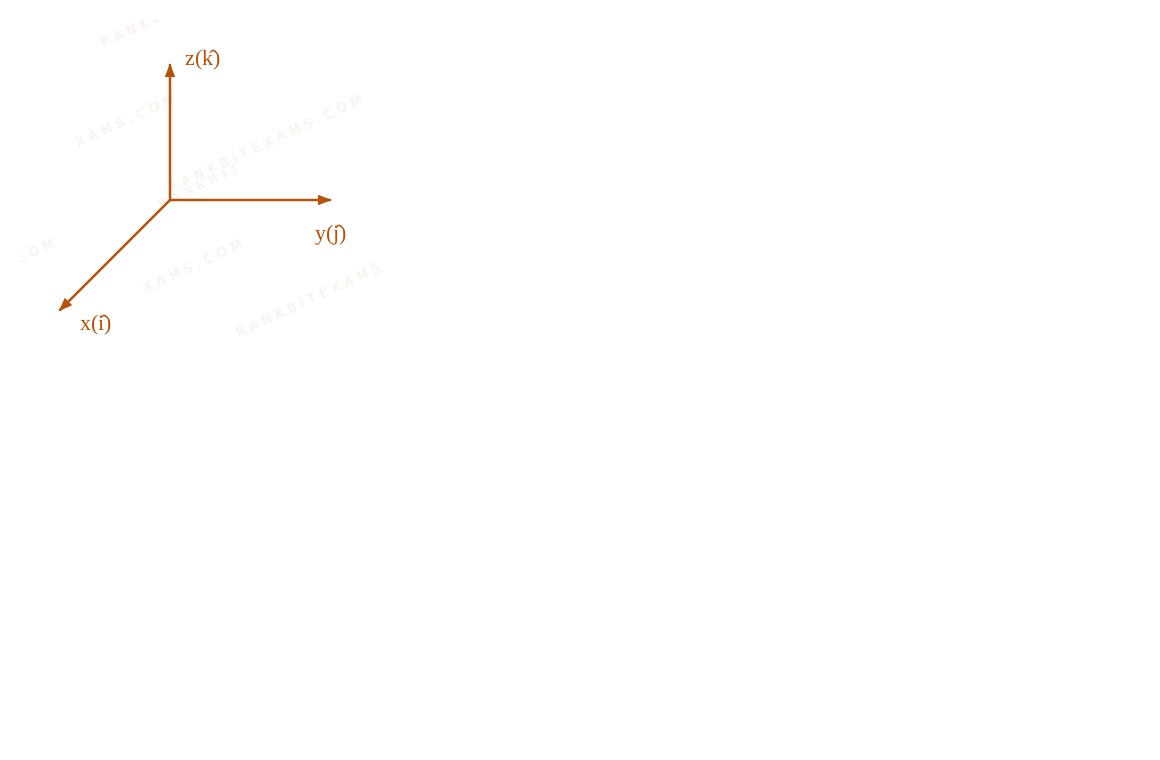
- Segment AB: current flows along +x, position vector to O is +y. d l × r = i × j = k. Wait, the diagram shows the loop in the x-y plane. Let's re-examine axes. Based on standard convention, if current is in xy plane, field is in z (k) direction. The solution shows vectors in i. This means the axes are drawn such that the loop is in the y-z plane. Yes, the provided axes show x pointing out, y to the right, z upwards.
- Segment AB (current along y axis): B at origin is along +x (i).
- Segment DE (current along y axis): B at origin is along +x (i).
- Circular Loop (current clockwise in y-z plane): B at origin points inwards, i.e., -x (- i).
Step 2: Final Conclusion
BO = (μ₀ I)/(4π r) i + (μ₀ I)/(4π r) i - (μ₀ I)/(2r) i BO = (μ₀ I)/(2π r) i - (μ₀ I)/(2r) i BO = (μ₀ I)/(2π r) (1 - π) i BO = -(μ₀ I)/(2π r) (π - 1) iPattern Recognition
Always separate complex wire geometries into standard segments: infinite wires, semi-infinite wires, and arcs. Use the Right-Hand Rule carefully with the given explicit coordinate frame to avoid sign errors.
Chapter Mix
Class 12 Physics: Moving Charges and Magnetism