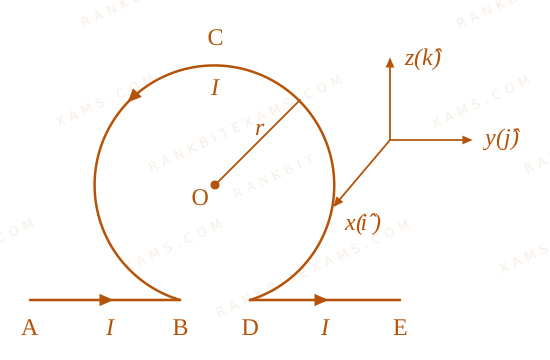
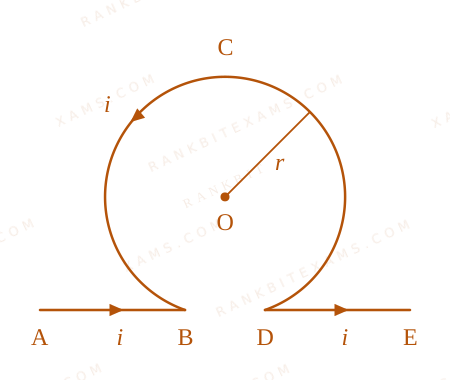
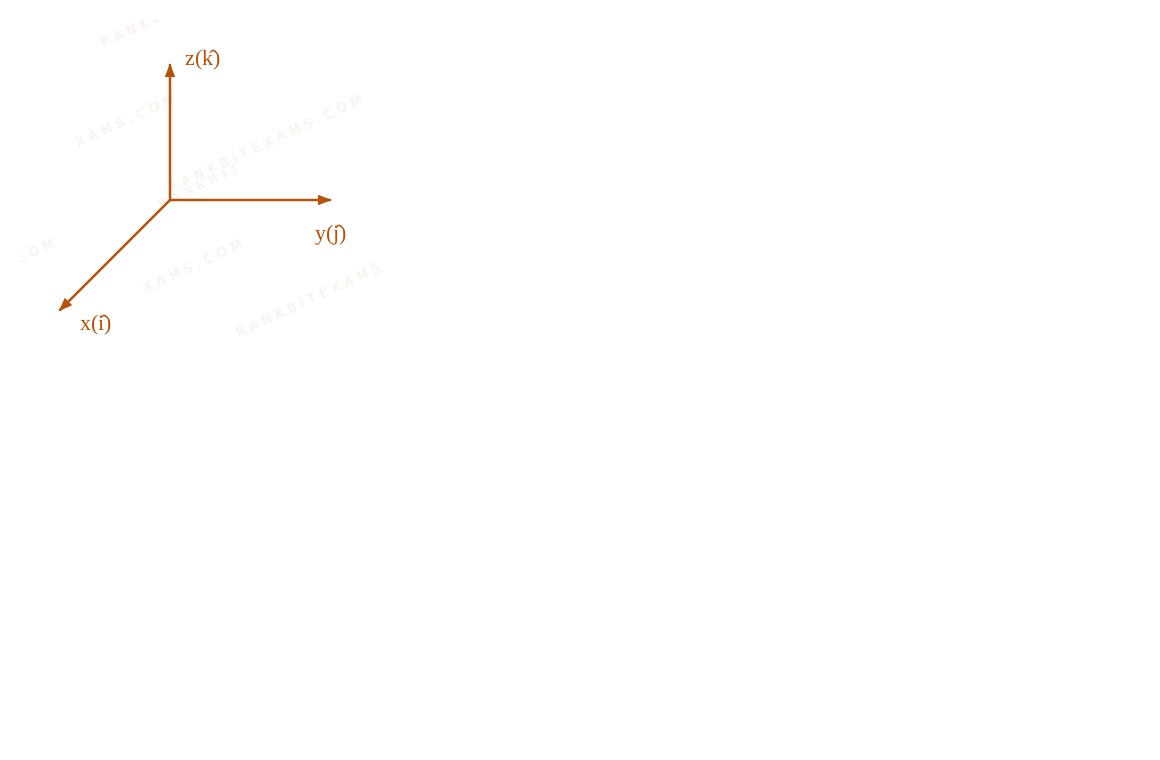
An infinitely long straight wire carrying current I is bent in a planer shape as shown in the diagram. The radius of the circular part is r. The magnetic field at the centre O of the circular loop is :
Wire bent into circular loop for Q42 - JEE Main 2026 Evening
Current carrying wire bent into a circular shape of radius r with straight extensions along the x-axis.

Solution & Explanation

### Related Formula For a semi-infinite wire segment at distance r: B = fracmu_0 I4pi r For a full circular loop at its center: B = fracmu_0 I2r ### Core Logic
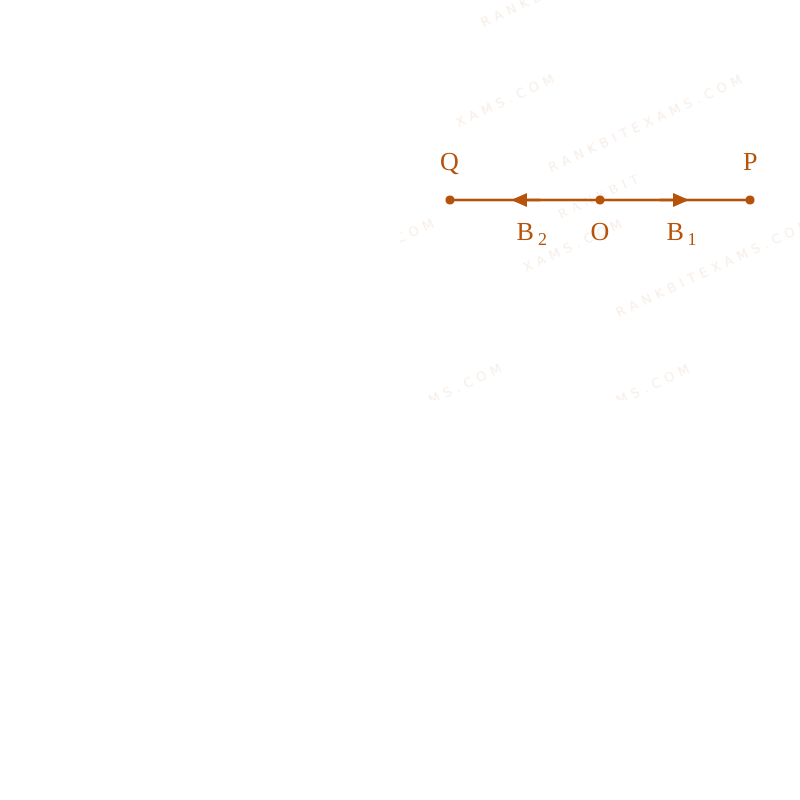
Vector resolution for Q42 solution - JEE Main 2026 Evening
Current carrying wire bent into a circular shape of radius r with straight extensions along the x-axis.
Vector resolution for Q42 solution - JEE Main 2026 Evening
Current carrying wire bent into a circular shape of radius r with straight extensions along the x-axis.
The total magnetic field at O is the vector sum of fields from three segments: 1. The incoming semi-infinite wire (AB) 2. The outgoing semi-infinite wire (DE) 3. The nearly full circular loop (BCD) Note: Based on the diagram, the loop is not fully closed, but geometrically it acts as a full circle subtracted by the gap. Typically this standard shape treats the circular part as a full circle and the straight wires as two semi-infinite wires. vecB_O = vecB_AB + vecB_DE + vecB_BCD ### Step 1: Adding the Vector Components Applying the Right Hand Rule: - Segment AB: current flows along +x, position vector to O is +y. dvecl times vecr = hati times hatj = hatk. Wait, the diagram shows the loop in the x-y plane. Let's re-examine axes. Based on standard convention, if current is in xy plane, field is in z (hatk) direction. The solution shows vectors in hati. This means the axes are drawn such that the loop is in the y-z plane. Yes, the provided axes show x pointing out, y to the right, z upwards. - Segment AB (current along y axis): B at origin is along +x (hati). - Segment DE (current along y axis): B at origin is along +x (hati). - Circular Loop (current clockwise in y-z plane): B at origin points inwards, i.e., -x (-hati). vecB_AB = fracmu_0 I4pi r hati vecB_DE = fracmu_0 I4pi r hati vecB_BCD = - fracmu_0 I2r hati ### Step 2: Final Conclusion vecB_O = fracmu_0 I4pi r hati + fracmu_0 I4pi r hati - fracmu_0 I2r hati vecB_O = fracmu_0 I2pi r hati - fracmu_0 I2r hati vecB_O = fracmu_0 I2pi r (1 - pi) hati vecB_O = -fracmu_0 I2pi r (pi - 1) hati ### Pattern Recognition Always separate complex wire geometries into standard segments: infinite wires, semi-infinite wires, and arcs. Use the Right-Hand Rule carefully with the given explicit coordinate frame to avoid sign errors. ### Evaluation Rubric / Model Answer null ### Chapter Mix Class 12 Physics: Moving Charges and Magnetism
Reference Study Guides

More Moving Charges and Magnetism Questions — jee_main_2026_21_jan_evening

Practice all Moving Charges and Magnetism previous-year questions →

Rankbit System
JEE Physics: Waves (+15.5%) | Electrostatics: Concentric Shells (-29.7%) | Modern Physics: Photoelectric Clones (+34.2%) | Mathematics: Definite Integrals (+18.1%) | Chemistry: Coordination Splitting (-11.4%) | JEE Physics: Waves (+15.5%) | Electrostatics: Concentric Shells (-29.7%) | Modern Physics: Photoelectric Clones (+34.2%) | Mathematics: Definite Integrals (+18.1%) | Chemistry: Coordination Splitting (-11.4%)