JEE Main · Physics ↓ Falling

Moving Charges and Magnetism appeared 37 times across 3 years — 4.3% of Physics. This question is from Magnetic Force on a Charged Particle.

Year 2026 2025 2024 Total
Questions 9 13 15 37

Consider a long thin conducting wire carrying a uniform current I. A particle having mass "M" and charge "q" is released at a distance "a" from the wire with a speed v₀ along the direction of current in the wire. The particle gets attracted to the wire due to magnetic force. The particle turns round when it is at distance x from the wire. The value of x is [μ₀ is vacuum permeability]

Solution & Explanation

Core Logic

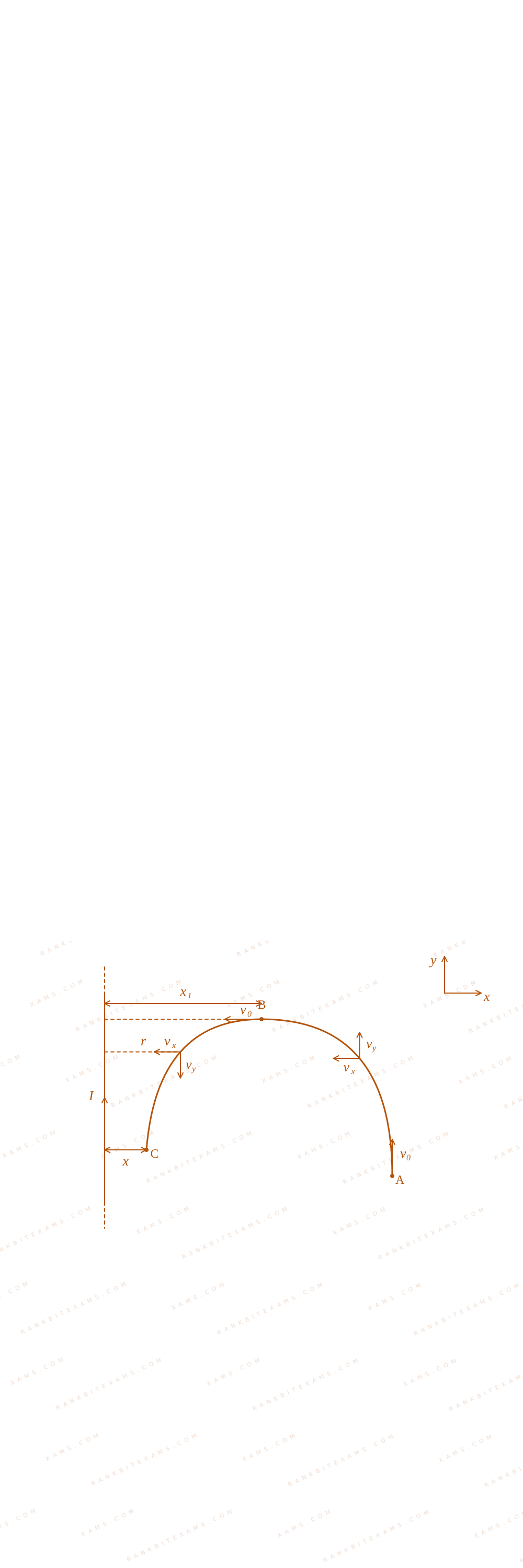
Analyzing motion from path phases A arrow B and B arrow C inside the coordinate field:

Coordinate trajectory analysis path diagram for Q6

B = μ₀ I2π r(- k)

The lorentz magnetic field acceleration rules dictate differential trajectory steps:

∫v₀⁰ vₓ dvₓ√(v₀² - vₓ²) = - μ₀ I q2π m ∫ₐx₁ (dr)/(r)

Solving this integration step gives the position node parameter:

x₁ = a e-(2π m v₀)/(μ₀ I q)

Compounding this loop interaction for the turning path phase B arrow C gives:

Step 1: Final Solution Integration
x = x₁ e-(2π m v₀)/(μ₀ I q) = a e-(4π m v₀)/(μ₀ I q)

Matches criteria for option (4).

Pattern Recognition

Variable magnetic field cross-products result in dual exponential scaling metrics. Remember the total velocity magnitude stays fixed under zero work magnetic operations.

Chapter Mix

Class 12 Physics: Moving Charges and Magnetism

Reference Study Guides

More Moving Charges and Magnetism Previous-Year Questions

Q33 jee_main_2026_21_jan_morning Motion in Magnetic Field
A current carrying is placed vertically and a particle of mass m with charge Q is released from rest. The particle moves along the axis of solenoid. If g is acceleration due to gravity then the acceleration (a) of the charged particle will satisfy :
  • A. a = g
  • B. a > g
  • C. a = 0
  • D. 0 < a < g

Solution

Related Formula
FB = q( v × B) Fₙₑₜ = m a
Core Logic

Since the solenoid is placed vertically, the magnetic field B inside the solenoid will be parallel or anti-parallel to the vertical axis (either +y or -y axis). When the charged particle is released from rest, gravity pulls it vertically downward, meaning it gains velocity v strictly along the y-axis (parallel or anti-parallel to B).

Because velocity and magnetic field are collinear (v ∥ B or v ∥ - B), the cross product v × B = 0. Therefore, the magnetic force FB = 0.

Step 1: Calculating Net Acceleration

The only force acting on the particle is gravity.

Fₙₑₜ = m g

aₙₑₜ = g

Motion in Magnetic Field diagram for Q33 - JEE Main 2026 Morning

Pattern Recognition

Whenever a charged particle moves parallel to a magnetic field lines (like moving along the axis of a solenoid), the magnetic force is absolutely zero. It behaves like free fall.

Chapter Mix

Class 12 Physics: Moving Charges and Magnetism
Q42 jee_main_2026_21_jan_evening Magnetic Field due to Current Element
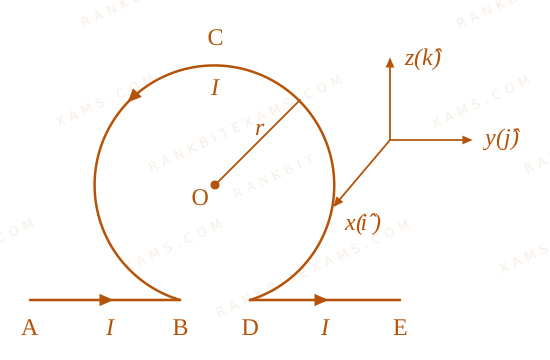
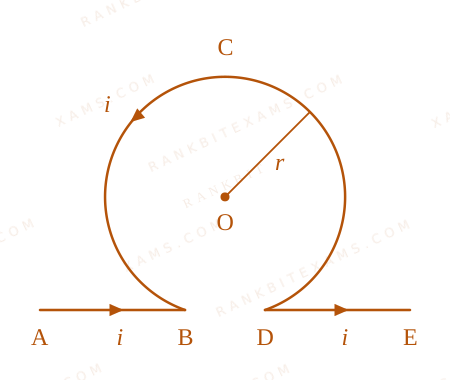
An infinitely long straight wire carrying current I is bent in a planer shape as shown in the diagram. The radius of the circular part is r. The magnetic field at the centre O of the circular loop is :
Wire bent into circular loop for Q42 - JEE Main 2026 Evening
Current carrying wire bent into a circular shape of radius r with straight extensions along the x-axis.
  • A. (μ₀)/(2π)(I)/(r)(π+1) i
  • B. -(μ₀)/(2π)(I)/(r)(π-1) i
  • C. (μ₀)/(2π)(I)/(r)(π-1) i
  • D. -(μ₀)/(2π)(I)/(r)(π+1) i

Solution

Related Formula

For a semi-infinite wire segment at distance r:

B = (μ₀ I)/(4π r)

For a full circular loop at its center:

B = (μ₀ I)/(2r)
Core Logic

Vector resolution for Q42 solution - JEE Main 2026 Evening
Current carrying wire bent into a circular shape of radius r with straight extensions along the x-axis.

Vector resolution for Q42 solution - JEE Main 2026 Evening
Current carrying wire bent into a circular shape of radius r with straight extensions along the x-axis.

The total magnetic field at O is the vector sum of fields from three segments:

  • The incoming semi-infinite wire (AB)
  • The outgoing semi-infinite wire (DE)
  • The nearly full circular loop (BCD)
  • Note: Based on the diagram, the loop is not fully closed, but geometrically it acts as a full circle subtracted by the gap. Typically this standard shape treats the circular part as a full circle and the straight wires as two semi-infinite wires.

BO = BAB + BDE + BBCD
Step 1: Adding the Vector Components

Applying the Right Hand Rule:

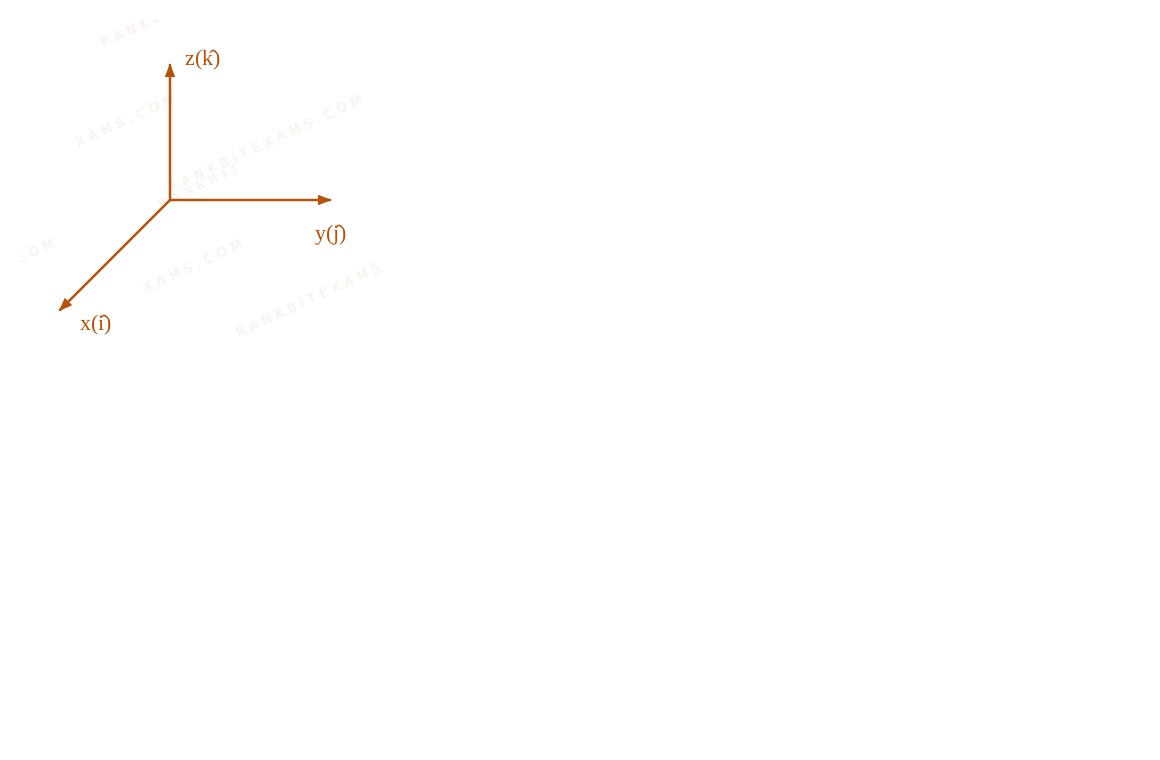
  • Segment AB: current flows along +x, position vector to O is +y. d l × r = i × j = k. Wait, the diagram shows the loop in the x-y plane. Let's re-examine axes. Based on standard convention, if current is in xy plane, field is in z (k) direction. The solution shows vectors in i. This means the axes are drawn such that the loop is in the y-z plane. Yes, the provided axes show x pointing out, y to the right, z upwards.
  • Segment AB (current along y axis): B at origin is along +x (i).
  • Segment DE (current along y axis): B at origin is along +x (i).
  • Circular Loop (current clockwise in y-z plane): B at origin points inwards, i.e., -x (- i).
BAB = (μ₀ I)/(4π r) i BDE = (μ₀ I)/(4π r) i BBCD = - (μ₀ I)/(2r) i
Step 2: Final Conclusion
BO = (μ₀ I)/(4π r) i + (μ₀ I)/(4π r) i - (μ₀ I)/(2r) i BO = (μ₀ I)/(2π r) i - (μ₀ I)/(2r) i BO = (μ₀ I)/(2π r) (1 - π) i BO = -(μ₀ I)/(2π r) (π - 1) i
Pattern Recognition

Always separate complex wire geometries into standard segments: infinite wires, semi-infinite wires, and arcs. Use the Right-Hand Rule carefully with the given explicit coordinate frame to avoid sign errors.

Chapter Mix

Class 12 Physics: Moving Charges and Magnetism
Q29 jee_main_2026_23_january_evening Magnetic Field due to Current Carrying Wire
The current passing through a conducting loop in the form of equilateral triangle of side 4√(3) cm is 2A. The magnetic field at its centroid is α × 10⁻⁵T . The value of α is ____. (Given: μₒ = 4π × 10⁻⁷ SI units)
  • A. 2√(3)
  • B. √(3)
  • C. 3√(3)
  • D. √(3)2

Solution

Related Formula
B = (μ₀ I)/(4π d) [ θ₁ + θ₂]
Core Logic

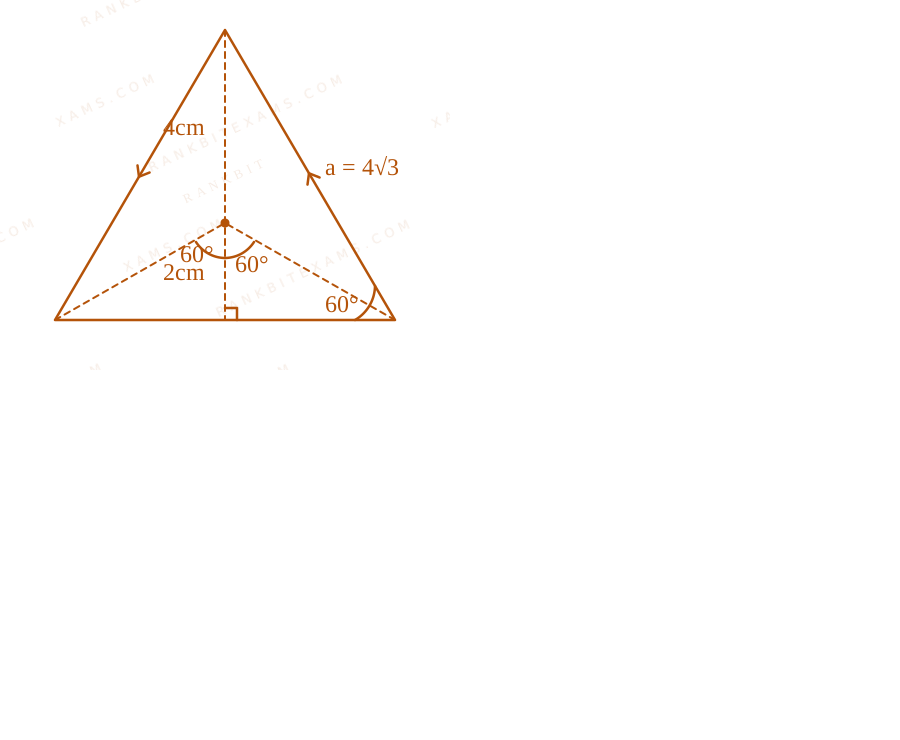
Magnetic Field due to Current Carrying Wire diagram for Q29 - JEE Main 2026 Evening

For an equilateral triangle, the perpendicular distance d from centroid to any side is given by d = a2√(3), where a = 4√(3) cm.

d = 4√(3)2√(3) = 2 cm = 2 × 10⁻² m

The angles subtended by the side at the centroid are θ₁ = 60° and θ₂ = 60°.

Step 1: Field due to one side
B₁ = (μ₀)/(4π) · (I)/(d) ( 60° + 60°) B₁ = 10⁻⁷ × 22 × 10⁻² ( √(3)2 + √(3)2 ) B₁ = 10⁻⁵ × √(3) T
Step 2: Total Magnetic Field

Since there are 3 identical sides and their field vectors point in the same direction at the centroid:

Bₙₑₜ = 3 × B₁ = 3 × √(3) × 10⁻⁵ T

Comparing with α × 10⁻⁵T, we get α = 3√(3).

Pattern Recognition

For regular polygons of n sides, Bcentroid = n · Bside. An equilateral triangle has n=3, d = a/(2√(3)), and angles are always 60°.

Chapter Mix

Class 12 Physics: Moving Charges and Magnetism
Q26 jee_main_2026_24_january_morning Magnetic Force and Field
Match the List-I with List-II
List-IList-II
A. Magnetic inductionI. ML T⁻²A⁻²
B. Magnetic fluxII. ML² T⁻²A⁻²
C. Magnetic permeabilityIII. ML⁰ T⁻²A⁻¹
D. Self inductanceIV. ML² T⁻²A⁻¹
Choose the correct answer from the options given below:
  • A. A-IV, B-III, C-I, D-II
  • B. A-III, B-IV, C-II, D-I
  • C. A-I, B-III, C-IV, D-II
  • D. A-III, B-IV, C-I, D-II

Solution

Related Formula

F = qvB

φ = B · Area U = (1)/(2) L I²
Core Logic

For Magnetic induction (B):

[B] = [ (F)/(qv) ] = [MT⁻²A⁻¹]

So, A matches III.

For Magnetic Flux (φ):

[φ] = [B] · [Area] = [ML²T⁻²A⁻¹]

So, B matches IV.

For Magnetic Permeability (μ):

[μ] = [MLT⁻²A⁻²]

So, C matches I.

For Self inductance (L): Using U = (1)/(2) LI²,

[L] = [ML²T⁻²A⁻¹]

Wait, the given option II is [ML² T⁻² A⁻²]. Let's re-verify: Energy U = [ML² T⁻²]. I² = [A²]. So L = [ML² T⁻² A⁻²]. So, D matches II.

Dimensional analysis matching diagram

Step 1: Final Conclusion

A-III, B-IV, C-I, D-II. Option (4) is correct.

Pattern Recognition

Dimensional analysis of electromagnetic quantities frequently hinges on knowing formulas for force, flux, and energy. Deriving from F=qvB and U=(1)/(2)LI² is the fastest approach.

Chapter Mix

Class 12 Physics: Moving Charges and Magnetism Class 12 Physics: Electromagnetic Induction
Q32 jee_main_2026_24_january_evening Magnetic Field of Circular Loops
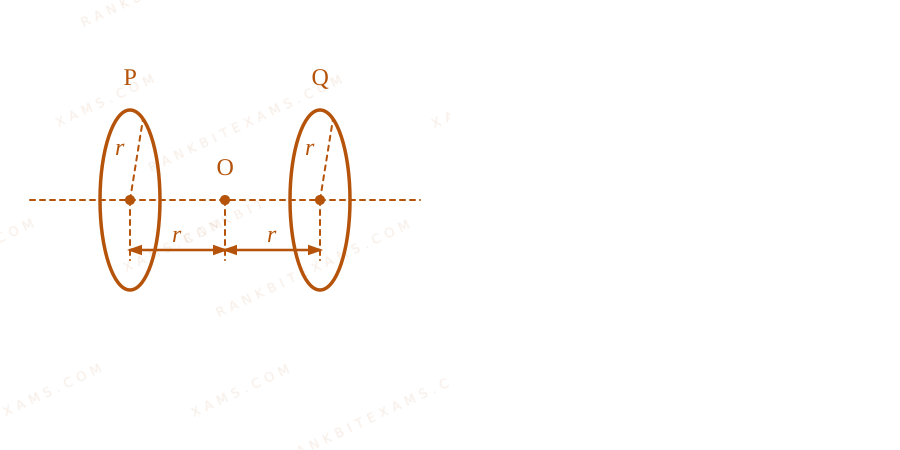
Magnetic Field of Circular Loops diagram for Q32 - JEE Main 2026 Evening
Two identical circular loops positioned parallel to each other with a common central axis O.
Two identical circular loops P and Q each of radius r are lying in parallel planes such that they have common axis. The current through P and Q are I and 4I respectively in clockwise direction as seen from O. The net magnetic field at O is:
  • A. 3μₒI4√(2)r toward P
  • B. μₒI4√(2)r toward P
  • C. μₒI4√(2)r towards Q
  • D. 3μₒI4√(2)r towards Q

Solution

Related Formula
B = μ₀ i R²2(x² + R²)3/2
Core Logic

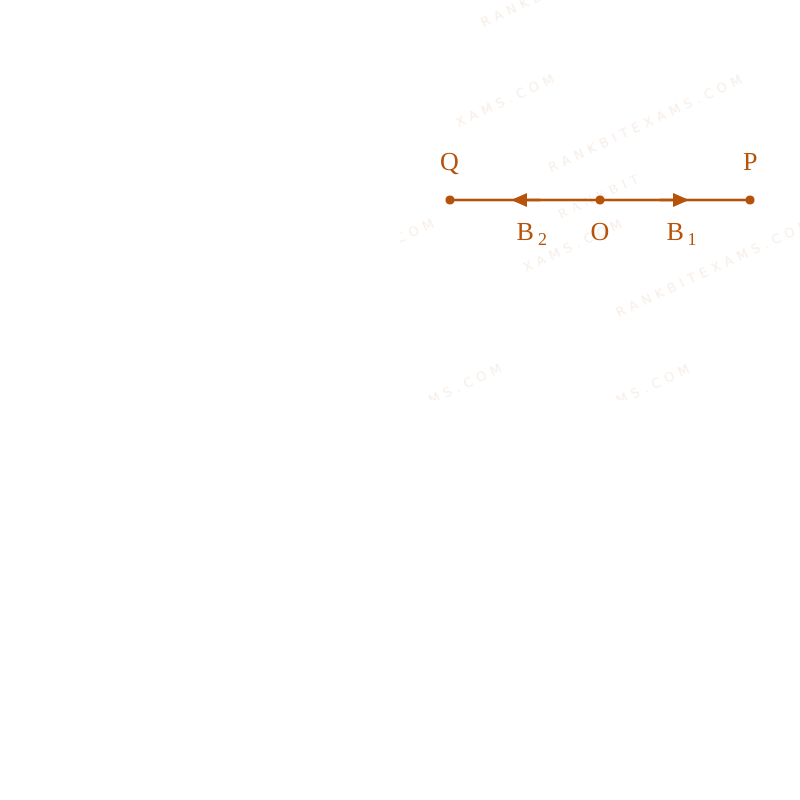
The net magnetic field at O is the vector sum of fields from both loops. Since the currents are in the same relative orientation (clockwise from O), their magnetic fields at O will point in opposite directions.

Bₙₑₜ = B₁ - B₂

Magnetic Field of Circular Loops diagram for Q32 - JEE Main 2026 Evening
Two identical circular loops positioned parallel to each other with a common central axis O.

Step 1: Superposition of Fields

Magnetic field due to loop Q (carrying 4I) towards Q, and due to loop P (carrying I) towards P.

Bₙₑₜ = μ₀ (4i) R²2(R² + R²)3/2 - μ₀ (i) R²2(R² + R²)3/2 Bₙₑₜ = 3μ₀ i R²2(2R²)3/2
Step 2: Final Calculation
Bₙₑₜ = 3μ₀ i R²2(2√(2)R³) = 3μ₀ i4√(2)R

The direction is towards Q because the field from the loop carrying 4I is dominant.

Pattern Recognition

When symmetrical coils carry opposing fields along their axis at equidistance, you simply subtract their current multipliers (4I - I = 3I) and apply the standard axial magnetic field formula once.

Chapter Mix

Class 12 Physics: Moving Charges and Magnetism

More Moving Charges and Magnetism Questions — jee_main_2025_28_jan_morning

Practice all Moving Charges and Magnetism previous-year questions →

Rankbit System
JEE Physics: Waves (+15.5%) | Electrostatics: Concentric Shells (-29.7%) | Modern Physics: Photoelectric Clones (+34.2%) | Mathematics: Definite Integrals (+18.1%) | Chemistry: Coordination Splitting (-11.4%) | JEE Physics: Waves (+15.5%) | Electrostatics: Concentric Shells (-29.7%) | Modern Physics: Photoelectric Clones (+34.2%) | Mathematics: Definite Integrals (+18.1%) | Chemistry: Coordination Splitting (-11.4%)