### Related Formula
F = qvB$F = qvB$phi = B cdot textArea$$\phi = B \cdot \text{Area}$$U = frac12 L I^2$$U = \frac{1}{2} L I^{2}$$
### Core Logic
For Magnetic induction (B):
[B] = left[ fracFqv right] = [MT^-2A^-1]$$[B] = \left[ \frac{F}{qv} \right] = [MT^{-2}A^{-1}]$$
So, A matches III.
For Magnetic Flux (phi$\phi$):
[phi] = [B] cdot [textArea] = [ML^2T^-2A^-1]$$[\phi] = [B] \cdot [\text{Area}] = [ML^{2}T^{-2}A^{-1}]$$
So, B matches IV.
For Magnetic Permeability (mu$\mu$):
[mu] = [MLT^-2A^-2]$$[\mu] = [MLT^{-2}A^{-2}]$$
So, C matches I.
For Self inductance (L):
Using U = frac12 LI^2$U = \frac{1}{2} LI^{2}$,
[L] = [ML^2T^-2A^-1]$$[L] = [ML^{2}T^{-2}A^{-1}]$$
Wait, the given option II is [ML^2 T^-2 A^-2]$[ML^2 T^{-2} A^{-2}]$.
Let's re-verify: Energy U = [ML^2 T^-2]$U = [ML^2 T^{-2}]$. I^2 = [A^2]$I^2 = [A^2]$. So L = [ML^2 T^-2 A^-2]$L = [ML^2 T^{-2} A^{-2}]$.
So, D matches II.
Dimensional analysis matching diagram
### Step 1: Final Conclusion
A-III, B-IV, C-I, D-II. Option (4) is correct.
### Pattern Recognition
Dimensional analysis of electromagnetic quantities frequently hinges on knowing formulas for force, flux, and energy. Deriving from F=qvB$F=qvB$ and U=frac12LI^2$U=\frac{1}{2}LI^2$ is the fastest approach.
### Evaluation Rubric / Model Answer
null
### Chapter Mix
Class 12 Physics: Moving Charges and Magnetism
Class 12 Physics: Electromagnetic Induction
Keywords:#dimensional formula magnetic induction#JEE Main 2026 Morning Q26#Moving Charges and Magnetism JEE Main 2026#Magnetic Force and Field JEE Main 2026
More Moving Charges and Magnetism Previous-Year Questions
Q33jee_main_2026_21_jan_morningMotion in Magnetic Field
A current carrying is placed vertically and a particle of mass m with charge Q is released from rest. The particle moves along the axis of solenoid. If g is acceleration due to gravity then the acceleration (a) of the charged particle will satisfy :
A.a = g$a = g$
B.a > g$a > g$
C.a = 0$a = 0$
D.0 < a < g$0 < a < g$
Solution
### Related Formula
vecF_B = q(vecv times vecB)$$\vec{F}_{B} = q(\vec{v} \times \vec{B})$$vecF_net = mveca$$\vec{F}_{net} = m\vec{a}$$
### Core Logic
Since the solenoid is placed vertically, the magnetic field vecB$\vec{B}$ inside the solenoid will be parallel or anti-parallel to the vertical axis (either +y$+y$ or -y$-y$ axis).
When the charged particle is released from rest, gravity pulls it vertically downward, meaning it gains velocity vecv$\vec{v}$ strictly along the y$y$-axis (parallel or anti-parallel to vecB$\vec{B}$).
Because velocity and magnetic field are collinear (vecv parallel vecB$\vec{v} \parallel \vec{B}$ or vecv parallel -vecB$\vec{v} \parallel -\vec{B}$), the cross product vecv times vecB = 0$\vec{v} \times \vec{B} = 0$.
Therefore, the magnetic force vecF_B = 0$\vec{F}_B = 0$.
### Step 1: Calculating Net Acceleration
The only force acting on the particle is gravity.
vecF_net = mvecg$$\vec{F}_{net} = m\vec{g}$$a_net = g$a_{net} = g$Motion in Magnetic Field diagram for Q33 - JEE Main 2026 Morning
### Pattern Recognition
Whenever a charged particle moves parallel to a magnetic field lines (like moving along the axis of a solenoid), the magnetic force is absolutely zero. It behaves like free fall.
### Evaluation Rubric / Model Answer
null
### Chapter Mix
Class 12 Physics: Moving Charges and Magnetism
Q42jee_main_2026_21_jan_eveningMagnetic Field due to Current Element
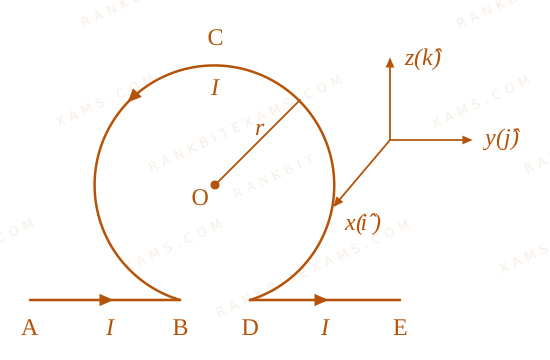
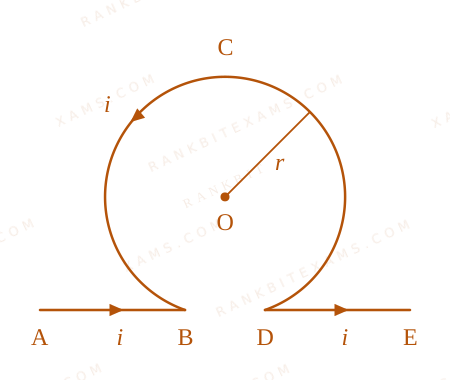
An infinitely long straight wire carrying current I is bent in a planer shape as shown in the diagram. The radius of the circular part is r. The magnetic field at the centre O of the circular loop is :
Current carrying wire bent into a circular shape of radius r with straight extensions along the x-axis.
### Related Formula
For a semi-infinite wire segment at distance r$r$:
B = fracmu_0 I4pi r$$B = \frac{\mu_0 I}{4\pi r}$$
For a full circular loop at its center:
B = fracmu_0 I2r$$B = \frac{\mu_0 I}{2r}$$
### Core Logic
Current carrying wire bent into a circular shape of radius r with straight extensions along the x-axis.Current carrying wire bent into a circular shape of radius r with straight extensions along the x-axis.
The total magnetic field at O is the vector sum of fields from three segments:
1. The incoming semi-infinite wire (AB)
2. The outgoing semi-infinite wire (DE)
3. The nearly full circular loop (BCD)
Note: Based on the diagram, the loop is not fully closed, but geometrically it acts as a full circle subtracted by the gap. Typically this standard shape treats the circular part as a full circle and the straight wires as two semi-infinite wires.
vecB_O = vecB_AB + vecB_DE + vecB_BCD$$\vec{B}_O = \vec{B}_{AB} + \vec{B}_{DE} + \vec{B}_{BCD}$$
### Step 1: Adding the Vector Components
Applying the Right Hand Rule:
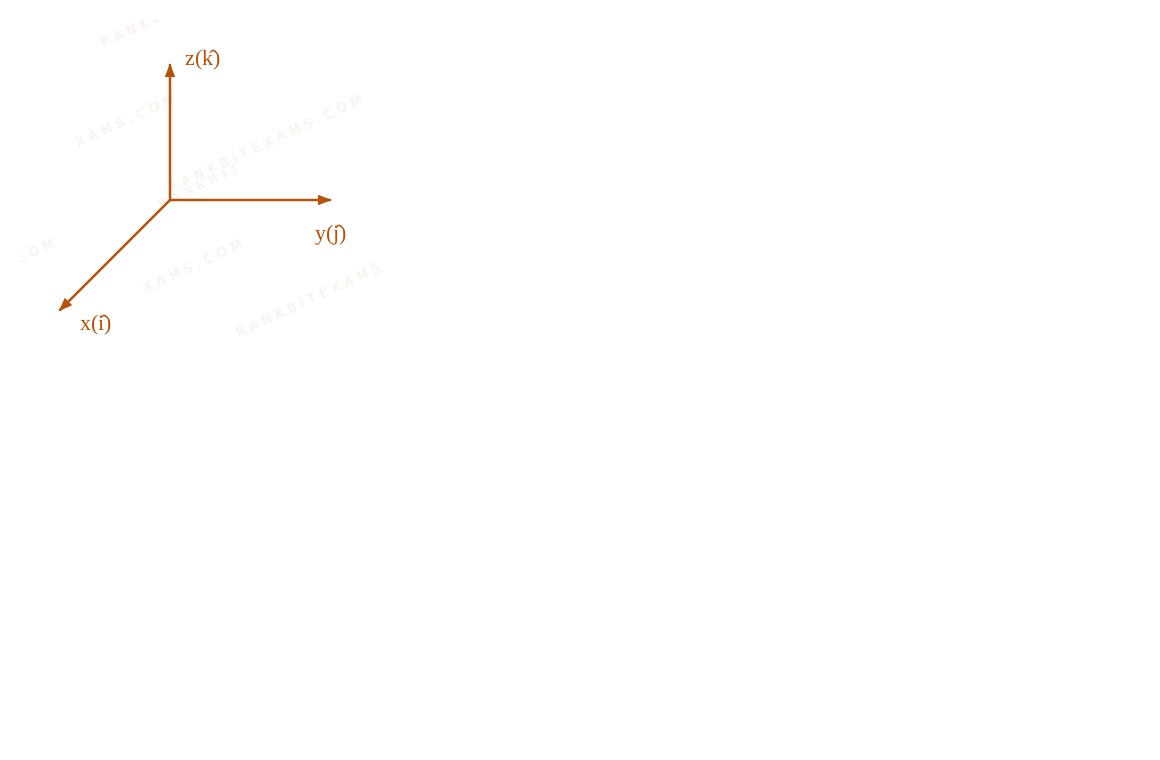
- Segment AB: current flows along +x$+x$, position vector to O is +y$+y$. dvecl times vecr = hati times hatj = hatk$d\vec{l} \times \vec{r} = \hat{i} \times \hat{j} = \hat{k}$. Wait, the diagram shows the loop in the x-y$x-y$ plane. Let's re-examine axes. Based on standard convention, if current is in xy$xy$ plane, field is in z$z$ (hatk$\hat{k}$) direction. The solution shows vectors in hati$\hat{i}$. This means the axes are drawn such that the loop is in the y-z$y-z$ plane. Yes, the provided axes show x$x$ pointing out, y$y$ to the right, z$z$ upwards.
- Segment AB (current along y$y$ axis): B$B$ at origin is along +x$+x$ (hati$\hat{i}$).
- Segment DE (current along y$y$ axis): B$B$ at origin is along +x$+x$ (hati$\hat{i}$).
- Circular Loop (current clockwise in y-z$y-z$ plane): B$B$ at origin points inwards, i.e., -x$-x$ (-hati$-\hat{i}$).
vecB_AB = fracmu_0 I4pi r hati $$ \vec{B}_{AB} = \frac{\mu_0 I}{4\pi r} \hat{i} $$ vecB_DE = fracmu_0 I4pi r hati $$ \vec{B}_{DE} = \frac{\mu_0 I}{4\pi r} \hat{i} $$ vecB_BCD = - fracmu_0 I2r hati $$ \vec{B}_{BCD} = - \frac{\mu_0 I}{2r} \hat{i} $$
### Step 2: Final Conclusion
vecB_O = fracmu_0 I4pi r hati + fracmu_0 I4pi r hati - fracmu_0 I2r hati$$\vec{B}_O = \frac{\mu_0 I}{4\pi r} \hat{i} + \frac{\mu_0 I}{4\pi r} \hat{i} - \frac{\mu_0 I}{2r} \hat{i}$$vecB_O = fracmu_0 I2pi r hati - fracmu_0 I2r hati$$\vec{B}_O = \frac{\mu_0 I}{2\pi r} \hat{i} - \frac{\mu_0 I}{2r} \hat{i}$$vecB_O = fracmu_0 I2pi r (1 - pi) hati$$\vec{B}_O = \frac{\mu_0 I}{2\pi r} (1 - \pi) \hat{i}$$vecB_O = -fracmu_0 I2pi r (pi - 1) hati$$\vec{B}_O = -\frac{\mu_0 I}{2\pi r} (\pi - 1) \hat{i}$$
### Pattern Recognition
Always separate complex wire geometries into standard segments: infinite wires, semi-infinite wires, and arcs. Use the Right-Hand Rule carefully with the given explicit coordinate frame to avoid sign errors.
### Evaluation Rubric / Model Answer
null
### Chapter Mix
Class 12 Physics: Moving Charges and Magnetism
Q29jee_main_2026_23_january_eveningMagnetic Field due to Current Carrying Wire
The current passing through a conducting loop in the form of equilateral triangle of side 4sqrt3 \, mathrmcm$4\sqrt{3} \, \mathrm{cm}$ is 2A. The magnetic field at its centroid is alpha times 10^-5mathrmT$\alpha \times 10^{-5}\mathrm{T}$ . The value of alpha$\alpha$ is ____.
(Given: mu_mathrmo = 4pi times 10^-7$\mu_{\mathrm{o}} = 4\pi \times 10^{-7}$ SI units)
A.2sqrt3$2\sqrt{3}$
B.sqrt3$\sqrt{3}$
C.3sqrt3$3\sqrt{3}$
D.fracsqrt32$\frac{\sqrt{3}}{2}$
Solution
### Related Formula
B = fracmu_0 I4pi d [sin theta_1 + sin theta_2]$$B = \frac{\mu_0 I}{4\pi d} [\sin \theta_1 + \sin \theta_2]$$
### Core Logic
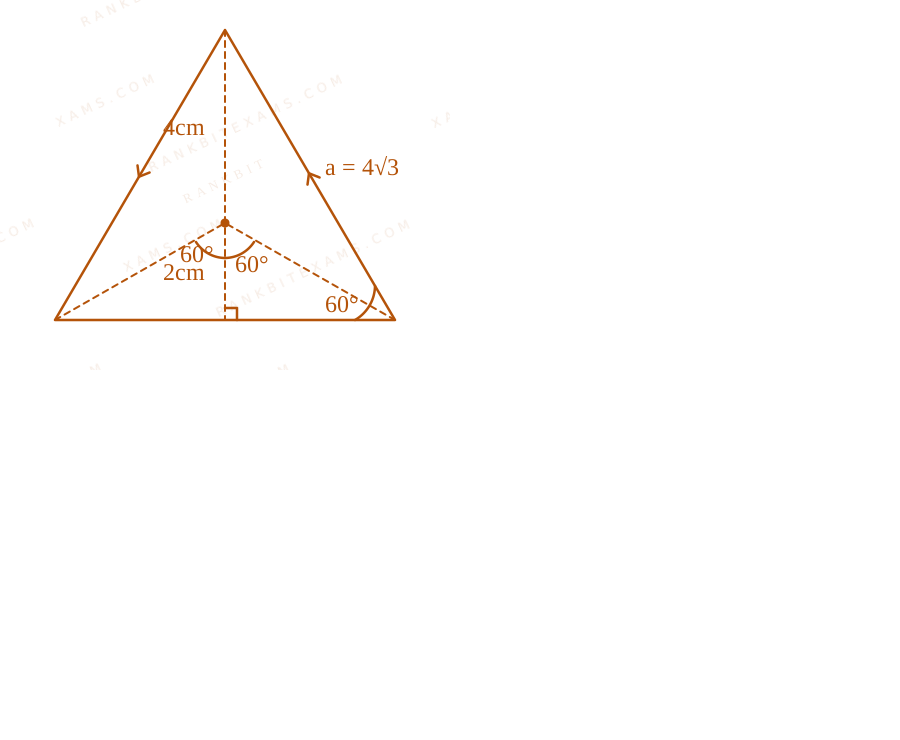
Magnetic Field due to Current Carrying Wire diagram for Q29 - JEE Main 2026 Evening
For an equilateral triangle, the perpendicular distance d$d$ from centroid to any side is given by d = fraca2sqrt3$d = \frac{a}{2\sqrt{3}}$, where a = 4sqrt3 \, mathrmcm$a = 4\sqrt{3} \, \mathrm{cm}$.
d = frac4sqrt32sqrt3 = 2 \, mathrmcm = 2 times 10^-2 \, mathrmm$$d = \frac{4\sqrt{3}}{2\sqrt{3}} = 2 \, \mathrm{cm} = 2 \times 10^{-2} \, \mathrm{m}$$
The angles subtended by the side at the centroid are theta_1 = 60^circ$\theta_1 = 60^{\circ}$ and theta_2 = 60^circ$\theta_2 = 60^{\circ}$.
### Step 1: Field due to one side
B_1 = fracmu_04pi cdot fracId (sin 60^circ + sin 60^circ)$$B_1 = \frac{\mu_0}{4\pi} \cdot \frac{I}{d} (\sin 60^{\circ} + \sin 60^{\circ})$$B_1 = 10^-7 times frac22 times 10^-2 left( fracsqrt32 + fracsqrt32 right)$$B_1 = 10^{-7} \times \frac{2}{2 \times 10^{-2}} \left( \frac{\sqrt{3}}{2} + \frac{\sqrt{3}}{2} \right)$$B_1 = 10^-5 times sqrt3 \, mathrmT$$B_1 = 10^{-5} \times \sqrt{3} \, \mathrm{T}$$
### Step 2: Total Magnetic Field
Since there are 3 identical sides and their field vectors point in the same direction at the centroid:
B_textnet = 3 times B_1 = 3 times sqrt3 times 10^-5 \, mathrmT$$B_{\text{net}} = 3 \times B_1 = 3 \times \sqrt{3} \times 10^{-5} \, \mathrm{T}$$
Comparing with alpha times 10^-5mathrmT$\alpha \times 10^{-5}\mathrm{T}$, we get alpha = 3sqrt3$\alpha = 3\sqrt{3}$.
### Pattern Recognition
For regular polygons of n$n$ sides, B_textcentroid = n cdot B_textside$B_{\text{centroid}} = n \cdot B_{\text{side}}$. An equilateral triangle has n=3$n=3$, d = a/(2sqrt3)$d = a/(2\sqrt{3})$, and angles are always 60^circ$60^{\circ}$.
### Evaluation Rubric / Model Answer
null
### Chapter Mix
Class 12 Physics: Moving Charges and Magnetism
In a moving coil galvanometer, two moving coils M_1$M_1$ and M_2$M_2$ have the following particulars:
beginaligned R_1 &= 5 \ Omega, quad N_1 = 15, quad A_1 = 3.6 times 10^-3 \ mathrmm^2, quad B_1 = 0.25 \ mathrmT \\ R_2 &= 7 \ Omega, quad N_2 = 21, quad A_2 = 1.8 times 10^-3 \ mathrmm^2, quad B_2 = 0.50 \ mathrmT endaligned$$\begin{aligned} R_1 &= 5 \ \Omega, \quad N_1 = 15, \quad A_1 = 3.6 \times 10^{-3} \ \mathrm{m}^2, \quad B_1 = 0.25 \ \mathrm{T} \\ R_2 &= 7 \ \Omega, \quad N_2 = 21, \quad A_2 = 1.8 \times 10^{-3} \ \mathrm{m}^2, \quad B_2 = 0.50 \ \mathrm{T} \end{aligned}$$
Assuming that torsional constant of the springs are same for both coils, what will be the ratio of voltage sensitivity of M_1$M_1$ and M_2$M_2$ ?
A.1:1$1:1$
B.1:4$1:4$
C.1:3$1:3$
D.1:2$1:2$
Solution
### Related Formula
textVoltage Sensitivity (V_s) = fracthetaV = fracN B AC R$$\text{Voltage Sensitivity } (V_s) = \frac{\theta}{V} = \frac{N B A}{C R}$$
where:
N$N$ = number of turns
B$B$ = magnetic field
A$A$ = area of the coil
C$C$ = torsional constant of the spring
R$R$ = resistance of the coil
### Core Logic
Since the torsional constant C$C$ is the same for both coils, the ratio of voltage sensitivities of M_1$M_1$ and M_2$M_2$ is:
frac(V_s)_1(V_s)_2 = left(fracN_1 A_1 B_1N_2 A_2 B_2right) cdot left(fracR_2R_1right)$$\frac{(V_s)_1}{(V_s)_2} = \left(\frac{N_1 A_1 B_1}{N_2 A_2 B_2}\right) \cdot \left(\frac{R_2}{R_1}\right)$$
We are given the following values:
- Coil 1: R_1 = 5 \ Omega$R_1 = 5 \ \Omega$, N_1 = 15$N_1 = 15$, A_1 = 3.6 times 10^-3 \ mathrmm^2$A_1 = 3.6 \times 10^{-3} \ \mathrm{m}^2$, B_1 = 0.25 \ mathrmT$B_1 = 0.25 \ \mathrm{T}$
- Coil 2: R_2 = 7 \ Omega$R_2 = 7 \ \Omega$, N_2 = 21$N_2 = 21$, A_2 = 1.8 times 10^-3 \ mathrmm^2$A_2 = 1.8 \times 10^{-3} \ \mathrm{m}^2$, B_2 = 0.50 \ mathrmT$B_2 = 0.50 \ \mathrm{T}$
### Step 1: Calculate the ratio
Substitute the values into the formula:
frac(V_s)_1(V_s)_2 = left(frac15 times 3.6 times 10^-3 times 0.2521 times 1.8 times 10^-3 times 0.50right) times frac75$$\frac{(V_s)_1}{(V_s)_2} = \left(\frac{15 \times 3.6 \times 10^{-3} \times 0.25}{21 \times 1.8 \times 10^{-3} \times 0.50}\right) \times \frac{7}{5}$$
Simplify the terms within the brackets:
- frac3.6 times 10^-31.8 times 10^-3 = 2$\frac{3.6 \times 10^{-3}}{1.8 \times 10^{-3}} = 2$
- frac0.250.50 = frac12$\frac{0.25}{0.50} = \frac{1}{2}$frac15 times 2 times frac1221 = frac1521 = frac57$$\frac{15 \times 2 \times \frac{1}{2}}{21} = \frac{15}{21} = \frac{5}{7}$$
Multiplying by fracR_2R_1 = frac75$\frac{R_2}{R_1} = \frac{7}{5}$:
frac(V_s)_1(V_s)_2 = frac57 times frac75 = 1$$\frac{(V_s)_1}{(V_s)_2} = \frac{5}{7} \times \frac{7}{5} = 1$$
Thus, the ratio is 1:1$1:1$.
### Pattern Recognition
Sees: Galvanometer sensitivity comparison with different parameters.
Trap: Confusing Current Sensitivity with Voltage Sensitivity. Current sensitivity is fracNBAC$\frac{NBA}{C}$ (independent of R$R$), while voltage sensitivity is fracNBAC R$\frac{NBA}{C R}$ (depends on R$R$).
Shortcut: Write the ratio as frac(I_s)_1(I_s)_2 times fracR_2R_1$\frac{(I_s)_1}{(I_s)_2} \times \frac{R_2}{R_1}$ to keep calculations clean.
### Evaluation Rubric / Model Answer
null
### Chapter Mix
Class 12 Physics: Moving Charges and Magnetism
More Moving Charges and Magnetism Questions — jee_main_2026_24_january_morning
We Map Every Repeating Question in Competitive Exams.
Say goodbye to generic mock test fatigue. RankBit uses smart analysis to group past exam questions into their foundational Repeating Question Types. Find chapter weightage, track repeating questions, and score higher with targeted practice.
Select Your Target Exam
Choose an exam track below to find formulas per chapter and patterns.
Syncing Exam Intelligence
Mapping formulas and patterns across all tracks…
PATH A — FULL LENGTH PRACTICE
Full Mock Test Hub
Simulate real NTA exam conditions with fully tracked mocks. Time yourself against past papers.
Practice past-year questions one chapter at a time. Pick an exam → subject → chapter and get every PYQ for that topic — pulled together from all past papers — with the chapter's key formulas alongside.