A sand dropper drops sand of massm(t)$m(t)$ on a conveyer belt at a rate proportional to the square root of speed (v$v$) of the belt, i.e. (dm)/(dt) ∝ √(v)$\frac{dm}{dt} \propto \sqrt{v}$ . If P$P$ is the power delivered to run the belt at constant speed then which of the following relationship is true?
(dm)/(dt) = C √(v) (where C is a constant)$$\frac{dm}{dt} = C \sqrt{v} \quad (\text{where } C \text{ is a constant})$$
To maintain a constant velocity v$v$, the continuous force applied by the conveyor system must balance the rate of gain of momentum of the dropped sand:
F = ((dm)/(dt)) v = (C √(v)) · v = C v3/2$$F = \left(\frac{dm}{dt}\right) v = (C \sqrt{v}) \cdot v = C v^{3/2}$$
Power delivered is the product of force and speed:
P = F · v = (C v3/2) · v = C v5/2$$P = F \cdot v = (C v^{3/2}) \cdot v = C v^{5/2}$$
Squaring both sides of the expression:
P² ∝ v⁵$P^2 \propto v^5$
Pattern Recognition
In variable mass problems involving dropping dust/sand at rest onto a moving frame, the thrust force always simplifies to v · (dm)/(dt)$v \cdot \frac{dm}{dt}$, which makes power scale as v² · (dm)/(dt)$v^2 \cdot \frac{dm}{dt}$.
Keywords:#sand dropper drops sand of mass#JEE Main 2025 Evening Q12#Laws of Motion JEE Main 2025#Variable Mass System
More Laws of Motion Previous-Year Questions — Page 7
Q31jee_main_2024_31_jan_eveningPulley Systems and Tension
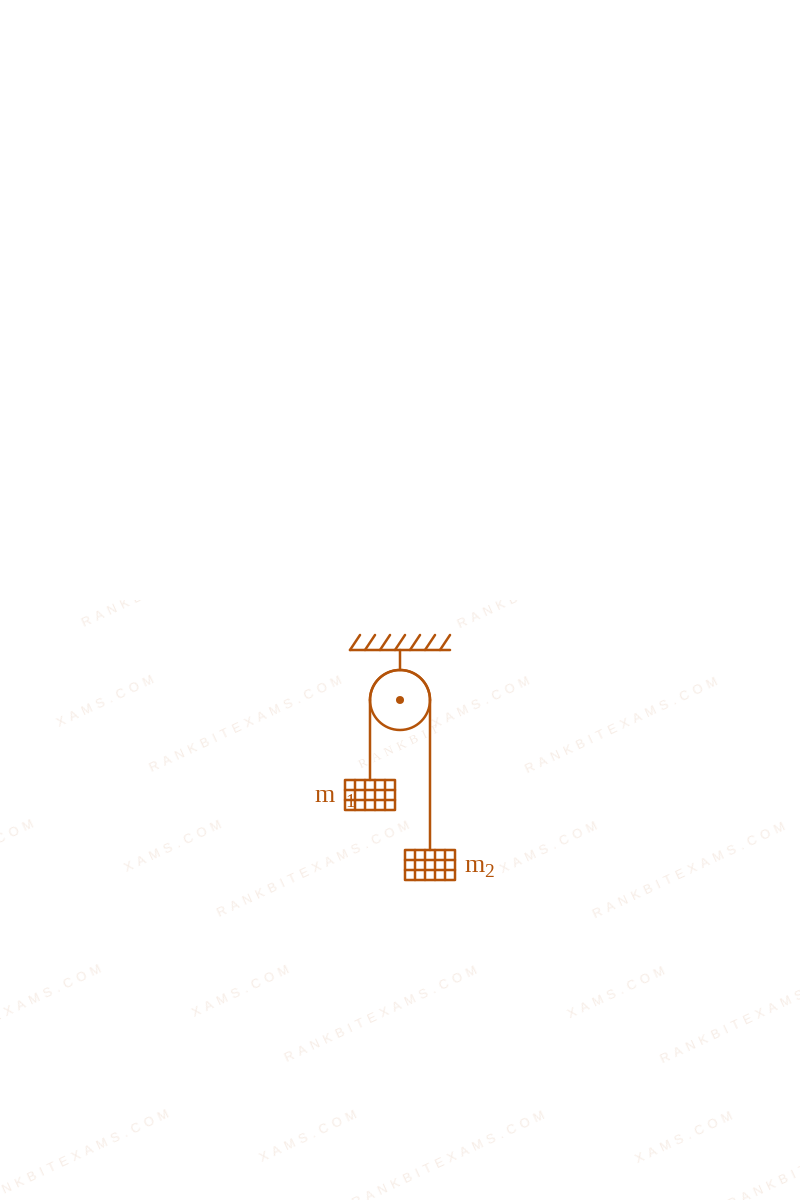
A light string passing over a smooth light fixed pulley connects two blocks of masses m₁$m_1$ and m₂$m_2$. If the acceleration of the system is g/8$g/8$, then the ratio of masses is
The image displays two masses suspended over a single fixed smooth pulley.
For standard Atwood machines, a = g × Difference in massSum of mass$a = g \times \frac{\text{Difference in mass}}{\text{Sum of mass}}$. If a/g = 1/8$a/g = 1/8$, then (m₁-m₂)/(m₁+m₂) = 1/8$(m_1-m_2)/(m_1+m_2) = 1/8$, which can be solved using componendo and dividendo: m₁/m₂ = (8+1)/(8-1) = 9/7$m_1/m_2 = (8+1)/(8-1) = 9/7$.
Chapter Mix
Class 11 Physics: Laws of Motion
Q42jee_main_2024_31_jan_eveningFriction on an Inclined Plane
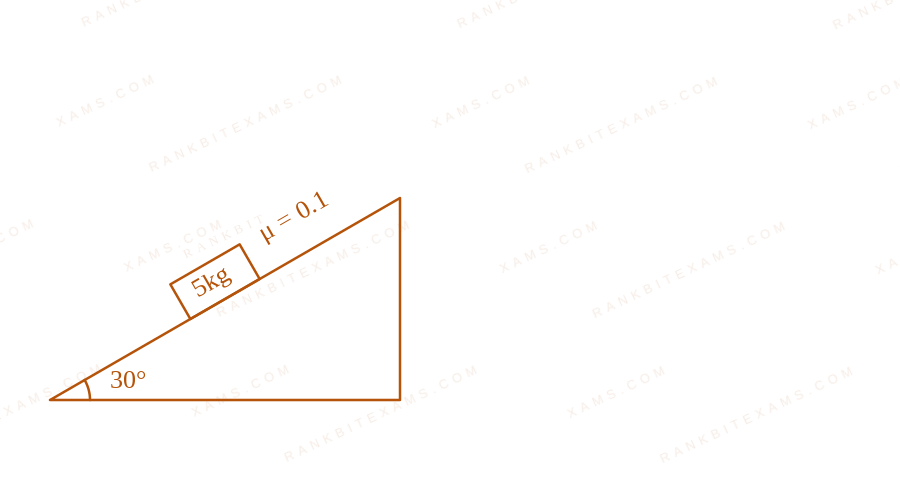
A block of mass 5 kg$5 \text{ kg}$ is placed on a rough inclined surface as shown in the figure.
The image shows a 5 kg block on a rough plane inclined at 30 degrees, with coefficient of friction mu = 0.1.
If F₁$\vec{F}_1$ is the force required to just move the block up the inclined plane and F₂$\vec{F}_2$ is the force required to just prevent the block from sliding down, then the value of | F₁| - | F₂|$|\vec{F}_1| - |\vec{F}_2|$ is: [Use g = 10 m/s²$g = 10 \text{ m/s}^2$]
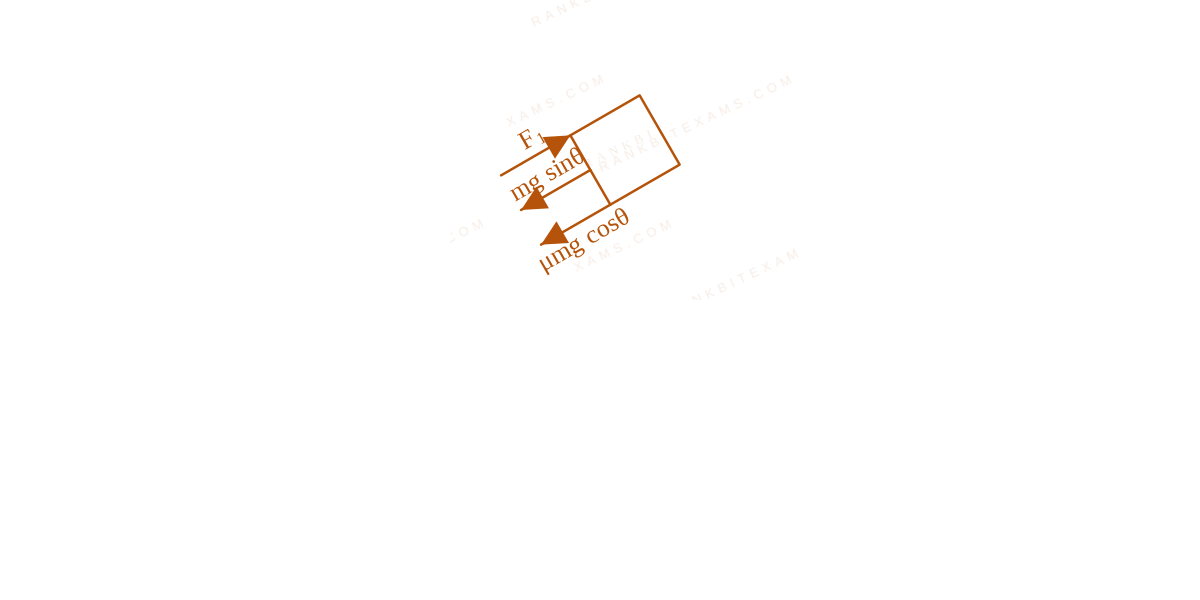
To move the block up, the applied force F₁$F_1$ must overcome both the downward gravitational component and the downward frictional force.
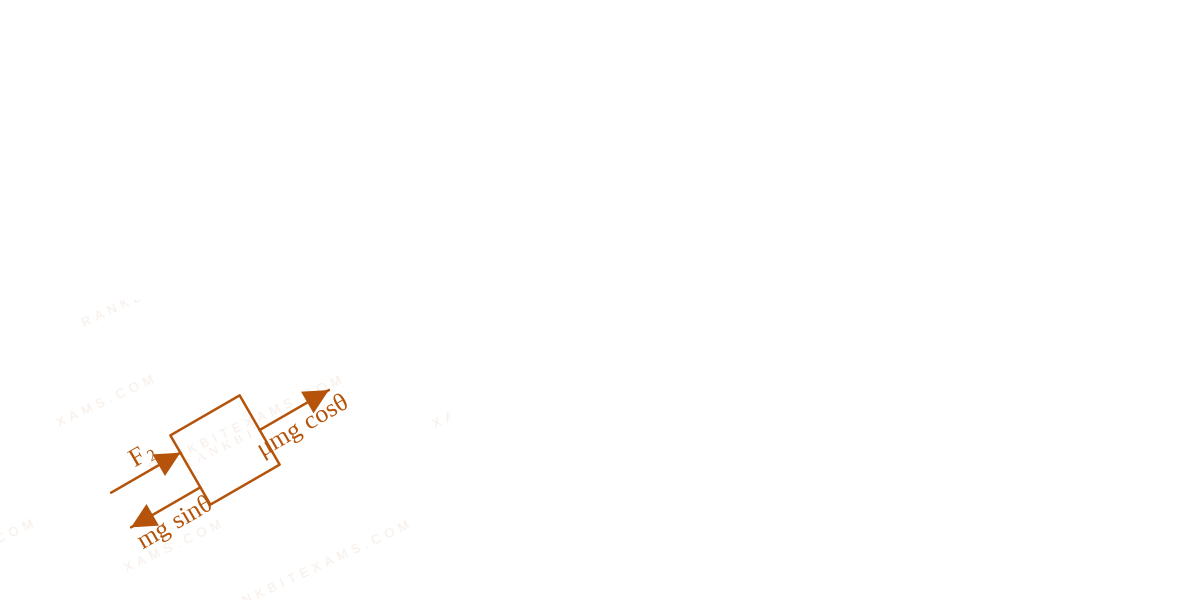
To prevent it from sliding down, the applied force F₂$F_2$ acts upwards and is aided by friction which acts upwards to oppose impending downward slip.
The image shows a 5 kg block on a rough plane inclined at 30 degrees, with coefficient of friction mu = 0.1.
The image shows a 5 kg block on a rough plane inclined at 30 degrees, with coefficient of friction mu = 0.1.
Note: The official options had an anomaly where 5√(3) N$5\sqrt{3} \text{ N}$ was missing or evaluated as a bonus. Option 2 was listed as 50√(3)$50\sqrt{3}$ in the primary text. We track the closest logic path indicating Bonus.
Pattern Recognition
The difference between 'push up' and 'hold from sliding' forces on an incline is always precisely 2 fk$2 f_k$ (2 μ mg θ$2 \mu mg \cos \theta$). Bypass calculating the mg θ$mg \sin \theta$ terms entirely.
Chapter Mix
Class 11 Physics: Laws of Motion
Qjee_main_2024_31_jan_morningPulley And Incline Friction
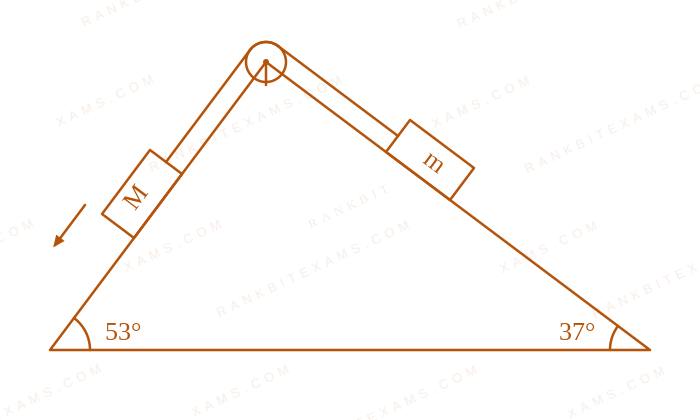
In the given arrangement of a doubly inclined plane two blocks of masses M$M$ and m$m$ are placed. The blocks are connected by a light string passing over an ideal pulley as shown. The coefficient of friction between the surface of the plane and the blocks is 0.25$0.25$. The value of m$m$, for which M = 10 kg$M = 10\mathrm{\ kg}$ will move down with an acceleration of 2 m/s²$2\mathrm{\ m/s^2}$ is : (take g = 10 m/s²$g = 10\mathrm{\ m/s^2}$ and 37° = 3 / 4$\tan 37^{\circ} = 3 / 4$)
Two blocks M and m on opposite sides of a double inclined plane linked by a rope over a top pulley. M is on the 53-degree slope and moving downwards, m is on the 37-degree slope.
A.9 kg$9\mathrm{\ kg}$
B.4.5 kg$4.5\mathrm{\ kg}$
C.6.5 kg$6.5\mathrm{\ kg}$
D.2.25 kg$2.25\mathrm{\ kg}$
Solution
Related Formula
Σ F = ma$$\sum F = ma$$fk = μk N = μk mg θ$$f_k = \mu_k N = \mu_k mg \cos\theta$$
Core Logic
Two blocks M and m on opposite sides of a double inclined plane linked by a rope over a top pulley. M is on the 53-degree slope and moving downwards, m is on the 37-degree slope.
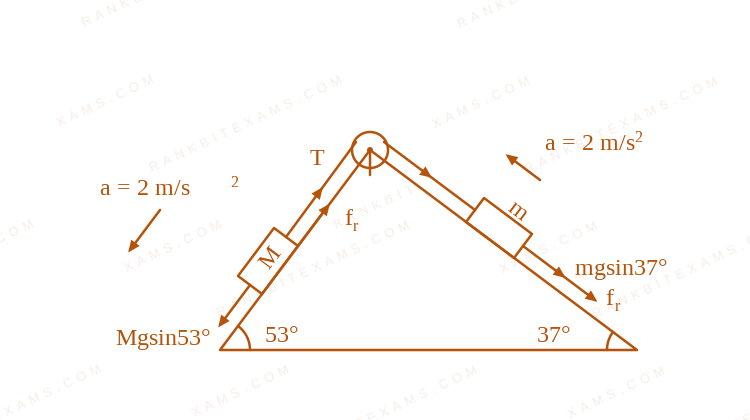
Since block M$M$ moves down the incline, kinetic friction opposes its motion (acts upwards).
Block m$m$ is pulled up the incline, so kinetic friction opposes its motion (acts downwards).
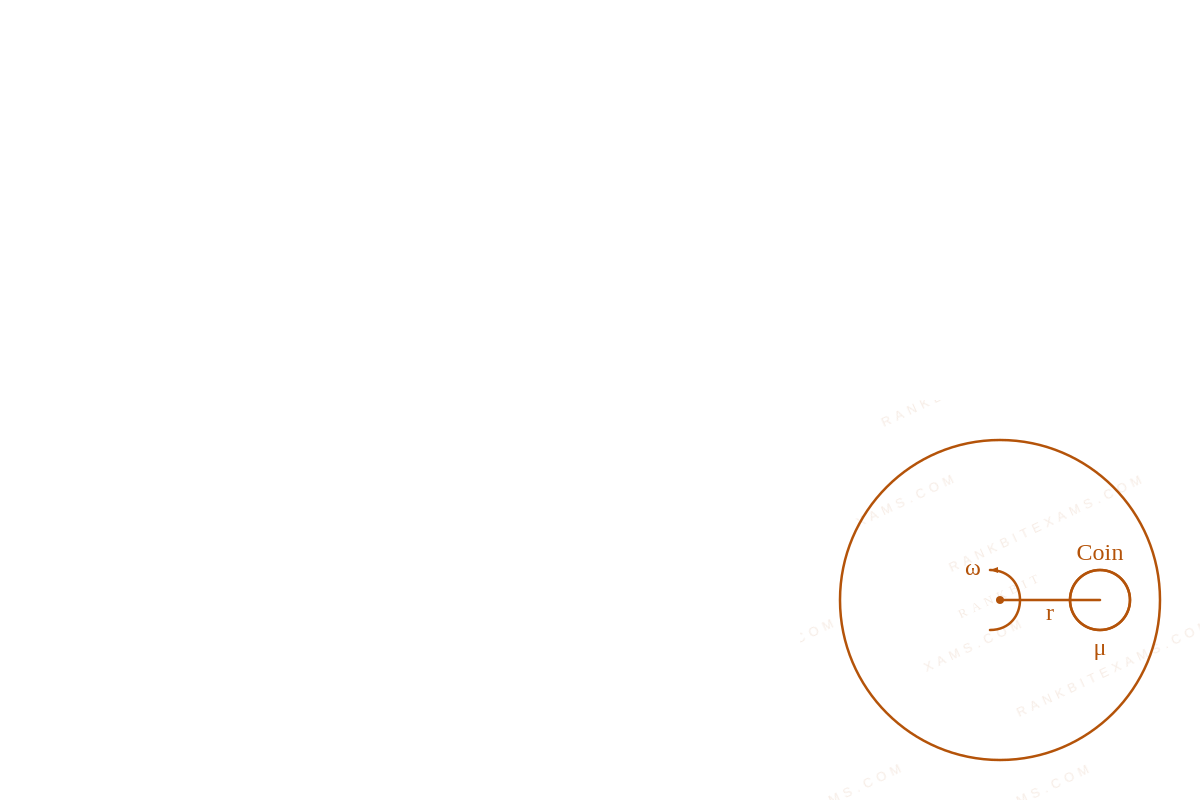
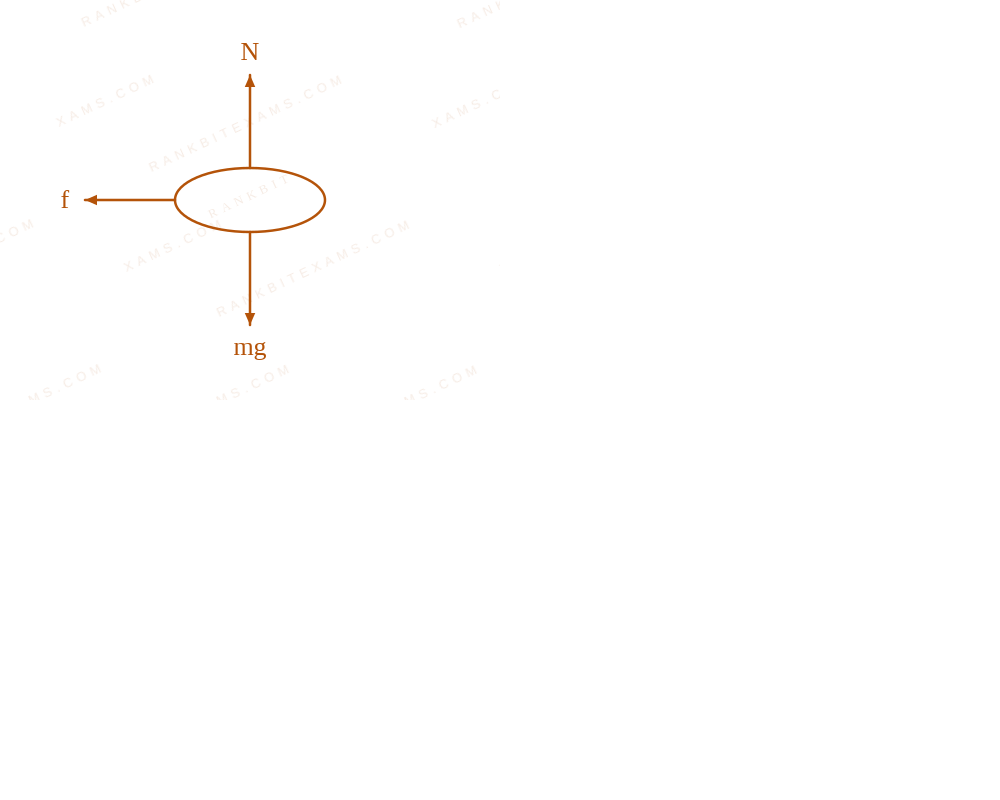
A coin is placed on a disc. The coefficient of friction between the coin and the disc is μ$\mu$. If the distance of the coin from the center of the disc is r$r$, the maximum angular velocity which can be given to the disc, so that the coin does not slip away, is:
Practice past-year questions one chapter at a time. Pick an exam → subject → chapter and get every PYQ for that topic — pulled together from all past papers — with the chapter's key formulas alongside.