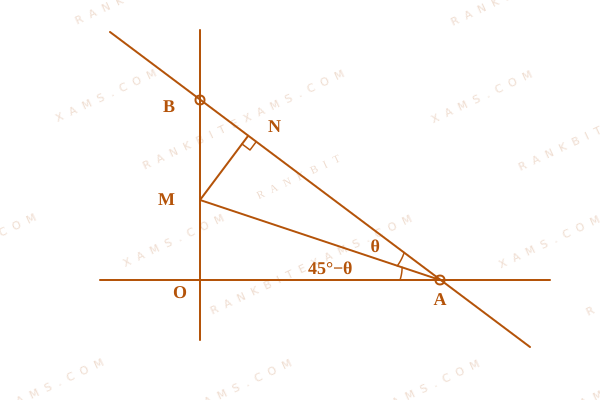
Let the line x + y = 1$x + y = 1$ meet the axes of x$x$ and y$y$ at A and B, respectively. A right angled triangle AMN is inscribed in the triangle OAB, where O is the origin and the points M and N lie on the lines OB and AB, respectively. If the area of the triangle AMN is (4)/(9)$\frac{4}{9}$ of the area of the triangle OAB and AN: NB = \lambda : 1, then the sum of all possible value(s) of λ$\lambda$ is :
A.(1)/(2)$\frac{1}{2}$
B.(13)/(6)$\frac{13}{6}$
C.(5)/(2)$\frac{5}{2}$
D.2$2$
Solution & Explanation
Related Formula
Area of a right-angled triangle:
Area = (1)/(2) × base × height$$\text{Area} = \frac{1}{2} \times \text{base} \times \text{height}$$
Core Logic
The line equation is x + y = 1$x + y = 1$, giving intercept coordinates A(1, 0)$A(1, 0)$ and B(0, 1)$B(0, 1)$.
Area of Triangles and Inscribed Shapes diagram for Q58 - JEE Main 2025 Evening
Area of Δ OAB = (1)/(2) × 1 × 1 = (1)/(2)$\Delta OAB = \frac{1}{2} \times 1 \times 1 = \frac{1}{2}$.
Given area condition:
Area of Δ AMN = (4)/(9) × (1)/(2) = (2)/(9)$$\text{Area of } \Delta AMN = \frac{4}{9} \times \frac{1}{2} = \frac{2}{9}$$
Step 1: Set up Trigonometric Tracing
Let ∠ MAO = 45^° - θ$\angle MAO = 45^\circ - \theta$. Since Δ OAB$\Delta OAB$ is isosceles right-angled at O$O$, ∠ OAB = 45^°$\angle OAB = 45^\circ$.
This establishes:
Thus, the valid evaluation matches the option sequence value of 2.
Pattern Recognition
When dealing with inscribed right triangles inside symmetric linear bounds, parameterizing coordinates with angles matching the axis slope simplifies configuration variables dramatically.
Keywords:#area of the triangle inscribed#JEE Main 2025 Evening Q58#Straight Lines JEE Main 2025#Area of Triangles and Inscribed Shapes JEE Main 2025
More Straight Lines Previous-Year Questions — Page 6
Q1jee_main_2024_30_jan_morningRotation of Axes and Lines
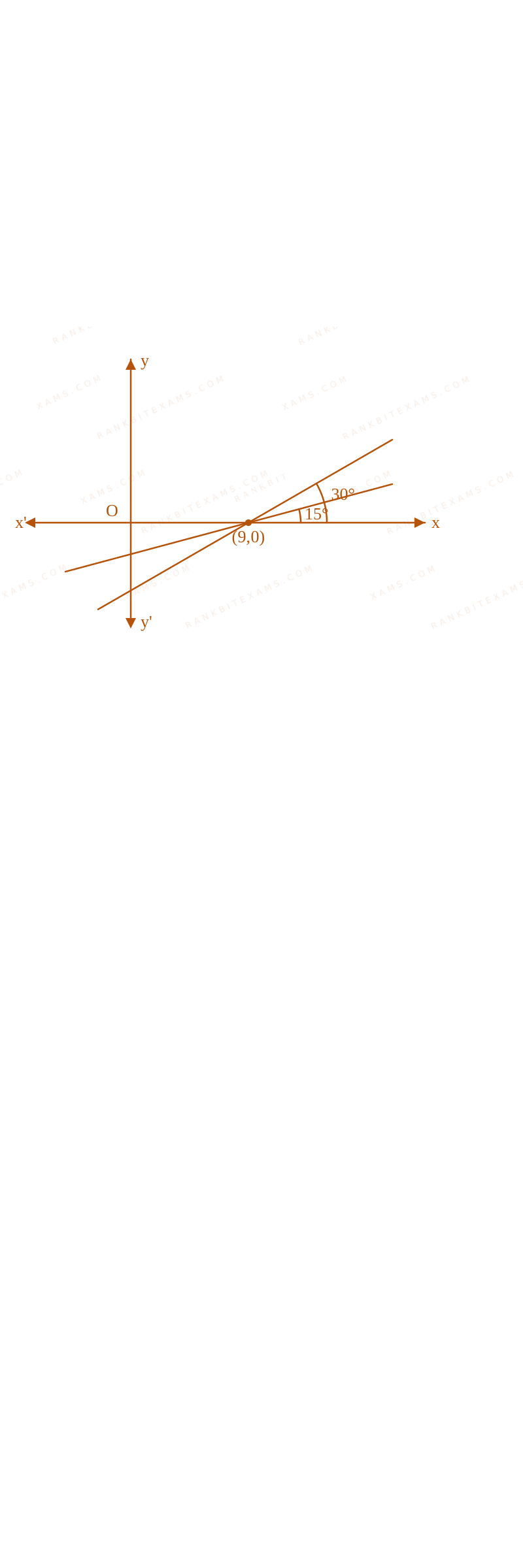
A line passing through the point A(9,0)$A(9,0)$ makes an angle of 30°$30^{\circ}$ with the positive direction of x-axis. If this line is rotated about A through an angle of 15°$15^{\circ}$ in the clockwise direction, then its equation in the new position is
A.y√(3) - 2 + x = 9$\frac{y}{\sqrt{3} - 2} + x = 9$
B.x√(3) - 2 + y = 9$\frac{x}{\sqrt{3} - 2} + y = 9$
C.x√(3) + 2 + y = 9$\frac{x}{\sqrt{3} + 2} + y = 9$
D.y√(3) + 2 + x = 9$\frac{y}{\sqrt{3} + 2} + x = 9$
Rotation of Axes and Lines diagram for Q1 - JEE Main 2024 Morning
The initial line makes an angle of 30°$30^{\circ}$ with the positive x-axis. It is rotated clockwise by 15°$15^{\circ}$ about the point A(9, 0)$A(9, 0)$.
The new angle made by the line with the positive direction of the x-axis is 30° - 15° = 15°$30^{\circ} - 15^{\circ} = 15^{\circ}$.
Step 1: Equation of the new line
The equation of the line passing through A(9, 0)$A(9, 0)$ with a slope of 15°$\tan 15^{\circ}$ is:
Eqⁿ: y - 0 = 15° (x - 9)$$\text{Eq}^n: y - 0 = \tan 15^{\circ} (x - 9)$$
We know that 15° = 2 - √(3)$\tan 15^{\circ} = 2 - \sqrt{3}$.
-y√(3) - 2 = x - 9$$\frac{-y}{\sqrt{3} - 2} = x - 9$$y√(3) - 2 + x = 9$$\frac{y}{\sqrt{3} - 2} + x = 9$$
Pattern Recognition
A clockwise rotation decreases the angle of inclination. Calculate the new angle, find its tangent, and carefully algebraicize the denominator to match the given option forms.
Chapter Mix
Class 11 Maths: Straight Lines
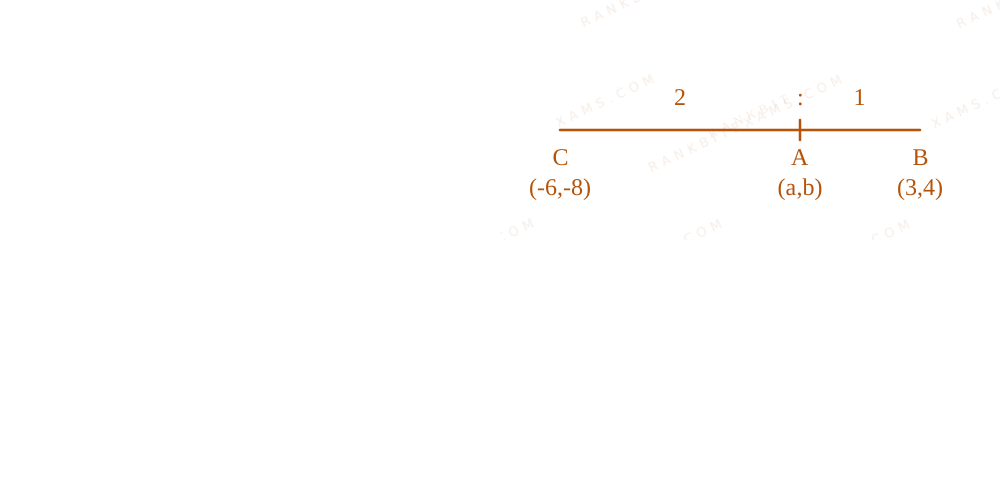
Q2jee_main_2024_31_jan_eveningCentroid and Orthocentre
Let A (a, b)$A (a, b)$, B(3, 4)$B(3, 4)$ and (-6, -8)$(-6, -8)$ respectively denote the centroid, circumcentre and orthocentre of a triangle. Then, the distance of the point P(2a + 3, 7b + 5)$P(2a + 3, 7b + 5)$ from the line 2x + 3y - 4 = 0$2x + 3y - 4 = 0$ measured parallel to the line x - 2y - 1 = 0$x - 2y - 1 = 0$ is
A.15 √(5)7$\frac{15 \sqrt{5}}{7}$
B.17√(5)6$\frac{17\sqrt{5}}{6}$
C.17 √(5)7$\frac{17 \sqrt{5}}{7}$
D.√(5)17$\frac{\sqrt{5}}{17}$
Solution
Related Formula
Centroid divides the line joining Orthocentre and Circumcentre in 2:1$$\text{Centroid divides the line joining Orthocentre and Circumcentre in } 2:1$$
Distance in parametric form: x = x₁ + r θ, y = y₁ + r θ$x = x_1 + r\cos\theta, y = y_1 + r\sin\theta$
Core Logic
Centroid and Orthocentre diagram for Q2 - JEE Main 2024 Evening
Let Orthocentre C(-6, -8)$C(-6, -8)$ and Circumcentre B(3, 4)$B(3, 4)$. Centroid A(a, b)$A(a, b)$ divides CB$CB$ in 2:1$2:1$.
So, P(2a+3, 7b+5) = (3, 5)$P(2a+3, 7b+5) = (3, 5)$.
The line along which distance is measured is parallel to x - 2y - 1 = 0$x - 2y - 1 = 0$, giving slope m = θ = (1)/(2)$m = \tan\theta = \frac{1}{2}$.
Using parametric coordinates from P(3,5)$P(3,5)$:
x = 3 + r θ, y = 5 + r θ$$x = 3 + r\cos\theta, \quad y = 5 + r\sin\theta$$
Substitute into the target line 2x + 3y - 4 = 0$2x + 3y - 4 = 0$:
Standard Euler line property: O, G, C$O, G, C$ are collinear and G$G$ divides OC$OC$ in 2:1$2:1$. Use parametric equation to find intersection distance directly without finding the intersection point.
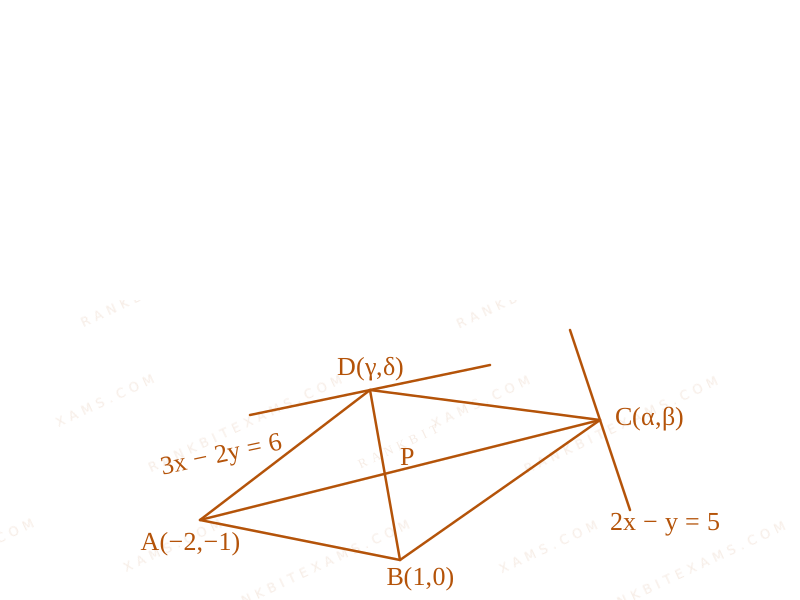
Let A(-2, -1)$A(-2, -1)$, B(1, 0)$B(1, 0)$, C(α, β)$C(\alpha, \beta)$ and D(γ, δ)$D(\gamma, \delta)$ be the vertices of a parallelogram ABCD. If the point C lies on 2x - y = 5$2x - y = 5$ and the point D lies on 3x - 2y = 6$3x - 2y = 6$, then the value of |α + β + γ + δ|$|\alpha + \beta + \gamma + \delta|$ is equal to
Numerical Answer.Answer: 32 to 32
Solution
Related Formula
In a parallelogram, midpoints of diagonals coincide: ((xA+xC)/(2), (yA+yC)/(2)) = ((xB+xD)/(2), (yB+yD)/(2))$$\text{In a parallelogram, midpoints of diagonals coincide: } \left(\frac{x_A+x_C}{2}, \frac{y_A+y_C}{2}\right) = \left(\frac{x_B+x_D}{2}, \frac{y_B+y_D}{2}\right)$$
Core Logic
Parallelogram Properties diagram for Q23 - JEE Main 2024 Evening
Given diagonals AC$AC$ and BD$BD$ bisect each other:
Q10jee_main_2024_31_jan_morningProperties of Parallelogram
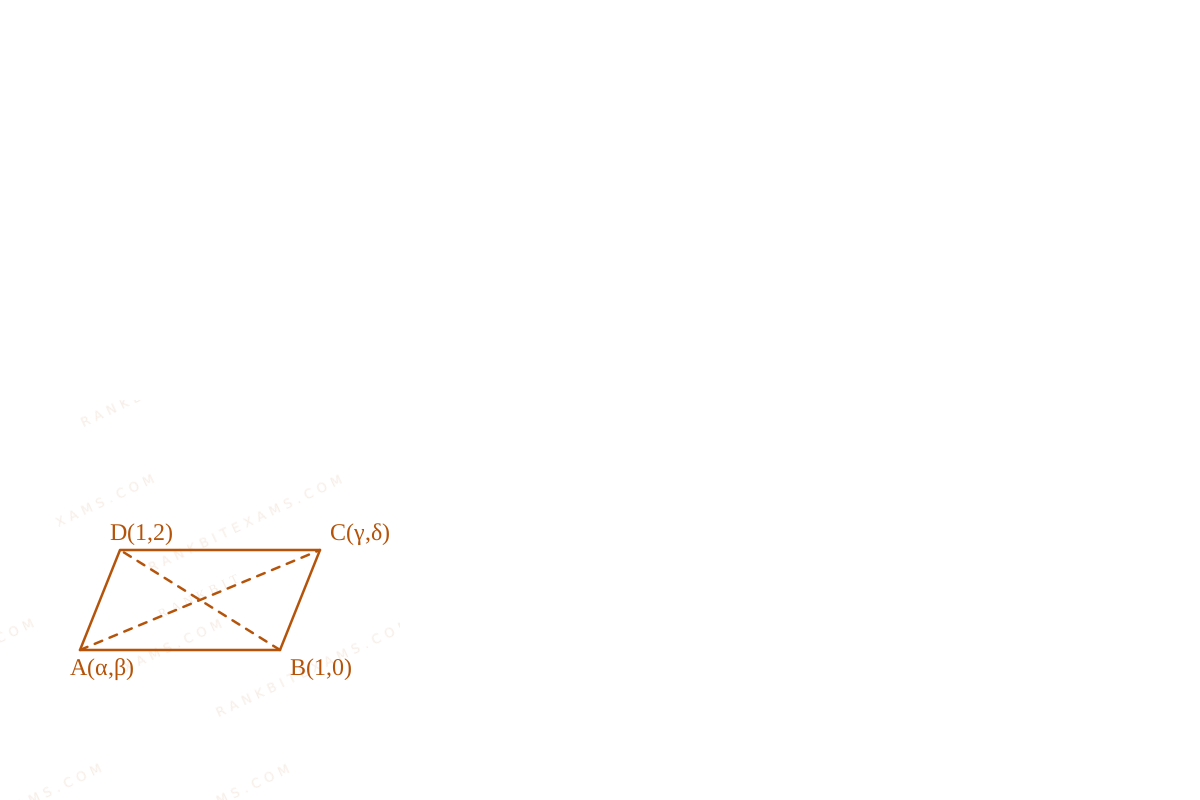
Let α, β, γ, δ in Z$\alpha, \beta, \gamma, \delta \in Z$ and let A (α, β)$A (\alpha, \beta)$, B (1, 0)$B (1, 0)$, C (γ, δ)$C (\gamma, \delta)$ and D (1, 2)$D (1, 2)$ be the vertices of a parallelogram ABCD$ABCD$. If AB = √(10)$AB = \sqrt{10}$ and the points A$A$ and C$C$ lie on the line 3y = 2x + 1$3y = 2x + 1$, then 2(α + β + γ + δ)$2(\alpha + \beta + \gamma + \delta)$ is equal to
A.10$10$
B.5$5$
C.12$12$
D.8$8$
Solution
Core Logic
Let E$E$ be the midpoint of the diagonals AC$AC$ and BD$BD$.
Since ABCD$ABCD$ is a parallelogram, the diagonals bisect each other.
Properties of Parallelogram diagram for Q10 - JEE Main 2024 Morning
Midpoint E$E$ from BD$BD$: ( (1+1)/(2), (0+2)/(2) ) = (1, 1)$\left( \frac{1+1}{2}, \frac{0+2}{2} \right) = (1, 1)$.
Practice past-year questions one chapter at a time. Pick an exam → subject → chapter and get every PYQ for that topic — pulled together from all past papers — with the chapter's key formulas alongside.