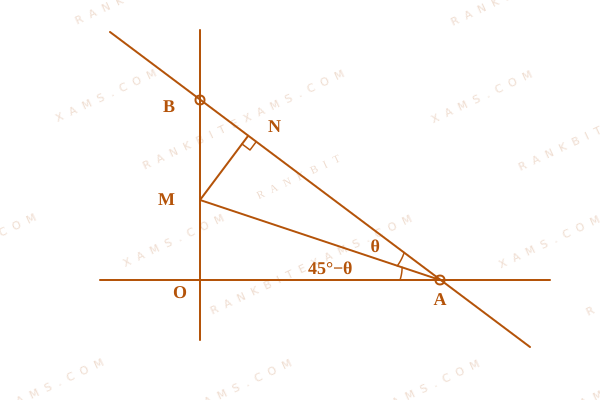
Let the line x + y = 1$x + y = 1$ meet the axes of x$x$ and y$y$ at A and B, respectively. A right angled triangle AMN is inscribed in the triangle OAB, where O is the origin and the points M and N lie on the lines OB and AB, respectively. If the area of the triangle AMN is (4)/(9)$\frac{4}{9}$ of the area of the triangle OAB and AN: NB = \lambda : 1, then the sum of all possible value(s) of λ$\lambda$ is :
A.(1)/(2)$\frac{1}{2}$
B.(13)/(6)$\frac{13}{6}$
C.(5)/(2)$\frac{5}{2}$
D.2$2$
Solution & Explanation
Related Formula
Area of a right-angled triangle:
Area = (1)/(2) × base × height$$\text{Area} = \frac{1}{2} \times \text{base} \times \text{height}$$
Core Logic
The line equation is x + y = 1$x + y = 1$, giving intercept coordinates A(1, 0)$A(1, 0)$ and B(0, 1)$B(0, 1)$.
Area of Triangles and Inscribed Shapes diagram for Q58 - JEE Main 2025 Evening
Area of Δ OAB = (1)/(2) × 1 × 1 = (1)/(2)$\Delta OAB = \frac{1}{2} \times 1 \times 1 = \frac{1}{2}$.
Given area condition:
Area of Δ AMN = (4)/(9) × (1)/(2) = (2)/(9)$$\text{Area of } \Delta AMN = \frac{4}{9} \times \frac{1}{2} = \frac{2}{9}$$
Step 1: Set up Trigonometric Tracing
Let ∠ MAO = 45^° - θ$\angle MAO = 45^\circ - \theta$. Since Δ OAB$\Delta OAB$ is isosceles right-angled at O$O$, ∠ OAB = 45^°$\angle OAB = 45^\circ$.
This establishes:
Thus, the valid evaluation matches the option sequence value of 2.
Pattern Recognition
When dealing with inscribed right triangles inside symmetric linear bounds, parameterizing coordinates with angles matching the axis slope simplifies configuration variables dramatically.
Keywords:#area of the triangle inscribed#JEE Main 2025 Evening Q58#Straight Lines JEE Main 2025#Area of Triangles and Inscribed Shapes JEE Main 2025
More Straight Lines Previous-Year Questions — Page 5
Qjee_main_2024_29_january_eveningDistance of a Point From a Line
The distance of the point (2, 3) from the line 2x - 3y + 28 = 0$2x - 3y + 28 = 0$, measured parallel to the line √(3) x - y + 1 = 0$\sqrt{3} x - y + 1 = 0$, is equal to
A.4√(2)$4\sqrt{2}$
B.6√(3)$6\sqrt{3}$
C.3 + 4√(2)$3 + 4\sqrt{2}$
D.4 + 6√(3)$4 + 6\sqrt{3}$
Solution
Related Formula
x = x₁ + r θ, y = y₁ + r θ$$x = x_1 + r \cos \theta, \quad y = y_1 + r \sin \theta$$
Core Logic
The line is measured parallel to √(3)x - y + 1 = 0$\sqrt{3}x - y + 1 = 0$, which has a slope θ = √(3) θ = 60^°$\tan \theta = \sqrt{3} \implies \theta = 60^\circ$.
Thus, θ = (1)/(2)$\cos \theta = \frac{1}{2}$ and θ = √(3)2$\sin \theta = \frac{\sqrt{3}}{2}$.
Writing any point P$P$ along this direction passing through (2,3)$(2,3)$ in parametric coordinates:
P = (2 + r 60^°, 3 + r 60^°) = (2 + (r)/(2), 3 + √(3)r2)$$P = \left(2 + r \cos 60^\circ, 3 + r \sin 60^\circ\right) = \left(2 + \frac{r}{2}, 3 + \frac{\sqrt{3}r}{2}\right)$$
Step 1: Finding Intersection Point
Since P$P$ must lie on the given line 2x - 3y + 28 = 0$2x - 3y + 28 = 0$:
Distance measured parallel to a given direction is always resolved most efficiently using parametric equations of lines rather than perpendicular metrics.
Chapter Mix
Class 11 Mathematics: Straight Lines
Qjee_main_2024_29_january_eveningIntersection of Lines and Distance
Let A$A$ be the point of intersection of the lines 3x + 2y = 14, 5x - y = 6$3x + 2y = 14, 5x - y = 6$ and B$B$ be the point of intersection of the lines 4x + 3y = 8, 6x + y = 5$4x + 3y = 8, 6x + y = 5$. The distance of the point P(5, -2)$P(5, -2)$ from the line AB is
Verify calculation metrics step-by-step. Finding straight intersections correctly upfront avoids scaling mistakes down the track.
Chapter Mix
Class 11 Mathematics: Straight Lines
Qjee_main_2024_27_jan_morningAngle Between Two Lines
The portion of the line 4x+5y=20$4x+5y=20$ in the first quadrant is trisected by the lines L₁$L_{1}$ and L₂$L_{2}$ passing through the origin. The tangent of an angle between the lines L₁$L_{1}$ and L₂$L_{2}$ is:
Find the intercepts of the line 4x + 5y = 20$4x + 5y = 20$ in the first quadrant.
Put y=0 ⇒ x=5$y=0 \Rightarrow x=5$. Point X(5, 0)$X(5, 0)$.
Put x=0 ⇒ y=4$x=0 \Rightarrow y=4$. Point Y(0, 4)$Y(0, 4)$.
The line segment XY$XY$ is trisected by two points, say A$A$ and B$B$.
Point A$A$ divides YX$YX$ in the ratio 2:1$2:1$, and B$B$ divides it in 1:2$1:2$.
Step 1: Trisection Points Calculation
Using the section formula for A$A$ (closer to Y-axis, ratio 1:2 from Y to X):
For trisection or specific division of an intercepted segment, identify the axis intercepts first, rapidly apply the internal section formula, compute origin-centered slopes (which equal just the y/x ratio of the points), and pass them into the tan formula.
Chapter Mix
Class 11 Maths: Straight Lines
Q7jee_main_2024_29_jan_morningAngle Bisector and Reflection
In a Δ ABC$\Delta ABC$, suppose y=x$y=x$ is the equation of the bisector of the angle B and the equation of the side AC is 2x-y=2$2x-y=2$. If 2AB=BC$2AB=BC$ and the point A and B are respectively (4,6)$(4,6)$ and (α,β)$(\alpha,\beta)$, then α+2β$\alpha+2\beta$ is equal to
A.42$42$
B.39$39$
C.48$48$
D.45$45$
Solution
Related Formula
Image of a point (x₁, y₁)$(x_1, y_1)$ across line y=x$y=x$ is (y₁, x₁)$(y_1, x_1)$.
Angle Bisector Theorem: The angle bisector of a triangle divides the opposite side into segments proportional to the lengths of the adjacent sides:
Given A(4,6)$A(4,6)$ and Angle bisector of B is y=x$y=x$.
Because y=x$y=x$ bisects angle B, the geometric reflection of vertex A across the bisector line y=x$y=x$ must lie exactly on the line containing the side BC$BC$.
Let the reflection of A(4,6)$A(4,6)$ be A'$A'$. Across y=x$y=x$, the coordinates swap:
A' = (6,4)$A' = (6,4)$
Next, find the intersection point D$D$ of the bisector y=x$y=x$ and side AC$AC$ (2x-y=2$2x-y=2$).
Substitute y=x$y=x$ into 2x-y=2$2x-y=2$:
2x - x = 2 ⇒ x = 2 ⇒ y = 2$$2x - x = 2 \Rightarrow x = 2 \Rightarrow y = 2$$
Given 2AB = BC$2AB = BC$, so (AB)/(BC) = (1)/(2)$\frac{AB}{BC} = \frac{1}{2}$.
This means point D(2,2)$D(2,2)$ divides the segment AC$AC$ in the ratio 1:2$1:2$.
Let C$C$ have coordinates (xc, yc)$(x_c, y_c)$.
Applying the section formula for D(2,2)$D(2,2)$ dividing A(4,6)$A(4,6)$ and C(xc, yc)$C(x_c, y_c)$ in ratio 1:2$1:2$:
Vertex B(α, β)$B(\alpha, \beta)$ is the intersection of line BC$BC$ and the angle bisector y=x$y=x$.
Substitute y=x$y=x$ into 5x - 4y - 14 = 0$5x - 4y - 14 = 0$:
Reflection properties drastically simplify angle bisector questions. If you know the bisector equation, reflecting one vertex over it gives a coordinate on the opposing extended ray. This paired with the angle bisector proportion theorem locks the entire geometric frame.
Chapter Mix
Class 11 Mathematics: Straight Lines
Q7jee_main_2024_30_january_eveningAngle Bisectors
If x² - y² + 2hxy + 2gx + 2fy + c = 0$x^2 - y^2 + 2hxy + 2gx + 2fy + c = 0$ is the locus of a point, which moves such that it is always equidistant from the lines x + 2y + 7 = 0$x + 2y + 7 = 0$ and 2x - y + 8 = 0$2x - y + 8 = 0$ , then the value of g + c + h - f$g + c + h - f$ equals
A.14$14$
B.6$6$
C.8$8$
D.29$29$
Solution
Related Formula
Distance of (x, y) from ax+by+c=0 is d = |ax + by + c|√(a² + b²)$$\text{Distance of } (x, y) \text{ from } ax+by+c=0 \text{ is } d = \frac{|ax + by + c|}{\sqrt{a^2 + b^2}}$$
Core Logic
The locus of a point P(x, y)$P(x, y)$ equidistant from lines x + 2y + 7 = 0$x + 2y + 7 = 0$ and 2x - y + 8 = 0$2x - y + 8 = 0$ is the pair of angle bisectors:
The standard form given is x² - y² + 2hxy + 2gx + 2fy + c = 0$x^2 - y^2 + 2hxy + 2gx + 2fy + c = 0$.
Divide our derived equation by 3 to match the leading coefficients:
Locus of equidistant points from two lines is their pair of angle bisectors. Equating squares d₁² = d₂²$d_1^2 = d_2^2$ directly yields the joint equation of bisectors without needing explicit line separation.
Chapter Mix
Class 11 Maths: Straight Lines
More Straight Lines Questions — jee_main_2025_29_jan_evening
Practice past-year questions one chapter at a time. Pick an exam → subject → chapter and get every PYQ for that topic — pulled together from all past papers — with the chapter's key formulas alongside.