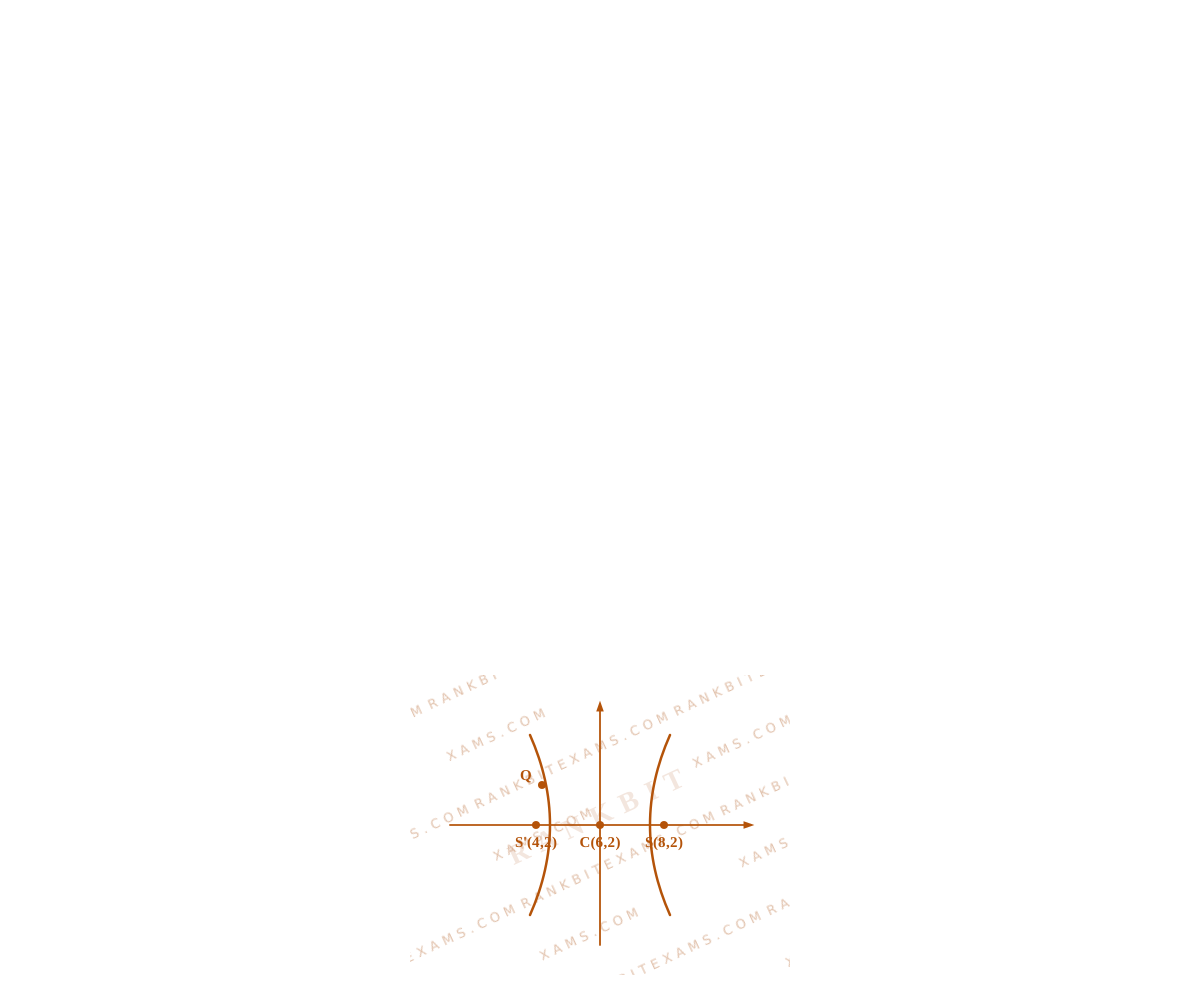
Let y^2 = 12x the parabola and S be its focus. Let PQ be a focal chord of the parabola such that (SP) (SQ) = frac1474. Let C be the circle described taking PQ as a diameter. If the equation of a circle C is 64x^2 + 64y^2 - alpha x - 64sqrt3y = beta, then \beta - \alpha is equal to

Numerical Answer Type:
Enter a numerical value Answer: 1328 to 1328 +4 marks

Solution & Explanation

### Related Formula Properties of focal chord parameter metrics in parabolas y^2 = 4ax: t_1 cdot t_2 = -1 Distance to the directrix property: SP = a(1 + t^2), quad SQ = aleft(1 + frac1t^2right) ### Core Logic Given parabola y^2 = 12x implies a = 3. Focus S = (3, 0). Set up focal segments product equation: SP cdot SQ = 3(1+t^2) cdot 3left(1+frac1t^2right) = frac1474 9 cdot frac(1+t^2)^2t^2 = frac1474 implies frac(1+t^2)^2t^2 = frac4912 Solving for t^2: 12t^4 - 25t^2 + 12 = 0 implies t^2 = frac34 quad textor quad frac43 ### Step 1: Compute Endpoint Coordinate Bounds Choosing t = -fracsqrt32 allows defining both chord coordinates symmetrically: P(3t^2, 6t) implies Pleft(frac94, -3sqrt3right) Qleft(frac3t^2, -frac6tright) implies Q(4, 4sqrt3) ### Step 2: Derive Circle Equation Write the diameter circle form equation: (x - 4)left(x - frac94right) + (y - 4sqrt3)(y + 3sqrt3) = 0 x^2 + y^2 - frac254x - sqrt3y - 27 = 0 Multiply by 64 to clear the fractions and match the given equation template structure: 64x^2 + 64y^2 - 400x - 64sqrt3y - 1728 = 0 Comparing directly with 64x^2 + 64y^2 - alpha x - 64sqrt3y = beta yields: alpha = 400, quad beta = 1728 beta - alpha = 1728 - 400 = 1328 ### Pattern Recognition The distance from focal chord endpoints to the focus equals their perpendicular distance to the directrix. This property connects parameter metrics to geometric lengths cleanly. ### Evaluation Rubric / Model Answer null ### Chapter Mix Class 11 Mathematics: Conic Sections Class 11 Mathematics: Circles

Reference Study Guides

More Conic Sections Previous-Year Questions — Page 7

Q74 jee_main_2025_07_april_evening Properties of Hyperbola
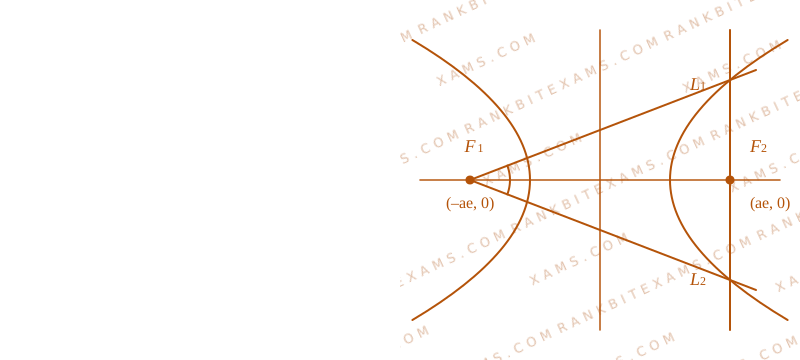
Let the lengths of the transverse and conjugate axes of a hyperbola in standard form be 2a and 2b, respectively, and one focus and the corresponding directrix of this hyperbola be (-5,0) and 5x + 9 = 0, respectively. If the product of the focal distances of a point (alpha,2sqrt5) on the hyperbola is p, then 4p is equal to
Numerical Answer. Answer: 189 to 189

Solution

### Related Formula Product of focal distances for a point on a hyperbola satisfies: PF_1 cdot PF_2 = e^2alpha^2 - a^2 ### Core Logic Given focus ae = 5 and directrix fracae = frac95. Multiplying gives a^2 = 9 implies a = 3. Then 3e = 5 implies e = frac53. Using hyperbola identity: b^2 = a^2(e^2 - 1) = 9left(frac259 - 1right) = 16 implies b = 4. The equation of the hyperbola is: fracx^29 - fracy^216 = 1 ### Step 1: Point Substitution Since point (alpha, 2sqrt5) lies on the hyperbola: fracalpha^29 - frac2016 = 1 implies fracalpha^29 = 1 + frac54 = frac94 implies alpha^2 = frac814 ### Step 2: Focal Product Calculation Evaluating p: p = e^2alpha^2 - a^2 = left(frac259right)left(frac814right) - 9 = frac2254 - 9 = frac1894 4p = 189 ### Pattern Recognition Combining the metric coordinates ae and fracae via simple multiplication locks in the basic structural axis parameter a^2 immediately. ### Evaluation Rubric / Model Answer null ### Chapter Mix Class 11 Mathematics: Conic Sections
Q51 jee_main_2025_24_jan_evening Ellipse - Equation of Chord with Given Midpoint
The equation of the chord, of the ellipse fracx^225+fracy^216=1, whose mid-point is (3,1) is: [cite: 3245, 3246]
  • A. 48x+25y=169
  • B. 4x+122y=134
  • C. 25x+101y=176
  • D. 5x+16y=31

Solution

### Related Formula The equation of a chord of an ellipse whose midpoint (x_1, y_1) is given is: T = S_1 fracxx_1a^2 + fracyy_1b^2 = fracx_1^2a^2 + fracy_1^2b^2 ### Core Logic For the given ellipse fracx^225 + fracy^216 = 1 and midpoint (x_1, y_1) = (3, 1) , we substitute these values into the T = S_1 expression. ### Step 1: Substitution and Expansion Substituting the coordinates into the formula: frac3x25 + frac1y16 - 1 = frac3^225 + frac1^216 - 1 frac3x25 + fracy16 = frac925 + frac116 ### Step 2: Simplification Multiply both sides by the least common multiple of 25 and 16, which is 400: 16(3x) + 25(y) = 16(9) + 25(1) 48x + 25y = 144 + 25 48x + 25y = 169 ### Pattern Recognition Whenever a midpoint is given for a chord of any second-degree conic curve, the relation T = S_1 simplifies the process instantaneously without finding the individual intersection points. ### Evaluation Rubric / Model Answer null ### Chapter Mix Class 11 Mathematics: Conic Sections
Q70 jee_main_2025_24_jan_evening Parabola Equation with Given Vertex and Directrix
If the equation of the parabola with vertex Vleft(frac32,3right) and the directrix x+2y=0 is alpha x^2+beta y^2-gamma xy-30x-60y+225=0, then alpha+beta+gamma is equal to: [cite: 3348, 3354, 3355]
  • A. 6
  • B. 8
  • C. 7
  • D. 9

Solution

### Related Formula The locus definition of a parabola states that the squared distance from any point P(x,y) to the focus S(x_0, y_0) equals the squared perpendicular distance to the directrix line Ax + By + C = 0: (x - x_0)^2 + (y - y_0)^2 = frac(Ax + By + C)^2A^2 + By^2 ### Step 1: Determine the Focus coordinates The axis line of the parabola is perpendicular to the directrix x + 2y = 0 and passes through the vertex V(1.5, 3) [cite: 3354, 3355]. Slope of directrix = -0.5 Rightarrow Slope of axis = 2. Equation of axis : y - 3 = 2left(x - frac32right) Rightarrow y - 2x = 0 [cite: 4059, 4060] The intersection of the axis (y - 2x = 0) and directrix (x + 2y = 0) gives the foot of the directrix, which is (0, 0) [cite: 4057, 4060]. Since the vertex is the midpoint between the focus and the foot of the directrix : left(frac32, 3right) = left(fracx_f + 02, fracy_f + 02right) Rightarrow textFocus S = (3, 6) ### Step 2: Derive the Parabola Locus Equation Equate the distance equations from point P(x,y) : (x - 3)^2 + (y - 6)^2 = frac(x + 2y)^21^2 + 2^2 5left(x^2 - 6x + 9 + y^2 - 12y + 36right) = x^2 + 4xy + 4y^2 5x^2 - 30x + 45 + 5y^2 - 60y + 180 = x^2 + 4xy + 4y^2 4x^2 + y^2 - 4xy - 30x - 60y + 225 = 0 ### Step 3: Coefficient Extraction Compare with the equation template alpha x^2 + beta y^2 - gamma xy - 30x - 60y + 225 = 0 : alpha = 4, quad beta = 1, quad gamma = 4 alpha + beta + gamma = 4 + 1 + 4 = 9 ### Pattern Recognition The vertex is always exactly midway between the focus and the foot of the directrix line along the line of symmetry. Finding the origin (0,0) as the foot quickly reveals the focus coordinates via doubling. ### Evaluation Rubric / Model Answer null ### Chapter Mix Class 11 Mathematics: Conic Sections
Q74 jee_main_2025_24_jan_evening Hyperbola - Latus Rectum and Eccentricity
Let H_1:fracx^2a^2-fracy^2b^2=1 and H_2:-fracx^2A^2+fracy^2B^2=1 be two hyperbolas having length of latus rectums 15sqrt2 and 12sqrt5 respectively. Let their eccentricities be e_1=sqrtfrac52 and e_2 respectively. If the product of the lengths of their transverse axes is 100sqrt10 then 25e_2^2 is equal to \_\_\_\_. [cite: 3413, 3414, 3415, 3416, 3417, 3418]
Numerical Answer. Answer: 55

Solution

### Related Formula 1. For standard hyperbola fracx^2a^2 - fracy^2b^2 = 1: Latus Rectum = frac2b^2a, transverse axis length = 2a, eccentricity relation b^2 = a^2(e^2 - 1). 2. For conjugate hyperbola -fracx^2A^2 + fracy^2B^2 = 1: Latus Rectum = frac2A^2B, transverse axis length = 2B, eccentricity relation A^2 = B^2(e^2 - 1). ### Step 1: Solve Parameters for Hyperbola H_1 Given latus rectum and eccentricity parameters [cite: 3416, 3417]: frac2b^2a = 15sqrt2 e_1^2 = 1 + fracb^2a^2 = frac52 Rightarrow fracb^2a^2 = frac32 Rightarrow b^2 = frac32a^2 Substitute b^2 into latus rectum equation: frac2left(frac32a^2right)a = 3a = 15sqrt2 Rightarrow a = 5sqrt2 b^2 = frac32(50) = 75 Rightarrow b = 5sqrt3 Transverse axis length of H_1 = 2a = 10sqrt2. ### Step 2: Solve Parameters for Hyperbola H_2 The product of their transverse axes lengths equals 100sqrt10 [cite: 3418, 4094]: 2a cdot 2B = 100sqrt10 Rightarrow 10sqrt2 cdot 2B = 100sqrt10 Rightarrow 2B = 10sqrt5 Rightarrow B = 5sqrt5 [cite: 4094, 4095, 4096] Given latus rectum for conjugate hyperbola H_2 [cite: 3416, 4093]: frac2A^2B = 12sqrt5 Rightarrow frac2A^25sqrt5 = 12sqrt5 Rightarrow 2A^2 = 60 times 5 = 300 Rightarrow A^2 = 150 [cite: 4093, 4097] ### Step 3: Calculate 25e_2^2 Find e_2^2 using the conjugate eccentricity relation : e_2^2 = 1 + fracA^2B^2 = 1 + frac150(5sqrt5)^2 = 1 + frac150125 = 1 + frac65 = frac115 [cite: 4104, 4106, 4107] Compute 25e_2^2 [cite: 3418, 4107]: 25e_2^2 = 25 times frac115 = 55 [cite: 4105, 4107] ### Pattern Recognition Pay extra attention to conjugate-type equations (-fracx^2A^2 + fracy^2B^2 = 1). For these vertical hyperbolas, the transverse axis corresponds to the variable with the positive sign (2B), and the components inside the latus rectum swap positions proportionally. ### Evaluation Rubric / Model Answer null ### Chapter Mix Class 11 Mathematics: Conic Sections
Q60 jee_main_2025_24_jan_morning Properties of Ellipse
Let the product of the focal distances of the point left(sqrt3,frac12right) on the ellipse fracx^2a^2 +fracy^2b^2 = 1 (a > b) be frac74 . Then the absolute difference of the eccentricities of two such ellipses is :
  • A. frac3 - 2sqrt23sqrt2
  • B. frac1 - sqrt3sqrt2
  • C. frac3 - 2sqrt22sqrt3
  • D. frac1 - 2sqrt2sqrt3

Solution

### Related Formula For a point P(x_1, y_1) on a standard horizontal ellipse, the focal distances are given by (a + ex_1) and (a - ex_1). Their algebraic product equals: textProduct = a^2 - e^2 x_1^2 ### Core Logic Substitute the given coordinate x_1 = sqrt3 into our focal distance product value: a^2 - e^2(sqrt3)^2 = frac74 implies a^2 - 3e^2 = frac74 4a^2 = 7 + 12e^2 quad dots (1) ### Step 1: Apply Point Ingestion into Conic Equation Since the point left(sqrt3, frac12right) lies directly on the ellipse perimeter: frac3a^2 + frac(1/2)^2b^2 = 1 implies frac3a^2 + frac14b^2 = 1 Using the standard eccentricity identity b^2 = a^2(1-e^2): frac3a^2 + frac14a^2(1-e^2) = 1 implies 12(1-e^2) + 1 = 4a^2(1-e^2) 13 - 12e^2 = 4a^2(1-e^2) quad dots (2) ### Step 2: Solve the Bi-quadratic Equation for Eccentricity Substitute 4a^2 from equation (1) directly into equation (2): 13 - 12e^2 = (7 + 12e^2)(1-e^2) 13 - 12e^2 = 7 - 7e^2 + 12e^2 - 12e^4 12e^4 - 17e^2 + 6 = 0 Factorize the quadratic form in terms of e^2: (4e^2 - 3)(3e^2 - 2) = 0 implies e^2 = frac34 text or e^2 = frac23 This yields two distinct valid eccentricity parameters: e_1 = fracsqrt32, quad e_2 = sqrtfrac23 ### Step 3: Evaluate Target Absolute Difference Find the difference between the two eccentricity parameters: textDifference = fracsqrt32 - fracsqrt2sqrt3 = frac3 - 2sqrt22sqrt3 ### Pattern Recognition Converting b^2 to a^2(1-e^2) early decouples the multi-variable polynomial down to a standard bi-quadratic format in eccentricity, which can be solved easily. ### Evaluation Rubric / Model Answer null ### Chapter Mix Class 11 Mathematics: Conic Sections

More Conic Sections Questions — jee_main_2025_29_jan_evening

Practice all Conic Sections previous-year questions →

Rankbit System
JEE Physics: Waves (+15.5%) | Electrostatics: Concentric Shells (-29.7%) | Modern Physics: Photoelectric Clones (+34.2%) | Mathematics: Definite Integrals (+18.1%) | Chemistry: Coordination Splitting (-11.4%) | JEE Physics: Waves (+15.5%) | Electrostatics: Concentric Shells (-29.7%) | Modern Physics: Photoelectric Clones (+34.2%) | Mathematics: Definite Integrals (+18.1%) | Chemistry: Coordination Splitting (-11.4%)