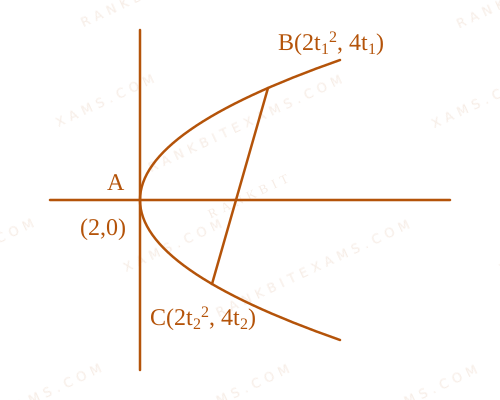
Let y^2 = 12x the parabola and S be its focus. Let PQ be a focal chord of the parabola such that (SP) (SQ) = frac1474. Let C be the circle described taking PQ as a diameter. If the equation of a circle C is 64x^2 + 64y^2 - alpha x - 64sqrt3y = beta, then \beta - \alpha is equal to

Numerical Answer Type:
Enter a numerical value Answer: 1328 to 1328 +4 marks

Solution & Explanation

### Related Formula Properties of focal chord parameter metrics in parabolas y^2 = 4ax: t_1 cdot t_2 = -1 Distance to the directrix property: SP = a(1 + t^2), quad SQ = aleft(1 + frac1t^2right) ### Core Logic Given parabola y^2 = 12x implies a = 3. Focus S = (3, 0). Set up focal segments product equation: SP cdot SQ = 3(1+t^2) cdot 3left(1+frac1t^2right) = frac1474 9 cdot frac(1+t^2)^2t^2 = frac1474 implies frac(1+t^2)^2t^2 = frac4912 Solving for t^2: 12t^4 - 25t^2 + 12 = 0 implies t^2 = frac34 quad textor quad frac43 ### Step 1: Compute Endpoint Coordinate Bounds Choosing t = -fracsqrt32 allows defining both chord coordinates symmetrically: P(3t^2, 6t) implies Pleft(frac94, -3sqrt3right) Qleft(frac3t^2, -frac6tright) implies Q(4, 4sqrt3) ### Step 2: Derive Circle Equation Write the diameter circle form equation: (x - 4)left(x - frac94right) + (y - 4sqrt3)(y + 3sqrt3) = 0 x^2 + y^2 - frac254x - sqrt3y - 27 = 0 Multiply by 64 to clear the fractions and match the given equation template structure: 64x^2 + 64y^2 - 400x - 64sqrt3y - 1728 = 0 Comparing directly with 64x^2 + 64y^2 - alpha x - 64sqrt3y = beta yields: alpha = 400, quad beta = 1728 beta - alpha = 1728 - 400 = 1328 ### Pattern Recognition The distance from focal chord endpoints to the focus equals their perpendicular distance to the directrix. This property connects parameter metrics to geometric lengths cleanly. ### Evaluation Rubric / Model Answer null ### Chapter Mix Class 11 Mathematics: Conic Sections Class 11 Mathematics: Circles

Reference Study Guides

More Conic Sections Previous-Year Questions — Page 4

Q59 jee_main_2025_29_jan_evening Chord with a Given Midpoint
If alpha x + beta y = 109 is the equation of the chord of the ellipse fracx^29 +fracy^24 = 1, whose mid point is left(frac52,frac12right), then alpha +beta is equal to
  • A. 37
  • B. 46
  • C. 58
  • D. 72

Solution

### Related Formula Equation of a chord of a conic section with a given midpoint (x_1, y_1) is: T = S_1 ### Core Logic Given midpoint Mleft(frac52, frac12 ight) and ellipse fracx^29 + fracy^24 = 1.
Chord with a Given Midpoint diagram for Q59 - JEE Main 2025 Evening
Write T and S_1 terms: T: fracxleft(frac52right)9 + fracyleft(frac12right)4 S_1: fracleft(frac52right)^29 + fracleft(frac12right)^24 Equating both sides: frac5x18 + fracy8 = frac2536 + frac116 ### Step 1: Simplify to Standard Form Multiply the entire equation by 144 to eliminate fractions: 144left(frac5x18right) + 144left(fracy8right) = 144left(frac2536right) + 144left(frac116right) 40x + 18y = 4(25) + 9(1) 40x + 18y = 109 Comparing this directly with alpha x + beta y = 109 provides: alpha = 40, quad beta = 18 alpha + beta = 40 + 18 = 58 ### Pattern Recognition Whenever you see 'chord whose midpoint is given', write T = S_1 automatically. Match coefficients directly at the final step after equating constant integers. ### Evaluation Rubric / Model Answer null ### Chapter Mix Class 11 Mathematics: Conic Sections
Q52 jee_main_2025_28_jan_morning Parabola and Trapezium Properties
Let ABCD be a trapezium whose vertices lie on the parabola y^2 = 4x. Let the sides AD and BC of the trapezium be parallel to y-axis. If the diagonal AC is of length frac254 and it passes through the point (1,0), then the area of ABCD is: (1) frac754 (2) frac252 (3) frac1258 (4) frac758
  • A. frac754
  • B. frac252
  • C. frac1258
  • D. frac758

Solution

### Related Formula Area of a trapezium is given by: textArea = frac12 times (textsum of parallel sides) times (textdistance between them) ### Core Logic Let the coordinates of the vertices be parameterized on the parabola y^2 = 4x. Since AD and BC are parallel to the y-axis, the coordinates take the form: A(at_1^2, 2at_1) and D(at_1^2, -2at_1) B(at_2^2, 2at_2) and C(at_2^2, -2at_2) Given a=1, the points simplify accordingly.
Parabola and Trapezium Properties diagram for Q52 - JEE Main 2025 Morning
### Step 1: Using Diagonal Properties The length of diagonal AC passing through focal point (1,0) implies focal chord properties: textLength AC = aleft(t_1 + frac1t_1right)^2 = frac254 t_1 + frac1t_1 = pmfrac52 implies t_1 = 2 text or frac12 ### Step 2: Finding Coordinates and Area Substituting t_1 = 2, we get: Aleft(frac12, 1right), Dleft(frac14, -1right), B(4, 4), C(4, -4) Evaluating the area formula: textArea = frac12 times (8 + 2) times left(4 - frac14 ight) = frac754 ### Pattern Recognition Focal chords of parabolas always satisfy t_1 t_2 = -1. Recognizing the passage through (1,0) unlocks quick parametric simplifications. ### Evaluation Rubric / Model Answer null ### Chapter Mix Class 11 Maths: Conic Sections
Q75 jee_main_2025_28_jan_morning Infinite Series of Ellipses
Let E_1: fracx^29 + fracy^24 = 1 be an ellipse. Ellipses E_i 's are constructed such that their centres and eccentricities are same as that of E_1 , and the length of minor axis of E_i is the length of major axis of E_i+1 ( i ge 1 ). If A_i is the area of the ellipse E_i , then frac5pi left( sum_i=1^infty A_i right) , is equal to ....
Numerical Answer. Answer: 54 to 54

Solution

### Related Formula Area of an ellipse with semi-axes a and b: textArea = pi a b ### Core Logic Calculate the constant eccentricity e from the initial ellipse E_1:
Infinite Series of Ellipses diagram for Q75 - JEE Main 2025 Morning
e = sqrt1 - frac49 = fracsqrt53 For any subsequent ellipse E_2, its major axis equals the minor axis of E_1 (2b_1 = 4 implies a_2 = 2). Since eccentricity remains constant: frac59 = 1 - fracb_2^2a_2^2 = 1 - fracb_2^24 implies b_2^2 = frac169 implies b_2 = frac43 ### Step 1: Finding the Area Sequence Terms Evaluate the area values for the initial ellipses: A_1 = pi cdot 3 cdot 2 = 6pi A_2 = pi cdot 2 cdot frac43 = frac8pi3 The areas form an infinite geometric progression with a common ratio r = frac49. ### Step 2: Summing the Infinite Geometric Series sum_i=1^infty A_i = frac6pi1 - frac49 = frac6pifrac59 = frac54pi5 Evaluating the final scaling formula: frac5pi left( frac54pi5 right) = 54 ### Pattern Recognition Iterative dimensional scaling creates geometric progressions where the ratio equals the square of the linear scaling factor. ### Evaluation Rubric / Model Answer null ### Chapter Mix Class 11 Maths: Conic Sections
Q56 jee_main_2025_03_april_morning Ellipse and Line Properties
A line passing through the point P(sqrt5, sqrt5) intersects the ellipse fracx^236 + fracy^225 = 1 at A and B [cite: 567] such that (PA) cdot (PB) is maximum. Then 5(PA^2 + PB^2) is equal to[cite: 570]:
  • A. 218
  • B. 377
  • C. 290
  • D. 338

Solution

### Related Formula Parametric line equation relative to an offset point P(x_0, y_0): x = x_0 + rcostheta, quad y = y_0 + rsintheta
Ellipse and Line Properties diagram for Q56 - JEE Main 2025 Morning
### Core Logic Assume any line through P can be represented parametrically by [cite: 1277]: Q(sqrt5 + rcostheta, sqrt5 + rsintheta) [cite: 1277] Substitute coordinates into the standard ellipse formula [cite: 1278]: 25(sqrt5 + rcostheta)^2 + 36(sqrt5 + rsintheta)^2 = 900 [cite: 1278] Expanding and gathering powers of r yields [cite: 1280]: r^2(25cos^2theta + 36sin^2theta) + 2sqrt5r(25costheta + 36sintheta) - 595 = 0 [cite: 1280] The product of roots corresponds to the distance product value[cite: 1281, 1283]: PA cdot PB = |r_1 r_2| = frac59525cos^2theta + 36sin^2theta = frac59525 + 11sin^2theta [cite: 1283] ### Step 1: Maximization condition To make PA cdot PB maximum, the denominator must be minimized [cite: 1284]: sin^2theta = 0 implies theta = 0 [cite: 1284] This implies the chord line AB must run parallel to the x-axis [cite: 1285]: y_A = y_B = sqrt5 [cite: 1285] Substitute y = sqrt5 back into the ellipse equation to calculate x-coordinates [cite: 1286]: fracx^236 + frac525 = 1 implies fracx^236 = frac45 implies x^2 = frac1445 [cite: 1287] Therefore, the coordinates are x = pm frac12sqrt5. ### Step 2: Distance value summation Compute PA^2 + PB^2 using coordinates directly [cite: 1289]: PA^2 + PB^2 = left(sqrt5 - frac12sqrt5right)^2 + left(sqrt5 + frac12sqrt5right)^2 [cite: 1289] = 2left(5 + frac1445right) = frac3385 [cite: 1290] Multiplying by 5 gives the target integer answer [cite: 1290]: 5(PA^2 + PB^2) = 338 [cite: 1290] ### Pattern Recognition Parametric distances from a point intersecting a conic configuration usually form a standard quadratic equation in r. The angle parameter immediately simplifies the boundary constraint optimization. ### Evaluation Rubric / Model Answer null ### Chapter Mix Class 11 Mathematics: Conic Sections (Ellipse)

More Conic Sections Questions — jee_main_2025_29_jan_evening

Practice all Conic Sections previous-year questions →

Rankbit System
JEE Physics: Waves (+15.5%) | Electrostatics: Concentric Shells (-29.7%) | Modern Physics: Photoelectric Clones (+34.2%) | Mathematics: Definite Integrals (+18.1%) | Chemistry: Coordination Splitting (-11.4%) | JEE Physics: Waves (+15.5%) | Electrostatics: Concentric Shells (-29.7%) | Modern Physics: Photoelectric Clones (+34.2%) | Mathematics: Definite Integrals (+18.1%) | Chemistry: Coordination Splitting (-11.4%)