JEE Main · Mathematics ↓ Falling

Conic Sections appeared 76 times across 3 years — 8.8% of Mathematics. This question is from Chord with a Given Midpoint.

Year 2026 2025 2024 Total
Questions 22 38 16 76

If α x + β y = 109 is the equation of the chord of the ellipse (x²)/(9) +(y²)/(4) = 1, whose mid point is ((5)/(2),(1)/(2)), then α +β is equal to

Solution & Explanation

Related Formula

Equation of a chord of a conic section with a given midpoint (x₁, y₁) is:

T = S₁

Core Logic

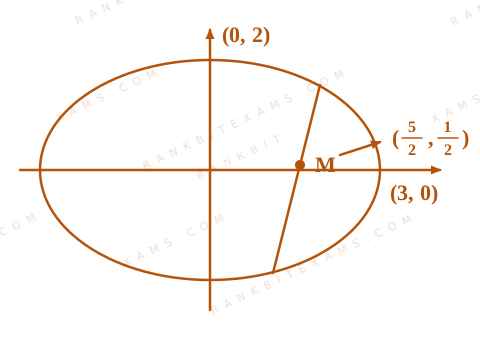
Given midpoint M((5)/(2), (1)/(2)) and ellipse (x²)/(9) + (y²)/(4) = 1.

Chord with a Given Midpoint diagram for Q59 - JEE Main 2025 Evening

Write T and S₁ terms:

T: (x((5)/(2)))/(9) + (y((1)/(2)))/(4) S₁: (((5)/(2))²)/(9) + (((1)/(2))²)/(4)

Equating both sides:

(5x)/(18) + (y)/(8) = (25)/(36) + (1)/(16)
Step 1: Simplify to Standard Form

Multiply the entire equation by 144 to eliminate fractions:

144((5x)/(18)) + 144((y)/(8)) = 144((25)/(36)) + 144((1)/(16)) 40x + 18y = 4(25) + 9(1)

40x + 18y = 109

Comparing this directly with α x + β y = 109 provides:

α = 40, β = 18 α + β = 40 + 18 = 58
Pattern Recognition

Whenever you see 'chord whose midpoint is given', write T = S₁ automatically. Match coefficients directly at the final step after equating constant integers.

Chapter Mix

Class 11 Mathematics: Conic Sections
Reference Study Guides

More Conic Sections Previous-Year Questions — Page 5

Q9 jee_main_2026_28_january_evening Ellipse Parameters and Latus Rectum
An ellipse has its center at (1,-2), one focus at (3,-2) and one vertex at (5, - 2). Then the length of its latus rectum is :
  • A. 16√(3)
  • B. 6
  • C. 4√(3)
  • D. 6√(3)

Solution

Related Formula
Latus Rectum (LR) = (2b²)/(a) = 2a(1-e²)
Core Logic

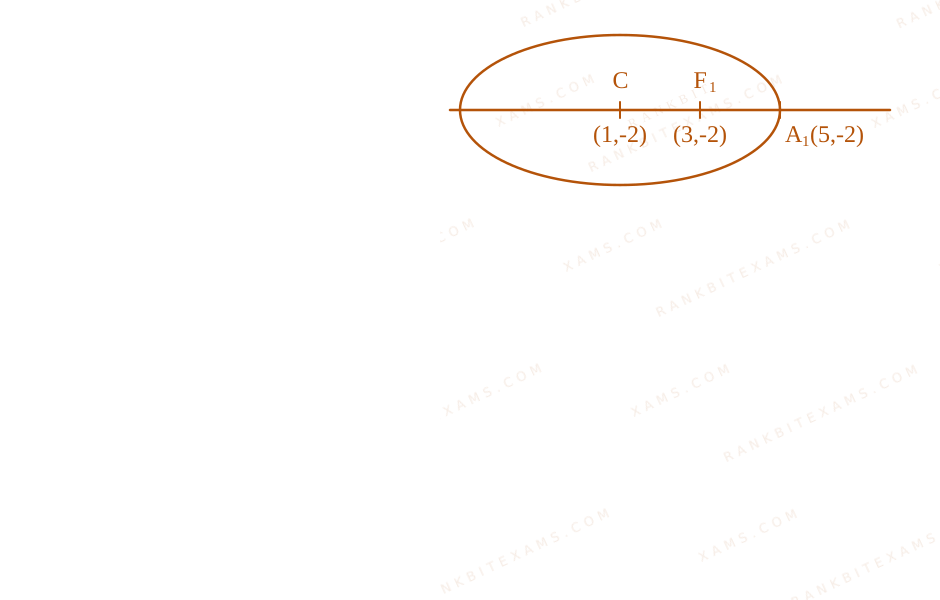
From the given coordinates on the major axis (y = -2): Center C(1, -2), Focus F₁(3, -2), Vertex A₁(5, -2). Distance from center to vertex, CA₁ = a = 5 - 1 = 4. Distance from center to focus, CF₁ = ae = 3 - 1 = 2.

Ellipse dimensions mapped to coordinates

Execution

Calculate eccentricity e:

ae = 2 ⇒ 4e = 2 ⇒ e = (1)/(2)

Use alternate formula for Latus Rectum:

LR = 2e((a)/(e) - ae) or directly 2a(1-e²) LR = 2(4)(1 - (1)/(4)) = 8 × (3)/(4) = 6
Pattern Recognition

Aligning focus, center, and vertex along a constant y-axis implies a standard shifted ellipse where absolute differences in x-coordinates yield standard parameters (a and ae) directly.

Chapter Mix

Class 11 Maths: Conic Sections

Q10 jee_main_2026_28_january_evening Confocal Ellipse and Hyperbola
Let the ellipse E: x²144 + y²169 = 1 and the hyperbola H: x²16 - y²λ² = -1 have the same foci. If e and L respectively denote the eccentricity and the length of the latus rectum of H, then the value of 24(e + L) is:
  • A. 296
  • B. 126
  • C. 148
  • D. 67

Solution

Related Formula
e = √(1 - (a²)/(b²)) (for vertical ellipse) e = √(1 + (a²)/(b²)) (for conjugate hyperbola)
Core Logic

For Ellipse E: (x²)/(144) + (y²)/(169) = 1 a² = 144, b² = 169. Since b > a, the major axis is along the y-axis. Eccentricity e' = √(1 - (144)/(169)) = √((25)/(169)) = (5)/(13). Foci of ellipse = (0, ± be') = (0, ± 13 × (5)/(13)) = (0, ± 5).

Execution

For Hyperbola H: (y²)/(λ²) - (x²)/(16) = 1 Foci of conjugate hyperbola are (0, ± λ e). Equating foci: λ e = 5.

e = √(1 + (16)/(λ²)) λ √(1 + (16)/(λ²)) = 5 ⇒ λ² + 16 = 25 ⇒ λ² = 9 ⇒ λ = 3

Eccentricity of hyperbola, e = (5)/(3). Length of latus rectum of hyperbola, L = (2(16))/(λ) = (32)/(3).

Calculate 24(e + L):

24(e + L) = 24[(5)/(3) + (32)/(3)] = 24((37)/(3)) = 8 × 37 = 296
Pattern Recognition

Confocal conics usually align along the same major axis. Notice the -1 on the RHS of the hyperbola equation indicates a conjugate hyperbola orienting it vertically to match the b>a ellipse.

Chapter Mix

Class 11 Maths: Conic Sections

Q55 jee_main_2025_02_april_evening Ellipse
If the length of the minor axis of an ellipse is equal to one fourth of the distance between the foci, then the eccentricity of the ellipse is :
  • A. 4√(17)
  • B. √(3)16
  • C. 3√(19)
  • D. √(5)7

Solution

Related Formula
Length of minor axis = 2b Distance between foci = 2ae Eccentricity: e = √(1 - (b²)/(a²))
Core Logic

We set up an algebraic equation relating b, a, and e from the given geometric condition, then substitute it into the eccentricity identity.

Step 1: Set up the geometric relation

Given that 2b = (1)/(4) (2ae):

b = (ae)/(4) (b)/(a) = (e)/(4)

Square both sides:

(b²)/(a²) = (e²)/(16)
Step 2: Solve for eccentricity

Using the eccentricity relation:

e² = 1 - (b²)/(a²) e² = 1 - (e²)/(16) e² (1 + (1)/(16)) = 1 (17)/(16) e² = 1 e² = (16)/(17) e = 4√(17)
Pattern Recognition

Standard Ellipse relations: For standard ellipses, the ratio of axes and the eccentricity are coupled quadratic equations. Expressing b/a as a function of e allows direct solving of the eccentricity.

Chapter Mix

Class 11 Mathematics: Conic Sections
Q67 jee_main_2025_02_april_evening Parabola
Let the point P of the focal chord PQ of the parabola y² = 16x be (1, -4). If the focus of the parabola divides the chord PQ in the ratio m : n, (m, n) = 1, then m² + n² is equal to:
  • A. 17
  • B. 10
  • C. 37
  • D. 26

Solution

Related Formula
Parametric coordinates on y² = 4ax: (at², 2at) Focal Chord relation: t₁ t₂ = -1 Section Formula: (xc, yc) = ( (m x₂ + n x₁)/(m+n), (m y₂ + n y₁)/(m+n) )
Core Logic

We find the parametric parameters of coordinates P and Q, obtain their Cartesian values, and then apply the section formula with the focus S to calculate the splitting ratio.

Step 1: Find coordinates of P and Q

For parabola y² = 16x, the focal parameter is a = 4. Focus is S(4, 0). Let P be (a t₁², 2a t₁) = (1, -4):

2a t₁ = -4 2(4) t₁ = -4 t₁ = -(1)/(2)

Since PQ is a focal chord, the parametric points are coupled:

t₁ t₂ = -1 t₂ = 2

Now, calculate the coordinates of Q:

Q ≡ (a t₂², 2 a t₂) = (4(4), 2(4)(2)) = (16, 16)
Step 2: Solve for the dividing ratio

Let the focus S(4, 0) divide the line segment PQ internally in the ratio λ : 1. Using the y-coordinate of the section formula:

yₛ = (λ yq + 1 yₚ)/(λ + 1) 0 = (λ(16) + 1(-4))/(λ + 1) 16λ - 4 = 0 λ = (1)/(4)

Thus, the focus S divides the chord internally in the ratio 1:4. Since (1, 4) = 1, we have m = 1 and n = 4:

m² + n² = 1² + 4² = 1 + 16 = 17
Pattern Recognition

Harmonic Mean Shortcut: In any parabola, the focus divides a focal chord internally into segments of lengths SP and SQ such that the semi-latus rectum 2a is the harmonic mean of these segments: (1)/(SP) + (1)/(SQ) = (1)/(a).

Chapter Mix

Class 11 Mathematics: Conic Sections

Q jee_main_2025_02_april_morning Properties of Hyperbola
Let one focus of the hyperbola H: (x²)/(a²) - (y²)/(b²) = 1 be at (√(10), 0) and the corresponding directrix be x = 9√(10). If e and l respectively are the eccentricity and the length of the latus rectum of H, then 9(e² + l) is equal to:
  • A. 14
  • B. 15
  • C. 16
  • D. 12

Solution

Related Formula

For a standard hyperbola: Focus: (± ae, 0) Directrix: x = ± (a)/(e) Eccentricity relation: (ae)² = a² + b² Length of latus rectum: l = (2b²)/(a)

Core Logic

Given ae = √(10) and (a)/(e) = 9√(10). Multiplying these gives a², which determines both parameters.

Step 1: Find a and e
a² = (ae) · ((a)/(e)) = √(10) · 9√(10) = 9 a = 3

Substitute a = 3 into ae = √(10):

e = √(10)3 e² = (10)/(9)
Step 2: Find b and l

Using (ae)² = a² + b²:

10 = 9 + b² b² = 1

Then the length of latus rectum l is:

l = (2b²)/(a) = (2(1))/(3) = (2)/(3)
Step 3: Evaluate Final Expression

Calculate 9(e² + l):

9((10)/(9) + (2)/(3)) = 10 + 6 = 16
Pattern Recognition

Multiplying focus location by directrix location immediately eliminates e, giving a² directly. Once a² is known, b² follow seamlessly via (ae)² = a²+b².

Chapter Mix

Class 11 Mathematics: Conic Sections

More Conic Sections Questions — jee_main_2025_29_jan_evening

Practice all Conic Sections previous-year questions →

Rankbit System
JEE Physics: Waves (+15.5%) | Electrostatics: Concentric Shells (-29.7%) | Modern Physics: Photoelectric Clones (+34.2%) | Mathematics: Definite Integrals (+18.1%) | Chemistry: Coordination Splitting (-11.4%) | JEE Physics: Waves (+15.5%) | Electrostatics: Concentric Shells (-29.7%) | Modern Physics: Photoelectric Clones (+34.2%) | Mathematics: Definite Integrals (+18.1%) | Chemistry: Coordination Splitting (-11.4%)