JEE Main · Chemistry ↑ Rising

Structure of Atom appeared 38 times across 3 years — 4.4% of Chemistry. This question is from Bohr Model for Hydrogen-like Species.

Year 2026 2025 2024 Total
Questions 14 15 9 38

For hydrogen like species, which of the following graphs provides the most appropriate representation of E vs Z plot for a constant n? [E: Energy of the stationary state, Z: atomic number, n: principal quantum number]

Solution & Explanation

Related Formula
Eₙ = -13.6 (Z²)/(n²) eV
Core Logic

For a constant principal quantum number n, the energy E is directly proportional to -Z². This represents a quadratic relation where the curve is a downward-opening parabola starting from the origin in the negative energy region.

Pattern Recognition

Since energy values are inherently negative for bound states, as Z increases, E becomes rapidly more negative following a parabolic curve.

Chapter Mix

Class 11 Chemistry: Structure of Atom

Reference Study Guides

More Structure of Atom Previous-Year Questions — Page 4

Q30 jee_main_2025_02_april_morning Bohr Model Orbit Radii
According to Bohr's model of hydrogen atom, which of the following statement is incorrect?
  • A. (1) Radius of 3rd orbit is nine times larger than that of 1st orbit.
  • B. (2) Radius of 8th orbit is four times larger than that of 4th orbit.
  • C. (3) Radius of 6th orbit is three time larger than that of 4th orbit.
  • D. (4) Radius of 4th orbit is four times larger than that of 2nd orbit.

Solution

Related Formula

Bohr orbit radius expression varies with principle quantum number:

rₙ ∝ n²

Core Logic

Let's check the proportional scaling across all choice items:

  • Statement 1: (r₃)/(r₁) = (3²)/(1²) = 9 (Correct).
  • Statement 2: (r₈)/(r₄) = (8²)/(4²) = (64)/(16) = 4 (Correct).
  • Statement 3: (r₆)/(r₄) = ((6)/(4))² = (36)/(16) = (9)/(4) = 2.25 ≠ 3 (Incorrect statement).
  • Statement 4: (r₄)/(r₂) = ((4)/(2))² = 2² = 4 (Correct).
Step 1: Identification

Therefore, choice (3) is mathematically incorrect.

Pattern Recognition

Remember to square the shell indexes immediately! Don't look at the linear ratio (6/4 = 1.5), always apply the quadratic scaling factor n² directly.

Chapter Mix

Class 11 Chemistry: Structure of Atom Class 12 Physics: Atoms
Q30 jee_main_2025_03_april_evening Quantum Numbers and Orbital Angular Momentum
For electron in '2s' and '2p' orbitals, the orbital angular momentum values, respectively are :
  • A. √(2)(h)/(2π) and 0
  • B. (h)/(2π) and √(2)(h)/(2π)
  • C. 0 and √(6)(h)/(2π)
  • D. 0 and √(2)(h)/(2π)

Solution

Related Formula

Orbital angular momentum (L) of an electron is determined exclusively by its azimuthal quantum number l:

L = √(l(l+1)) (h)/(2π)

where values of l are:

  • For s-orbitals: l=0
  • For p-orbitals: l=1
  • For d-orbitals: l=2
Core Logic

Evaluate for both specified orbitals:

  • For '2s' orbital (l=0):
L = √(0(0+1)) (h)/(2π) = 0
  • For '2p' orbital (l=1):
L = √(1(1+1)) (h)/(2π) = √(2) (h)/(2π)
Step 1: Match the values

The orbital angular momentum values are 0 and √(2)(h)/(2π) respectively, corresponding to Option (4).

Pattern Recognition

Always note that orbital angular momentum does not depend on the principal quantum number n (the '2' in 2s and 2p is irrelevant). An electron in a 1s, 2s, or 3s orbital always has L=0.

Chapter Mix

Class 11 Chemistry: Structure of Atom

Q jee_main_2025_07_april_morning Photoelectric Effect
Which of the following statements are correct, if the threshold frequency of caesium is 5.16 × 10¹⁴ ~Hz ?
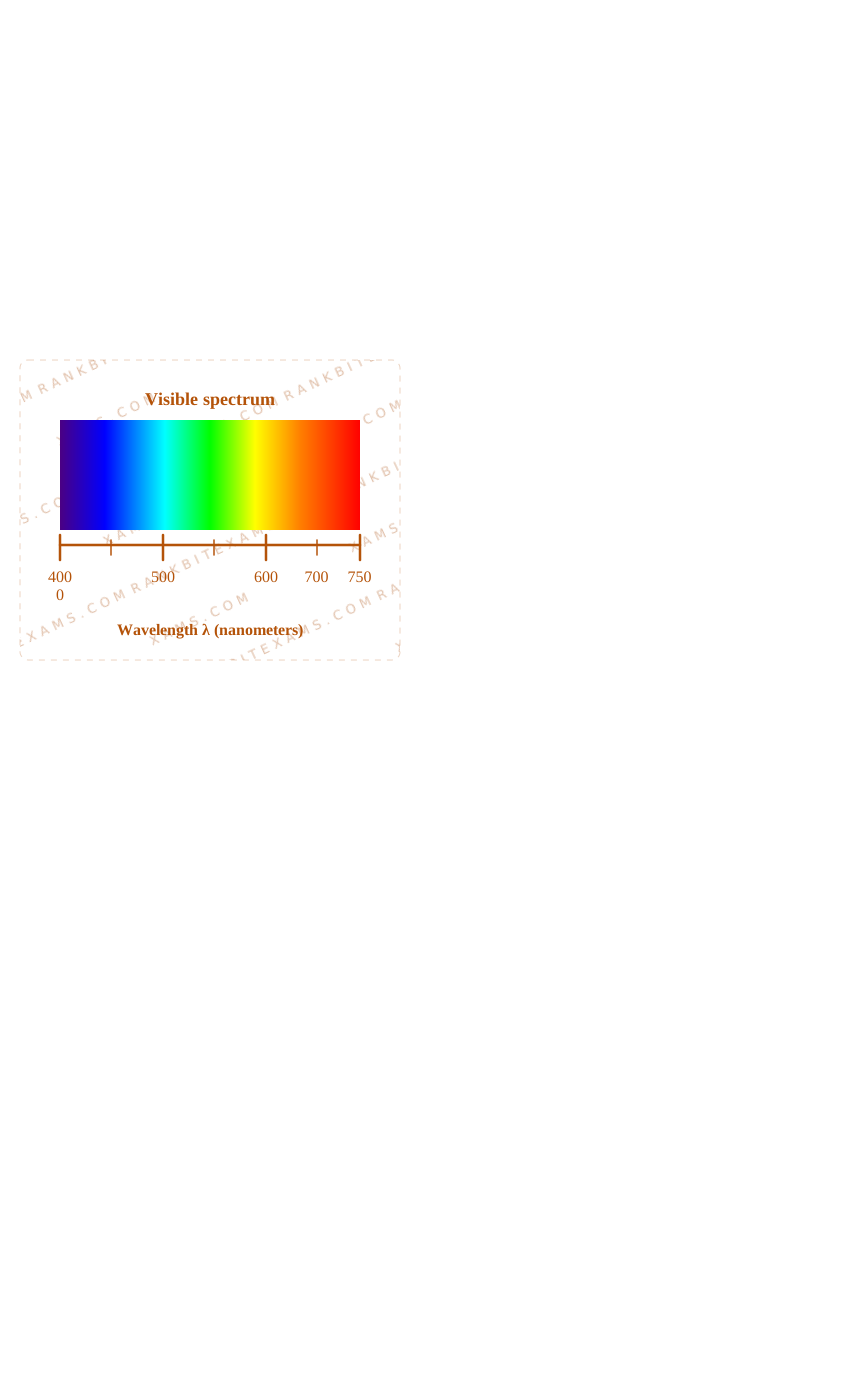
Visible spectrum wavelength diagram for Q32 - JEE Main 2025
The visible spectrum wavelength scale shows the relationship between red, yellow, and blue light frequency thresholds.
A. When Cs is placed inside a vacuum chamber with an ammeter connected to it and yellow light is focused on Cs the ammeter shows the presence of current. B. When the brightness of the yellow light is dimmed, the value of the current in the ammeter is reduced. C. When a red light is used instead of the yellow light, the current produced is higher with respect to the yellow light. D. When a blue light is used, the ammeter shows the formation of current. E. When a white light is used, the ammeter shows formation of current. Choose the correct answer from the options given below:
  • A. A, D and E Only
  • B. B, C and D Only
  • C. A, C, D and E Only
  • D. A, B, D and E Only

Solution

Related Formula
λ = (c)/(ν)

where, c = 3.0 × 10⁸ m s⁻¹ ν₀ = 5.16 × 10¹⁴ Hz

Core Logic

Let's first calculate the threshold wavelength (λ₀) for Caesium:

λ₀ = 3.0 × 10⁸5.16 × 10¹⁴ ≈ 5.81 × 10⁻⁷ m = 581.4 nm

Comparing this with the visible spectrum:

  • Yellow light (580 nm) corresponds closely to the threshold wavelength. Hence, photoelectric emission occurs (Statement A is correct).
  • The photocurrent is directly proportional to the light intensity (brightness). Reducing brightness decreases the current (Statement B is correct).
  • Red light (620--750 nm) has a lower frequency than the threshold frequency, meaning no current is produced (Statement C is incorrect).
  • Blue light (450--490 nm) has a higher frequency than the threshold. Thus, current is produced (Statement D is correct).
  • White light contains all wavelengths (including blue, violet, etc.), which will produce a photoelectric current (Statement E is correct).
  • Therefore, statements A, B, D, and E are correct.

Pattern Recognition

The wavelength threshold is 581 nm (yellow-green region). Any light with shorter wavelength (higher frequency), like blue or white, will cause emission. Dimming simply decreases photon flux and hence current.

Chapter Mix

Class 11 Chemistry: Structure of Atom Class 12 Physics: Dual Nature of Radiation and Matter

Q40 jee_main_2025_08_april_evening Quantum Numbers and Electronic Configuration
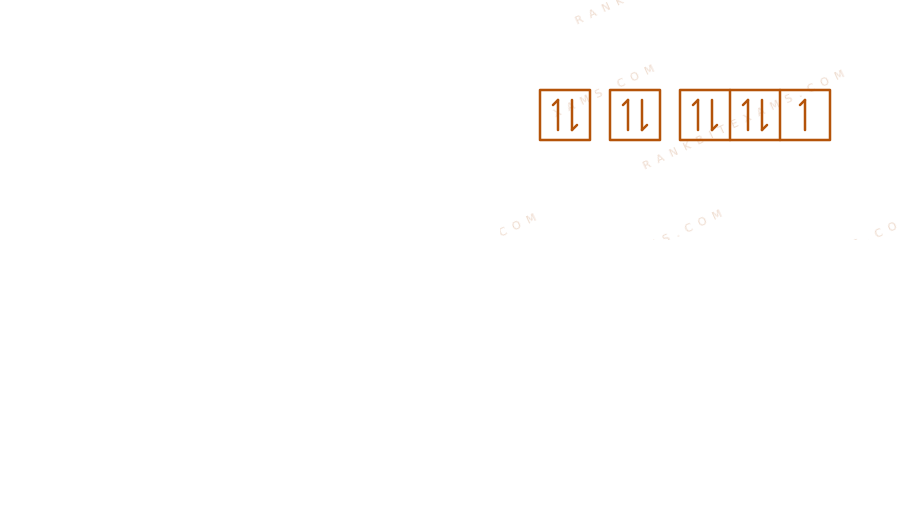
Identify the correct statements for an element possessing atomic number 9: A. There can be 5 electrons for which mₛ = +(1)/(2) and 4 electrons for which mₛ = -(1)/(2). B. There is only one electron in the pz orbital. C. The last electron goes into an orbital described by quantum parameters n = 2 and l = 1. D. The sum of angular nodes of all populated atomic orbitals is 1. Choose the correct answer from the options given below:
  • A. C and D Only
  • B. A and C Only
  • C. A, C and D Only
  • D. A and B Only

Solution

Core Logic

The element with atomic number 9 is Fluorine (F). Let's write out its ground state electronic configuration:

F (Z=9) = 1s² 2s² 2p⁵

Let's systematically audit each statement:

  • Statement A: Within the total population of 9 electrons, the pairing distribution across shells shows: 1s² (one up, one down), 2s² (one up, one down), 2p⁵ (three up, two down). Summing up-spins (mₛ = +(1)/(2)) yields 1 + 1 + 3 = 5 electrons. Down-spins (mₛ = -(1)/(2)) yield 1 + 1 + 2 = 4 electrons. Statement A is fully correct.
    Orbital spin configuration box diagram for Fluorine atom
    Orbital spin configuration box diagram for Fluorine atom
  • Statement B: By Hund's Rule, the 5 electrons in the 2p subshell occupy the degenerate pₓ, py, pz states. This produces two fully-filled sub-orbitals and one half-filled sub-orbital. The unpaired slot can reside arbitrarily in any of the three orbitals (pₓ, py, or pz) due to spatial symmetry. It is not constrained to pz. Statement B is incorrect.
  • Statement C: The highest energy valence electron enters the 2p subshell, which is defined by principal number n = 2 and azimuthal index l = 1. Statement C is fully correct.
  • Statement D: Angular nodes are given directly by the quantum number l. For s-orbitals (1s, 2s), angular nodes = 0. For each of the three populated p-orbitals (2p), angular nodes = 1. The sum total of angular nodes across all orbitals is 0 + 0 + 3 = 3. Statement D is incorrect.
Pattern Recognition

Total angular nodes equals the total number of p-electrons' spatial orientation count, not simply the subshell boundary value. Recognizing that degenerate p-orbitals share uniform probability status exposes the restriction in Statement B instantly.

Chapter Mix

Class 11 Chemistry: Structure of Atom

Q47 jee_main_2025_08_april_evening Bohr's Model
The energy of an electron in the first Bohr orbit of the Hydrogen atom is -13.6 eV. The magnitude of the energy value of an electron in the first excited state of the Be³⁺ ion is _________ eV (as the nearest integer value).
Numerical Answer. Answer: 54 to 54

Solution

Related Formula

Bohr energy level formula for hydrogenic species:

Eₙ = -13.6 × (Z²)/(n²) eV

where: Z = atomic number of the species n = principal quantum number of the orbit

Execution

Step 1: Identify the parameters for the first excited state of Be³⁺:

  • For Beryllium (Be), the atomic number is Z = 4.
  • The term 'first excited state' refers to the second energy level, so n = 2.
  • Step 2: Substitute these values into the Bohr energy equation:

EBe³⁺ = -13.6 × (4²)/(2²) = -13.6 × (16)/(4) EBe³⁺ = -13.6 × 4 = -54.4 eV

Step 3: Extract the magnitude and round to the nearest integer value:

|EBe³⁺| = 54.4 ≈ 54
Pattern Recognition

For the first excited state of Beryllium (Z=4, n=2), the term (Z²)/(n²) = (4²)/(2²) = (16)/(4) = 4. Thus, the energy value is exactly 4 times that of the ground-state hydrogen atom (13.6 × 4 = 54.4).

Chapter Mix

Class 11 Chemistry: Structure of Atom

More Structure of Atom Questions — jee_main_2025_29_jan_evening

Practice all Structure of Atom previous-year questions →

Rankbit System
JEE Physics: Waves (+15.5%) | Electrostatics: Concentric Shells (-29.7%) | Modern Physics: Photoelectric Clones (+34.2%) | Mathematics: Definite Integrals (+18.1%) | Chemistry: Coordination Splitting (-11.4%) | JEE Physics: Waves (+15.5%) | Electrostatics: Concentric Shells (-29.7%) | Modern Physics: Photoelectric Clones (+34.2%) | Mathematics: Definite Integrals (+18.1%) | Chemistry: Coordination Splitting (-11.4%)