JEE Main · Chemistry ↑ Rising

Structure of Atom appeared 38 times across 3 years — 4.4% of Chemistry. This question is from Bohr Model for Hydrogen-like Species.

Year 2026 2025 2024 Total
Questions 14 15 9 38

For hydrogen like species, which of the following graphs provides the most appropriate representation of E vs Z plot for a constant n? [E: Energy of the stationary state, Z: atomic number, n: principal quantum number]

Solution & Explanation

Related Formula
Eₙ = -13.6 (Z²)/(n²) eV
Core Logic

For a constant principal quantum number n, the energy E is directly proportional to -Z². This represents a quadratic relation where the curve is a downward-opening parabola starting from the origin in the negative energy region.

Pattern Recognition

Since energy values are inherently negative for bound states, as Z increases, E becomes rapidly more negative following a parabolic curve.

Chapter Mix

Class 11 Chemistry: Structure of Atom

Reference Study Guides

More Structure of Atom Previous-Year Questions — Page 3

Q66 jee_main_2026_28_january_morning Hydrogen Emission Spectrum
The wave numbers of three spectral lines of H atom are considered. Identify the set of spectral lines belonging to Balmer series. (R = Rydberg constant)
  • A. 5R36, 3R16, 21R100
  • B. 5R36, 8R9, 15R16
  • C. 7R144, 3R16, 16R255
  • D. 3R4, 3R16, 7R144

Solution

Related Formula
ν = RH Z² [(1)/(n₁²) - (1)/(n₂²)]
Core Logic

For the Balmer series in a Hydrogen atom (Z=1), the lower energy level is always n₁ = 2. The higher energy levels are n₂ = 3, 4, 5,

Step 1: Calculate First 3 Lines of Balmer Series

If n₂ = 3 (First line):\nν = R(1)² [(1)/(2²) - (1)/(3²)] = R [(1)/(4) - (1)/(9)] = (5R)/(36)\n\nIf n₂ = 4 (Second line):\nν = R [(1)/(4) - (1)/(16)] = R [(3)/(16)] = (3R)/(16)\n\nIf n₂ = 5 (Third line):\nν = R [(1)/(4) - (1)/(25)] = R [(21)/(100)] = (21R)/(100)

Final Conclusion

The set (5R)/(36), (3R)/(16), (21R)/(100) correctly matches the first three spectral lines of the Balmer series.

Pattern Recognition

Rydberg fractions for Balmer start exclusively with denominators involving common multiples of 4 and squares: 4 × 9 = 36, 4 × 16 = 64 arrow 16, 4 × 25 = 100.

Chapter Mix

Class 11 Chemistry: Structure of Atom
Q67 jee_main_2026_28_january_morning Radial Nodes in Quantum Mechanics
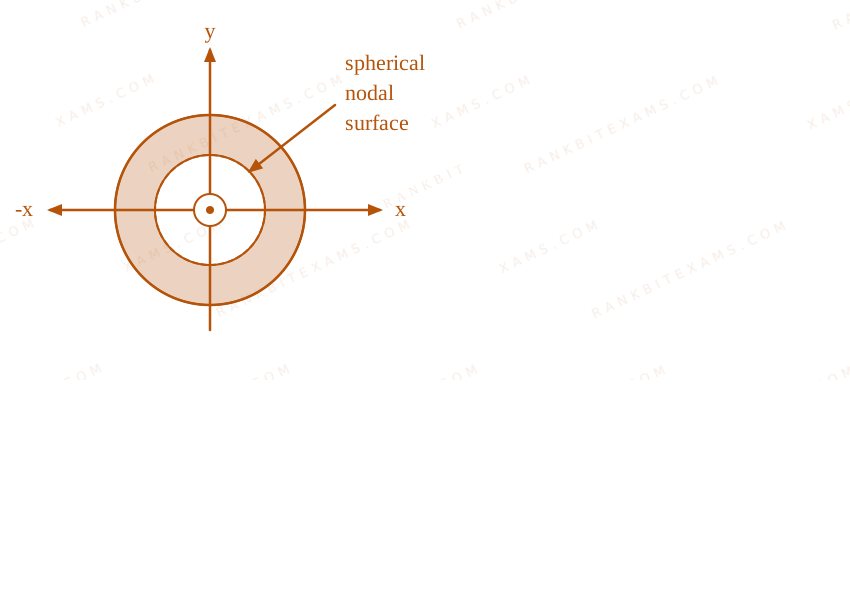
Electron probability density and wave function for 2s orbital
Displays a radial probability slice and a psi versus distance graph.
Figure 1. electron probability density for 2s orbital
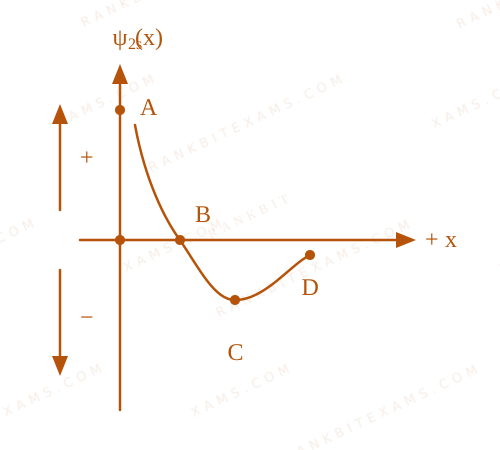
Electron probability density and wave function for 2s orbital
Displays a radial probability slice and a psi versus distance graph.
Figure 2. wave function for 2s orbital Which of the following point in Figure 2 most accurately represents the nodal surface as shown in Figure 1?
  • A. B
  • B. D
  • C. C
  • D. A

Solution

Core Logic

A nodal surface (or spherical node) in an atom is a region where the probability of finding an electron is zero. Mathematically, this corresponds to the radial wave function ψ crossing the axis (i.e., ψ₂ₛ(x) = 0).

Step 1: Graph Analysis

Looking at Figure 2, the wave function ψ₂ₛ(x) intersects the horizontal x-axis exactly at point B. At this point, ψ = 0, indicating zero electron density.

Final Conclusion

Point B represents the spherical nodal surface shown in Figure 1.

Pattern Recognition

Nodes on any wave function graph always occur exactly where the plotted line intercepts the zero axis.

Chapter Mix

Class 11 Chemistry: Structure of Atom
Q59 jee_main_2026_28_january_evening Energy Of Photon And Electromagnetic Spectrum
The wavelength of photon 'A' is 400 nm. The frequency of photon 'B' is 10¹⁶ s⁻¹. The wave number of photon 'C' is 10⁴ cm⁻¹. The correct order of energy of these photons is :
  • A. (1) C > B > A
  • B. (2) B > A > C
  • C. (3) A > B > C
  • D. (4) A > C > B

Solution

Related Formula
E = hν = (hc)/(λ) = hc ν
Core Logic

Let's convert all parameters to wavelength (λ) in nanometers for easy comparison. (1) Wavelength of A = 400 nm.

(2) Wavelength of B (λB):

λB = (c)/(νB) = 3 × 10⁸ m/s10¹⁶ s⁻¹ = 3 × 10⁻⁸ m = 30 × 10⁻⁹ m = 30 nm

(3) Wavelength of C (λC):

λC = 1 νC = 110⁴ cm⁻¹ = 10⁻⁴ cm = 10⁻⁶ m = 1000 nm
Step 1: Compare Wavelengths and Energies

Comparing wavelengths: λC (1000 nm) > λA (400 nm) > λB (30 nm) Since Energy (E) is inversely proportional to wavelength (E ∝ (1)/(λ)): EB > EA > EC

Energy Of Photon And Electromagnetic Spectrum diagram for Q59 - JEE Main 2026 Evening

Pattern Recognition

Convert distinct units (frequency, wavenumber, wavelength) into a single metric (usually wavelength) to rank. Remember E ∝ 1/λ.

Chapter Mix

Class 11 Chemistry: Structure of Atom
Q71 jee_main_2026_28_january_evening De Broglie Wavelength
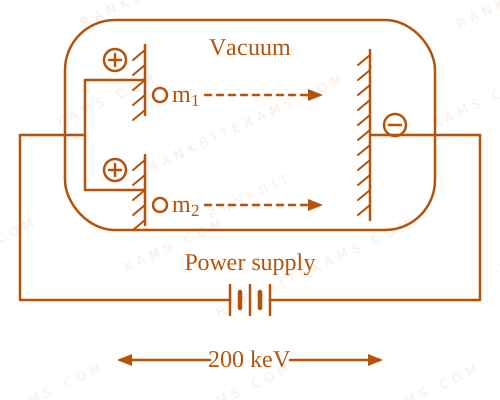
Two positively charged particles m₁ and m₂ have been accelerated across the same potential difference of 200 keV as shown below.
De Broglie Wavelength diagram for Q71 - JEE Main 2026 Evening
Two particles m1 and m2 are shown being accelerated in a vacuum over a 200 keV potential.
[Given mass of m₁=1 amu and m₂=4 amu] The deBroglie wavelength of m₁ will be x times of m₂. The value of x is ____. (nearest integer)
Numerical Answer. Answer: 2 to 2

Solution

Related Formula
λ = h√(2m(K.E.))

where K.E. is the kinetic energy acquired, which equals qV.

Core Logic

Since both particles have the same charge and are accelerated through the same potential difference (200 keV), they will acquire the exact same kinetic energy. So, λ ∝ 1√(m)

Ratio of their de Broglie wavelengths:

(λd)m₁(λd)m₂ = √((m₂)/(m₁)) = √((4)/(1)) = 2

Therefore, (λd)m₁ = 2 (λd)m₂

Step 1: Final Conclusion

The value of x is 2.

Pattern Recognition

For same K.E., λ depends purely on the inverse square root of mass.

Chapter Mix

Class 11 Chemistry: Structure of Atom Class 12 Physics: Dual Nature of Radiation and Matter
Q jee_main_2025_02_april_evening Quantum Numbers and Atomic Orbitals
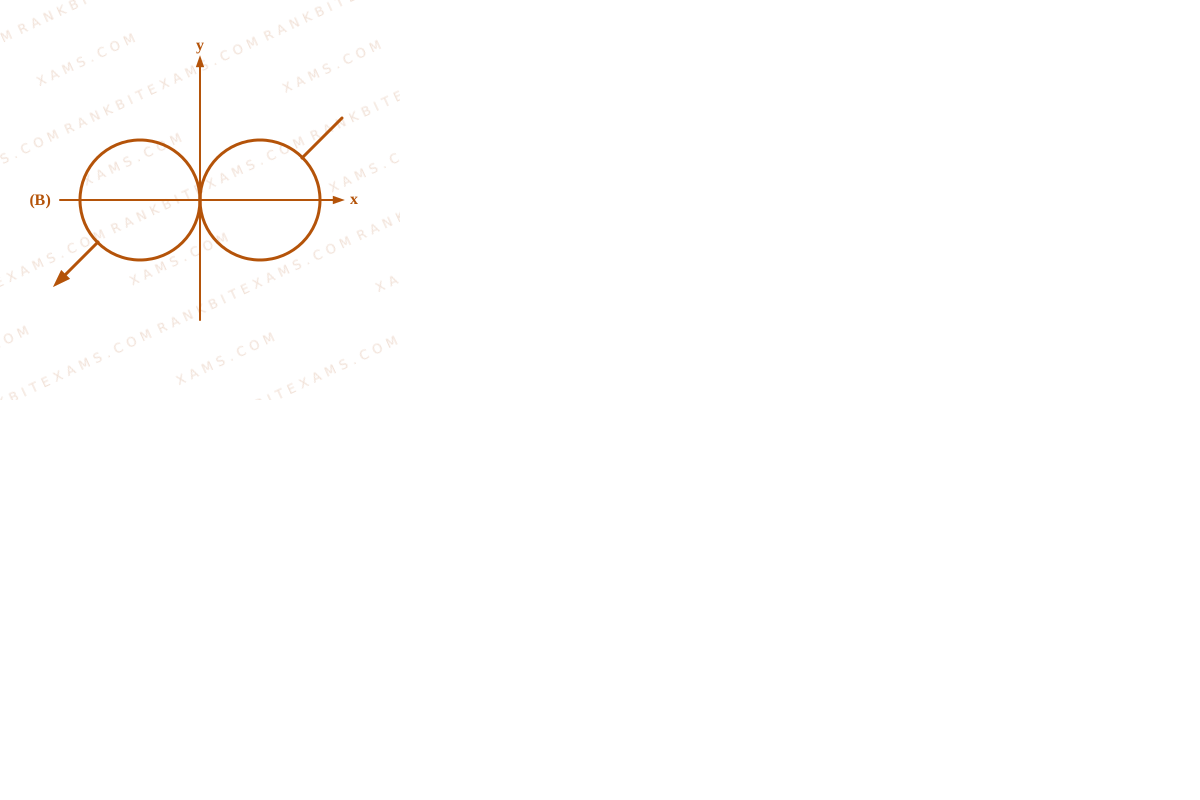
Which of the following statements are true? (A) The subsidiary quantum number l describes the shape of the orbital occupied by the electron.
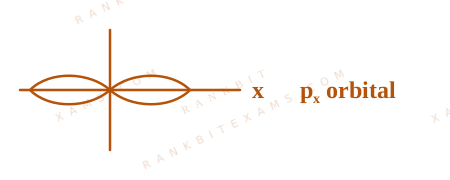
Boundary surface diagram of 2px orbital for Q32 - JEE Main 2025 Evening
The diagram displays the boundary surface showing two symmetrical lobes situated along the x-axis, representing a 2px orbital with phase signs.
is the boundary surface diagram of the 2pₓ orbital. (C) The + and - signs in the wave function of the 2pₓ orbital refer to charge. (D) The wave function of 2pₓ orbital is zero everywhere in the xy plane.
  • A. (B) and (D) only
  • B. (A), (B) and (C) only
  • C. (C) and (D) only
  • D. (A) and (B) only

Solution

Related Formula
ψn,l,m(r, θ, φ) = Rn,l(r) · Yl,m(θ, φ)
Core Logic

Let us evaluate each statement carefully:

  • Statement (A) is True: The subsidiary (or azimuthal) quantum number l dictates the orbital shape (l=0 spherical s, l=1 dumbbell p, l=2 double-dumbbell d, etc.).
  • Statement (B) is True:
    Quantum Numbers and Atomic Orbitals
    The diagram displays the boundary surface showing two symmetrical lobes situated along the x-axis, representing a 2px orbital with phase signs.
  • The diagram clearly displays a boundary surface showing two symmetrical lobes situated along the x-axis, which is the exact depiction of a 2pₓ orbital.

  • Statement (C) is False: The + and - signs in orbital diagrams indicate the mathematical sign (or phase) of the spatial wave function ψ in those regions, not electric charge.
  • Statement (D) is False: The wave function of a 2pₓ orbital is zero everywhere in its nodal plane. For a 2pₓ orbital, the nodal plane is the yz-plane (i.e., at x=0), not the xy-plane.
Step 1: Conclusion

Only statements (A) and (B) are correct.

Pattern Recognition

Nodal planes of p-orbitals are perpendicular to the orbital axis:

  • pₓ arrow yz-plane is node (x=0)
  • py arrow xz-plane is node (y=0)
  • pz arrow xy-plane is node (z=0)
Chapter Mix

Class 11 Chemistry: Structure of Atom
More Structure of Atom Questions — jee_main_2025_29_jan_evening

Practice all Structure of Atom previous-year questions →

Rankbit System
JEE Physics: Waves (+15.5%) | Electrostatics: Concentric Shells (-29.7%) | Modern Physics: Photoelectric Clones (+34.2%) | Mathematics: Definite Integrals (+18.1%) | Chemistry: Coordination Splitting (-11.4%) | JEE Physics: Waves (+15.5%) | Electrostatics: Concentric Shells (-29.7%) | Modern Physics: Photoelectric Clones (+34.2%) | Mathematics: Definite Integrals (+18.1%) | Chemistry: Coordination Splitting (-11.4%)