The energy required by electrons, present in the first Bohr orbit of hydrogen atom to be excited to second Bohr orbit is ____ Jtext mol^-1. Given: R_H = 2.18 times 10^-11text ergs.

Solution & Explanation

### Related Formula E_n = -R_H times fracZ^2n^2 Delta E = R_H Z^2 left( frac1n_1^2 - frac1n_2^2 right) ### Core Logic Given R_H = 2.18 times 10^-11text ergs. Convert this to Joules: 1text Joule = 10^7text ergs implies R_H = 2.18 times 10^-18text J. Calculate energy difference per atom: Delta E = 2.18 times 10^-18 times 1^2 left[ frac11^2 - frac12^2 right] Delta E = 2.18 times 10^-18 times left( 1 - frac14 right) = 2.18 times 10^-18 times frac34 Delta E = 1.635 times 10^-18text Joule/atom ### Step 1: Conversion to per mole To find the energy per mole, multiply by Avogadro's number (N_A = 6.02 times 10^23): Delta E_mole = 1.635 times 10^-18 times 6.02 times 10^23text Joule/mole Delta E_mole = 9.84 times 10^5text Joule/mole approx 9.835 times 10^5text J mol^-1 ### Pattern Recognition Energy gaps in Hydrogen: 1 rightarrow 2 transition is exactly frac34 of the ionization energy. Watch out for per atom vs per mole unit traps. ### Evaluation Rubric / Model Answer null ### Chapter Mix Class 11 Chemistry: Structure of Atom

Reference Study Guides

More Structure of Atom Previous-Year Questions

Q70 jee_main_2026_21_jan_morning Hydrogen Spectrum
Given below are two statements: Statement I: When an electric discharge is passed through gaseous hydrogen, the hydrogen molecules dissociate and the energetically excited hydrogen atoms produce electromagnetic radiation of discrete frequencies. Statement II: The frequency of second line of Balmer series obtained from He^+ is equal to that of first line of Lyman series obtained from hydrogen atom. In the light of the above statements, choose the correct answer from the options given below:
  • A. textBoth Statement I and Statement II are true
  • B. textBoth Statement I and Statement II are false
  • C. textStatement I is false but Statement II is true
  • D. textStatement I is true but Statement II is false

Solution

### Related Formula frac1lambda = RZ^2left(frac1n_1^2 - frac1n_2^2right) ### Core Logic Statement I is a factual description of how the hydrogen emission spectrum is obtained. Dissociation yields excited atoms that emit light at discrete frequencies. So Statement I is true. For Statement II: First line of Lyman series for H atom (Z=1, n_1=1, n_2=2): frac1lambda_1 = R(1)^2left(frac11^2 - frac12^2right) = Rleft(1 - frac14right) = frac3R4 Second line of Balmer series for He^+ (Z=2, n_1=2, n_2=4): frac1lambda_2 = R(2)^2left(frac12^2 - frac14^2right) = 4Rleft(frac14 - frac116right) = 4Rleft(frac316right) = frac3R4 Since frac1lambda_1 = frac1lambda_2, their wavelengths (and therefore frequencies) are exactly the same. Statement II is true. ### Step 1: Final Conclusion Both statements are correct. ### Evaluation Rubric / Model Answer null ### Chapter Mix Class 11 Chemistry: Structure of Atom
Q51 jee_main_2026_21_jan_evening Hydrogen Spectrum and Energy Levels
Consider the following spectral lines for atomic hydrogen: A. First line of Paschen series B. Second line of Balmer series C. Third line of Paschen series D. Fourth line of Bracket series The correct arrangement of the above lines in ascending order of energy is:
  • A. (1) \ D < C < A < B
  • B. (2) \ A < B < C < D
  • C. (3) \ C < D < B < A
  • D. (4) \ D < A < C < B

Solution

### Related Formula Delta E = 13.6 Z^2 left(frac1n_1^2 - frac1n_2^2right) text eV ### Core Logic Let's find the values of n_1 and n_2 for each transition: - (A) Paschen (1^st line): n_1 = 3, n_2 = 4 - (B) Balmer (2^nd line): n_1 = 2, n_2 = 4 - (C) Paschen (3^rd line): n_1 = 3, n_2 = 6 - (D) Bracket (4^th line): n_1 = 4, n_2 = 8 Calculating or comparing the energy values corresponding to these transitions yields the ascending order of energy. ### Step 1: Final Conclusion The correct ascending order of energy of the given lines is D < A < C < B, corresponding to option (4). ### Pattern Recognition Sees: hydrogen spectral lines energy comparison. Trap: Confusing series limits with specific line numbers. Shortcut: Evaluate transition frequencies or wavelength gaps using Rydberg formula equivalents. ### Chapter Mix Class 11 Chemistry: Structure of Atom
Q64 jee_main_2026_22_january_evening Balmer Series Energy Transitions
The energy of first (lowest) Balmer line of H atom is x J. The energy (in J) of second Balmer line of H atom is:
  • A. x^2
  • B. fracx1.35
  • C. 2x
  • D. 1.35x

Solution

### Related Formula Delta E = 13.6 Z^2 left(frac1n_1^2 - frac1n_2^2right)text eV ### Core Logic Step 1: First Balmer line (n_1 = 2, n_2 = 3): Delta E_1 = x = 13.6 left(frac12^2 - frac13^2right) = 13.6 left(frac14 - frac19right) = 13.6 left(frac536right) Step 2: Second Balmer line (n_1 = 2, n_2 = 4): Delta E_2 = 13.6 left(frac12^2 - frac14^2right) = 13.6 left(frac14 - frac116right) = 13.6 left(frac316right) Step 3: Ratio of energies: fracDelta E_2x = fracfrac316frac536 = frac3 times 3616 times 5 = frac2720 = 1.35 Delta E_2 = 1.35 x ### Pattern Recognition Sees: Ratio of hydrogen spectrum spectral line energies. Shortcut: (3/16) / (5/36) = 27/20 = 1.35. ### Evaluation Rubric / Model Answer null ### Chapter Mix Class 11 Chemistry: Structure of Atom Class 12 Physics: Atoms

Q jee_main_2025_02_april_evening Quantum Numbers and Atomic Orbitals
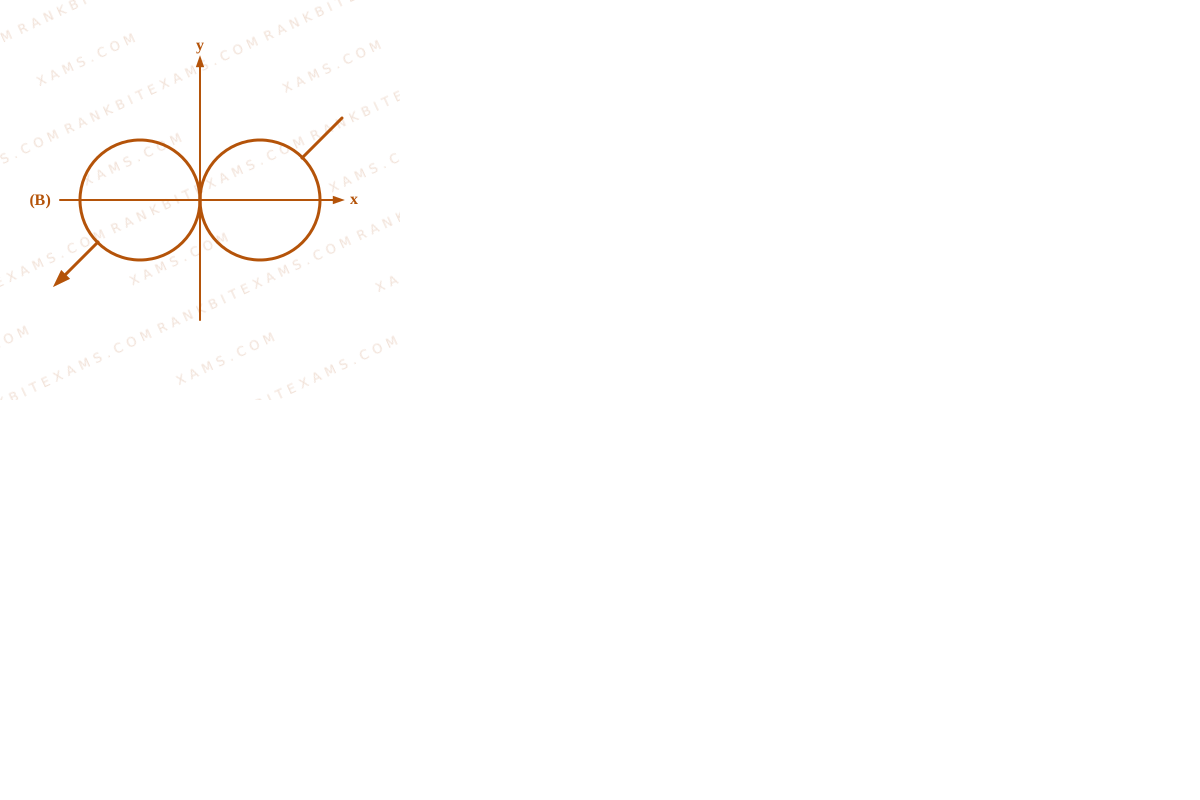
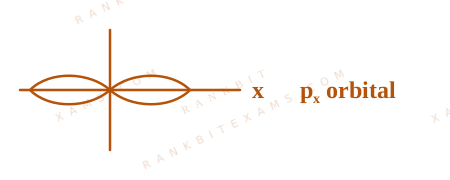
Which of the following statements are true? (A) The subsidiary quantum number l describes the shape of the orbital occupied by the electron.
Boundary surface diagram of 2px orbital for Q32 - JEE Main 2025 Evening
The diagram displays the boundary surface showing two symmetrical lobes situated along the x-axis, representing a 2px orbital with phase signs.
is the boundary surface diagram of the 2mathrmp_x orbital. (C) The + and - signs in the wave function of the 2mathrmp_x orbital refer to charge. (D) The wave function of 2mathrmp_x orbital is zero everywhere in the xy plane.
  • A. text(B) and (D) only
  • B. text(A), (B) and (C) only
  • C. text(C) and (D) only
  • D. text(A) and (B) only

Solution

### Related Formula psi_n,l,m(r, theta, phi) = R_n,l(r) cdot Y_l,m(theta, phi) ### Core Logic Let us evaluate each statement carefully: - **Statement (A)** is **True**: The subsidiary (or azimuthal) quantum number l dictates the orbital shape (l=0 implies textspherical s, l=1 implies textdumbbell p, l=2 implies textdouble-dumbbell d, etc.).
- **Statement (B)** is **True**:
Quantum Numbers and Atomic Orbitals
The diagram displays the boundary surface showing two symmetrical lobes situated along the x-axis, representing a 2px orbital with phase signs.
The diagram clearly displays a boundary surface showing two symmetrical lobes situated along the x-axis, which is the exact depiction of a 2mathrmp_x orbital.
- **Statement (C)** is **False**: The + and - signs in orbital diagrams indicate the mathematical sign (or phase) of the spatial wave function psi in those regions, not electric charge.
- **Statement (D)** is **False**: The wave function of a 2mathrmp_x orbital is zero everywhere in its nodal plane. For a 2mathrmp_x orbital, the nodal plane is the **yz-plane** (i.e., at x=0), not the xy-plane. ### Step 1: Conclusion Only statements (A) and (B) are correct. ### Pattern Recognition Nodal planes of p-orbitals are perpendicular to the orbital axis: - p_x rightarrow yz-plane is node (x=0) - p_y rightarrow xz-plane is node (y=0) - p_z rightarrow xy-plane is node (z=0) ### Evaluation Rubric / Model Answer null ### Chapter Mix Class 11 Chemistry: Structure of Atom

More Structure of Atom Questions — jee_main_2026_22_january_morning

Practice all Structure of Atom previous-year questions →

Rankbit System
JEE Physics: Waves (+15.5%) | Electrostatics: Concentric Shells (-29.7%) | Modern Physics: Photoelectric Clones (+34.2%) | Mathematics: Definite Integrals (+18.1%) | Chemistry: Coordination Splitting (-11.4%) | JEE Physics: Waves (+15.5%) | Electrostatics: Concentric Shells (-29.7%) | Modern Physics: Photoelectric Clones (+34.2%) | Mathematics: Definite Integrals (+18.1%) | Chemistry: Coordination Splitting (-11.4%)