JEE Main · Chemistry ↑ Rising

Structure of Atom appeared 38 times across 3 years — 4.4% of Chemistry. This question is from Quantum Numbers and Electronic Configuration.

Year 2026 2025 2024 Total
Questions 14 15 9 38

Identify the correct statements for an element possessing atomic number 9: A. There can be 5 electrons for which mₛ = +(1)/(2) and 4 electrons for which mₛ = -(1)/(2). B. There is only one electron in the pz orbital. C. The last electron goes into an orbital described by quantum parameters n = 2 and l = 1. D. The sum of angular nodes of all populated atomic orbitals is 1. Choose the correct answer from the options given below:

Solution & Explanation

Core Logic

The element with atomic number 9 is Fluorine (F). Let's write out its ground state electronic configuration:

F (Z=9) = 1s² 2s² 2p⁵

Let's systematically audit each statement:

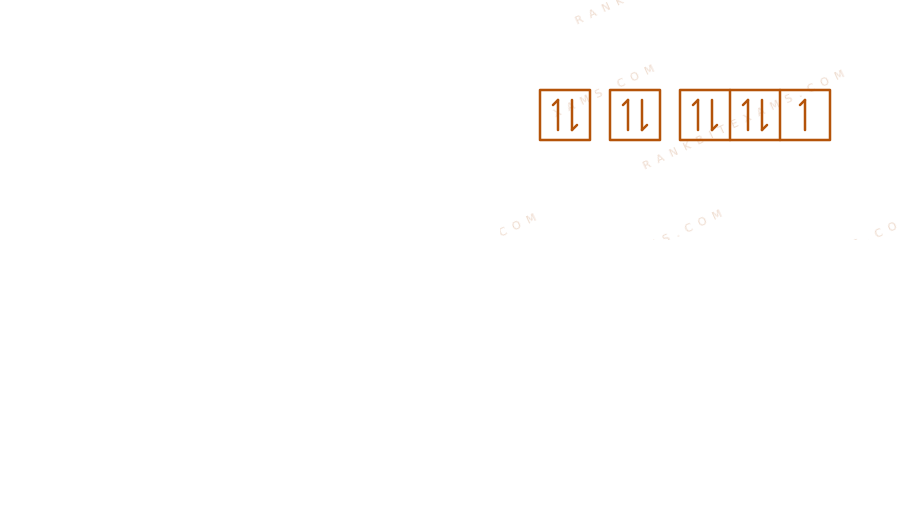
  • Statement A: Within the total population of 9 electrons, the pairing distribution across shells shows: 1s² (one up, one down), 2s² (one up, one down), 2p⁵ (three up, two down). Summing up-spins (mₛ = +(1)/(2)) yields 1 + 1 + 3 = 5 electrons. Down-spins (mₛ = -(1)/(2)) yield 1 + 1 + 2 = 4 electrons. Statement A is fully correct.
    Orbital spin configuration box diagram for Fluorine atom
    Orbital spin configuration box diagram for Fluorine atom
  • Statement B: By Hund's Rule, the 5 electrons in the 2p subshell occupy the degenerate pₓ, py, pz states. This produces two fully-filled sub-orbitals and one half-filled sub-orbital. The unpaired slot can reside arbitrarily in any of the three orbitals (pₓ, py, or pz) due to spatial symmetry. It is not constrained to pz. Statement B is incorrect.
  • Statement C: The highest energy valence electron enters the 2p subshell, which is defined by principal number n = 2 and azimuthal index l = 1. Statement C is fully correct.
  • Statement D: Angular nodes are given directly by the quantum number l. For s-orbitals (1s, 2s), angular nodes = 0. For each of the three populated p-orbitals (2p), angular nodes = 1. The sum total of angular nodes across all orbitals is 0 + 0 + 3 = 3. Statement D is incorrect.
Pattern Recognition

Total angular nodes equals the total number of p-electrons' spatial orientation count, not simply the subshell boundary value. Recognizing that degenerate p-orbitals share uniform probability status exposes the restriction in Statement B instantly.

Chapter Mix

Class 11 Chemistry: Structure of Atom

Reference Study Guides

More Structure of Atom Previous-Year Questions

Q70 jee_main_2026_21_jan_morning Hydrogen Spectrum
Given below are two statements: Statement I: When an electric discharge is passed through gaseous hydrogen, the hydrogen molecules dissociate and the energetically excited hydrogen atoms produce electromagnetic radiation of discrete frequencies. Statement II: The frequency of second line of Balmer series obtained from He⁺ is equal to that of first line of Lyman series obtained from hydrogen atom. In the light of the above statements, choose the correct answer from the options given below:
  • A. Both Statement I and Statement II are true
  • B. Both Statement I and Statement II are false
  • C. Statement I is false but Statement II is true
  • D. Statement I is true but Statement II is false

Solution

### Related Formula (1)/(λ) = RZ²((1)/(n₁²) - (1)/(n₂²)) ### Core Logic Statement I is a factual description of how the hydrogen emission spectrum is obtained. Dissociation yields excited atoms that emit light at discrete frequencies. So Statement I is true. For Statement II: First line of Lyman series for H atom (Z=1, n₁=1, n₂=2): (1)/(λ₁) = R(1)²((1)/(1²) - (1)/(2²)) = R(1 - (1)/(4)) = (3R)/(4) Second line of Balmer series for He^+ (Z=2, n₁=2, n₂=4): (1)/(λ₂) = R(2)²((1)/(2²) - (1)/(4²)) = 4R((1)/(4) - (1)/(16)) = 4R((3)/(16)) = (3R)/(4) Since (1)/(λ₁) = (1)/(λ₂), their wavelengths (and therefore frequencies) are exactly the same. Statement II is true. ### Step 1: Final Conclusion Both statements are correct. ### Evaluation Rubric / Model Answer null ### Chapter Mix Class 11 Chemistry: Structure of Atom

Q51 jee_main_2026_21_jan_evening Hydrogen Spectrum and Energy Levels
Consider the following spectral lines for atomic hydrogen: A. First line of Paschen series B. Second line of Balmer series C. Third line of Paschen series D. Fourth line of Bracket series The correct arrangement of the above lines in ascending order of energy is:
  • A. (1) D < C < A < B
  • B. (2) A < B < C < D
  • C. (3) C < D < B < A
  • D. (4) D < A < C < B

Solution

### Related Formula Δ E = 13.6 Z² ((1)/(n₁²) - (1)/(n₂²)) eV ### Core Logic Let's find the values of n₁ and n₂ for each transition: - (A) Paschen (1st line): n₁ = 3, n₂ = 4 - (B) Balmer (2nd line): n₁ = 2, n₂ = 4 - (C) Paschen (3rd line): n₁ = 3, n₂ = 6 - (D) Bracket (4th line): n₁ = 4, n₂ = 8 Calculating or comparing the energy values corresponding to these transitions yields the ascending order of energy. ### Step 1: Final Conclusion The correct ascending order of energy of the given lines is D < A < C < B, corresponding to option (4). ### Pattern Recognition Sees: hydrogen spectral lines energy comparison. Trap: Confusing series limits with specific line numbers. Shortcut: Evaluate transition frequencies or wavelength gaps using Rydberg formula equivalents. ### Chapter Mix Class 11 Chemistry: Structure of Atom
Q54 jee_main_2026_22_january_morning Bohr Model Energy Calculations
The energy required by electrons, present in the first Bohr orbit of hydrogen atom to be excited to second Bohr orbit is ____ J mol⁻¹. Given: RH = 2.18 × 10⁻¹¹ ergs.
  • A. 1.635 × 10⁻¹⁸
  • B. 9.835 × 10⁵
  • C. 9.835 × 10¹²
  • D. 1.635 × 10⁻¹¹

Solution

### Related Formula Eₙ = -RH × Z²n² Δ E = RH Z² ( (1)/(n₁²) - (1)/(n₂²) ) ### Core Logic Given RH = 2.18 × 10⁻¹¹ ergs. Convert this to Joules: 1 Joule = 10⁷ ergs RH = 2.18 × 10⁻¹⁸ J. Calculate energy difference per atom: Δ E = 2.18 × 10⁻¹⁸ × 1² [ 11² - 12² ] Δ E = 2.18 × 10⁻¹⁸ × ( 1 - (1)/(4) ) = 2.18 × 10⁻¹⁸ × (3)/(4) Δ E = 1.635 × 10⁻¹⁸ Joule/atom ### Step 1: Conversion to per mole To find the energy per mole, multiply by Avogadro's number (NA = 6.02 × 10²³): Δ Emole = 1.635 × 10⁻¹⁸ × 6.02 × 10²³ Joule/mole Δ Emole = 9.84 × 10⁵ Joule/mole ≈ 9.835 × 10⁵ J mol⁻¹ ### Pattern Recognition Energy gaps in Hydrogen: 1 arrow 2 transition is exactly (3)/(4) of the ionization energy. Watch out for per atom vs per mole unit traps. ### Evaluation Rubric / Model Answer null ### Chapter Mix Class 11 Chemistry: Structure of Atom
Q64 jee_main_2026_22_january_evening Balmer Series Energy Transitions
The energy of first (lowest) Balmer line of H atom is x J. The energy (in J) of second Balmer line of H atom is:
  • A. x²
  • B. (x)/(1.35)
  • C. 2x
  • D. 1.35x

Solution

### Related Formula Δ E = 13.6 Z² ((1)/(n₁²) - (1)/(n₂²)) eV ### Core Logic Step 1: First Balmer line (n₁ = 2, n₂ = 3): Δ E₁ = x = 13.6 ((1)/(2²) - (1)/(3²)) = 13.6 ((1)/(4) - (1)/(9)) = 13.6 ((5)/(36)) Step 2: Second Balmer line (n₁ = 2, n₂ = 4): Δ E₂ = 13.6 ((1)/(2²) - (1)/(4²)) = 13.6 ((1)/(4) - (1)/(16)) = 13.6 ((3)/(16)) Step 3: Ratio of energies: (Δ E₂)/(x) = ((3)/(16))/((5)/(36)) = (3 × 36)/(16 × 5) = (27)/(20) = 1.35 Δ E₂ = 1.35 x ### Pattern Recognition Sees: Ratio of hydrogen spectrum spectral line energies. Shortcut: (3/16) / (5/36) = 27/20 = 1.35. ### Evaluation Rubric / Model Answer null ### Chapter Mix Class 11 Chemistry: Structure of Atom Class 12 Physics: Atoms
Q51 jee_main_2026_23_january_morning Bohr Model for Hydrogen Like Species
Which of the following statements regarding the energy of the stationary state is true in the following one-electron system?
  • A. -1.09 × 10⁻¹⁸ J for second orbit of H atom.
  • B. +2.18 × 10⁻¹⁸ J for second orbit of He⁺ ion
  • C. +8.72 × 10⁻¹⁸ J for first orbit of He⁺ ion
  • D. -2.18 × 10⁻¹⁸ J for third orbit of Li²⁺ ion

Solution

### Related Formula Eₙ = -2.18 × 10⁻¹⁸ (Z²)/(n²) J/atom ### Core Logic Evaluate the energy of the stationary state for the given species by substituting the atomic number Z and the orbit number n into the energy formula for hydrogen-like species. ### Step 1: Calculation for Li2+ Ion For the 3rd orbit of the Li²⁺ ion, we have Z = 3 (since lithium has 3 protons) and n = 3. E₃ = -2.18 × 10⁻¹⁸ × (3²)/(3²) E₃ = -2.18 × 10⁻¹⁸ J ### Pattern Recognition When Z = n, the Z²/n² ratio becomes 1, immediately resulting in the ground state energy of a hydrogen atom (-2.18 × 10⁻¹⁸ J). This is a common shortcut for identifying correct energy states. ### Evaluation Rubric / Model Answer null ### Chapter Mix Class 11 Chemistry: Structure of Atom

More Structure of Atom Questions — jee_main_2025_08_april_evening

Practice all Structure of Atom previous-year questions →

Rankbit System
JEE Physics: Waves (+15.5%) | Electrostatics: Concentric Shells (-29.7%) | Modern Physics: Photoelectric Clones (+34.2%) | Mathematics: Definite Integrals (+18.1%) | Chemistry: Coordination Splitting (-11.4%) | JEE Physics: Waves (+15.5%) | Electrostatics: Concentric Shells (-29.7%) | Modern Physics: Photoelectric Clones (+34.2%) | Mathematics: Definite Integrals (+18.1%) | Chemistry: Coordination Splitting (-11.4%)