JEE Main · Chemistry ↓ Falling

Organic Chemistry - Some Basic Principles and Techniques appeared 101 times across 3 years — 11.8% of Chemistry. This question is from Sigma and Pi Bond Counting.

Year 2026 2025 2024 Total
Questions 22 49 30 101

Total number of sigma (sigma) and pi(pi) bonds respectively present in hex-1-en-4-yne are:

Solution & Explanation

Core Logic

The structural formula of hex-1-en-4-yne is given by:

CH₂ = CH - CH₂ - C equiv C - CH₃

Let's count the chemical bonds chronologically:

  • Number of C-H sigma bonds = 2 + 1 + 2 + 3 = 8
  • Number of C-C sigma bonds = 5
  • Total sigma bonds = 8 + 5 = 13.

    Sigma and Pi Bond Counting diagram for Q38 - JEE Main 2025 Evening
    Sigma and Pi Bond Counting diagram for Q38 - JEE Main 2025 Evening

  • Number of pi bonds: 1 from double bond + 2 from triple bond = 3 pi bonds.
Pattern Recognition

Every single bond is 1sigma, every double bond contains 1sigma + 1pi, and every triple bond contains 1sigma + 2pi.

Chapter Mix

Class 11 Chemistry: Organic Chemistry - Some Basic Principles and Techniques

Reference Study Guides

More Organic Chemistry - Some Basic Principles and Techniques Previous-Year Questions — Page 5

Q60 jee_main_2026_28_january_evening Hyperconjugation
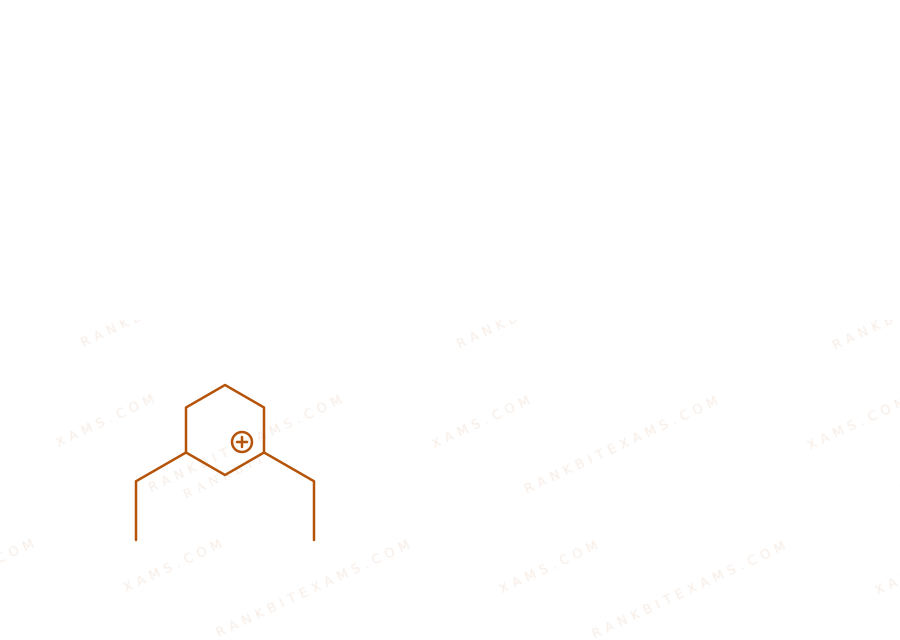
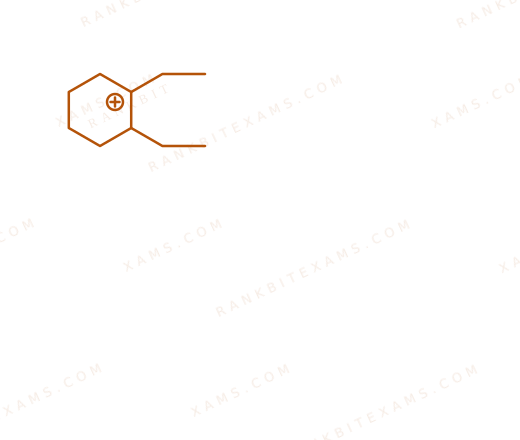
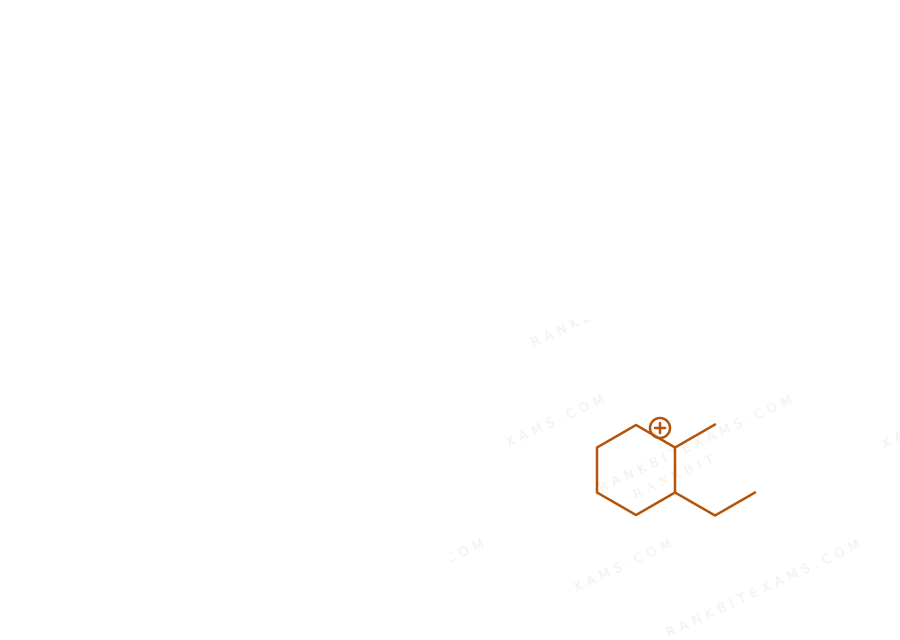
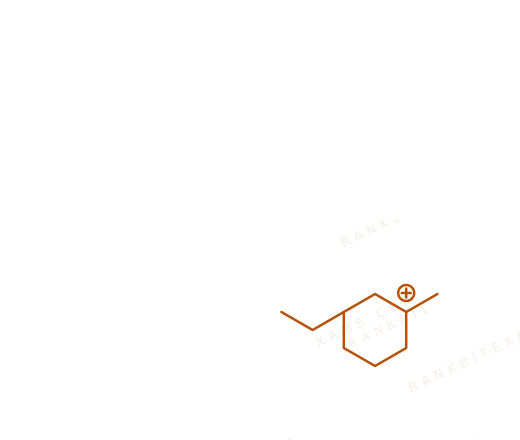
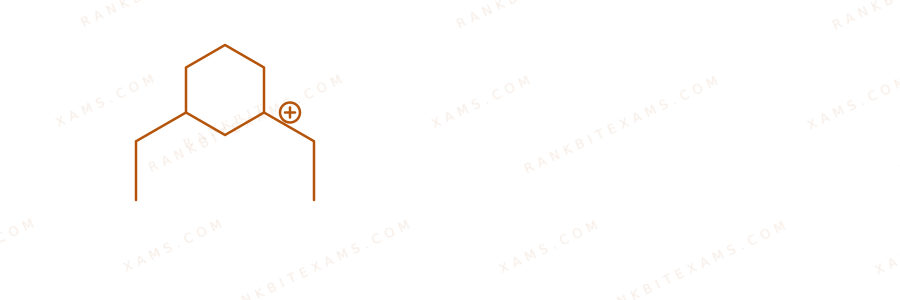
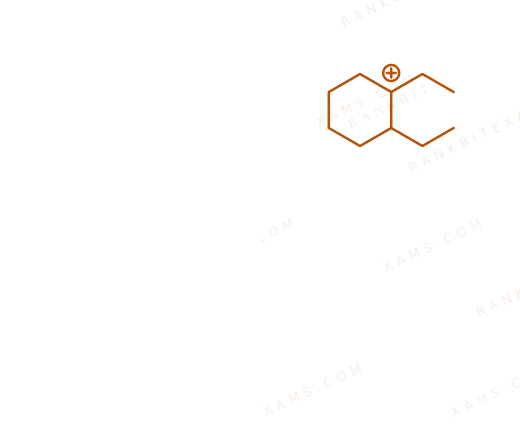
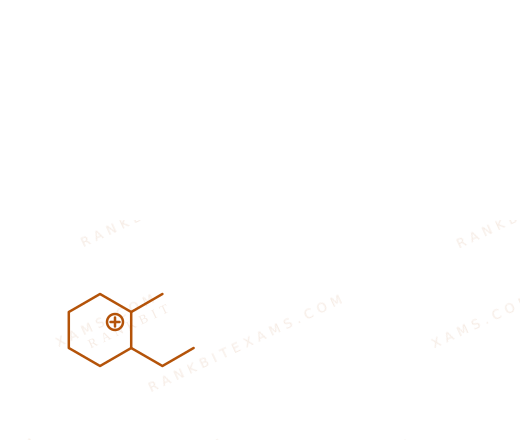
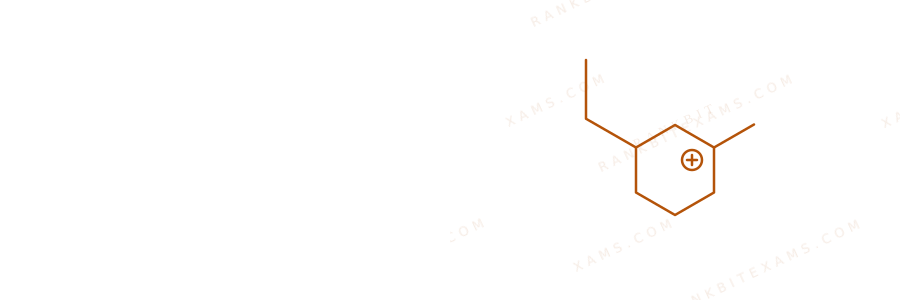
The cyclic cations having the same number of hyperconjugation are : A.
Hyperconjugation
Hyperconjugation
B.
Hyperconjugation
Hyperconjugation
C.
Hyperconjugation
Hyperconjugation
D.
Hyperconjugation
Hyperconjugation
Choose the correct answer from the options given below :
  • A. (1) A and C Only
  • B. (2) B and C Only
  • C. (3) A and B Only
  • D. (4) A, C and D only

Solution

Core Logic

Count the number of alpha hydrogens (α-H) adjacent to the carbocation in each structure. (A)

Hyperconjugation
Hyperconjugation
α-H = 6 (B)
Hyperconjugation
Hyperconjugation
α-H = 7 (C)
Hyperconjugation
Hyperconjugation
α-H = 6 (D)
Hyperconjugation
Hyperconjugation
α-H = 5

Step 1: Final Conclusion

Both cations (A) and (C) have 6 α-hydrogens, meaning they share the same number of hyperconjugative structures.

Pattern Recognition

Hyperconjugation count corresponds strictly to the number of C-H bonds on the carbon atoms immediately adjacent (sp³) to the positive center.

Chapter Mix

Class 11 Chemistry: Organic Chemistry - Some Basic Principles and Techniques

Q70 jee_main_2026_28_january_evening Quantitative Analysis Of Elements
A student has been given 0.314 g of an organic compound and asked to estimate Sulphur. During the experiment, the student has obtained 0.4813 g of barium sulphate. The percentage of sulphur present in the compound is (Given Molar mass in g mol⁻¹ S:32, BaSO₄:233)
  • A. (1) 42.10%
  • B. (2) 63.15%
  • C. (3) 21.05%
  • D. (4) 48.24%

Solution

Related Formula
% of S = (32)/(233) × Mass of BaSO₄Mass of organic compound × 100
Core Logic

Mass of organic compound = 0.314 g Mass of BaSO₄ formed = 0.4813 g Substituting the values:

% S = (32)/(233) × (0.4813)/(0.314) × 100 % S = 0.1373 × 1.5328 × 100 ≈ 21.052%
Step 1: Final Conclusion

The percentage of sulphur is approximately 21.05%.

Pattern Recognition

Straight application of Carius method for Sulphur estimation formula.

Chapter Mix

Class 11 Chemistry: Organic Chemistry - Some Basic Principles and Techniques

Q jee_main_2025_02_april_evening Hybridization in Organic Compounds
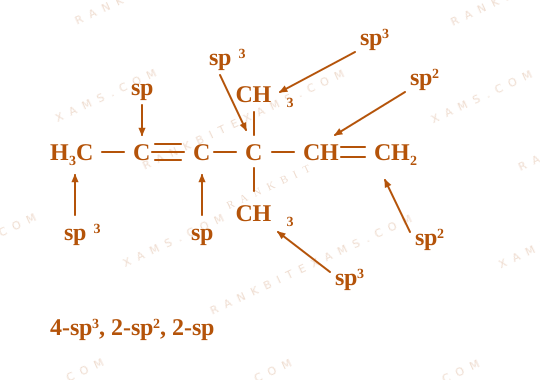
In 3, 3-dimethylhex-1-ene-4-yne, there are sp³, sp² and sp hybridised carbon atoms respectively:
  • A. 4, 2, 2
  • B. 3, 3, 2
  • C. 2, 4, 2
  • D. 2, 2, 4

Solution

Related Formula
Hybridization of Carbon = cases sp³ & 4~σ-bonds sp² & 3~σ-bonds, 1~π-bond sp & 2~σ-bonds, 2~π-bonds cases
Core Logic

Let's first draw the structural formula of 3,3-dimethylhex-1-ene-4-yne:

Hybridization in Organic Compounds

6CH₃ - 5C ≡ 4C - 3C(CH₃)₂ - 2CH = 1CH₂
Step 1: Identify Hybridization of Each Carbon

We count the sigma (σ) bonds or pi (π) bonds on each carbon:

  • C₁: Involved in a double bond (CH₂ =) sp²
  • C₂: Involved in a double bond (=CH-) sp²
  • C₃: Single bonds only (bonded to C₂, C₄, and two methyl carbons) sp³
  • Two methyl carbons attached to C₃: Single bonds only 2 × sp³
  • C₄: Involved in a triple bond (-C ≡) sp
  • C₅: Involved in a triple bond (≡ C-) sp
  • C₆: Single bonds only (-CH₃) sp³
Step 2: Calculate the Count

Summing the hybridization counts:

  • sp³ carbons: C₃, C₆, and 2 × CH₃ on C₃ = 4 carbon atoms
  • sp² carbons: C₁ and C₂ = 2 carbon atoms
  • sp carbons: C₄ and C₅ = 2 carbon atoms
  • Thus, the number of sp³, sp² and sp hybridized carbons is 4, 2, 2 respectively.

Pattern Recognition

Quick Tip: Always draw side substituents (like methyl groups) explicitly. A common mistake is to skip counting the methyl substituent carbons as sp³.

Chapter Mix

Class 11 Chemistry: Organic Chemistry - Some Basic Principles and Techniques

Q jee_main_2025_02_april_evening Methods of Purification of Organic Compounds
Match List-I with List-II: array|l|l| arrayc List-I (Purification technique) array & arrayc List-II (Mixture of organic compounds) array (A) Distillation (simple) & (I) Diesel + Petrol (B) Fractional distillation & (II) Aniline + Water (C) Distillation under reduced pressure & (III) Chloroform + Aniline (D) Steam distillation & (IV) Glycerol + Spent-lye array Choose the correct answer from the options given below:
  • A. (A)-(II), (B)-(III), (C)-(IV), (D)-(I)
  • B. (A)-(II), (B)-(IV), (C)-(I), (D)-(III)
  • C. (A)-(III), (B)-(IV), (C)-(II), (D)-(I)
  • D. (A)-(III), (B)-(I), (C)-(IV), (D)-(II)

Solution

Related Formula
Method Selection = f( Δ Tb, decomposition threshold, volatility with steam )
Core Logic

Let's align each purification technique to its designated mixtures based on NCERT guidelines:

  • (A) Simple distillation: Used for liquids having a significant difference in their boiling points (>30~K or 30^). Chloroform (b.p. 334~K) and aniline (b.p. 457~K) are separated easily using simple distillation arrow (III).
  • (B) Fractional distillation: Used if boiling point differences of the components are very close (less than 25~K). Separation of petrochemical fractions such as diesel and petrol uses this technique arrow (I).
  • (C) Distillation under reduced pressure: Used for liquids that tend to decompose at or below their normal boiling points. Glycerol is separated from spent-lye in soap manufacturing industry using this vacuum method to prevent glycerol decomposition arrow (IV).
  • (D) Steam distillation: Applied to substances which are steam-volatile and completely immiscible in water. Aniline and water are separated using this technique arrow (II).
Step 1: Conclusion

Thus, the correct match is: (A)-(III), (B)-(I), (C)-(IV), (D)-(II) This corresponds perfectly to option (4).

Pattern Recognition

Glycerol from spent-lye is a highly tested practical chemistry concept. Remember that vacuum distillation lowers the boiling point, permitting evaporation without decomposition.

Chapter Mix

Class 11 Chemistry: Organic Chemistry - Some Basic Principles and Techniques

Q jee_main_2025_02_april_evening Quantitative Estimation (Dumas Method)
In Dumas' method for estimation of nitrogen, 0.5 gram of an organic compound gave 60~mL of nitrogen collected at 300K temperature and 715~mmHg pressure. The percentage composition of nitrogen in the compound (Aqueous tension at 300K = 15~mmHg) is
  • A. 1.257
  • B. 20.87
  • C. 18.67
  • D. 12.57

Solution

Related Formula
pN₂ = ptotal - paq nN₂ = pN₂ VR T % N = Mass of nitrogenMass of organic compound × 100
Core Logic

Dumas' method estimates nitrogen by collecting dry nitrogen gas (N₂). We must subtract the aqueous tension (vapor pressure of water) to find the pressure exerted solely by the dry nitrogen gas.

Step 1: Calculate Pressure of Dry Nitrogen
pN₂ = 715~mmHg - 15~mmHg = 700~mmHg

Converting pressure to atmospheres:

pN₂ = (700)/(760)~atm
Step 2: Calculate Moles of Nitrogen Gas

Using the ideal gas law with R = 0.0821~ L~atm~mol⁻¹~K⁻¹, T = 300~K, and V = 60~mL = 60 × 10⁻³~L:

nN₂ = ((700)/(760)) × 60 × 10⁻³0.0821 × 300 nN₂ = (0.92105 × 0.060)/(24.63) ≈ 2.244 × 10⁻³~mol
Step 3: Calculate Mass and Percentage of Nitrogen

The molar mass of N₂ is 28~ g~mol⁻¹:

Mass of N₂ = nN₂ × 28 = 2.244 × 10⁻³ × 28 ≈ 0.06283~g

Now find the percentage in 0.5~g of organic compound:

% N = 0.06283~g0.5~g × 100 = 12.566% ≈ 12.57%
Pattern Recognition

Watch out! Always subtract the aqueous tension from the wet gas pressure first to find the dry gas pressure. Forgetting this step is the most common source of error in Dumas calculations.

Chapter Mix

Class 11 Chemistry: Organic Chemistry - Some Basic Principles and Techniques

More Organic Chemistry - Some Basic Principles and Techniques Questions — jee_main_2025_29_jan_evening
Practice all Organic Chemistry - Some Basic Principles and Techniques previous-year questions →
Rankbit System
JEE Physics: Waves (+15.5%) | Electrostatics: Concentric Shells (-29.7%) | Modern Physics: Photoelectric Clones (+34.2%) | Mathematics: Definite Integrals (+18.1%) | Chemistry: Coordination Splitting (-11.4%) | JEE Physics: Waves (+15.5%) | Electrostatics: Concentric Shells (-29.7%) | Modern Physics: Photoelectric Clones (+34.2%) | Mathematics: Definite Integrals (+18.1%) | Chemistry: Coordination Splitting (-11.4%)