
JEE Main · Chemistry ↓ Falling

Organic Chemistry - Some Basic Principles and Techniques appeared 101 times across 3 years — 11.8% of Chemistry. This question is from Sigma and Pi Bond Counting.

Year 2026 2025 2024 Total
Questions 22 49 30 101

Total number of sigma (sigma) and pi(pi) bonds respectively present in hex-1-en-4-yne are:

Solution & Explanation

Core Logic

The structural formula of hex-1-en-4-yne is given by:

CH₂ = CH - CH₂ - C equiv C - CH₃

Let's count the chemical bonds chronologically:

  • Number of C-H sigma bonds = 2 + 1 + 2 + 3 = 8
  • Number of C-C sigma bonds = 5
  • Total sigma bonds = 8 + 5 = 13.

    Sigma and Pi Bond Counting diagram for Q38 - JEE Main 2025 Evening
    Sigma and Pi Bond Counting diagram for Q38 - JEE Main 2025 Evening

  • Number of pi bonds: 1 from double bond + 2 from triple bond = 3 pi bonds.
Pattern Recognition

Every single bond is 1sigma, every double bond contains 1sigma + 1pi, and every triple bond contains 1sigma + 2pi.

Chapter Mix

Class 11 Chemistry: Organic Chemistry - Some Basic Principles and Techniques

Reference Study Guides

More Organic Chemistry - Some Basic Principles and Techniques Previous-Year Questions — Page 4

Q60 jee_main_2026_24_january_evening Electronic Effects and Intermediates
Find out the statements which are not true. A. Resonating structure with more number of covalent bonds and lesser charge separation are more stable. B. In electromagnetic effect, an unsaturated system shows + E effect with nucleophile and -E effect with electrophile. C. Inductive effect is responsible for high melting point, boiling point and dipole moment of polar compounds. D. The greater the number of alkyl groups attached to the doubly bonded carbon atoms, higher is the heat of hydrogenation. E. Stability of carbanion increases with the increase in s-character of the carbon carrying the negative charge.
Electronic Effects and Intermediates diagram for Q60 - JEE Main 2026 Evening
Image lists the statements for the question.
Choose the correct answer from the options given below.
  • A. A, D & E only
  • B. B, D & E only
  • C. A, C & D only
  • D. B & D only

Solution

Core Logic

Let's analyze the statements: Statement A: Resonating structure with more covalent bonds and lesser charge separation are indeed more stable. (True)

Statement B: In the electromeric effect, when the pi electrons shift towards the attacking reagent (electrophile), it's +E. When they shift away from the attacking reagent (nucleophile), it's -E. The statement says +E with nucleophile and -E with electrophile, which is reversed. (False)

Statement C: Inductive effect is a permanent polarization that contributes to the dipole moment and intermolecular forces, thereby influencing boiling/melting points. (True)

Statement D: The greater the number of alkyl groups attached to the double bond, the more stable the alkene is (due to hyperconjugation). More stable alkenes release LESS energy upon hydrogenation, meaning they have a LOWER heat of hydrogenation. (False)

Statement E: Stability of a carbanion increases with the s-character of the carbon atom because an orbital with more s-character is closer to the nucleus, stabilizing the negative charge better (sp > sp² > sp³). (True)

Step 1: Conclusion

Statements B and D are NOT true.

Pattern Recognition

Heat of Hydrogenation (HOH) is inversely proportional to alkene stability. More substituted alkene = more stable = lower HOH.

Chapter Mix

Class 11 Chemistry: Organic Chemistry Some Basic Principles and Techniques
Q71 jee_main_2026_24_january_evening Quantitative Analysis
0.25 g of an organic compound "A" containing carbon, hydrogen and oxygen was analysed using the combustion method. There was an increase in mass of CaCl₂ tube and potash tube at the end of the experiment. The amount was found to be 0.15 g and 0.1837 g, respectively. The percentage of oxygen in compound A is ____%. (Nearest integer)
Numerical Answer. Answer: 73 to 73

Solution

Related Formula
Mass of C = (12)/(44) × Mass of CO₂ Mass of H = (2)/(18) × Mass of H₂O
Core Logic

Combustion equation: CₓHyOz + O₂ arrow CO₂ + H₂O

Potash (KOH) tube absorbs CO₂. So, mass of CO₂ produced = 0.1837 g (approximated as 0.18 g in solution data for simplicity, but strictly 0.1837 based on prompt. The solution explicitly uses 0.18 for C calculation, let's trace: Mass of 'C' = (0.18)/(44) × 12). CaCl₂ tube absorbs H₂O. So, mass of H₂O produced = 0.15 g.

Mass of Carbon (C) = (12)/(44) × 0.18 0.049 0.05 gm Mass of Hydrogen (H) = (2)/(18) × 0.15 = 0.0166 0.017 gm

Step 1: Calculate Mass of Oxygen

Since the total mass of compound A is 0.25 gm: Mass of Oxygen (O) = 0.25 - (Mass of C + Mass of H) Mass of 'O' = 0.25 - 0.05 - 0.017 = 0.183 gm

Step 2: Calculate Percentage

Mass % of 'O' = (0.1833)/(0.25) × 100 = 73.32% Rounding to the nearest integer gives 73.

Pattern Recognition

In Liebig's combustion method, the CaCl₂ U-tube maps strictly to H₂O mass, and the Potash bulb maps strictly to CO₂ mass. Find carbon and hydrogen masses, subtract from total sample mass to find the third element (Oxygen).

Chapter Mix

Class 11 Chemistry: Organic Chemistry Some Basic Principles and Techniques
Q52 jee_main_2026_28_january_morning Stability of Carbanions
CORRECT order of stability for the following is CH₂=CH⁻, CH₃-CH₂⁻, CH≡ C⁻
  • A. CH₃-CH₂⁻>CH₂=CH⁻>CH≡ C⁻
  • B. CH₂=CH⁻>CH≡ C⁻>CH₃-CH₂⁻
  • C. CH≡ C⁻>CH₂=CH⁻>CH₃-CH₂⁻
  • D. CH≡ C⁻>CH₃-CH₂⁻>CH₂=CH⁻

Solution

Core Logic

The stability of a carbanion is directly proportional to the electronegativity of the carbon atom bearing the negative charge. The electronegativity of carbon increases with the increase in s-character of its hybridization state.

Step 1: Hybridization Analysis

CH≡ C⁻ (sp hybridized, 50% s-character) -> Highest electronegativity, most stable.\nCH₂=CH⁻ (sp² hybridized, 33.3% s-character) -> Intermediate electronegativity.\nCH₃-CH₂⁻ (sp³ hybridized, 25% s-character) -> Lowest electronegativity, least stable.

Final Conclusion

Order of stability: CH≡ C⁻ > CH₂=CH⁻ > CH₃-CH₂⁻

Pattern Recognition

Stability of carbanion ∝ % s-character. More s-character pulls the electron pair closer to the nucleus, stabilizing the negative charge.

Chapter Mix

Class 11 Chemistry: Organic Chemistry Some Basic Principles and Techniques

Q55 jee_main_2026_28_january_morning Separation Techniques
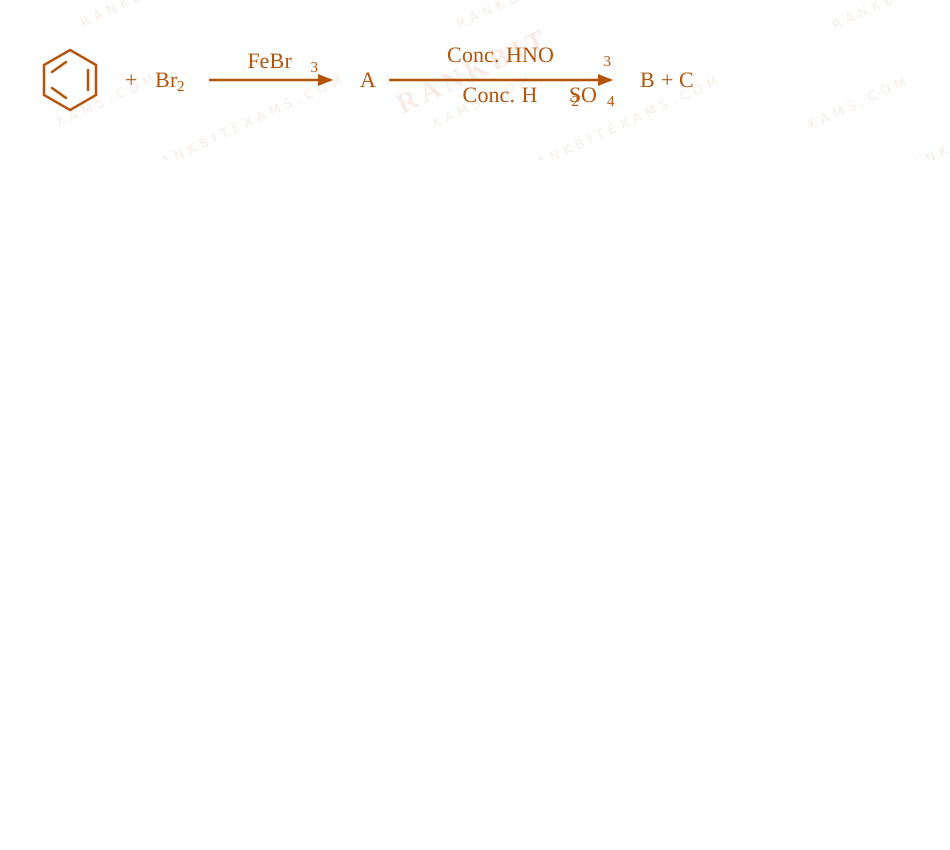
Method used for separation of mixture of products (B and C) obtained in the following reaction is:
Reaction yielding mixture B and C
Sequence of reactions on benzene yielding ortho and para substituted isomers.

Solution

Core Logic

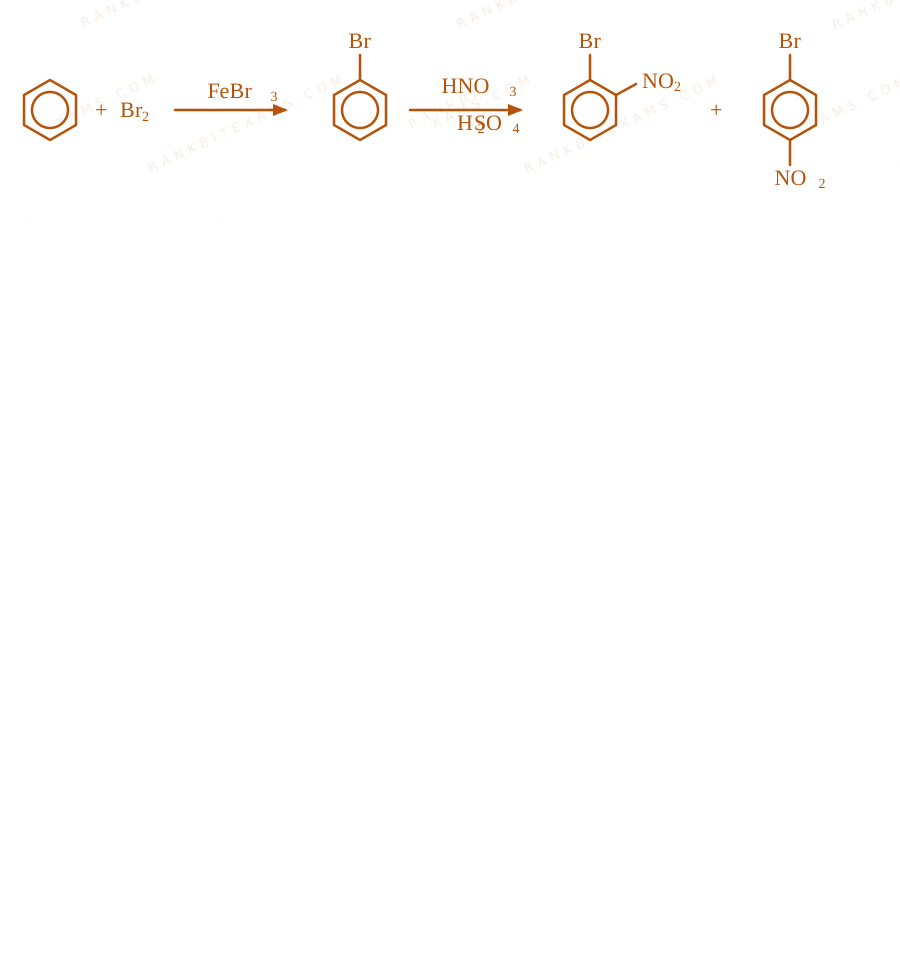
The reaction of Benzene with Br₂ / FeBr₃ yields Bromobenzene (A). Nitration of Bromobenzene (conc. HNO₃ / conc. H₂SO₄) yields a mixture of ortho-bromonitrobenzene (B) and para-bromonitrobenzene (C).

Separation of Ortho and Para isomers
Sequence of reactions on benzene yielding ortho and para substituted isomers.

Step 1: Justification of Separation Technique

The ortho and para isomers of bromonitrobenzene have differing boiling points but not sufficiently far apart for simple distillation. Thus, Fractional Distillation is the appropriate method to separate these positional isomers accurately based on slight differences in boiling points.

Pattern Recognition

Mixtures of isomeric organic liquids (like ortho/para derivatives) that differ mildly in boiling points are classically separated by fractional distillation.

Chapter Mix

Class 11 Chemistry: Organic Chemistry Some Basic Principles and Techniques Class 12 Chemistry: Haloalkanes and Haloarenes

Q74 jee_main_2026_28_january_morning Quantitative Analysis of Organic Compounds
0.53~g of an organic compound (x) when heated with excess of nitric acid (concentrated) and then with silver nitrate gave 0.75~g of silver bromide precipitate. 1.0~g of (x) gave 1.32~g of CO₂ gas on combustion. The percentage of hydrogen in the compound (x) is _____ %. [Nearest Integer] [Given : Molar mass in g~mol⁻¹ H : 1, C : 12, Br : 80, Ag : 108, O : 16; Compound (x) : CₓHyBrz]
Numerical Answer. Answer: 4 to 4

Solution

Step 1: Calculate Percentage of Carbon

1.0~g of compound gives 1.32~g of CO₂.\nMoles of CO₂ = (1.32)/(44) = 0.03~mol.\nMass of Carbon = 0.03 × 12 = 0.36~g.\nPercentage of C = ((0.36)/(1.0)) × 100 = 36%.

Step 2: Calculate Percentage of Bromine

0.53~g of compound gives 0.75~g of AgBr (Molar mass = 108 + 80 = 188~g/mol).\nMass of Br = ((80)/(188)) × 0.75 ≈ 0.319~g.\nPercentage of Br = ((0.319)/(0.53)) × 100 = 60.2%.

Step 3: Calculate Percentage of Hydrogen

The compound strictly consists of C, H, and Br (as formula is given as CₓHyBrz).\nPercentage of H = 100 - (%C + %Br)\nPercentage of H = 100 - (36 + 60.2) = 100 - 96.2 = 3.8%.\nRounding off to the nearest integer, we get 4%.

Pattern Recognition

For basic gravimetric elemental analysis: always map precipitate mass back to elemental mass using strict molar mass ratios, then find mass fractions, ensuring everything sums to 100%.

Chapter Mix

Class 11 Chemistry: Organic Chemistry Some Basic Principles and Techniques

More Organic Chemistry - Some Basic Principles and Techniques Questions — jee_main_2025_29_jan_evening

Practice all Organic Chemistry - Some Basic Principles and Techniques previous-year questions →

Rankbit System
JEE Physics: Waves (+15.5%) | Electrostatics: Concentric Shells (-29.7%) | Modern Physics: Photoelectric Clones (+34.2%) | Mathematics: Definite Integrals (+18.1%) | Chemistry: Coordination Splitting (-11.4%) | JEE Physics: Waves (+15.5%) | Electrostatics: Concentric Shells (-29.7%) | Modern Physics: Photoelectric Clones (+34.2%) | Mathematics: Definite Integrals (+18.1%) | Chemistry: Coordination Splitting (-11.4%)