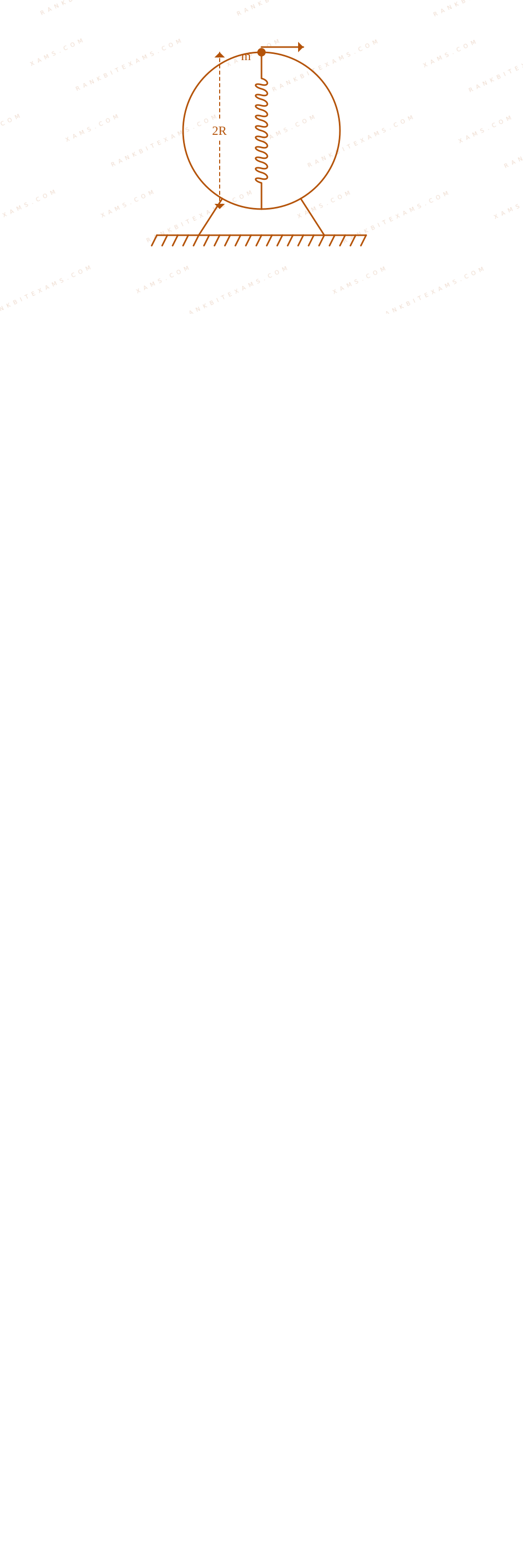
A bead of mass m$\mathrm{m}$ slides without friction on the wall of a vertical circular hoop of radius R$\mathrm{R}$ as shown in figure. The bead moves under the combined action of gravity and a massless spring (k) attached to the bottom of the hoop. The equilibrium length of the spring is R$\mathrm{R}$ . If the bead is released from top of the hoop with (negligible) zero initial speed, velocity of bead, when the length of spring becomes R$\mathrm{R}$ , would be (spring constant is k$\mathrm{k}$ , g is acceleration due to gravity)
A bead sliding along a vertical circular ring constrained by a tracking baseline spring system.
A.2 gR + kR²m$2 \sqrt{\mathrm{gR} + \frac{\mathrm{kR}^2}{\mathrm{m}}}$
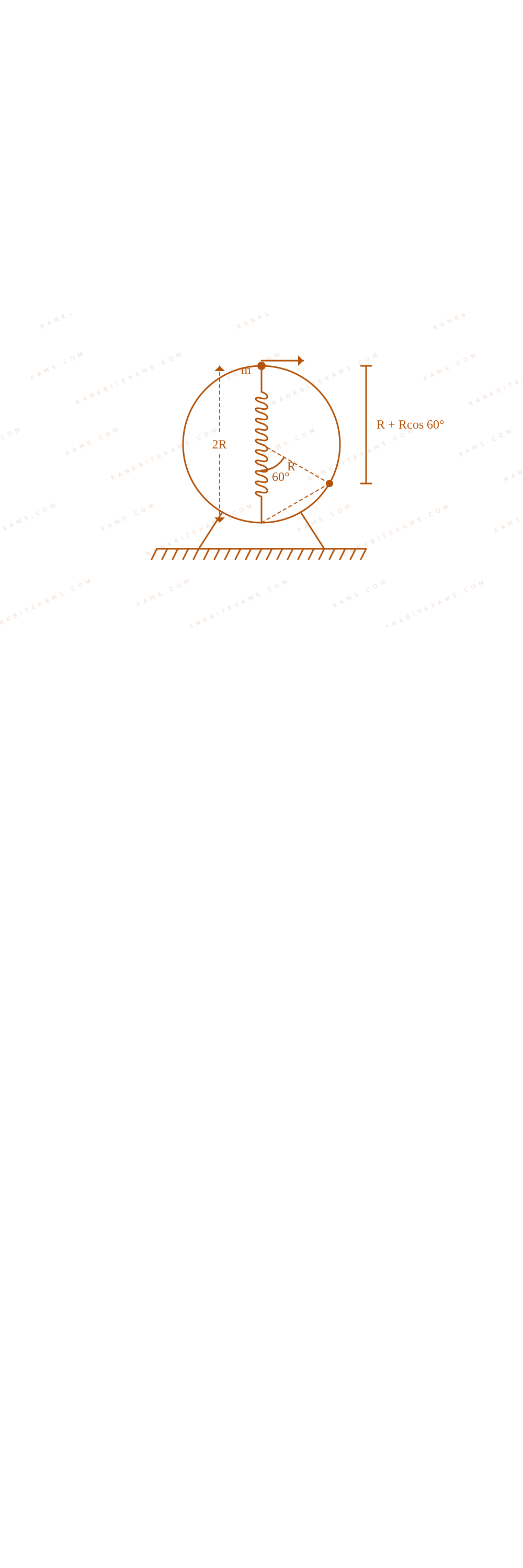
Let's apply the comprehensive Work-Energy theorem framework across key layout tracking nodes:
A bead sliding along a vertical circular ring constrained by a tracking baseline spring system.
Wall = Δ K$$\mathrm{W}_{\text{all}} = \Delta \mathrm{K}$$M g (R + R 60°) + (1)/(2) k (R² - 0²) = (1)/(2) m v²$$\mathrm{M g} (\mathrm{R} + \mathrm{R} \cos 60^{\circ}) + \frac{1}{2} \mathrm{k} (\mathrm{R}^2 - 0^2) = \frac{1}{2} \mathrm{m v}^2$$
Simplifying the gravitational shift and potential expansions:
M g 3R2 + kR²2 = (1)/(2) m v²$$\mathrm{M g} \frac{3\mathrm{R}}{2} + \frac{\mathrm{k}\mathrm{R}^2}{2} = \frac{1}{2} \mathrm{m v}^2$$
Step 1: Final Kinematic Value
v = 3gR + kR²m$$\mathrm{v} = \sqrt{3\mathrm{gR} + \frac{\mathrm{k}\mathrm{R}^2}{\mathrm{m}}}$$
Matches parameters specified by option (4).
Pattern Recognition
Isolate spring metrics at node points: Initial extension equals 2R - R = R$2\mathrm{R} - \mathrm{R} = \mathrm{R}$. Final extension is 0$0$ since spring length matching R$\mathrm{R}$ satisfies unextended conditions.
Chapter Mix
Class 11 Physics: Work, Energy and Power
Keywords:#Circular hoop#Massless spring#Work energy theorem
More Work, Energy and Power Previous-Year Questions — Page 6
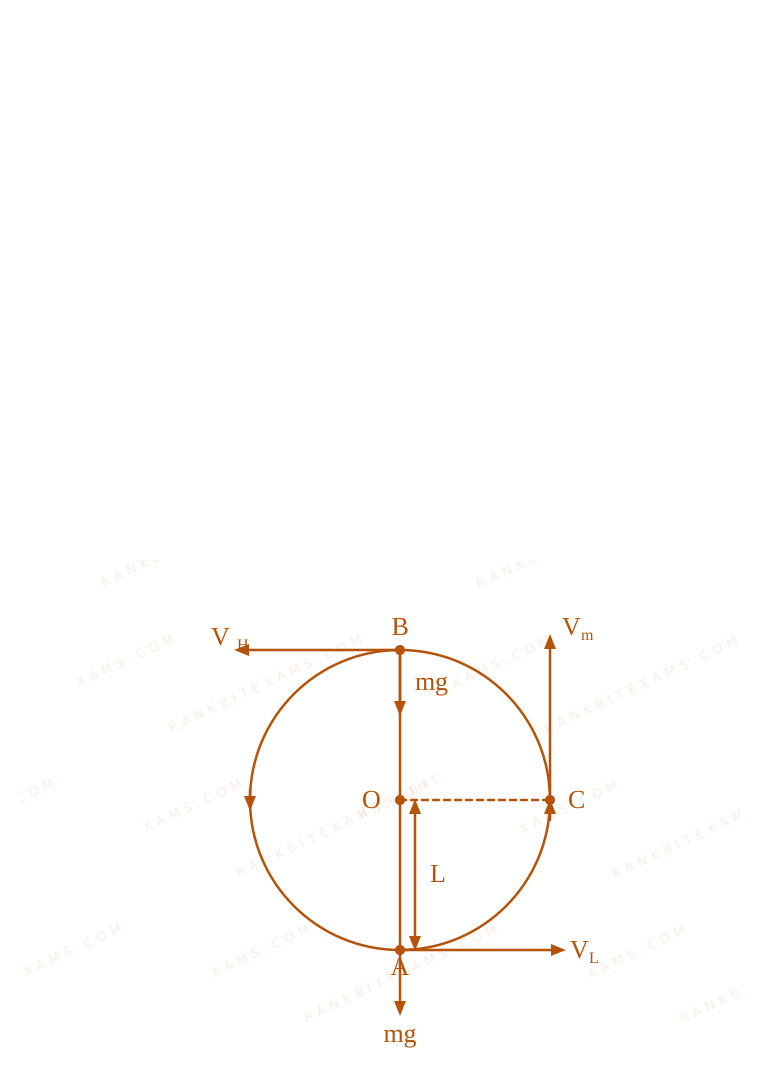
A bob of mass 'm$m$' is suspended by a light string of length 'L$L$'. It is imparted a minimum horizontal velocity at the lowest point A$A$ such that it just completes half circle reaching the top most position B$B$. The ratio of kinetic energies (K.E.)A(K.E.)B$\frac{(\mathrm{K.E.})_{\mathrm{A}}}{(\mathrm{K.E.})_{\mathrm{B}}}$ is:
The diagram displays a bob of mass m in vertical circular motion with velocity indicators at points A, B, and C.
A.3:2$3:2$
B.5:1$5:1$
C.2:5$2:5$
D.1:5$1:5$
Solution
Related Formula
For a body to just complete a vertical loop of radius L$L$:
Speed at the lowest point A$A$: vA = √(5gL)$v_A = \sqrt{5gL}$
Speed at the highest point B$B$: vB = √(gL)$v_B = \sqrt{gL}$
Since K.E. ∝ v²$\text{K.E.} \propto v^2$, the ratio of kinetic energies is simply the ratio of the squares of the critical velocities at the bottom and top of the vertical loop: (√(5gL))² : (√(gL))² = 5:1$(\sqrt{5gL})^2 : (\sqrt{gL})^2 = 5:1$.
Chapter Mix
Class 11 Physics: Work, Energy and Power
Q39jee_main_2024_27_jan_morningKinetic Energy and Momentum
Two bodies of mass 4 g$4\text{ g}$ and 25 g$25\text{ g}$ are moving with equal kinetic energies. The ratio of the magnitude of their linear momentum is:
A.3:5$3:5$
B.5:4$5:4$
C.2:5$2:5$
D.4:5$4:5$
Solution
Related Formula
K = (P²)/(2m) P = √(2mK)$$K = \frac{P^2}{2m} \implies P = \sqrt{2mK}$$
Where P$P$ is linear momentum, m$m$ is mass, and K$K$ is kinetic energy.
Core Logic
Given K₁ = K₂$K_1 = K_2$, the momentum ratio simplifies directly to the square root of their masses:
For constant kinetic energy tracking profiles, momentum maps proportionally to √(m)$\sqrt{m}$.
Chapter Mix
Class 11 Physics: Work, Energy and Power
Q37jee_main_2024_29_jan_morningPotential Energy and Force Relationship
The potential energy function (in J) of a particle in a region of space is given as U = (2x² + 3y³ + 2z)$U = (2x^2 + 3y^3 + 2z)$. Here x, y and z are in meter. The magnitude of x - component of force (in N) acting on the particle at point P (1, 2, 3) m is:
A. 2
B. 6
C. 4
D. 8
Solution
Related Formula
The force vector F$\vec{F}$ is related to the potential energy U$U$ by the negative gradient of potential energy:
F = - ∇ U = -( (∂ U)/(∂ x) i + (∂ U)/(∂ y) j + (∂ U)/(∂ z) k )$$\vec{F} = -\vec{\nabla} U = -\left( \frac{\partial U}{\partial x}\hat{i} + \frac{\partial U}{\partial y}\hat{j} + \frac{\partial U}{\partial z}\hat{k} \right)$$
When asked for a specific component (like x-component), only differentiate partially with respect to that specific variable. The remaining coordinates (y, z$y, z$) act purely as constants and vanish.
Chapter Mix
Class 11 Physics: Work, Energy and Power
Q37jee_main_2024_30_jan_morningConservation of Mechanical Energy
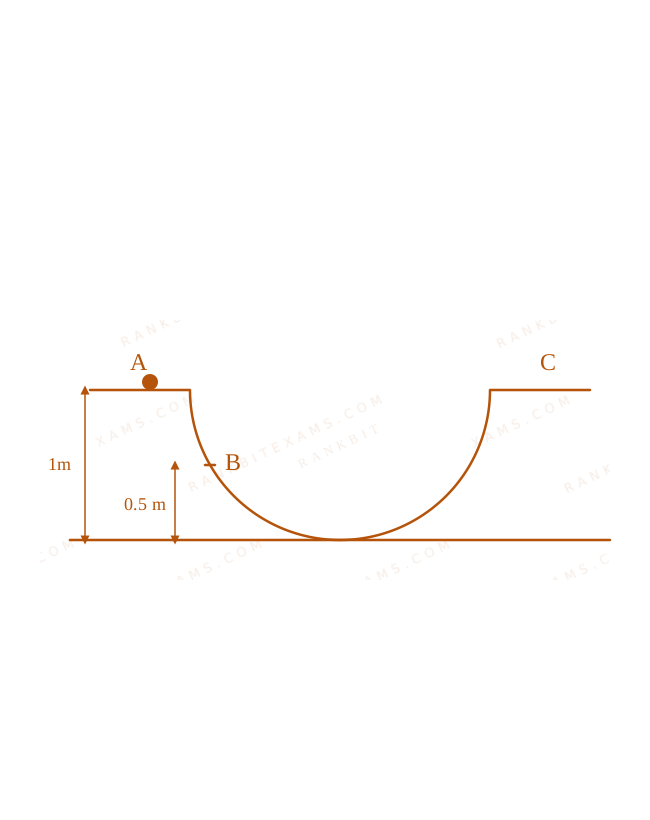
A particle is placed at the point A of a frictionless track ABC as shown in figure. It is gently pushed toward right. The speed of the particle when it reaches the point B is: (Take g = 10 ~m/s²$g = 10 \mathrm{~m/s^2}$).
A particle on a frictionless track moving from height 1m at point A to 0.5m at point B.
A.20 ~m / s$20 \mathrm{~m / s}$
B.√(10) ~m / s$\sqrt{10} \mathrm{~m / s}$
C.2 √(10) ~m / s$2 \sqrt{10} \mathrm{~m / s}$
D.10 ~m / s$10 \mathrm{~m / s}$
Solution
Related Formula
Kᵢ + Uᵢ = Kf + Uf$$K_i + U_i = K_f + U_f$$(1)/(2) m u² + mghᵢ = (1)/(2) m v² + mghf$$\frac{1}{2} m u^2 + mgh_i = \frac{1}{2} m v^2 + mgh_f$$
Core Logic
Since the track is frictionless, mechanical energy is conserved. We can apply the Principle of Conservation of Mechanical Energy (COME) between point A and point B.
Step 1: Apply Conservation of Energy
At point A (initially pushed gently, u ≈ 0$u \approx 0$):
For a mass sliding down a frictionless slope, its speed relies only on the vertical height dropped: v = √(2gΔ h)$v = \sqrt{2g\Delta h}$.
Chapter Mix
Class 11 Physics: Work, Energy and Power
Q48jee_main_2024_31_jan_eveningPower by a Variable Force
A body of mass 2 kg$2 \text{ kg}$ begins to move under the action of a time dependent force given by F = (6t i + 6t² j)N$\vec{F} = (6t\hat{i} + 6t^2\hat{j})\text{N}$. The power developed by the force at the time t$t$ is given by:
A.(6t⁴ + 9t⁵)W$(6t^4 + 9t^5)\text{W}$
B.(3t³ + 6t⁵)W$(3t^3 + 6t^5)\text{W}$
C.(9t⁵ + 6t³)W$(9t^5 + 6t^3)\text{W}$
D.(9t³ + 6t⁵)W$(9t^3 + 6t^5)\text{W}$
Solution
Related Formula
F = m a$$\vec{F} = m\vec{a}$$a = d vdt v = ∫ a dt$$\vec{a} = \frac{d\vec{v}}{dt} \implies \vec{v} = \int \vec{a} dt$$P = F · v$$P = \vec{F} \cdot \vec{v}$$
Core Logic
First find acceleration from force and mass. Then integrate acceleration to find the velocity vector at time t$t$ (starting from rest). Finally, compute the dot product of Force and Velocity to get instantaneous power.
Step 1: Calculate Acceleration
Given F = (6t i + 6t² j) N$\vec{F} = (6t\hat{i} + 6t^2\hat{j}) \text{ N}$ and m = 2 kg$m = 2 \text{ kg}$.
a = Fm = 6t i + 6t² j2$$\vec{a} = \frac{\vec{F}}{m} = \frac{6t\hat{i} + 6t^2\hat{j}}{2}$$a = (3t i + 3t² j) m/s²$$\vec{a} = (3t\hat{i} + 3t^2\hat{j}) \text{ m/s}^2$$
Step 2: Calculate Velocity
Assuming the body begins to move from rest (at t=0, v=0$t=0, v=0$):
When force varies as a polynomial in time tⁿ$t^n$, acceleration does too. Velocity jumps to tⁿ⁺¹$t^{n+1}$. Power (F · v$F \cdot v$) will result in terms behaving as t²ⁿ⁺¹$t^{2n+1}$. Here t → t³$t \to t^3$ and t² → t⁵$t^2 \to t^5$.
Chapter Mix
Class 11 Physics: Work, Energy and Power
Class 11 Physics: Motion in a Plane
More Work, Energy and Power Questions — jee_main_2025_28_jan_morning
Practice past-year questions one chapter at a time. Pick an exam → subject → chapter and get every PYQ for that topic — pulled together from all past papers — with the chapter's key formulas alongside.