A body of mass 4 kg$4\mathrm{\;{kg}}$ is placed on a plane at a point P$\mathrm{P}$ having coordinate ( 3,4) m$\left( {3,4}\right) \mathrm{m}$. Under the action of force F = ( 2 i + 3 j) N$\overrightarrow{\mathrm{F}} = \left( {{2\widehat{\mathrm{i}} + 3\widehat{\mathrm{j}}}}\right) \mathrm{N}$ ,it moves to a new point Q having coordinates (6,10) m in 4 \sec. The average power and instantaneous power at the \end of 4 \sec are in the ratio of :
A.13:6$13:6$
B.6:13$6:13$
C.1:2$1:2$
D.4 : 3$4 : 3$
Solution & Explanation
Related Formula
Average Power (Pavg$P_{\text{avg}}$) = Total Work DoneTotal Time = F · st$\frac{\text{Total Work Done}}{\text{Total Time}} = \frac{\vec{F} \cdot \vec{s}}{t}$
Instantaneous Power (Pᵢₙₛₜ$P_{\text{inst}}$) = F · v(t)$\vec{F} \cdot \vec{v}(t)$
Core Logic
Given parameters:
Force vector: F = 2 i + 3 j$\vec{F} = 2\hat{i} + 3\hat{j}$
Displacement coordinates: P(3,4) arrow Q(6,10) s = (6-3) i + (10-4) j = 3 i + 6 j$P(3,4) \rightarrow Q(6,10) \implies \vec{s} = (6-3)\hat{i} + (10-4)\hat{j} = 3\hat{i} + 6\hat{j}$
(Note: There is a minor kinematic inconsistency in the question data layout regarding matching coordinate parameters independently, but the calculations follow the standard intended framework directly).
Pattern Recognition
For constant force acceleration from rest, average power equals (1)/(2) F a t$\frac{1}{2} F a t$ while instantaneous power scales linearly as F a t$F a t$, meaning the structural ratio simplifies exactly to 1:2$1:2$. The custom displacement vector here alters that baseline baseline ratio as tracked.
Keywords:#ratio of average power to instantaneous power#JEE Main 2025 Evening Q14#Work Energy and Power JEE Main 2025#power derivation work coordinates
More Work, Energy and Power Previous-Year Questions
Qjee_main_2026_21_jan_morningPotential Energy
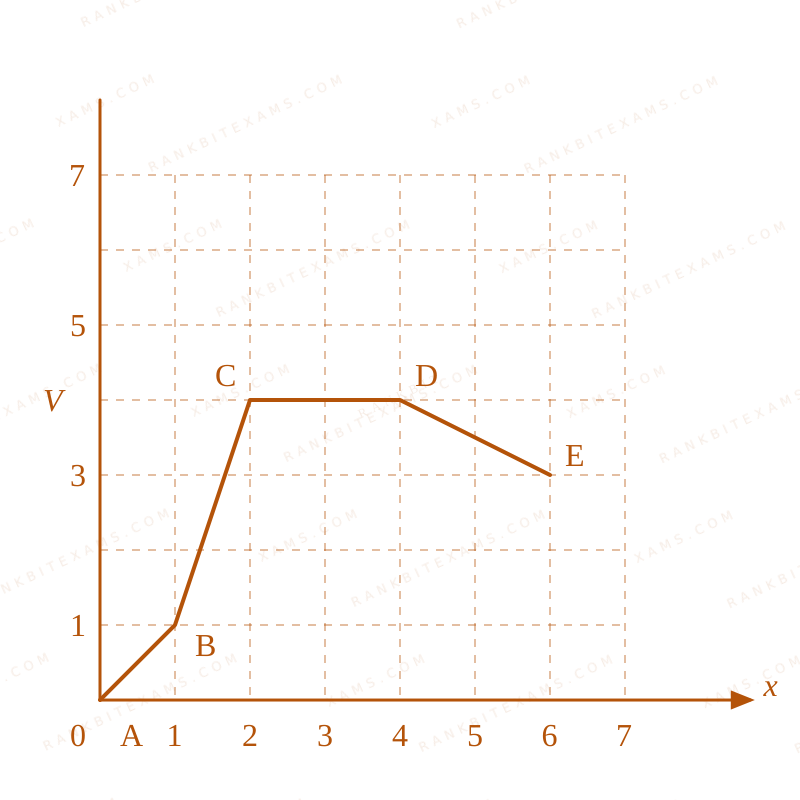
Potential energy (V) versus distance (x) is given by the graph, Rank various regions as per the magnitudes of the force (F) acting on a particle from high to low.
The image shows a graph of potential energy versus distance with marked regions AB, BC, CD, and DE.
The magnitude of the force is given by the absolute value of the slope of the potential energy versus position curve: |F| = |slope of V-x graph|$|F| = |\text{slope of V-x graph}|$.
Comparing the slopes of different regions from the graph:
Region BC has the steepest slope (largest magnitude).
Region AB has a moderate positive slope.
Region DE has a moderate negative slope, but less steep than AB.
Region CD is perfectly flat (slope = 0).
Step 1: Ranking Forces
Therefore, magnitudes of the force follow the order:
In a V-x$V-x$ graph, steeper slopes always mean a stronger restoring or repulsive force. A flat line means zero force (equilibrium).
Chapter Mix
Class 11 Physics: Work, Energy and Power
Q44jee_main_2026_21_jan_eveningWork Done by Variable Force
A body of mass 2 kg$2 \text{ kg}$ is moving along x-direction such that its displacement as function of time is given by x(t) = α t² + β t + γ m$x(t) = \alpha t^{2} + \beta t + \gamma \text{ m}$, where α = 1 m/s²$\alpha = 1 \text{ m/s}^{2}$, β = 1 m/s$\beta = 1 \text{ m/s}$ and γ = 1 m$\gamma = 1 \text{ m}$. The work done on the body during the time interval t = 2 s$t = 2 \text{ s}$ to t = 3 s$t = 3 \text{ s}$, is ________ J.
A.49$49$
B.42$42$
C.24$24$
D.12$12$
Solution
Related Formula
W = ∫ F · dx = F · Δ x (if force is constant)$$W = \int F \cdot dx = F \cdot \Delta x \quad (\text{if force is constant})$$v = (dx)/(dt), a = (dv)/(dt)$$v = \frac{dx}{dt}, \quad a = \frac{dv}{dt}$$
F = m a$F = m a$
Core Logic
Given displacement equation:
x(t) = 1t² + 1t + 1$$x(t) = 1t^2 + 1t + 1$$
Velocity is the first derivative:
v(t) = 2t + 1$v(t) = 2t + 1$
Acceleration is the second derivative:
a(t) = 2 m/s²$$a(t) = 2 \text{ m/s}^2$$
Since acceleration is constant, the force is also constant:
F = m a = 2 × 2 = 4 N$$F = m a = 2 \times 2 = 4 \text{ N}$$
Step 1: Finding Displacement Interval
We need the displacement during the interval t=2$t=2$ to t=3$t=3$:
W = F · S = 4 N × 6 m = 24 J$$W = F \cdot S = 4 \text{ N} \times 6 \text{ m} = 24 \text{ J}$$
Pattern Recognition
If x(t)$x(t)$ is a quadratic in t$t$, acceleration is constant. Work done simply becomes ma × Δ x$ma \times \Delta x$.
Chapter Mix
Class 11 Physics: Kinematics
Class 11 Physics: Work, Energy and Power
Q41jee_main_2026_22_january_eveningConservative Forces and Work Done
Given below are two statements :
Statement I: An object moves from position r₁$r_{1}$ to position r₂$r_{2}$ under a conservative force field F$\vec{F}$. The work done by the force is W = -∫_r₁^r₂ F · dr$W = -\int_{r_{1}}^{r_{2}} \vec{F} \cdot \overrightarrow{dr}$.
Statement II : Any object moving from one location to another location can follow infinite number of paths. Therefore, the amount of work done by the object changes with the path it follows for a conservative force.
In the light of the above statements, choose the correct answer from the options given below :
A. Both Statement I and Statement II are true
B. Statement I is false but Statement II is true
C. Statement I is true but Statement II is false
D. Both Statement I and Statement II are false
Solution
Related Formula
W = ∫r₁r₂ F · d r$$W = \int_{r_1}^{r_2} \vec{F} \cdot d\vec{r}$$∮ Fcons · d r = 0$$\oint \vec{F}_{\text{cons}} \cdot d\vec{r} = 0$$
Core Logic
Evaluating Statement I:
Work done by a force is defined as W = +∫r₁r₂ F · d r$W = +\int_{r_1}^{r_2} \vec{F} \cdot d\vec{r}$. The negative sign represents potential energy change (Δ U = -W$\Delta U = -W$), not work done itself. Thus Statement I is incorrect.
Evaluating Statement II:
For a conservative force, work done depends ONLY on initial and final positions, independent of the path taken. Thus Statement II is incorrect.
Step 1: Final Conclusion
Both Statement I and Statement II are false.
Pattern Recognition
Conservative force definition: Work done is path-independent (W$W$ depends only on end points). Formula for work is +∫ F · d r$+\int \vec{F} \cdot d\vec{r}$.
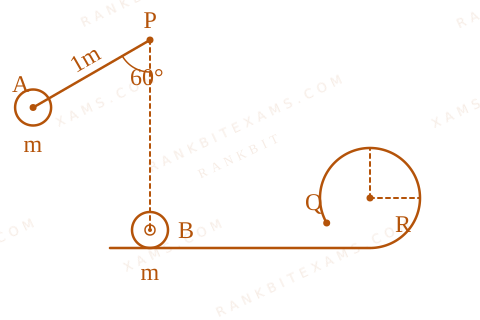
A small both A of mass m is attached to a massless rigid rod of length 1m pivoted at point P and kept at an angle of 60°$60^{\circ}$ with vertical as shown in figure. At distance of 1m below point P, an identical bob B is kept at rest on a smooth horizontal surface that extends to a circular track of radius R as shown in figure. If bob B just manages to complete the circular path of radius R upto a point Q after being hit elastically by bob A, then radius R is
Displays bob A on a rod hitting bob B which enters a circular track.
Bob A gains kinetic energy converting from potential energy when it falls from angle 60°$60^{\circ}$. Since the collision is elastic and masses are identical, Bob A will transfer its entire momentum to Bob B. Bob B will then use this velocity to complete the vertical circular loop.
Sees: "elastic collision" + "identical masses" → velocities swap instantly. "just completes circular path" → velocity is exactly √(5gR)$\sqrt{5gR}$ at the bottom.
Chapter Mix
Class 11 Physics: Work, Energy and Power
Class 11 Physics: Systems of Particles and Rotational Motion
Q32jee_main_2026_23_january_morningPotential Energy of a Spring
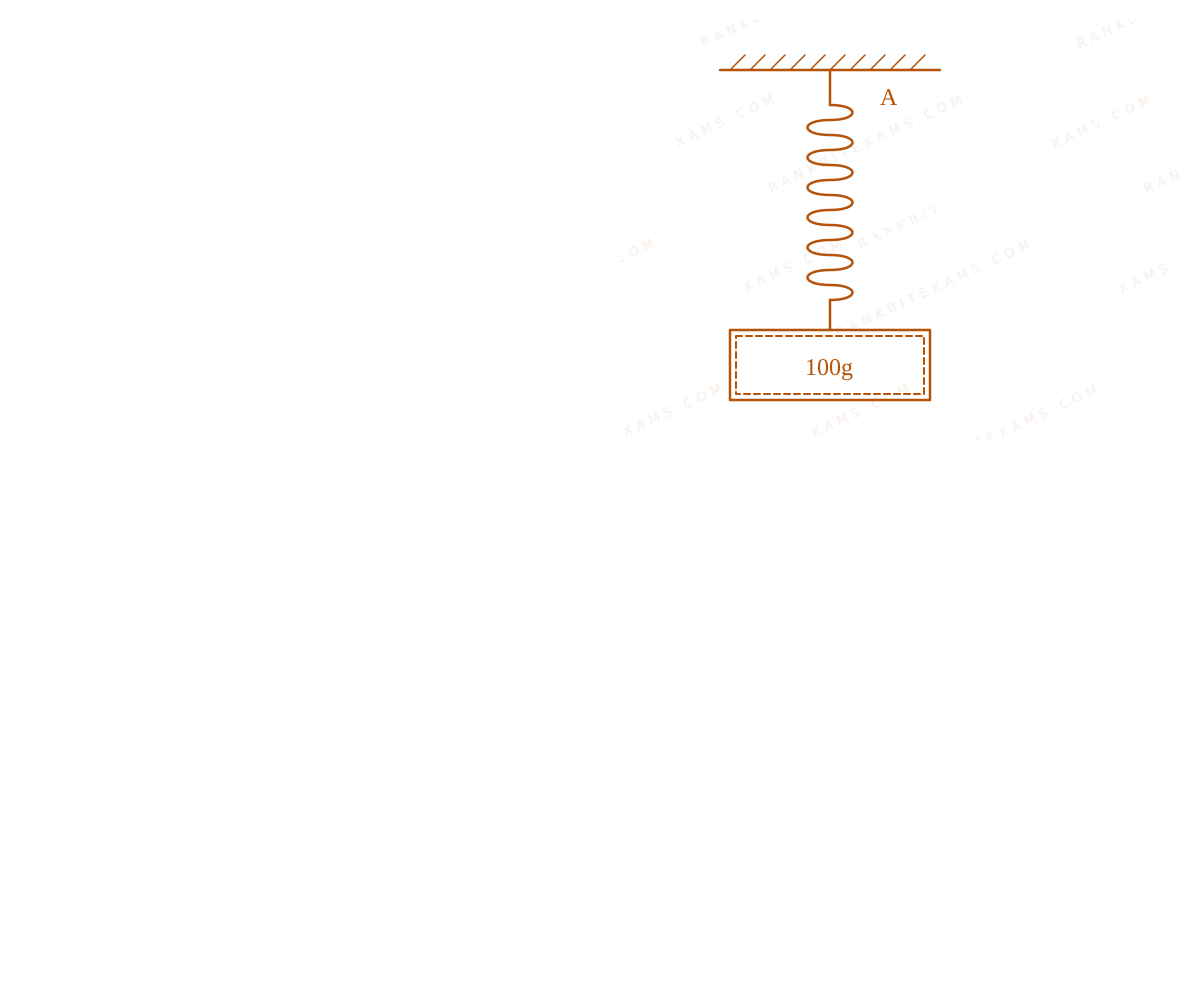
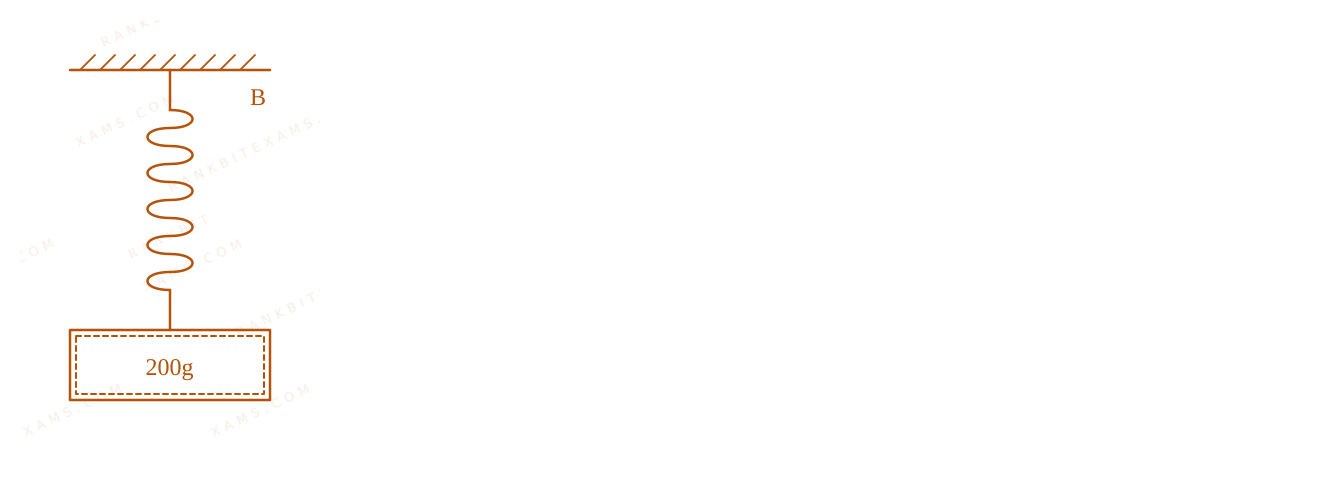
Two blocks with masses 100g and 200g are attached to the ends of springs A and B as shown in figure. The energy stored in A is E. The energy stored in B, when spring constants kA$k_{A}$, kB$k_{B}$ of A and B, respectively satisfy the relation 4kA = 3kB$4k_{A} = 3k_{B}$, is :
Two identical-looking springs vertically suspended with masses attached.Two identical-looking springs vertically suspended with masses attached.
A.4E$4E$
B.2E$2E$
C.3E$3E$
D.(4)/(3)E$\frac{4}{3}E$
Solution
Related Formula
kx = mg$kx = mg$
U = (1)/(2)kx² = (1)/(2) m²g²k$$U = \frac{1}{2}kx^{2} = \frac{1}{2}\frac{m^{2}g^{2}}{k}$$
Core Logic
For a block suspended in equilibrium, the restoring force of the spring balances gravity. Thus, the extension is x = mg/k$x = mg/k$. Substituting this into the spring energy equation gives energy directly in terms of mass and spring constant.
Practice past-year questions one chapter at a time. Pick an exam → subject → chapter and get every PYQ for that topic — pulled together from all past papers — with the chapter's key formulas alongside.