JEE Main · Physics ↓ Falling

Work, Energy and Power appeared 31 times across 3 years — 3.6% of Physics. This question is from Conservation of Mechanical Energy.

Year 2026 2025 2024 Total
Questions 8 15 8 31

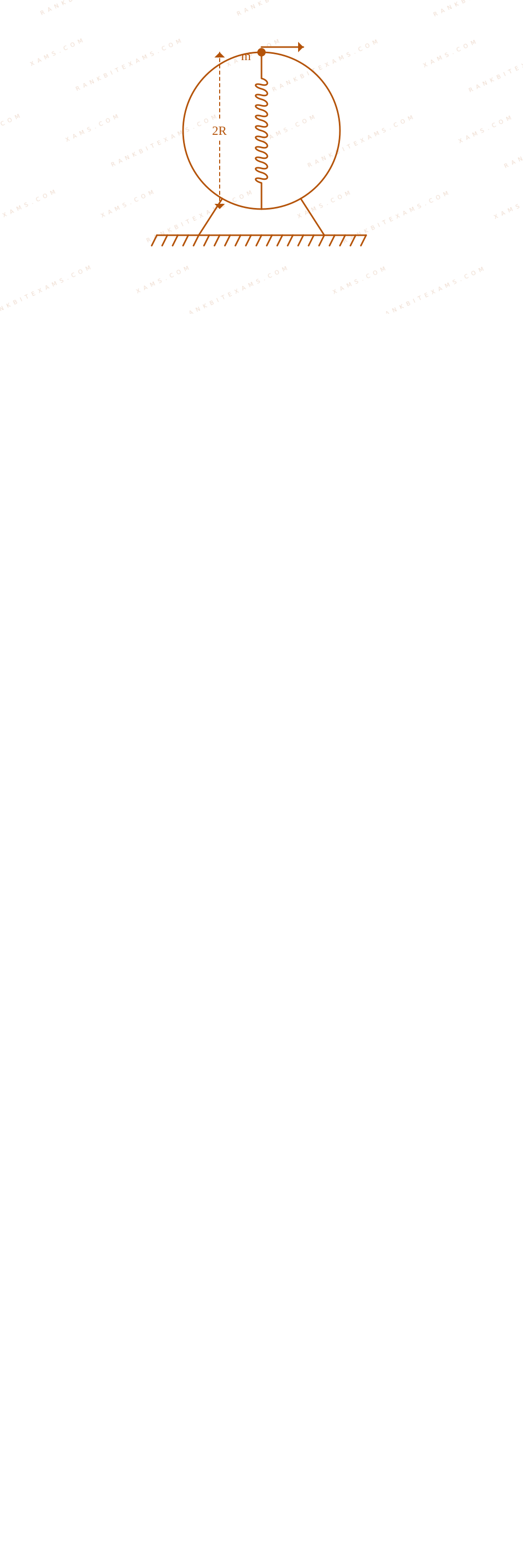
A bead of mass m slides without friction on the wall of a vertical circular hoop of radius R as shown in figure. The bead moves under the combined action of gravity and a massless spring (k) attached to the bottom of the hoop. The equilibrium length of the spring is R . If the bead is released from top of the hoop with (negligible) zero initial speed, velocity of bead, when the length of spring becomes R , would be (spring constant is k , g is acceleration due to gravity)
Conservation of Mechanical Energy diagram for Q10 - JEE Main 2025 Morning
A bead sliding along a vertical circular ring constrained by a tracking baseline spring system.

Solution & Explanation

Core Logic

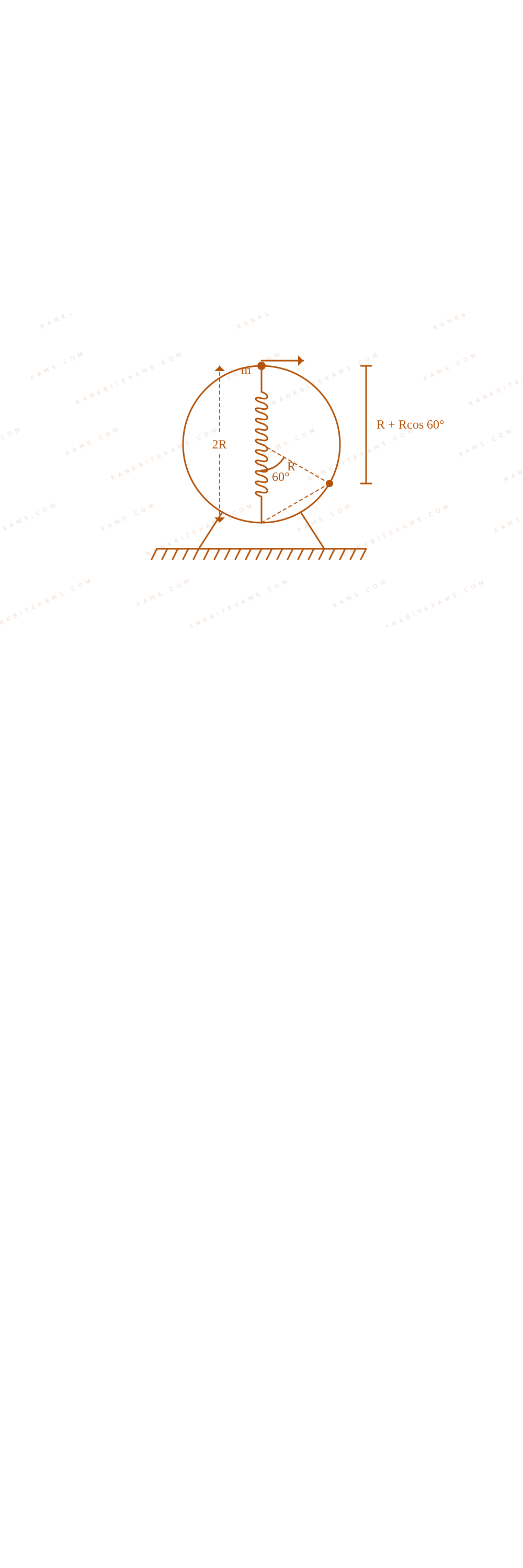
Let's apply the comprehensive Work-Energy theorem framework across key layout tracking nodes:

Geometric resolution angle resolution profile for Q10
A bead sliding along a vertical circular ring constrained by a tracking baseline spring system.

Wall = Δ K M g (R + R 60°) + (1)/(2) k (R² - 0²) = (1)/(2) m v²

Simplifying the gravitational shift and potential expansions:

M g 3R2 + kR²2 = (1)/(2) m v²
Step 1: Final Kinematic Value
v = 3gR + kR²m

Matches parameters specified by option (4).

Pattern Recognition

Isolate spring metrics at node points: Initial extension equals 2R - R = R. Final extension is 0 since spring length matching R satisfies unextended conditions.

Chapter Mix

Class 11 Physics: Work, Energy and Power

More Work, Energy and Power Previous-Year Questions — Page 7

Q49 jee_main_2024_31_jan_morning Conservation Of Momentum
An artillery piece of mass M₁ fires a shell of mass M₂ horizontally. Instantaneously after the firing, the ratio of kinetic energy of the artillery and that of the shell is :
  • A. M₁ / (M₁ + M₂)
  • B. (M₂)/(M₁)
  • C. M₂ / (M₁ + M₂)
  • D. (M₁)/(M₂)

Solution

Related Formula
KE = (p²)/(2m)
Core Logic

By conservation of linear momentum (since no external horizontal force acts on the system):

0 = M₁ v₁ + M₂ v₂ | p₁| = | p₂| = p

Both the artillery and the shell acquire the exact same magnitude of momentum during firing.

Step 2: Kinetic Energy Ratio

The kinetic energy is related to momentum by KE = (p²)/(2m). Since p is identical for both bodies:

KE ∝ (1)/(m)

Therefore, the ratio of kinetic energy of the artillery (M₁) to the shell (M₂) is:

KE₁KE₂ = ((p²)/(2M₁))/((p²)/(2M₂)) = (M₂)/(M₁)
Chapter Mix

Class 11 Physics: Work, Energy And Power

More Work, Energy and Power Questions — jee_main_2025_28_jan_morning

Practice all Work, Energy and Power previous-year questions →

Rankbit System
JEE Physics: Waves (+15.5%) | Electrostatics: Concentric Shells (-29.7%) | Modern Physics: Photoelectric Clones (+34.2%) | Mathematics: Definite Integrals (+18.1%) | Chemistry: Coordination Splitting (-11.4%) | JEE Physics: Waves (+15.5%) | Electrostatics: Concentric Shells (-29.7%) | Modern Physics: Photoelectric Clones (+34.2%) | Mathematics: Definite Integrals (+18.1%) | Chemistry: Coordination Splitting (-11.4%)