JEE Main · Physics ↓ Falling

Work, Energy and Power appeared 31 times across 3 years — 3.6% of Physics. This question is from Conservation of Mechanical Energy.

Year 2026 2025 2024 Total
Questions 8 15 8 31

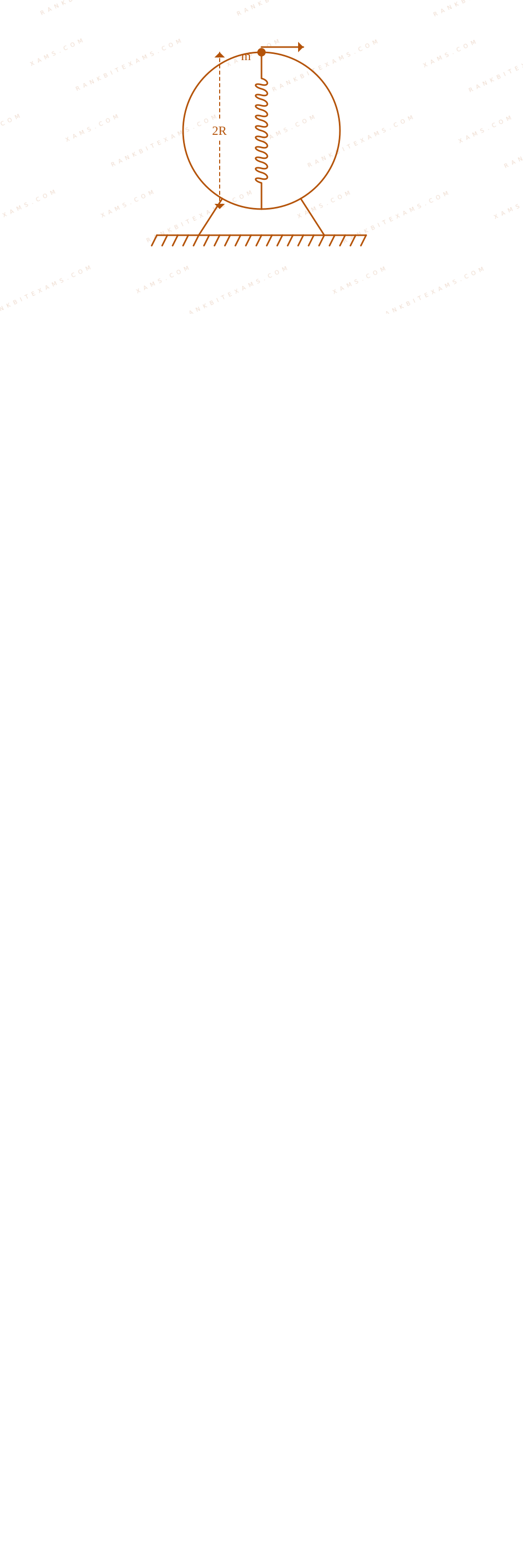
A bead of mass m slides without friction on the wall of a vertical circular hoop of radius R as shown in figure. The bead moves under the combined action of gravity and a massless spring (k) attached to the bottom of the hoop. The equilibrium length of the spring is R . If the bead is released from top of the hoop with (negligible) zero initial speed, velocity of bead, when the length of spring becomes R , would be (spring constant is k , g is acceleration due to gravity)
Conservation of Mechanical Energy diagram for Q10 - JEE Main 2025 Morning
A bead sliding along a vertical circular ring constrained by a tracking baseline spring system.

Solution & Explanation

Core Logic

Let's apply the comprehensive Work-Energy theorem framework across key layout tracking nodes:

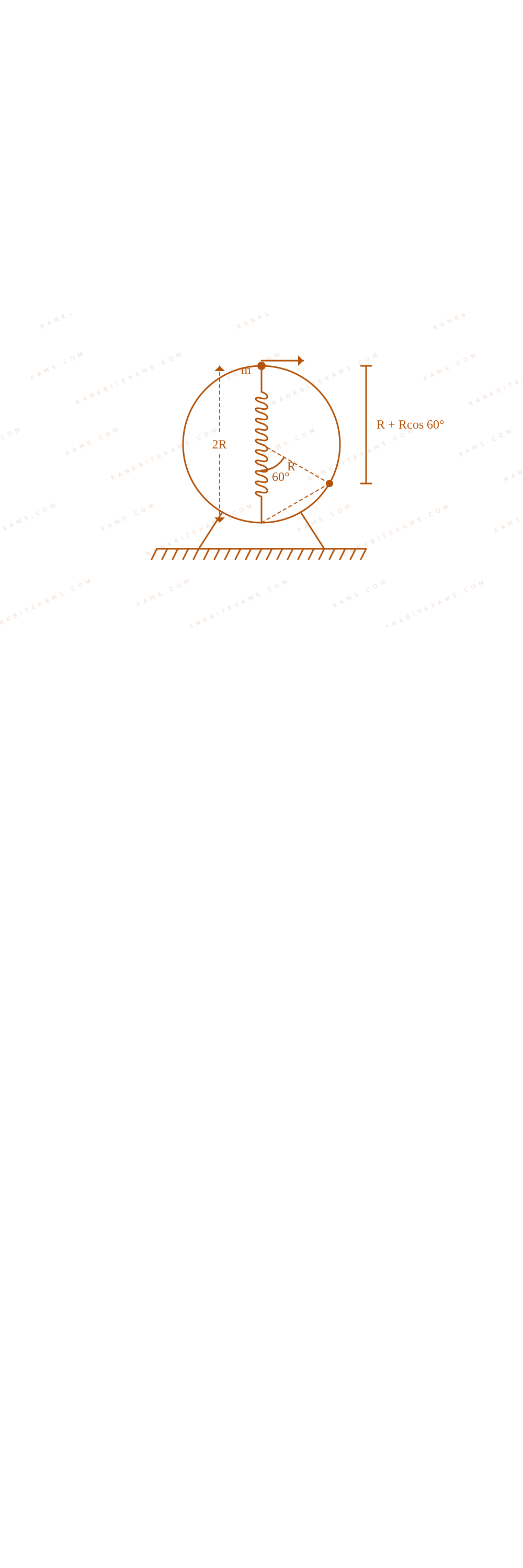
Geometric resolution angle resolution profile for Q10
A bead sliding along a vertical circular ring constrained by a tracking baseline spring system.

Wall = Δ K M g (R + R 60°) + (1)/(2) k (R² - 0²) = (1)/(2) m v²

Simplifying the gravitational shift and potential expansions:

M g 3R2 + kR²2 = (1)/(2) m v²
Step 1: Final Kinematic Value
v = 3gR + kR²m

Matches parameters specified by option (4).

Pattern Recognition

Isolate spring metrics at node points: Initial extension equals 2R - R = R. Final extension is 0 since spring length matching R satisfies unextended conditions.

Chapter Mix

Class 11 Physics: Work, Energy and Power

More Work, Energy and Power Previous-Year Questions — Page 5

Q14 jee_main_2025_28_jan_evening Average and Instantaneous Power
A body of mass 4 kg is placed on a plane at a point P having coordinate ( 3,4) m. Under the action of force F = ( 2 i + 3 j) N ,it moves to a new point Q having coordinates (6,10) m in 4 \sec. The average power and instantaneous power at the \end of 4 \sec are in the ratio of :
  • A. 13:6
  • B. 6:13
  • C. 1:2
  • D. 4 : 3

Solution

Related Formula
  • Average Power (Pavg) = Total Work DoneTotal Time = F · st
  • Instantaneous Power (Pᵢₙₛₜ) = F · v(t)
Core Logic

Given parameters:

  • Force vector: F = 2 i + 3 j
  • Displacement coordinates: P(3,4) arrow Q(6,10) s = (6-3) i + (10-4) j = 3 i + 6 j
  • Time window, t = 4 s
  • Calculate Average Power :

W = F · s = (2 i + 3 j) · (3 i + 6 j) = (2 × 3) + (3 × 6) = 6 + 18 = 24 J Pavg = (W)/(t) = (24)/(4) = 6 W

Now, analyze the instantaneous dynamics to extract final velocity v at t=4 s: Acceleration vector : a = Fm = 2 i + 3 j4 = 0.5 i + 0.75 j

Assuming the body starts from rest, velocity at t=4 s is :

v = a · t = (0.5 i + 0.75 j) × 4 = 2 i + 3 j

Calculate Instantaneous Power at t=4 s :

Pᵢₙₛₜ = F · v = (2 i + 3 j) · (2 i + 3 j) = 2² + 3² = 4 + 9 = 13 W

Taking the final ratio :

PavgPᵢₙₛₜ = (6)/(13)

(Note: There is a minor kinematic inconsistency in the question data layout regarding matching coordinate parameters independently, but the calculations follow the standard intended framework directly).

Pattern Recognition

For constant force acceleration from rest, average power equals (1)/(2) F a t while instantaneous power scales linearly as F a t, meaning the structural ratio simplifies exactly to 1:2. The custom displacement vector here alters that baseline baseline ratio as tracked.

Chapter Mix

Class 11 Physics: Work, Energy and Power

Q jee_main_2025_29_jan_morning Collisions
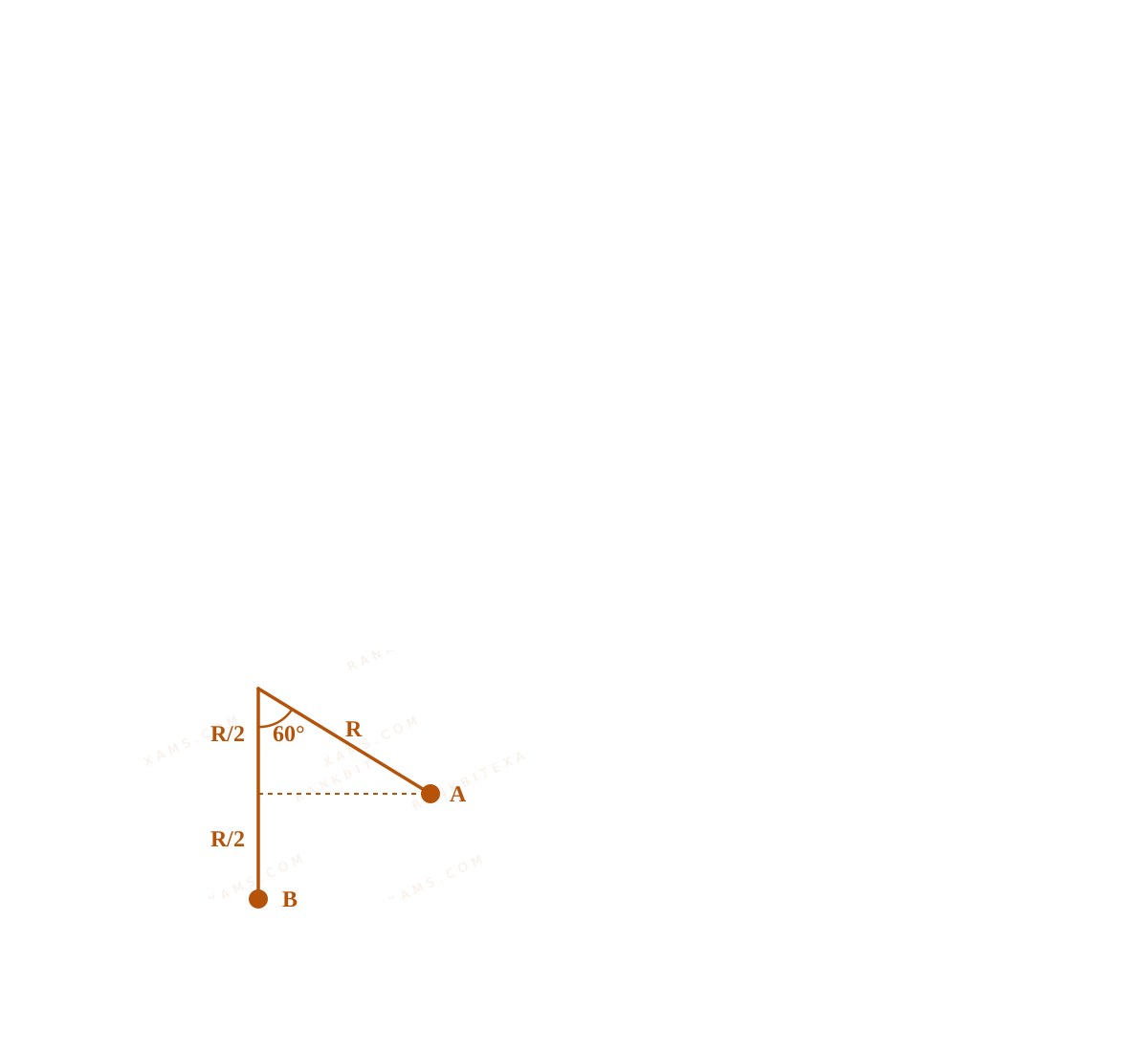
As shown below, bob A of a pendulum having massless string of length 'R' is released from 60° to the vertical. It hits another bob B of half the mass that is at rest on a friction less table in the centre. Assuming elastic collision, the magnitude of the velocity of bob A after the collision will be (take g as acceleration due to gravity)
Collisions diagram for Q10 - JEE Main 2025 Morning
The diagram displays a pendulum bob A suspended at an angle of 60 degrees ready to strike bob B at the lowest equilibrium center point.
  • A. (1)/(3) Rg
  • B. Rg
  • C. (4)/(3) Rg
  • D. (2)/(3) Rg

Solution

Related Formula
u = √(2gh) = √(2gR(1 - θ)) v₁ = ((m₁ - m₂)/(m₁ + m₂))u + ((2m₂)/(m₁ + m₂))v₂i
Core Logic

Collisions explanation diagram for Q10
The diagram displays a pendulum bob A suspended at an angle of 60 degrees ready to strike bob B at the lowest equilibrium center point.

Velocity of bob A just prior to collision :

u = 2g(R - R 60°) = √(2g(R)/(2)) = √(gR)

Using conservation of momentum and coefficient of restitution e=1 for elastic interaction [cite: 660, 662]:

mA u = mA v₁ + mB v₂ m u = m v₁ + (m)/(2) v₂ 2v₁ + v₂ = 2u
Step 1: Apply Restitution Velocity Difference

v₂ - v₁ = u Subtracting equations yields :

3v₁ = u v₁ = (u)/(3) = (1)/(3)√(gR)
Pattern Recognition

In an elastic head-on collision where one body hits half its mass at rest, it retains exactly one-third of its initial hitting speed[cite: 661, 663].

Chapter Mix

Class 11 Physics: Work, Energy and Power

Q jee_main_2025_29_jan_morning Vertical Circular Motion
A body of mass 'm' connected to a massless and unstretchable string goes in a vertical circle of radius 'R' under gravity g. The other end of the string is fixed at the center of a circle. If velocity at top of circular path is n √(gR) , where, n ≥ 1 , then ratio of kinetic energy of the body at bottom to that at top of the circle is
  • A. nn + 4
  • B. n + 4n
  • C. n²n² + 4
  • D. n² + 4n²

Solution

Related Formula
VBottom = VTop² + 4gR
Core Logic

Given velocity at the top position :

VTop = √(n² gR)

By work-energy theorem, mechanical energy conservation between the top and bottom positions gives :

VBottom = √(n² gR + 4gR)

Since KE = (1)/(2)m v², the ratio of kinetic energy at the bottom to that at the top is

Ratio = VBottom²VTop² = (n² gR + 4gR)/(n² gR) = (n² + 4)/(n²)
Pattern Recognition

Kinetic energy change in vertical circles always gains a fixed additive value of 2mg(2R) = 4mgR due to gravity work.

Chapter Mix

Class 11 Physics: Work, Energy and Power

Q jee_main_2024_01_february_morning Collisions
A simple pendulum of length 1~m has a wooden bob of mass 1~kg. It is struck by a bullet of mass 10⁻²~kg moving with a speed of 2 × 10²~ms⁻¹. The bullet gets embedded into the bob. The height to which the bob rises before swinging back is (use g = 10~m/s²):
  • A. 0.30 m
  • B. 0.20 m
  • C. 0.35 m
  • D. 0.40 m

Solution

Related Formula

Conservation of Linear Momentum during embedded collision:

mu = (M + m)V

Conservation of Mechanical Energy during vertical rise:

(1)/(2)(M+m)V² = (M+m)gh h = (V²)/(2g)
Core Logic

Given data: m = 10⁻²~kg, u = 2 × 10²~ms⁻¹, M = 1~kg, g = 10~m/s².

Apply momentum balance:

10⁻² × (2 × 10²) = (1 + 0.01)V 2 = 1.01V V ≈ 2~ms⁻¹ (since 1.01 ≈ 1)
Step 1: Compute Maximum Rise Height

Using the work-energy relation for the subsequent upward swing:

h = (V²)/(2g) = (2²)/(2 × 10) = (4)/(20) = 0.20~m
Pattern Recognition

Perfectly inelastic collision approximation: because m ll M, we can simplify M+m ≈ M during velocity matching to complete the calculation rapidly.

Chapter Mix

Class 11 Physics: Work, Energy and Power Class 11 Physics: Laws of Motion

Q37 jee_main_2024_29_january_evening Conservation of Mechanical Energy
The bob of a pendulum was released from a horizontal position. The length of the pendulum is 10 m. If it dissipates 10% of its initial energy against air resistance, the speed with which the bob arrives at the lowest point is: [Use g = 10 m s⁻²]
  • A. 6√(5) m s⁻¹
  • B. 5√(6) m s⁻¹
  • C. 5√(5) m s⁻¹
  • D. 2√(5) m s⁻¹

Solution

Related Formula

Potential energy at the horizontal release point relative to the lowest point:

Uᵢ = mg

If 10% of energy is dissipated, the remaining 90% is converted entirely to kinetic energy at the lowest point:

Ef = 0.90 × Uᵢ = (1)/(2)mv²
Core Logic

Let the horizontal position be our reference for potential energy relative to the lowest point.

  • Initial potential energy: Uᵢ = mg
  • Energy remaining after 10% loss: 0.90(mg )
  • Equating this to kinetic energy at the bottom:

(9)/(10) mg = (1)/(2) mv²
Step 1: Calculate the Velocity

We can cancel m from both sides:

(9)/(10) g = (1)/(2) v²

Substitute = 10 m and g = 10 m s⁻²:

(9)/(10) (10)(10) = (1)/(2) v² 90 = (1)/(2) v² v² = 180 v = √(180) = √(36 × 5) = 6√(5) m s⁻¹

Pendulum trajectory diagram for Q37

Pattern Recognition

Whenever there is a fractional energy loss x, use the formula: v = √(2(1-x)g ). Substituting x = 0.1 gives v = √(1.8g ) directly.

Chapter Mix

Class 11 Physics: Work, Energy and Power

More Work, Energy and Power Questions — jee_main_2025_28_jan_morning

Practice all Work, Energy and Power previous-year questions →

Rankbit System
JEE Physics: Waves (+15.5%) | Electrostatics: Concentric Shells (-29.7%) | Modern Physics: Photoelectric Clones (+34.2%) | Mathematics: Definite Integrals (+18.1%) | Chemistry: Coordination Splitting (-11.4%) | JEE Physics: Waves (+15.5%) | Electrostatics: Concentric Shells (-29.7%) | Modern Physics: Photoelectric Clones (+34.2%) | Mathematics: Definite Integrals (+18.1%) | Chemistry: Coordination Splitting (-11.4%)