Given below are two statements :
Statement I: An object moves from position r_1$r_{1}$ to position r_2$r_{2}$ under a conservative force field vecF$\vec{F}$. The work done by the force is W = -int_r_1^r_2 vecF cdot overrightarrowdr$W = -\int_{r_{1}}^{r_{2}} \vec{F} \cdot \overrightarrow{dr}$.
Statement II : Any object moving from one location to another location can follow infinite number of paths. Therefore, the amount of work done by the object changes with the path it follows for a conservative force.
In the light of the above statements, choose the correct answer from the options given below :
A.Both Statement I and Statement II are true
B.Statement I is false but Statement II is true
C.Statement I is true but Statement II is false
D.Both Statement I and Statement II are false
Solution & Explanation
### Related Formula
W = int_r_1^r_2 vecF cdot dvecr$$W = \int_{r_1}^{r_2} \vec{F} \cdot d\vec{r}$$oint vecF_textcons cdot dvecr = 0$$\oint \vec{F}_{\text{cons}} \cdot d\vec{r} = 0$$
### Core Logic
Evaluating Statement I:
Work done by a force is defined as W = +int_r_1^r_2 vecF cdot dvecr$W = +\int_{r_1}^{r_2} \vec{F} \cdot d\vec{r}$. The negative sign represents potential energy change (Delta U = -W$\Delta U = -W$), not work done itself. Thus Statement I is incorrect.
Evaluating Statement II:
For a conservative force, work done depends ONLY on initial and final positions, independent of the path taken. Thus Statement II is incorrect.
### Step 1: Final Conclusion
Both Statement I and Statement II are false.
### Pattern Recognition
Conservative force definition: Work done is path-independent (W$W$ depends only on end points). Formula for work is +int vecF cdot dvecr$+\int \vec{F} \cdot d\vec{r}$.
### Evaluation Rubric / Model Answer
null
### Chapter Mix
Class 11 Physics: Work, Energy and Power
Keywords:#conservative force work done path independent#JEE Main 2026 Evening Q41#Work Energy Power JEE Main 2026#Conservative Force JEE Main 2026
More Work, Energy and Power Previous-Year Questions
Qjee_main_2026_21_jan_morningPotential Energy
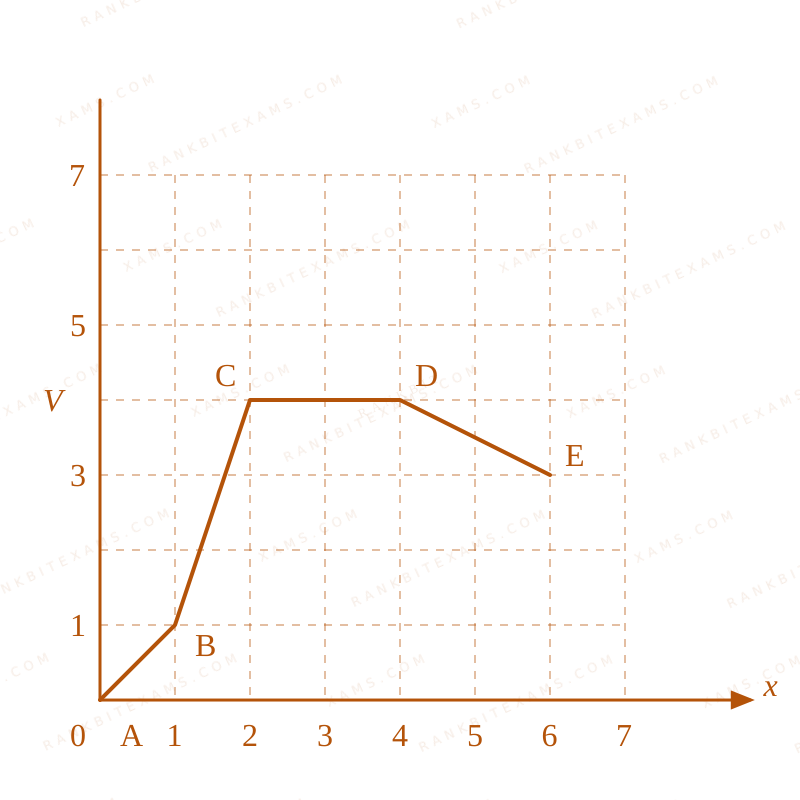
Potential energy (V) versus distance (x) is given by the graph, Rank various regions as per the magnitudes of the force (F) acting on a particle from high to low.
The image shows a graph of potential energy versus distance with marked regions AB, BC, CD, and DE.
### Related Formula
F = -fracdVdx$$F = -\frac{dV}{dx}$$
### Core Logic
The magnitude of the force is given by the absolute value of the slope of the potential energy versus position curve: |F| = |textslope of V-x graph|$|F| = |\text{slope of V-x graph}|$.
Comparing the slopes of different regions from the graph:
- Region BC has the steepest slope (largest magnitude).
- Region AB has a moderate positive slope.
- Region DE has a moderate negative slope, but less steep than AB.
- Region CD is perfectly flat (slope = 0).
### Step 1: Ranking Forces
Therefore, magnitudes of the force follow the order:
F_BC > F_AB > F_DE > F_CD$$F_{BC} > F_{AB} > F_{DE} > F_{CD}$$
### Pattern Recognition
In a V-x$V-x$ graph, steeper slopes always mean a stronger restoring or repulsive force. A flat line means zero force (equilibrium).
### Evaluation Rubric / Model Answer
null
### Chapter Mix
Class 11 Physics: Work, Energy and Power
Q44jee_main_2026_21_jan_eveningWork Done by Variable Force
A body of mass 2 text kg$2 \text{ kg}$ is moving along x-direction such that its displacement as function of time is given by x(t) = alpha t^2 + beta t + gamma text m$x(t) = \alpha t^{2} + \beta t + \gamma \text{ m}$, where alpha = 1 text m/s^2$\alpha = 1 \text{ m/s}^{2}$, beta = 1 text m/s$\beta = 1 \text{ m/s}$ and gamma = 1 text m$\gamma = 1 \text{ m}$. The work done on the body during the time interval t = 2 text s$t = 2 \text{ s}$ to t = 3 text s$t = 3 \text{ s}$, is ________ J.
A.49$49$
B.42$42$
C.24$24$
D.12$12$
Solution
### Related Formula
W = int F cdot dx = F cdot Delta x quad (textif force is constant)$$W = \int F \cdot dx = F \cdot \Delta x \quad (\text{if force is constant})$$v = fracdxdt, quad a = fracdvdt$$v = \frac{dx}{dt}, \quad a = \frac{dv}{dt}$$F = m a$F = m a$
### Core Logic
Given displacement equation:
x(t) = 1t^2 + 1t + 1$$x(t) = 1t^2 + 1t + 1$$
Velocity is the first derivative:
v(t) = 2t + 1$v(t) = 2t + 1$
Acceleration is the second derivative:
a(t) = 2 text m/s^2$$a(t) = 2 \text{ m/s}^2$$
Since acceleration is constant, the force is also constant:
F = m a = 2 times 2 = 4 text N$$F = m a = 2 \times 2 = 4 \text{ N}$$
### Step 1: Finding Displacement Interval
We need the displacement during the interval t=2$t=2$ to t=3$t=3$:
x(3) = 3^2 + 3 + 1 = 9 + 3 + 1 = 13 text m$$x(3) = 3^2 + 3 + 1 = 9 + 3 + 1 = 13 \text{ m}$$x(2) = 2^2 + 2 + 1 = 4 + 2 + 1 = 7 text m$$x(2) = 2^2 + 2 + 1 = 4 + 2 + 1 = 7 \text{ m}$$
Total displacement S = x(3) - x(2) = 13 - 7 = 6 text m$S = x(3) - x(2) = 13 - 7 = 6 \text{ m}$
### Step 2: Final Conclusion
Work done:
W = F cdot S = 4 text N times 6 text m = 24 text J$$W = F \cdot S = 4 \text{ N} \times 6 \text{ m} = 24 \text{ J}$$
### Pattern Recognition
If x(t)$x(t)$ is a quadratic in t$t$, acceleration is constant. Work done simply becomes ma times Delta x$ma \times \Delta x$.
### Evaluation Rubric / Model Answer
null
### Chapter Mix
Class 11 Physics: Kinematics
Class 11 Physics: Work, Energy and Power
Q10jee_main_2025_03_april_eveningCollisions and Spring Potential Energy
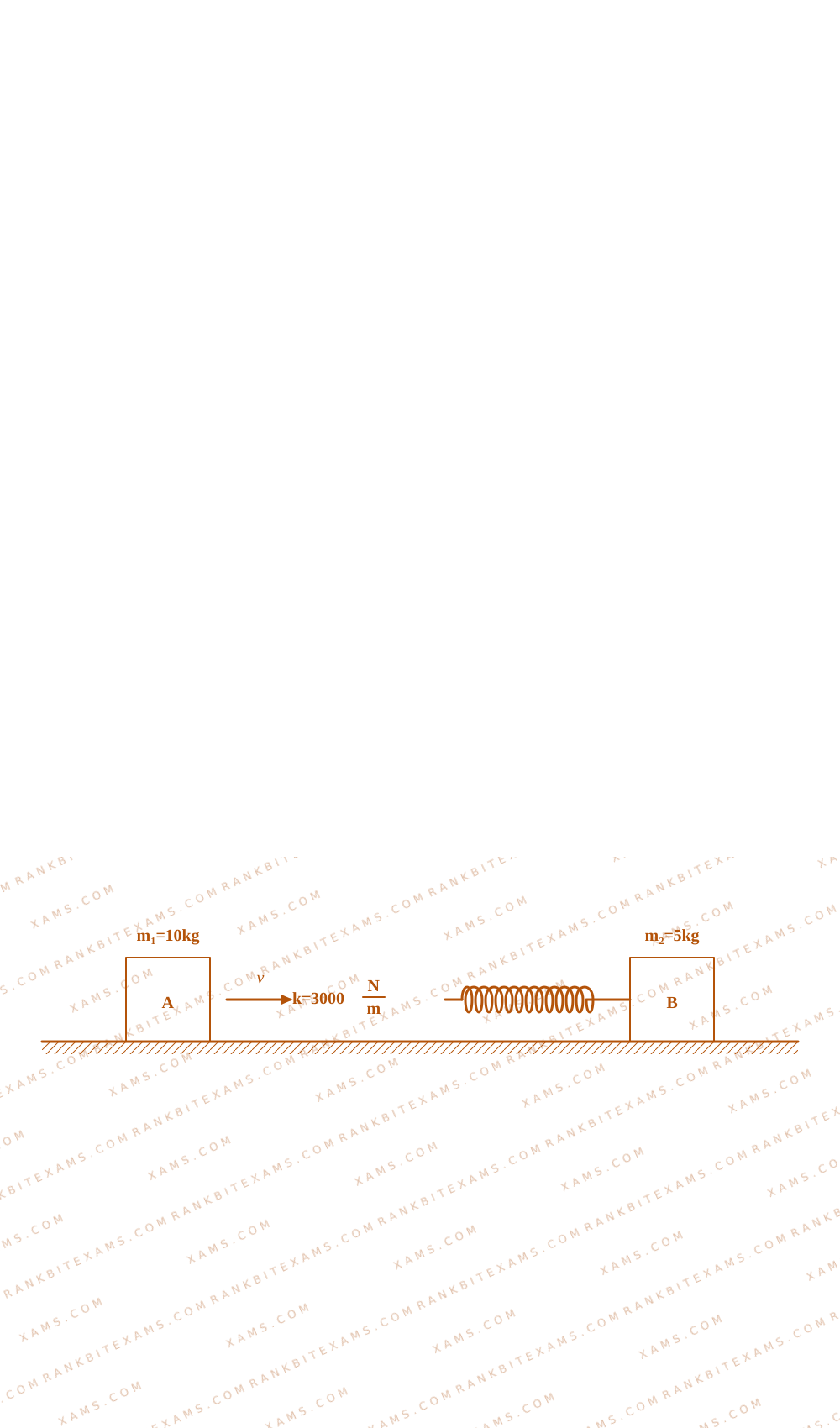
Consider two blocks A and B of masses m_1=10mathrm~kg$m_{1}=10\mathrm{~kg}$ and m_2=5mathrm~kg$m_{2}=5\mathrm{~kg}$ that are placed on a frictionless table. The block A moves with a constant speed v=3mathrm~m/s$v=3\mathrm{~m/s}$ towards the block B kept at rest. A spring with spring constant k=3000mathrm~N/m$k=3000\mathrm{~N/m}$ is attached with the block B as shown in the figure. Diagram showing Block A of mass m1 moving with velocity v towards Block B of mass m2 with a spring attached on a frictionless table. After the collision, suppose that the blocks A and B, along with the spring in constant compression state, move together, then the compression in the spring is,
(Neglect the mass of the spring)
A. 0.2 m
B. 0.4 m
C. 0.1 m
D. 0.3 m
Solution
### Related Formula
By conservation of linear momentum, the common velocity v_textcm$v_{\text{cm}}$ of the combined mass system is:
m_1 v_1 + m_2 v_2 = (m_1 + m_2) v_textcm$$m_1 v_1 + m_2 v_2 = (m_1 + m_2) v_{\text{cm}}$$
By conservation of energy, the loss in Kinetic Energy during maximum compression converted to the potential energy of the spring:
Delta K = frac12 k x^2 Rightarrow frac12 m_1 v^2 - frac12 (m_1 + m_2) v_textcm^2 = frac12 k x^2$$\Delta K = \frac{1}{2} k x^2 \Rightarrow \frac{1}{2} m_1 v^2 - \frac{1}{2} (m_1 + m_2) v_{\text{cm}}^2 = \frac{1}{2} k x^2$$
### Core Logic
Given parameters:
- m_1 = 10mathrm~kg$m_1 = 10\mathrm{~kg}$, m_2 = 5mathrm~kg$m_2 = 5\mathrm{~kg}$
- Initial velocity of A: v = 3mathrm~m/s$v = 3\mathrm{~m/s}$
- Initial velocity of B: v_2 = 0$v_2 = 0$
- Spring constant k = 3000mathrm~N/m$k = 3000\mathrm{~N/m}$
### Step 1: Calculate the common center of mass velocity (v_textcm$v_{\text{cm}}$)
v_textcm = frac10 times 3 + 5 times 010 + 5 = frac3015 = 2mathrm~m/s$$v_{\text{cm}} = \frac{10 \times 3 + 5 \times 0}{10 + 5} = \frac{30}{15} = 2\mathrm{~m/s}$$
### Step 2: Apply Energy Conservation to find spring compression ($
### Step 2: Apply Energy Conservation to find spring compression ($x)
$)
$frac12 k x^2 = K_i - K_f$\frac{1}{2} k x^2 = K_i - K_f$$
$frac12 (3000) x^2 = left[ frac12 (10) (3^2) right] - left[ frac12 (10 + 5) (2^2) right]$\frac{1}{2} (3000) x^2 = \left[ \frac{1}{2} (10) (3^2) \right] - \left[ \frac{1}{2} (10 + 5) (2^2) \right]$$
$1500 x^2 = frac12(90) - frac12(15)(4)$1500 x^2 = \frac{1}{2}(90) - \frac{1}{2}(15)(4)$$
$1500 x^2 = 45 - 30 = 15$1500 x^2 = 45 - 30 = 15$$
$x^2 = frac151500 = frac1100$x^2 = \frac{15}{1500} = \frac{1}{100}$$
$x = frac110mathrm~m = 0.1mathrm~m$x = \frac{1}{10}\mathrm{~m} = 0.1\mathrm{~m}$
### Pattern Recognition
For maximum compression in block-spring-block collisions, the relative kinetic energy gets fully transformed into spring potential energy.
$
### Pattern Recognition
For maximum compression in block-spring-block collisions, the relative kinetic energy gets fully transformed into spring potential energy.
$frac12 mu v_textrel^2 = frac12 k x^2$\frac{1}{2} \mu v_{\text{rel}}^2 = \frac{1}{2} k x^2$
where $
where $\mu = \frac{m_1 m_2}{m_1 + m_2} is the reduced mass. Here:
$ is the reduced mass. Here:
$mu = frac10 times 515 = frac103mathrm~kg$\mu = \frac{10 \times 5}{15} = \frac{10}{3}\mathrm{~kg}$$
$frac12 left(frac103right) (3)^2 = frac12 (3000) x^2 Rightarrow 15 = 1500 x^2 Rightarrow x = 0.1mathrm~m$\frac{1}{2} \left(\frac{10}{3}\right) (3)^2 = \frac{1}{2} (3000) x^2 \Rightarrow 15 = 1500 x^2 \Rightarrow x = 0.1\mathrm{~m}$$
Using reduced mass simplifies center-of-mass collision problems instantly.
### Evaluation Rubric / Model Answer
null
### Chapter Mix
Class 11 Physics: Work, Energy and Power
Q18jee_main_2025_03_april_eveningPower and Efficiency of Motor
A motor operating on 100mathrm~V$100\mathrm{~V}$ draws a current of 1 A. If the efficiency of the motor is 91.6\%$91.6\%$, then the loss of power in units of cal/s is :
A. 4
B. 8.4
C. 2
D. 6.2
Solution
### Related Formula
The electrical input power P_textin$P_{\text{in}}$ delivered to the motor is:
P_textin = V cdot I$$P_{\text{in}} = V \cdot I$$
The fraction of power lost is determined by the efficiency eta$\eta$:
P_textlost = P_textin - P_textout = P_textin (1 - eta)$$P_{\text{lost}} = P_{\text{in}} - P_{\text{out}} = P_{\text{in}} (1 - \eta)$$
To convert watts (mathrmJ/s$\mathrm{J/s}$) to calories per second:
P_textlost (mathrmcal/s) = fracP_textlost (mathrmW)4.2$$P_{\text{lost}} (\mathrm{cal/s}) = \frac{P_{\text{lost}} (\mathrm{W})}{4.2}$$
### Core Logic
Given parameters:
- Potential $
### Core Logic
Given parameters:
- Potential $V = 100\mathrm{~V}
- Current $
- Current $I = 1\mathrm{~A}
- Efficiency $
- Efficiency $\eta = 91.6\% = 0.916
### Step 1: Calculate Input Power ($
### Step 1: Calculate Input Power ($P_{\text{in}})
$)
$P_textin = 100 times 1 = 100mathrm~W$P_{\text{in}} = 100 \times 1 = 100\mathrm{~W}$
### Step 2: Calculate Power Loss in Watts
$
### Step 2: Calculate Power Loss in Watts
$P_textlost = 100 times (1 - 0.916) = 100 times 0.084 = 8.4mathrm~W$P_{\text{lost}} = 100 \times (1 - 0.916) = 100 \times 0.084 = 8.4\mathrm{~W}$
### Step 3: Convert Power Loss to cal/s
$
### Step 3: Convert Power Loss to cal/s
$P_textlost = frac8.44.2 = 2mathrm~cal/s$P_{\text{lost}} = \frac{8.4}{4.2} = 2\mathrm{~cal/s}$
### Pattern Recognition
Efficiency calculations often feature clean conversion rates. Recognizing that $
### Pattern Recognition
Efficiency calculations often feature clean conversion rates. Recognizing that $8.4 is exactly twice $ is exactly twice $4.2$ (the conversion factor for Joules to calories) simplifies the final step.
### Evaluation Rubric / Model Answer
null
### Chapter Mix
Class 11 Physics: Work, Energy and Power
More Work, Energy and Power Questions — jee_main_2026_22_january_evening
We Map Every Repeating Question in Competitive Exams.
Say goodbye to generic mock test fatigue. RankBit uses smart analysis to group past exam questions into their foundational Repeating Question Types. Find chapter weightage, track repeating questions, and score higher with targeted practice.
Select Your Target Exam
Choose an exam track below to find formulas per chapter and patterns.
Syncing Exam Intelligence
Mapping formulas and patterns across all tracks…
PATH A — FULL LENGTH PRACTICE
Full Mock Test Hub
Simulate real NTA exam conditions with fully tracked mocks. Time yourself against past papers.
Practice past-year questions one chapter at a time. Pick an exam → subject → chapter and get every PYQ for that topic — pulled together from all past papers — with the chapter's key formulas alongside.