JEE Main · Physics ↓ Falling

Work, Energy and Power appeared 31 times across 3 years — 3.6% of Physics. This question is from Conservation of Mechanical Energy.

Year 2026 2025 2024 Total
Questions 8 15 8 31

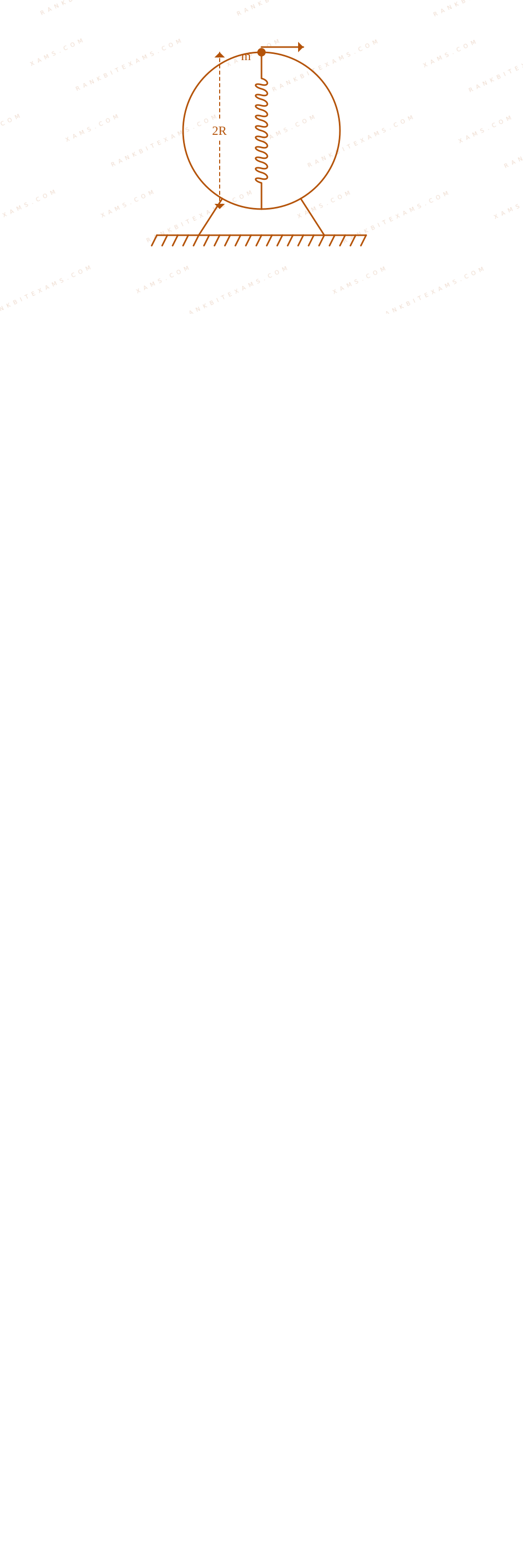
A bead of mass m slides without friction on the wall of a vertical circular hoop of radius R as shown in figure. The bead moves under the combined action of gravity and a massless spring (k) attached to the bottom of the hoop. The equilibrium length of the spring is R . If the bead is released from top of the hoop with (negligible) zero initial speed, velocity of bead, when the length of spring becomes R , would be (spring constant is k , g is acceleration due to gravity)
Conservation of Mechanical Energy diagram for Q10 - JEE Main 2025 Morning
A bead sliding along a vertical circular ring constrained by a tracking baseline spring system.

Solution & Explanation

Core Logic

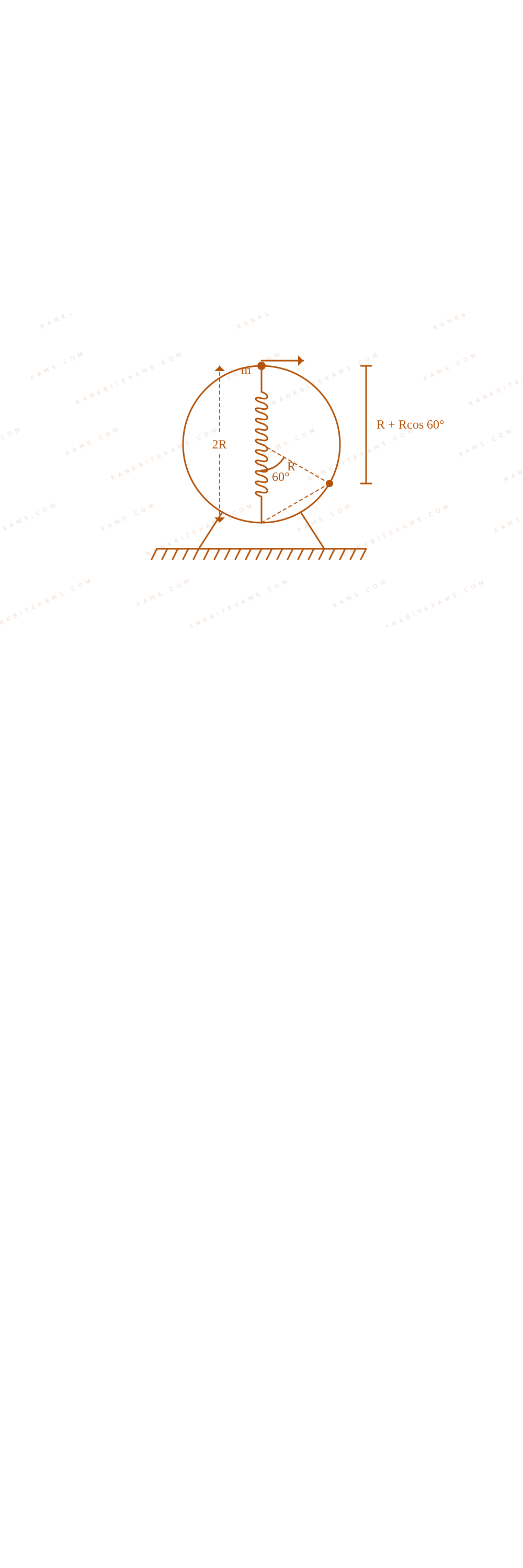
Let's apply the comprehensive Work-Energy theorem framework across key layout tracking nodes:

Geometric resolution angle resolution profile for Q10
A bead sliding along a vertical circular ring constrained by a tracking baseline spring system.

Wall = Δ K M g (R + R 60°) + (1)/(2) k (R² - 0²) = (1)/(2) m v²

Simplifying the gravitational shift and potential expansions:

M g 3R2 + kR²2 = (1)/(2) m v²
Step 1: Final Kinematic Value
v = 3gR + kR²m

Matches parameters specified by option (4).

Pattern Recognition

Isolate spring metrics at node points: Initial extension equals 2R - R = R. Final extension is 0 since spring length matching R satisfies unextended conditions.

Chapter Mix

Class 11 Physics: Work, Energy and Power

More Work, Energy and Power Previous-Year Questions — Page 4

Q11 jee_main_2025_28_jan_morning Conservative and Non-conservative Forces
Given below are two statements: one is labelled as Assertion A and the other is labelled as Reason R. Assertion A: In a central force field, the work done is independent of the path chosen Reason R: Every force encountered in mechanics does not have an associated potential energy. In the light of the above statements, choose the most appropriate answer from the options given below:
  • A. A is true but R is false
  • B. Both A and R are true but R is NOT the correct explanation of A
  • C. Both A and R are true and R is the correct explanation of A
  • D. A is false but R is true

Solution

Core Logic

Assertion A: Central force configurations depend solely on the positional distance parameter r. They are strictly conservative fields, making path metrics completely irrelevant for total work evaluation. (True)

Reason R: Non-conservative profiles like friction or drag dissipate thermal energy paths and do not possess any state potential energy function. (True)

Since statement R provides general information about non-conservative forces rather than stating why central fields are path independent, it fails as a direct explanatory bridge.

Step 1: Final Conclusion

Both assertions are factually accurate, but R is not the appropriate explanation for A. This selects option (2).

Pattern Recognition

Conservative fields allow defining potential profiles (F = -∇ U); non-conservative structures completely break this relation.

Chapter Mix

Class 11 Physics: Work, Energy and Power

Q16 jee_main_2025_03_april_morning Conservation of Mechanical Energy
A particle is released from height S above the surface of the earth. At certain height its kinetic energy is three times its potential energy. The height from the surface of the earth and the speed of the particle at that instant are respectively.
  • A. (S)/(2), √((3gS)/(2))
  • B. (S)/(2), (3gS)/(2)
  • C. (S)/(4), (3gS)/(2)
  • D. (S)/(4), √((3gS)/(2))

Solution

Related Formula

Conservation of Mechanical Energy:

Etotal = K + U = constant

At the initial height S (velocity v = 0):

Etotal = mgS

At any height x above the ground:

U = mgx and K = (1)/(2)mv²
Core Logic

Let the height of the particle at that instant be x. We are given: K = 3U

Substitute the energy terms:

(1)/(2)mv² = 3mgx

By energy conservation:

K + U = Etotal 3U + U = mgS 4U = mgS 4(mgx) = mgS x = (S)/(4)
Step 1: Calculating the Speed

Now find the speed v at this height x = S/4. Since K = 3U:

(1)/(2)mv² = 3mgx (1)/(2)mv² = 3mg((S)/(4)) v² = (6gS)/(4) = (3gS)/(2) v = √((3gS)/(2))
Pattern Recognition

Standard ratio trick: If K = n U, then by energy conservation (n+1)U = Etotal. This immediately yields:

x = (S)/(n+1)

Here n = 3, so x = S/4. This rapid shortcut lets you find the height in a split second!

Chapter Mix

Class 11 Physics: Work, Energy and Power

Q16 jee_main_2025_07_april_evening Conservative and Non-Conservative Forces
Which one of the following forces cannot be expressed in terms of potential energy? [cite: 145]
  • A. Coulomb's force [cite: 146]
  • B. Gravitational force [cite: 147]
  • C. Frictional force [cite: 148]
  • D. Restoring force [cite: 149]

Solution

Core Logic

Potential energy functions are strictly mathematically defined exclusively for conservative force interactions via the relationship F = -(dU)/(dx)[cite: 727]. Coulomb's force, Gravitational force, and Spring restoring force are completely path-independent conservative fields[cite: 146, 147, 149]. Frictional force is a path-dependent, dissipative non-conservative force[cite: 148, 727, 728]. Consequently, it is impossible to define a scalar potential energy function for mechanical friction[cite: 727, 728].

Pattern Recognition

Whenever you encounter a potential energy definition requirement, remember that it is a direct marker for conservative fields. Dissipative forces like friction or viscous drag instantly break this condition[cite: 727, 728].

Chapter Mix

Class 11 Physics: Work, Energy and Power

Q19 jee_main_2025_07_april_evening Variable Force
An object with mass 500 g moves along x-axis with speed v=4√(x)~m/s. The force acting on the object is: [cite: 164]
  • A. 8 N [cite: 165]
  • B. 5 N [cite: 167]
  • C. 6 N [cite: 166]
  • D. 4 N [cite: 168]

Solution

Related Formula
a = v(dv)/(dx)

F = m · a [cite: 778]

Core Logic

Given velocity as a function of position x: [cite: 164, 779]

v = 4√(x) v² = 16x [cite: 164, 779]

Differentiating both sides with respect to position coordinate x: [cite: 780]

2v(dv)/(dx) = 16 v(dv)/(dx) = 8 [cite: 780, 781]

Thus, the acceleration of the object is a constant value a = 8 m/s²[cite: 781]. Converting mass to kilograms (m = 500 g = 0.5 kg) [cite: 164, 788]:

F = 0.5 × 8 = 4 N [cite: 788]

Pattern Recognition

When velocity depends on position coordinate x like v = k√(x), squaring instantly reveals that acceleration is constant, since v² = k² x matches the third kinematic profile v² = 2ax directly[cite: 779].

Chapter Mix

Class 11 Physics: Work, Energy and Power

Q jee_main_2025_24_jan_morning Work Done by a Variable Force
A force F=α+β x² acts on an object in the x-direction. The work done by the force is 5J when the object is displaced by 1 m. If the constant α=1N then β will be
  • A. 15 N/m²
  • B. 10 N/m²
  • C. 12 N/m²
  • D. 8 N/m²

Solution

Related Formula

The work done W by a variable force component F(x) over a displacement step is given by:

W = ∫_x₁^x₂ F(x) dx
Core Logic

Assuming the object moves from the origin x=0 to x=1 m :

W = ∫₀¹ (α + β x²) dx = 5 J
Step 1: Integration and Variable Isolation

Perform the integration step :

W = [ α x + β x³3 ]₀¹ = α + (β)/(3) = 5

Given α = 1 N , substitute this into the equation to find β :

1 + (β)/(3) = 5 (β)/(3) = 4 β = 12 N/m²
Pattern Recognition

For polynomial forces, the integration steps always yield fractional coefficients matching their power index (1 for constant, (1)/(3) for squared terms).

Chapter Mix

Class 11 Physics: Work, Energy and Power

More Work, Energy and Power Questions — jee_main_2025_28_jan_morning

Practice all Work, Energy and Power previous-year questions →

Rankbit System
JEE Physics: Waves (+15.5%) | Electrostatics: Concentric Shells (-29.7%) | Modern Physics: Photoelectric Clones (+34.2%) | Mathematics: Definite Integrals (+18.1%) | Chemistry: Coordination Splitting (-11.4%) | JEE Physics: Waves (+15.5%) | Electrostatics: Concentric Shells (-29.7%) | Modern Physics: Photoelectric Clones (+34.2%) | Mathematics: Definite Integrals (+18.1%) | Chemistry: Coordination Splitting (-11.4%)