JEE Main · Physics ↓ Falling

Moving Charges and Magnetism appeared 37 times across 3 years — 4.3% of Physics. This question is from Magnetic Force on a Charged Particle.

Year 2026 2025 2024 Total
Questions 9 13 15 37

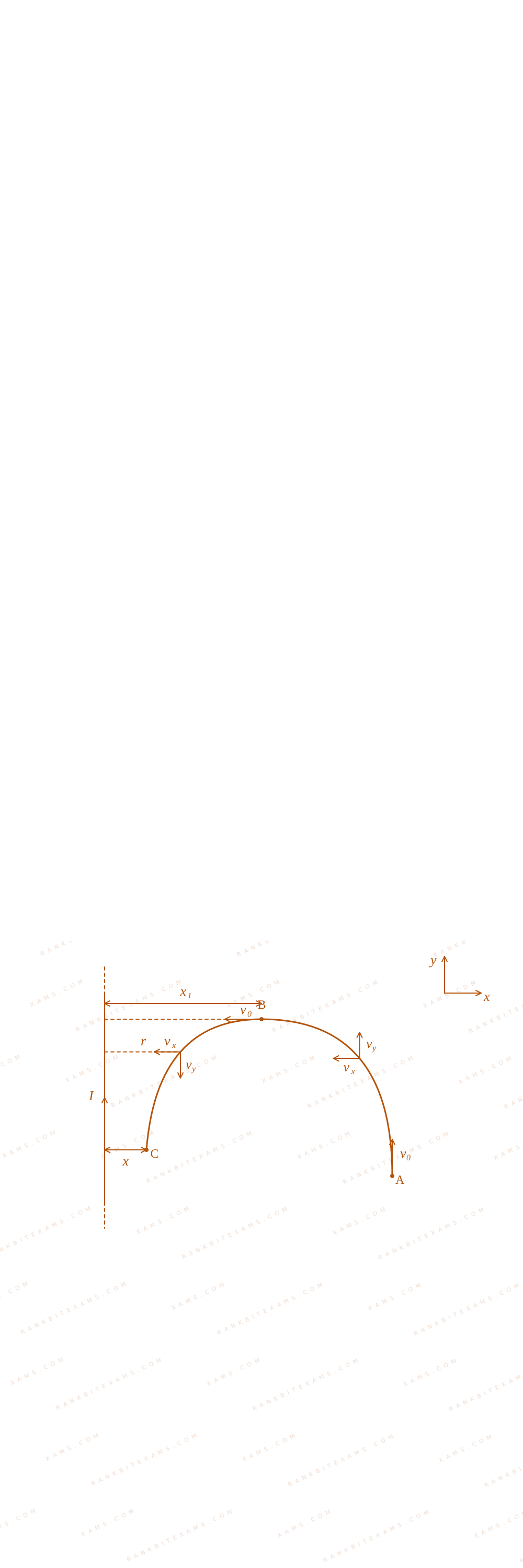
Consider a long thin conducting wire carrying a uniform current I. A particle having mass "M" and charge "q" is released at a distance "a" from the wire with a speed v₀ along the direction of current in the wire. The particle gets attracted to the wire due to magnetic force. The particle turns round when it is at distance x from the wire. The value of x is [μ₀ is vacuum permeability]

Solution & Explanation

Core Logic

Analyzing motion from path phases A arrow B and B arrow C inside the coordinate field:

Coordinate trajectory analysis path diagram for Q6

B = μ₀ I2π r(- k)

The lorentz magnetic field acceleration rules dictate differential trajectory steps:

∫v₀⁰ vₓ dvₓ√(v₀² - vₓ²) = - μ₀ I q2π m ∫ₐx₁ (dr)/(r)

Solving this integration step gives the position node parameter:

x₁ = a e-(2π m v₀)/(μ₀ I q)

Compounding this loop interaction for the turning path phase B arrow C gives:

Step 1: Final Solution Integration
x = x₁ e-(2π m v₀)/(μ₀ I q) = a e-(4π m v₀)/(μ₀ I q)

Matches criteria for option (4).

Pattern Recognition

Variable magnetic field cross-products result in dual exponential scaling metrics. Remember the total velocity magnitude stays fixed under zero work magnetic operations.

Chapter Mix

Class 12 Physics: Moving Charges and Magnetism

Reference Study Guides

More Moving Charges and Magnetism Previous-Year Questions — Page 5

Q jee_main_2025_24_jan_morning Magnetic Field due to a Current Element
A current of 5A exists in a square loop of side 1√(2) m Then the magnitude of the magnetic field B at the centre of the square loop will be p×10⁻⁶ T where, value of p is [Take μ₀=4π×10⁻⁷ T mA⁻¹].
Numerical Answer. Answer: 8 to 8

Solution

Related Formula

The magnetic field B₁ produced by a straight wire segment carrying current I at a perpendicular distance d is given by the Biot-Savart relation:

B₁ = μ₀I4π d( θ₁ + θ₂)
Core Logic

As shown in the square geometric layout

Magnetic Field due to a Current Element diagram for Q24 - JEE Main 2025 Morning
, the perpendicular distance from any side to the central origin point is exactly half the total side length :

d = (a)/(2) = 12√(2) m

Connecting the ends of a side to the center forms internal angles of θ₁ = θ₂ = 45°.

Step 1: Summing the Contributions

Calculate the magnetic field contribution from a single side :

B₁ = 10⁻⁷ × 5 12√(2) ( 45° + 45°) = 10⁻⁷ × 10√(2) × ( 2√(2)) = 2 × 10⁻⁶ T

Since the current flows in the same rotational direction along all four sides, their individual magnetic fields add constructively at the center :

Bₙₑₜ = 4 × B₁ = 4 × (2 × 10⁻⁶ T) = 8 × 10⁻⁶ T

Comparing this with p × 10⁻⁶ T , we get:

p = 8

Pattern Recognition

The magnetic field at the center of any square loop simplifies to the standard formula: B = 2√(2)μ₀Iπ a.

Chapter Mix

Class 12 Physics: Moving Charges and Magnetism

Q jee_main_2025_29_jan_morning Ampere\'s Circuital Law
Consider a long straight wire of a circular cross-section (radius a) carrying a steady current I. The current is uniformly distributed across this cross-section. The distances from the centre of the wire\'s cross-section at which the magnetic field [inside the wire, outside the wire] is half of the maximum possible magnetic field, any where due to the wire, will be
  • A. [a / 4,3a / 2]
  • B. [ a2, 2a]
  • C. [a / 2,3a]
  • D. [a / 4,2a]

Solution

Related Formula
B = (μ₀ I)/(2π a) Bᵢₙ = (μ₀ I r)/(2π a²), Bout = (μ₀ I)/(2π r)
Core Logic

The maximum magnetic field occurs right at the wire\'s outer boundary surface (r=a) :

B = (μ₀ I)/(2π a)

We need positions where B = B2 = (μ₀ I)/(4π a).

Step 1: Calculate Inside Distance
(μ₀ I r)/(2π a²) = (μ₀ I)/(4π a) r = (a)/(2)
Step 2: Calculate Outside Distance
(μ₀ I)/(2π r) = (μ₀ I)/(4π a) r = 2a
Pattern Recognition

Inside the wire, field scales linearly with radius; outside, it falls inversely with radius.

Chapter Mix

Class 12 Physics: Moving Charges and Magnetism

Q jee_main_2024_01_february_morning Galvanometer Conversion
A galvanometer has a resistance of 50~Ω and it allows maximum current of 5~mA. It can be converted into voltmeter to measure upto 100~V by connecting in series a resistor of resistance:
  • A. 5975~Ω
  • B. 20050~Ω
  • C. 19950~Ω
  • D. 19500~Ω

Solution

Related Formula

Voltmeter series conversion formula:

V = Ig(Rg + R) R = (V)/(Ig) - Rg
Core Logic

Given data: Rg = 50~Ω, Ig = 5~mA = 5 × 10⁻³~A, target voltage range V = 100~V.

Substitute values:

R = 1005 × 10⁻³ - 50
Step 1: Complete Arithmetic Evaluation

R = 20000 - 50 = 19950~Ω

Pattern Recognition

Voltmeter resistance is always high because it is connected in parallel to circuits to prevent current drawing leaks.

Chapter Mix

Class 12 Physics: Moving Charges and Magnetism Class 12 Physics: Current Electricity

Q jee_main_2024_01_february_morning Magnetic Field due to a Current Element
A regular polygon of 6 sides is formed by bending a wire of length 4pi meter. If an electric current of 4pisqrt3~A is flowing through the sides of the polygon, the magnetic field at the centre of the polygon would be x × 10⁻⁷~T. The value of x is:
Numerical Answer. Answer: 72 to 72

Solution

Related Formula

Magnetic field due to a straight wire segment of length 2L at distance r:

B₁ = (μ₀ I)/(4π r)( θ₁ + θ₂)

Total field for a regular hexagon (n=6):

B = 6 × B₁
Core Logic

Total perimeter = 6 · a = 4π side length a = (4π)/(6) = (2π)/(3)~m. For a regular hexagon segment, the interior angles relative to the normal vector are θ₁ = θ₂ = 30^°.

The normal distance r from the center to a side is:

r = (a)/(2) (30^°) = (4π)/(2 × 6) × √(3) = √(3)π3 = π√(3)~m
Step 1: Calculate Total Magnetic Field

Substitute r and I = 4π√(3)~A into the hexagon configuration:

B = 6 × [ (μ₀ I)/(4π r) ( (30^°) + (30^°)) ] B = 6 × [ 10⁻⁷ × 4π√(3)( √(3)π3) × (0.5 + 0.5) ] B = 6 × [ 10⁻⁷ × 4π√(3) × 3√(3)π × 1 ] B = 6 × [ 4 × 3 × 10⁻⁷ ] = 6 × 12 × 10⁻⁷ = 72 × 10⁻⁷~T

Thus, x = 72.

Pattern Recognition

For regular polygons, the normal distance r to the side is always r = (a)/(2) ((π)/(n)). The contribution from all n symmetric segments adds up constructively.

Chapter Mix

Class 12 Physics: Moving Charges and Magnetism

Q39 jee_main_2024_29_january_evening Motion of Charged Particle in Magnetic Field
Two particles X and Y having equal charges are being accelerated through the same potential difference. Thereafter they enter normally in a region of uniform magnetic field and describes circular paths of radii R₁ and R₂ respectively. The mass ratio of X and Y is:
  • A. ((R₂)/(R₁))²
  • B. ((R₁)/(R₂))²
  • C. ((R₁)/(R₂))
  • D. ((R₂)/(R₁))

Solution

Related Formula

The radius R of the path of a charged particle moving perpendicular to a magnetic field B is:

R = (mv)/(qB) = (p)/(qB)

In terms of kinetic energy K:

R = √(2mK)qB

Since the particle is accelerated through potential V, kinetic energy K = qV:

R = √(2mqV)qB R = (1)/(B) √((2mV)/(q))
Core Logic

For both particles X and Y, the following parameters are the same:

  • Potential Difference, V
  • Magnetic Field, B
  • Charge, q
  • Therefore, we have the proportionality:

R ∝ √(m) R² ∝ m
Step 1: Calculate Mass Ratio

Using the proportionality relationship:

(m₁)/(m₂) = ( (R₁)/(R₂) )²

Thus, the mass ratio of X and Y is ((R₁)/(R₂))².

Pattern Recognition

Shortcut: Whenever charges and potential differences are equal, the radius of orbit in a magnetic field scales as R ∝ √(m). Squaring both sides yields m ∝ R² instantly.

Chapter Mix

Class 12 Physics: Moving Charges and Magnetism

More Moving Charges and Magnetism Questions — jee_main_2025_28_jan_morning

Practice all Moving Charges and Magnetism previous-year questions →

Rankbit System
JEE Physics: Waves (+15.5%) | Electrostatics: Concentric Shells (-29.7%) | Modern Physics: Photoelectric Clones (+34.2%) | Mathematics: Definite Integrals (+18.1%) | Chemistry: Coordination Splitting (-11.4%) | JEE Physics: Waves (+15.5%) | Electrostatics: Concentric Shells (-29.7%) | Modern Physics: Photoelectric Clones (+34.2%) | Mathematics: Definite Integrals (+18.1%) | Chemistry: Coordination Splitting (-11.4%)