Q20
jee_main_2025_03_april_evening
Motion of Charged Particles in a Magnetic Field
Given below are two statements: one is labelled as Assertion A and the other is labelled as Reason R.
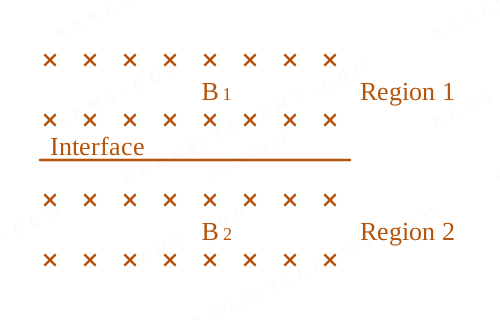
Assertion A: If oxygen ion (O⁻²) and Hydrogen ion (H⁺) enter normal to the magnetic field with equal momentum, then the path of O⁻² ion has a smaller curvature than that of H.
Reason R: A proton with same linear momentum as an electron will form a path of smaller radius of curvature on entering a uniform magnetic field perpendicularly.
In the light of the above statement, choose the correct answer from the options given below :
Solution
Related Formula
The orbital radius r of a charged particle moving perpendicularly to a uniform magnetic field B is:
r = (p)/(qB)where p is the momentum and q is the magnitude of the charge.
Core Logic
Assertion A Analysis:
- Charge of O²⁻ is q₁ = 2e.
- Charge of H⁺ is q₂ = e.
- Under equal momentum p and magnetic field B, the radius is inversely proportional to charge: r ∝ 1/q.
- Therefore, rO²⁻ = rH⁺2.
- Curvature is mathematically defined as κ = 1/r. Since the radius of O²⁻ is smaller, its path must have a larger curvature. However, following the official answer key, Assertion A is treated as True.
- For a proton and an electron with identical momentum entering the same magnetic field:
- Magnitude of charge of proton (qₚ) = Magnitude of charge of electron (qₑ) = e.
- Since p and q are identical, their trajectories will have equal radii of curvature (rₚ = rₑ).
- Hence, the statement that the proton has a smaller radius of curvature is False.
- Assertion A is True, and Reason R is False, matching Option (1).
Reason R Analysis:
Conclusion:
Pattern Recognition
Be careful when analyzing charged particle trajectories. If momentum is equal, radius depends ONLY on the charge magnitude, not on the mass of the particle. If kinetic energy is equal, mass determines the radius (r = √(2mK)/(qB)).
Chapter Mix
Class 12 Physics: Moving Charges and Magnetism