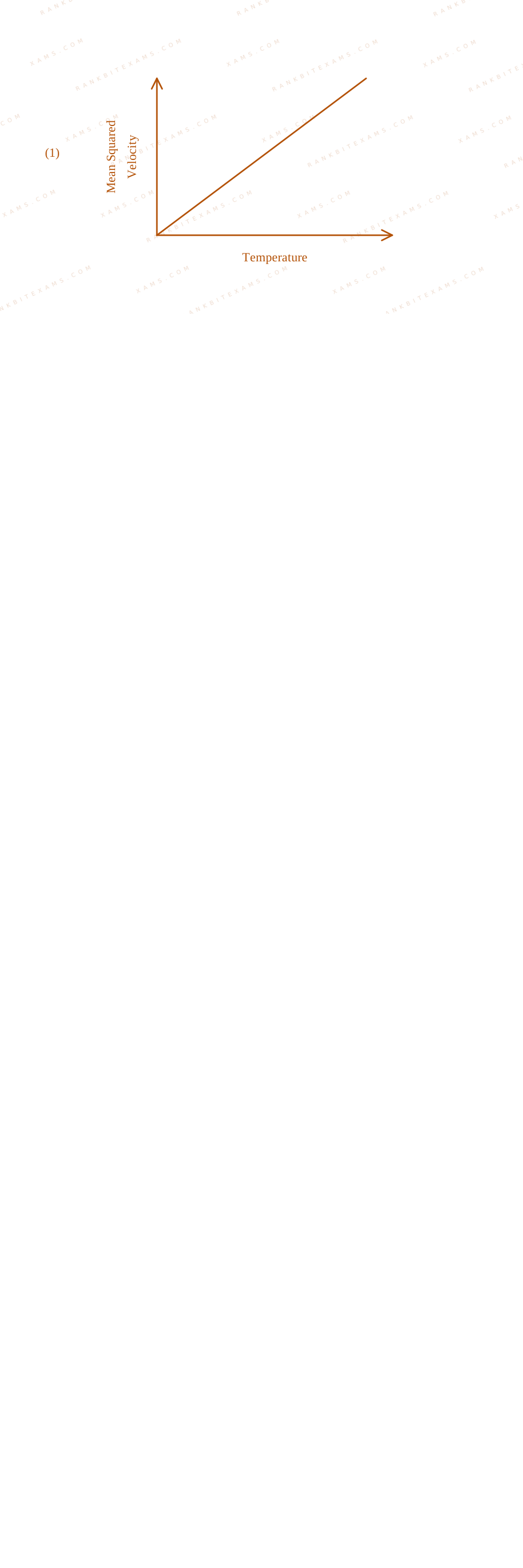
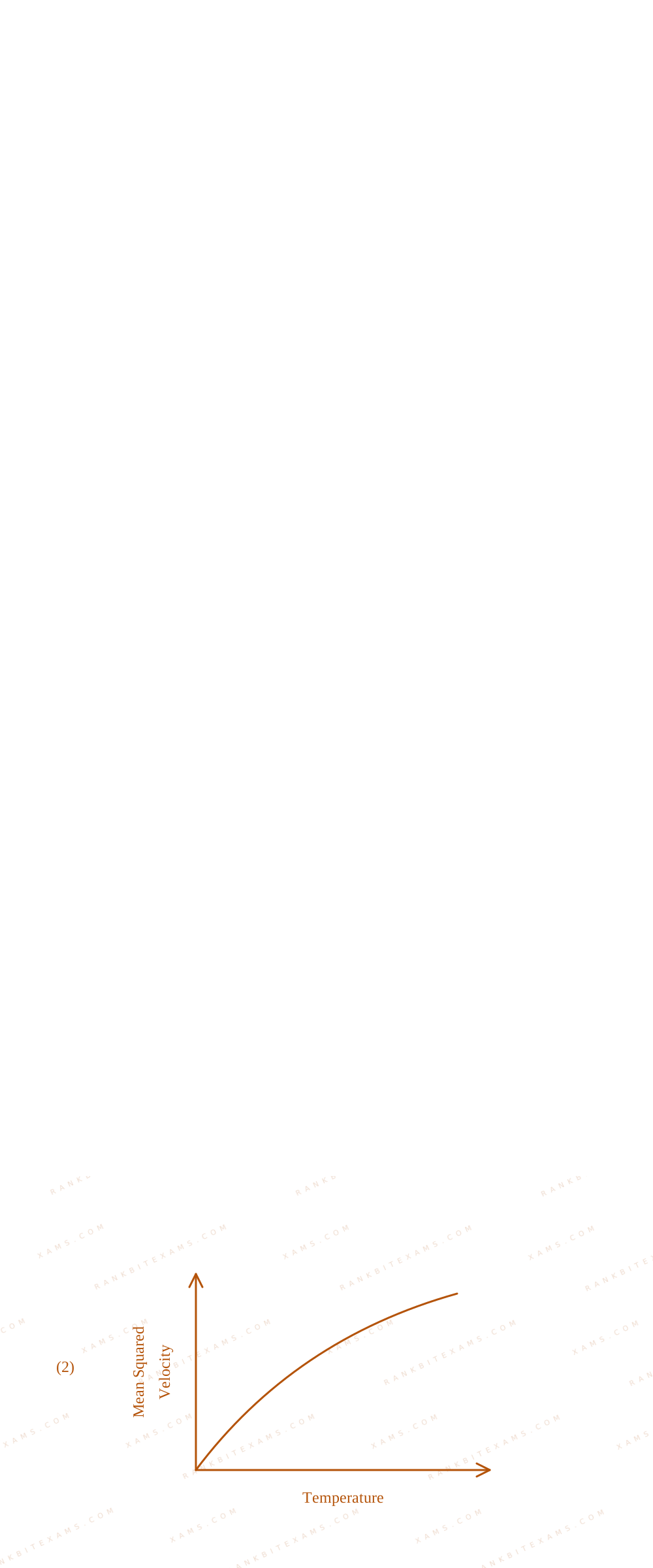

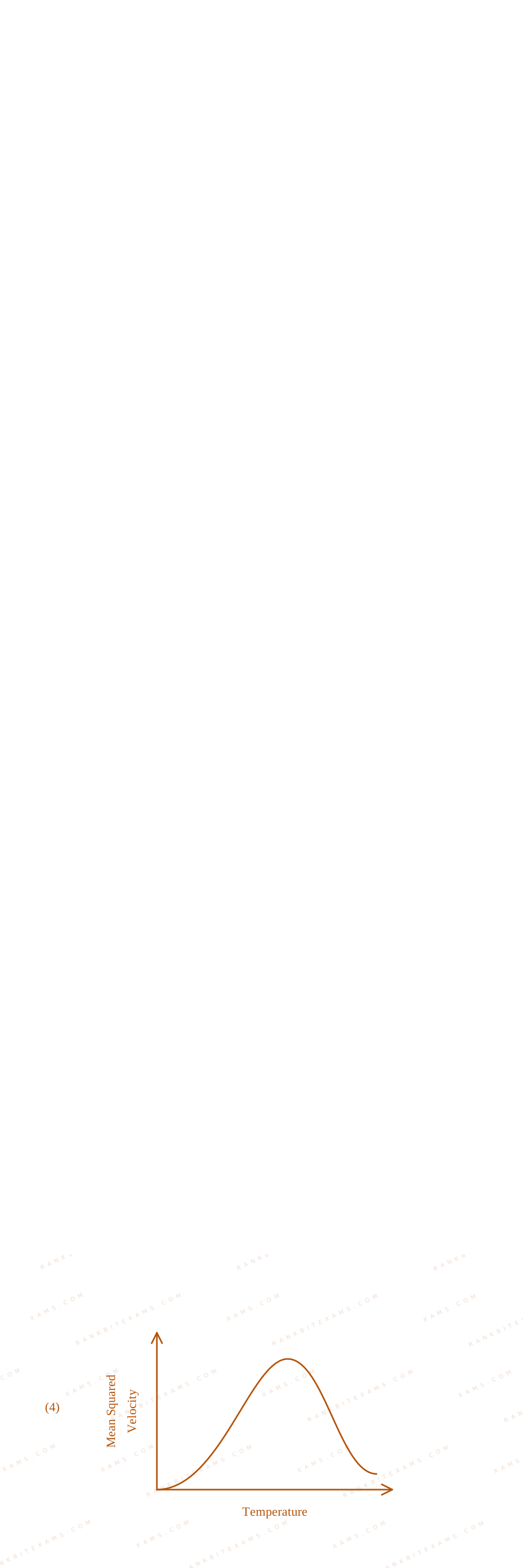
For a particular ideal gas which of the following graphs represents the variation of mean squared velocity of the gas molecules with temperature?

Solution & Explanation

Related Formula
Vrms = 3RTM Vrms² = 3RMT
Core Logic

The parameter asked is the mean squared velocity, which corresponds directly to Vrms².

From the ideal gas kinematics relation, we observe:

Vrms² ∝ T

Comparing this format against standard geometric linear templates (y = mx), the curve must map as a clean straight line originating from absolute zero zero coordinates.

Step 1: Final Conclusion

This linear profile matches Graph (1), selecting option (1).

Pattern Recognition

Watch the vertical ordinate labels carefully: Root-mean-square velocity scales as a sub-linear curve (T), while mean squared metric trends linearly directly (y ∝ x).

Chapter Mix

Class 11 Physics: Kinetic Theory

More Kinetic Theory Previous-Year Questions — Page 4

Q5 jee_main_2025_28_jan_evening Translational Kinetic Energy
The kinetic energy of translation of the molecules in 50 ~g of CO₂ gas at 17° C is :
  • A. 3986.3 J
  • B. 4102.8 J
  • C. 4205.5 ~J
  • D. 3582.7 J

Solution

Related Formula

The total translational kinetic energy of a gas sample depends only on the number of moles and absolute temperature, regardless of whether the molecule is monoatomic or polyatomic:

K.E.translational = (3)/(2) n R T
Core Logic

Given data:

  • Mass of CO₂ gas, m = 50 g
  • Molar mass of CO₂, M = 44 g/mol
  • Absolute Temperature, T = 17 + 273.15 = 290.15 K
  • Universal gas constant, R ≈ 8.314 J/(mol )
  • Calculate total moles n:

n = (50)/(44) ≈ 1.1364 moles

Substitute values into the expression :

K.E.translational = (3)/(2) × (50)/(44) × 8.314 × 290.15 K.E.translational = 1.5 × 1.1364 × 8.314 × 290.15 ≈ 4108.6 J

The closest matching value specified in the test alternatives is 4102.8 J.

Pattern Recognition

A common mistake is using (5)/(2)nRT or (7)/(2)nRT because CO₂ is a triatomic linear molecule. Remember that translational kinetic energy is always (3)/(2)nRT for any gas sample, as translation has exactly 3 degrees of freedom regardless of the molecular layout.

Chapter Mix

Class 11 Physics: Kinetic Theory of Gases

Q jee_main_2025_29_jan_morning Ideal Gas Laws
A container of fixed volume contains a gas at 27°C . To double the pressure of the gas, the temperature of gas should be raised to _________ °C
Numerical Answer. Answer: 327 to 327

Solution

Related Formula
(P₁)/(T₁) = (P₂)/(T₂)
Core Logic

Initial temperature T₁ = 27 + 273 = 300 K. Since volume is kept fixed :

(P)/(300) = (2P)/(T₂) T₂ = 600 K

Converting back to Celsius :

T₂ = 600 - 273 = 327°C
Chapter Mix

Class 11 Physics: Kinetic Theory of Gases

Q36 jee_main_2024_01_february_morning Specific Heat Capacity
Two moles a monoatomic gas is mixed with six moles of a diatomic gas. The molar specific heat of the mixture at constant volume is:
  • A. (9)/(4) R
  • B. (7)/(4) R
  • C. (3)/(2) R
  • D. (5)/(2) R

Solution

Related Formula

Molar specific heat at constant volume for a gas mixture:

CV, mix = n₁ CV1 + n₂ CV2n₁ + n₂

For a monoatomic gas:

CV1 = (3)/(2)R

For a diatomic gas:

CV2 = (5)/(2)R
Core Logic

Given values: n₁ = 2 (monoatomic), n₂ = 6 (diatomic).

Substitute these inputs directly into the mixture equation:

CV, mix = (2 × ((3)/(2)R) + 6 × ((5)/(2)R))/(2 + 6)
Step 1: Simplify Expression
CV, mix = (3R + 15R)/(8) = (18R)/(8) = (9)/(4)R
Pattern Recognition

Weighted average rule based on internal degrees of freedom: total internal energy changes scale additively with mole numbers.

Chapter Mix

Class 11 Physics: Kinetic Theory of Gases Class 11 Physics: Thermodynamics

Q35 jee_main_2024_29_january_evening Ideal Gas Equation and Temperature
The temperature of a gas having 2.0 × 10²⁵ molecules per cubic meter at 1.38 atm (Given, k = 1.38 × 10⁻²³ J K⁻¹) is:
  • A. 500 K
  • B. 200 K
  • C. 100 K
  • D. 300 K

Solution

Related Formula

The state equation of an ideal gas in terms of the number of molecules N and Boltzmann constant k is:

PV = NkT

Rearranging to express pressure in terms of number density n = N/V:

P = n k T

Core Logic

Given parameters:

  • Number density, n = (N)/(V) = 2.0 × 10²⁵ molecules/m³
  • Pressure, P = 1.38 atm = 1.38 × 1.01 × 10⁵ N/m²
  • Boltzmann constant, k = 1.38 × 10⁻²³ J K⁻¹
Step 1: Solve for Temperature

Rearranging P = n k T for temperature T:

T = (P)/(nk)

Substitute the values:

T = 1.38 × 1.01 × 10⁵(2.0 × 10²⁵) × (1.38 × 10⁻²³)

Notice that the term 1.38 cancels out from numerator and denominator:

T = (1.01 × 10⁵)/(2.0 × 10²) T = (1.01 × 10³)/(2.0) ≈ (1010)/(2) ≈ 500 K
Pattern Recognition

The numerical values are designed to cancel out smoothly. Spotting the 1.38 cancelation instantly saves valuable calculation time.

Chapter Mix

Class 11 Physics: Kinetic Theory of Gases

Q48 jee_main_2024_29_january_evening Degrees of Freedom and Specific Heat of Gas Mixtures
N moles of a polyatomic gas (f = 6) must be mixed with two moles of a monoatomic gas so that the mixture behaves as a diatomic gas. The value of N is:
  • A. 6
  • B. 3
  • C. 4
  • D. 2

Solution

Related Formula

The equivalent degrees of freedom feq for a mixture of gases is:

feq = (n₁ f₁ + n₂ f₂)/(n₁ + n₂)

where:

  • n₁, n₂ are the number of moles of each gas.
  • f₁, f₂ are the respective degrees of freedom of each gas.
Core Logic

For the given gases:

  • Polyatomic gas:
  • Moles, n₁ = N
  • Degrees of freedom, f₁ = 6
  • Monoatomic gas:
  • Moles, n₂ = 2
  • Degrees of freedom, f₂ = 3
  • We want the mixture to behave as a diatomic gas. For a diatomic gas:

  • Equivalent degrees of freedom, feq = 5
Step 1: Solve for N

Substitute the values into the degrees of freedom mixture formula:

5 = ((N)(6) + (2)(3))/(N + 2) 5(N + 2) = 6N + 6 5N + 10 = 6N + 6 10 - 6 = 6N - 5N N = 4
Pattern Recognition

Diatomic equivalent degree of freedom is 5. Since the monoatomic degrees of freedom (3) and polyatomic degrees of freedom (6) bracket 5, you can use the weighted ratio method to find the molar proportions directly.

Chapter Mix

Class 11 Physics: Kinetic Theory of Gases

More Kinetic Theory Questions — jee_main_2025_28_jan_morning

Practice all Kinetic Theory previous-year questions →

Rankbit System
JEE Physics: Waves (+15.5%) | Electrostatics: Concentric Shells (-29.7%) | Modern Physics: Photoelectric Clones (+34.2%) | Mathematics: Definite Integrals (+18.1%) | Chemistry: Coordination Splitting (-11.4%) | JEE Physics: Waves (+15.5%) | Electrostatics: Concentric Shells (-29.7%) | Modern Physics: Photoelectric Clones (+34.2%) | Mathematics: Definite Integrals (+18.1%) | Chemistry: Coordination Splitting (-11.4%)