A gas of certain mass filled in a closed cylinder at a pressure of 3.23 kPa has temperature 50^circtextC. The gas is now heated to double its temperature. The modified pressure is ____ Pa.

Numerical Answer Type:
Enter a numerical value Answer: 3730 to 3730 +4 marks

Solution & Explanation

### Related Formula P propto T quad (textGay-Lussac's Law for constant V) ### Core Logic Since the gas is filled in a closed cylinder, the volume V remains constant. Therefore, P propto T (where T must be in Kelvin). Initial temperature T_i = 50^circtextC = 273 + 50 = 323 text K. Final temperature T_f = 100^circtextC = 273 + 100 = 373 text K. Note: The phrasing "double its temperature" is slightly ambiguous (Celsius vs Kelvin). As per standard interpretations in such exams, "double its temperature" given in Celsius means 100^circtextC (which is 373 K). If it meant doubling absolute temperature, final would be 646 K. The official interpretation used here doubles the Celsius scale value. ### Step 1: Calculate Final Pressure Using the relation: fracP_fP_i = fracT_fT_i fracP_f3.23 times 10^3 = frac373323 P_f = 3.23 times 10^3 times frac373323 = 3.73 times 10^3 text Pa P_f = 3730 text Pa ### Pattern Recognition Be highly alert to 'double temperature' traps when given in Celsius. The question specifically intends 50^circ rightarrow 100^circ, not 323textK rightarrow 646textK. Calculating with 373K nicely cancels with the 3.23textkPa. ### Evaluation Rubric / Model Answer null ### Chapter Mix Class 11 Physics: Kinetic Theory Class 11 Physics: Thermodynamics

Reference Study Guides

More Kinetic Theory Previous-Year Questions

Q30 jee_main_2026_21_jan_evening RMS Speed
The r.m.s speed of oxygen molecules at 47^circtextC is equal to that of the hydrogen molecules kept at ________ ^circtextC. (Mass of oxygen molecule / mass of hydrogen molecule = 32 / 2)
  • A. -235
  • B. -100
  • C. -253
  • D. -20

Solution

### Related Formula V_textrms = sqrtfrac3RTM ### Core Logic Given that the RMS speed of oxygen molecules equals the RMS speed of hydrogen molecules: V_textrms(O_2) = V_textrms(H_2) sqrtfrac3RT_O_2M_O_2 = sqrtfrac3RT_H_2M_H_2 Squaring both sides: fracT_O_2M_O_2 = fracT_H_2M_H_2 ### Step 1: Absolute Temperature Conversion Temperature of oxygen in Kelvin: T_O_2 = 273 + 47 = 320 text K ### Step 2: Evaluating for Hydrogen Substitute the given mass ratio and absolute temperature: frac32032 = fracT_H_22 10 = fracT_H_22 T_H_2 = 20 text K ### Step 3: Final Conclusion Convert back to Celsius: T_H_2 text in ^circtextC = 20 - 273 = -253^circtextC ### Pattern Recognition Direct proportionality between Temperature and Molecular Mass for equal RMS speeds. T_1/M_1 = T_2/M_2. Always convert to Kelvin before evaluating. ### Evaluation Rubric / Model Answer null ### Chapter Mix Class 11 Physics: Kinetic Theory of Gases
Q37 jee_main_2026_22_january_morning Rotating Gas Cylinder Pressure
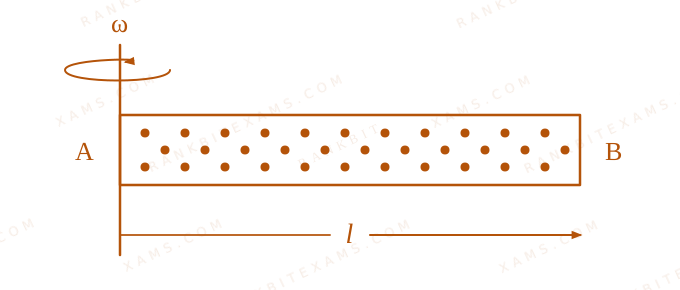
A cylindrical tube AB of length l, closed at both ends contains an ideal gas of 1 mol having molecular weight M. The tube is rotated in a horizontal plane with constant angular velocity omega about an axis perpendicular to AB and passing through the edge at end A, as shown in the figure. If P_A and P_B are the pressures at A and B respectively, then (Consider the temperature is same at all points in the tube)
Kinetic Theory of Gases diagram for Q37 - JEE Main 2026 January Morning
Cylindrical tube rotating about an axis passing through end A.
  • A. P_B = P_Aexp (Momega^2l^2 / 2RT)
  • B. P_B = P_A
  • C. P_B = P_Aexp (Momega^2l^2 / 3RT)
  • D. P_B = P_Aexp (Momega^2l^2 / RT)

Solution

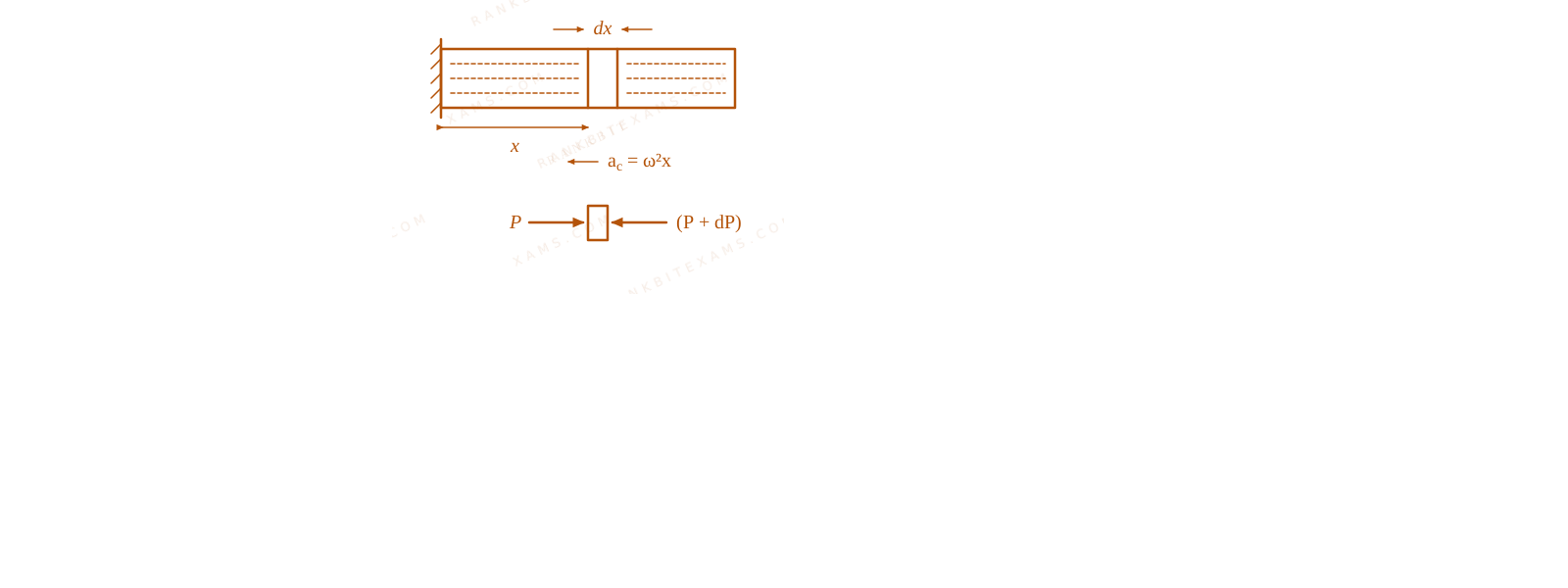
### Related Formula dP = rho omega^2 x dx, quad PM = rho RT ### Core Logic
Solution derivation diagram for Q37 - JEE Main 2026 Morning
Cylindrical tube rotating about an axis passing through end A.
Setting up differential pressure equation: A[(P+dP) - P] = (dm)(omega^2 x) implies dP = fracdmA omega^2 x Substituting rho = fracPMRT: int_P_A^P_B fracdPP = fracomega^2 MRT int_0^l x dx lnleft(fracP_BP_Aright) = fracomega^2 l^2 M2RT implies P_B = P_A e^fracMomega^2 l^22RT ### Pattern Recognition Sees: Rotating gas column with centrifugal pressure gradient. Shortcut: Integrate hydrostatic equation with centripetal acceleration term. Check: Matches option (1). ✓ ### Chapter Mix Class 11 Physics: Kinetic Theory of Gases
Q28 jee_main_2026_22_january_evening Mean Free Path and Collision Frequency
Consider two boxes containing ideal gases A and B such that their temperatures, pressures and number densities are same. The molecular size of A is half of that of B and mass of molecule A is four times that of B. If the collision frequency in gas B is 32 times 10^18/mathrms then collision frequency in gas A is ____/s.
  • A. 32 times 10^8
  • B. 4 times 10^8
  • C. 2 times 10^8
  • D. 8 times 10^8

Solution

### Related Formula Z = sqrt2pi d^2 N sqrtfrac8RTpi M where d is molecular diameter, N is number density, T is temperature, and M is molar mass. ### Core Logic Given that T and N are identical for both gases: Z propto fracd^2sqrtM From the problem statement: d_A = fracd_B2, quad M_A = 4M_B Calculating the ratio of collision frequencies: fracZ_AZ_B = left(fracd_Ad_Bright)^2 times sqrtfracM_BM_A = left(frac12right)^2 times sqrtfrac14 = frac14 times frac12 = frac18 Substituting Z_B = 32 times 10^8 /mathrms: Z_A = frac32 times 10^88 = 4 times 10^8 /mathrms ### Step 1: Final Conclusion The collision frequency in gas A is 4 times 10^8 /mathrms. ### Pattern Recognition Proportionality check: Z propto d^2 / sqrtM. Diameter halved implies 1/4 factor. Mass quadrupled implies 1/sqrt4 = 1/2 factor. Combined factor = 1/4 times 1/2 = 1/8. 32 / 8 = 4. ### Evaluation Rubric / Model Answer null ### Chapter Mix Class 11 Physics: Kinetic Theory of Gases
Q36 jee_main_2026_23_january_evening Gas Laws
An air bubble of volume 2.9 \, mathrmcm^3 rises from the bottom of a swimming pool of 5 m deep. At the bottom of the pool water temperature is 17 \, ^circmathrmC . The volume of the bubble when it reaches the surface, where the water temperature is 27 \, ^circmathrmC , is ____ mathrmcm^3 . (g = 10 \, mathrmm/s^2 , density of water = 10^3 \, mathrmkg/m^3 , and 1 atm pressure is 10^5 \, mathrmPa )
  • A. 4.2
  • B. 2.0
  • C. 3.0
  • D. 4.5

Solution

### Related Formula fracP_1 V_1T_1 = fracP_2 V_2T_2 P = P_textatm + rho g h ### Core Logic
Gas Laws diagram for Q36 - JEE Main 2026 Evening
For an air bubble rising in water, the number of moles of gas remains constant. P_1 = Pressure at bottom = P_textatm + rho gh T_1 = Temperature at bottom = 17^circmathrmC = 290 \, mathrmK V_1 = 2.9 \, mathrmcm^3 P_2 = Pressure at surface = P_textatm T_2 = Temperature at surface = 27^circmathrmC = 300 \, mathrmK ### Step 1: Calculate Pressures P_1 = 10^5 + (10^3 times 10 times 5) = 10^5 + 50,000 = 1.5 times 10^5 \, mathrmPa P_2 = 10^5 \, mathrmPa ### Step 2: Apply Ideal Gas Law frac(1.5 times 10^5)(2.9)290 = frac(10^5)(V_2)300 frac1.5 times 2.9290 = fracV_2300 V_2 = frac1.5 times 2.9 times 300290 = 1.5 times 3 = 4.5 \, mathrmcm^3 ### Pattern Recognition Standard combined gas law application. Always remember to convert Celsius to Kelvin and carefully compute gauge pressure plus atmospheric pressure for the submerged state. ### Evaluation Rubric / Model Answer null ### Chapter Mix Class 11 Physics: Kinetic Theory of Gases Class 11 Physics: Mechanical Properties of Fluids

More Kinetic Theory Questions — jee_main_2026_24_january_morning

Practice all Kinetic Theory previous-year questions →

Rankbit System
JEE Physics: Waves (+15.5%) | Electrostatics: Concentric Shells (-29.7%) | Modern Physics: Photoelectric Clones (+34.2%) | Mathematics: Definite Integrals (+18.1%) | Chemistry: Coordination Splitting (-11.4%) | JEE Physics: Waves (+15.5%) | Electrostatics: Concentric Shells (-29.7%) | Modern Physics: Photoelectric Clones (+34.2%) | Mathematics: Definite Integrals (+18.1%) | Chemistry: Coordination Splitting (-11.4%)
