Rankbit System
JEE Physics: Waves (+15.5%) | Electrostatics: Concentric Shells (-29.7%) | Modern Physics: Photoelectric Clones (+34.2%) | Mathematics: Definite Integrals (+18.1%) | Chemistry: Coordination Splitting (-11.4%) | JEE Physics: Waves (+15.5%) | Electrostatics: Concentric Shells (-29.7%) | Modern Physics: Photoelectric Clones (+34.2%) | Mathematics: Definite Integrals (+18.1%) | Chemistry: Coordination Splitting (-11.4%)

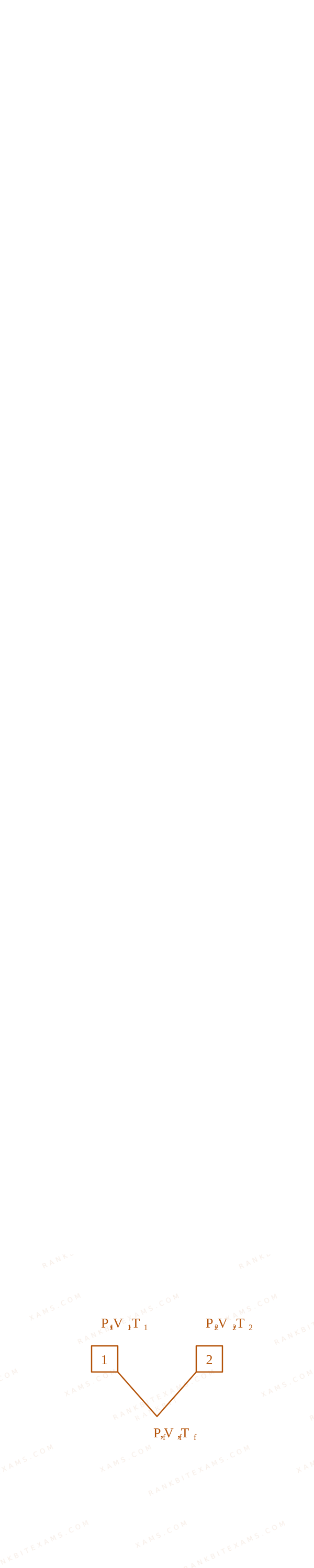
There are two vessels filled with an ideal gas where volume of one is double the volume of other. The large vessel contains the gas at 8 kPa at 1000 K while the smaller vessel contains the gas at 7 kPa at 500 K. If the vessels are connected to each other by a thin tube allowing the gas to flow and the temperature of both vessels is maintained at 600 K, at steady state the pressure in the vessels will be (in kPa).

Solution & Explanation

### Related Formula Ideal Gas Law: n = fracPVRT Conservation of moles: n_1 + n_2 = n_f ### Core Logic Let the volume of the smaller vessel be V_1 = V, then the volume of the larger vessel is V_2 = 2V. Initial moles in large vessel: n_2 = frac8 times 2VR times 1000 = frac16V1000R Initial moles in small vessel: n_1 = frac7 times VR times 500 = frac14V1000R Total total initial moles: n_texttotal = n_1 + n_2 = frac30V1000R ### Step 1: Connect Vessels to Dynamic Equilibrium When connected, the total final volume is V_f = V + 2V = 3V. The final temperature is T_f = 600text K. Using mole conservation: frac30V1000R = fracP_f (3V)R times 600 frac301000 = frac3P_f600 implies frac301000 = fracP_f200 P_f = frac30 times 2001000 = 6text kPa
Dual vessel gas flow schema
### Pattern Recognition Connecting chambers preserves the net mass/moles (sum n_i = textconstant). Keep everything relative to a common volume multiplier V to easily cancel terms. ### Evaluation Rubric / Model Answer null ### Chapter Mix Class 11 Physics: Kinetic Theory

Reference Study Guides

More Kinetic Theory Previous-Year Questions

Q 2025 Specific Heat Capacity
Match the List-I with List-II
List-IList-II
A. Triatomic rigid gasI. fracC_PC_V=frac53
B. Diatomic non-rigid gasII. fracC_PC_V=frac75
C. Monoatomic gasIII. fracC_PC_V=frac43
D. Diatomic rigid gasIV. fracC_PC_V=frac97
Choose the correct answer from the options given below:
  • A. A-III, B-IV, C-I, D-II
  • B. A-III, B-II, C-IV, D-I
  • C. A-II, B-IV, C-I, D-III
  • D. A-IV, B-II, C-III, D-I

Solution

### Related Formula The ratio of specific heats gamma is related to degrees of freedom f by: gamma = fracC_PC_V = 1 + frac2f ### Core Logic Determine the degrees of freedom f for each type of gas: - **Monoatomic gas**: Translational only \implies f = 3 gamma = 1 + frac23 = frac53 quad text(Matches C-I) - **Diatomic rigid gas**: Translational (3) + Rotational (2) \implies f = 5 gamma = 1 + frac25 = frac75 quad text(Matches D-II) ### Step 1: Check Remaining Categories - **Diatomic non-rigid gas**: Translational (3) + Rotational (2) + Vibrational (2) \implies f = 7 gamma = 1 + frac27 = frac97 quad text(Matches B-IV) - **Triatomic rigid gas**: Translational (3) + Rotational (3) \implies f = 6 gamma = 1 + frac26 = 1 + frac13 = frac43 quad text(Matches A-III) This yields the matching order: A-III, B-IV, C-I, D-II. ### Pattern Recognition Sees: Degrees of freedom and \gamma values. Shortcut: Lower degrees of freedom result in higher \gamma values. Order of degrees of freedom: Monoatomic (3) < Diatomic rigid (5) < Triatomic rigid (6) < Diatomic non-rigid (7). Corresponding \gamma: \frac{5}{3} > \frac{7}{5} > \frac{4}{3} > \frac{9}{7}$. ### Evaluation Rubric / Model Answer null ### Chapter Mix Class 11 Physics: Kinetic Theory
Q9 2025 Rms Speed and Temperature
For a particular ideal gas which of the following graphs represents the variation of mean squared velocity of the gas molecules with temperature?
  • A. textGraph (1)
  • B. textGraph (2)
  • C. textGraph (3)
  • D. textGraph (4)

Solution

### Related Formula mathrmV_mathrmrms = sqrtfrac3mathrmRmathrmTmathrmM implies mathrmV_mathrmrms^2 = frac3mathrmRmathrmMmathrmT ### Core Logic The parameter asked is the mean squared velocity, which corresponds directly to mathrmV_mathrmrms^2. From the ideal gas kinematics relation, we observe: mathrmV_mathrmrms^2 propto mathrmT Comparing this format against standard geometric linear templates (y = mx), the curve must map as a clean straight line originating from absolute zero zero coordinates. ### Step 1: Final Conclusion This linear profile matches Graph (1), selecting option (1). ### Pattern Recognition Watch the vertical ordinate labels carefully: Root-mean-square velocity scales as a sub-linear curve (sqrtmathrmT), while mean squared metric trends linearly directly (y propto x). ### Evaluation Rubric / Model Answer null ### Chapter Mix Class 11 Physics: Kinetic Theory
Q1 2025 Mean Free Path and Collision Frequency
The mean free path and the average speed of oxygen molecules at 300mathrm~K and 1mathrm~atm are 3 times 10^-7mathrm~m and 600mathrm~m/s, respectively. Find the frequency of its collisions.
  • A. 2 times 10^10/mathrms
  • B. 9 times 10^5/mathrms
  • C. 2 times 10^9/mathrms
  • D. 5 times 10^8/mathrms

Solution

### Related Formula f = frac1T = fracv_textavglambda where: * f = frequency of collisions * v_textavg = average speed of the molecules * lambda = mean free path ### Core Logic Given parameters: * Average speed, v_textavg = 600mathrm~m/s * Mean free path, lambda = 3 times 10^-7mathrm~m ### Step 1: Calculate Frequency Substitute the values into the formula: f = frac6003 times 10^-7 = 2 times 10^9mathrm~s^-1 Hence, the collision frequency is 2 times 10^9/mathrms. ### Pattern Recognition Collision frequency is simply distance covered per unit time (average velocity) divided by the average distance between consecutive collisions (mean free path). ### Evaluation Rubric / Model Answer null ### Chapter Mix Class 11 Physics: Kinetic Theory

More Kinetic Theory Questions — jee_main_2025_04_april_evening

Practice all Kinetic Theory previous-year questions →

YOUR FIRST PREP STEP STARTS HERE

We Map Every Repeating Question in Competitive Exams.

Say goodbye to generic mock test fatigue. RankBit uses smart analysis to group past exam questions into their foundational Repeating Question Types. Find chapter weightage, track repeating questions, and score higher with targeted practice.

Select Your Target Exam

Choose an exam track below to find formulas per chapter and patterns.

Syncing Exam Intelligence

Mapping formulas and patterns across all tracks…

PATH A — FULL LENGTH PRACTICE

Full Mock Test Hub

Simulate real NTA exam conditions with fully tracked mocks. Time yourself against past papers.

Under Development
PATH B — TARGETED PRACTICE

Topic-wise Practice Hub

Practice past-year questions one chapter at a time. Pick an exam → subject → chapter and get every PYQ for that topic — pulled together from all past papers — with the chapter's key formulas alongside.

Loading Questions... Browse Topics
Latest from the Blog
View all →

Loading articles...