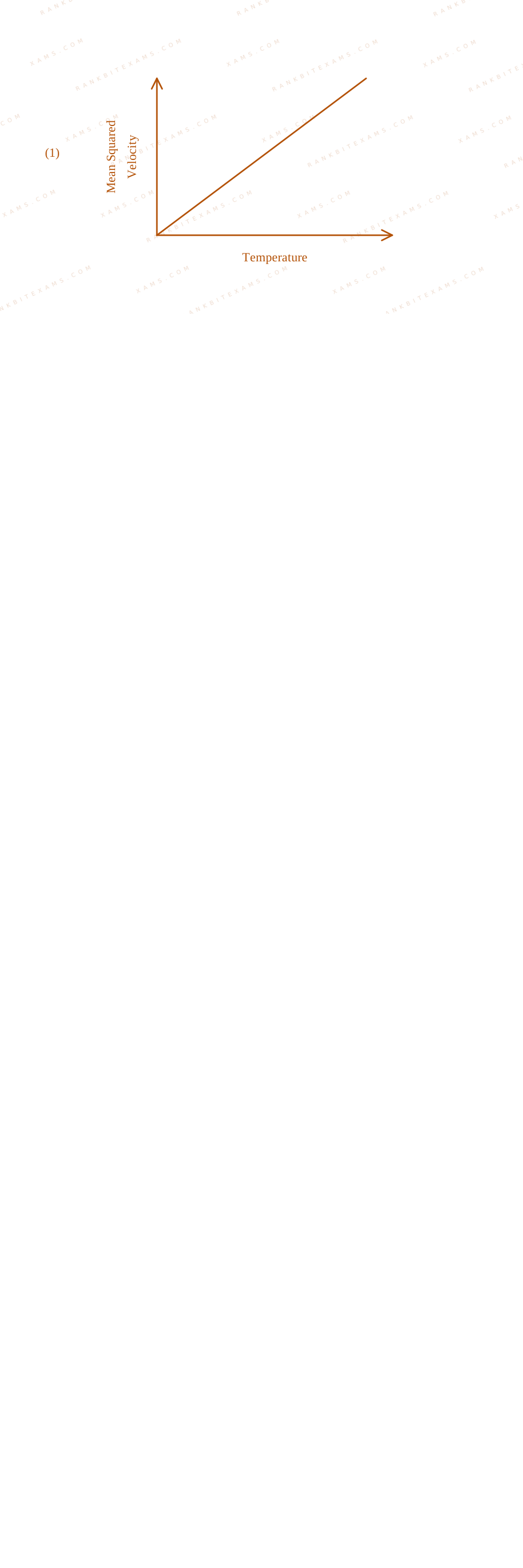
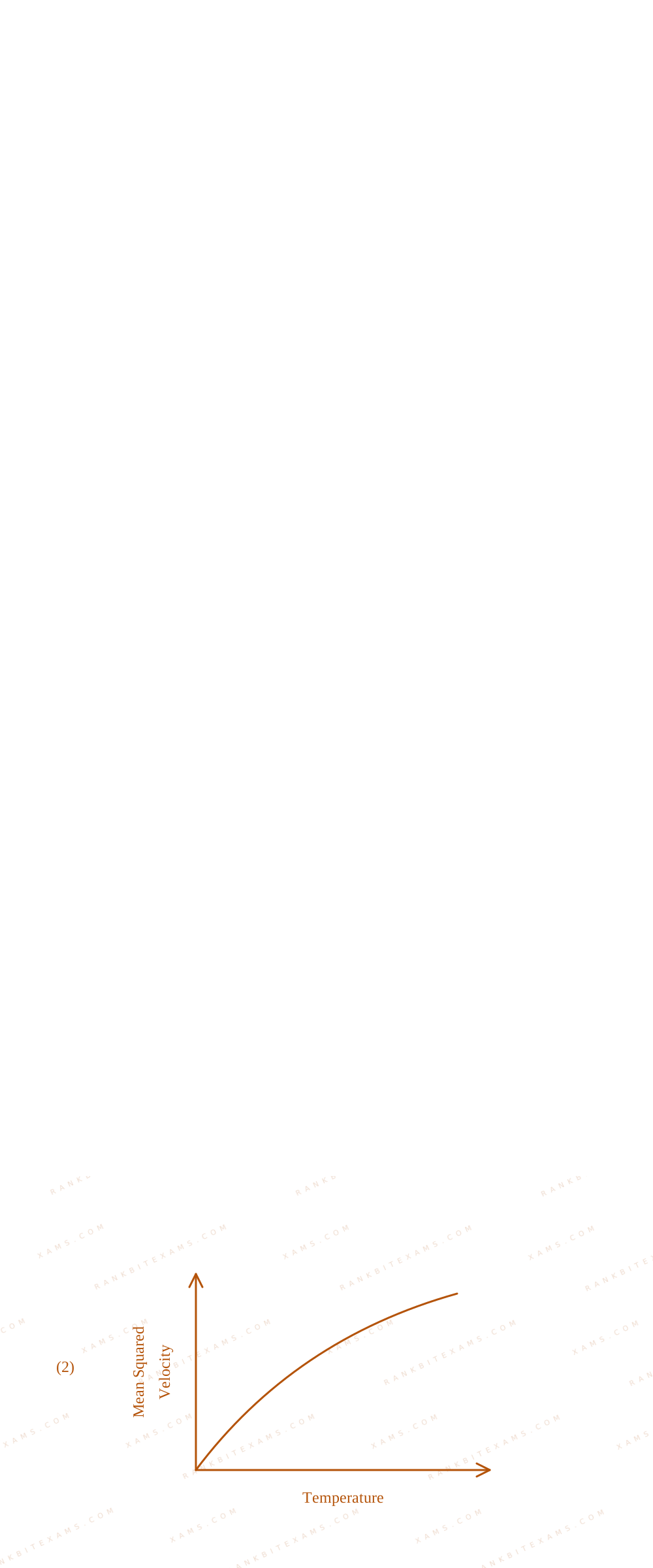

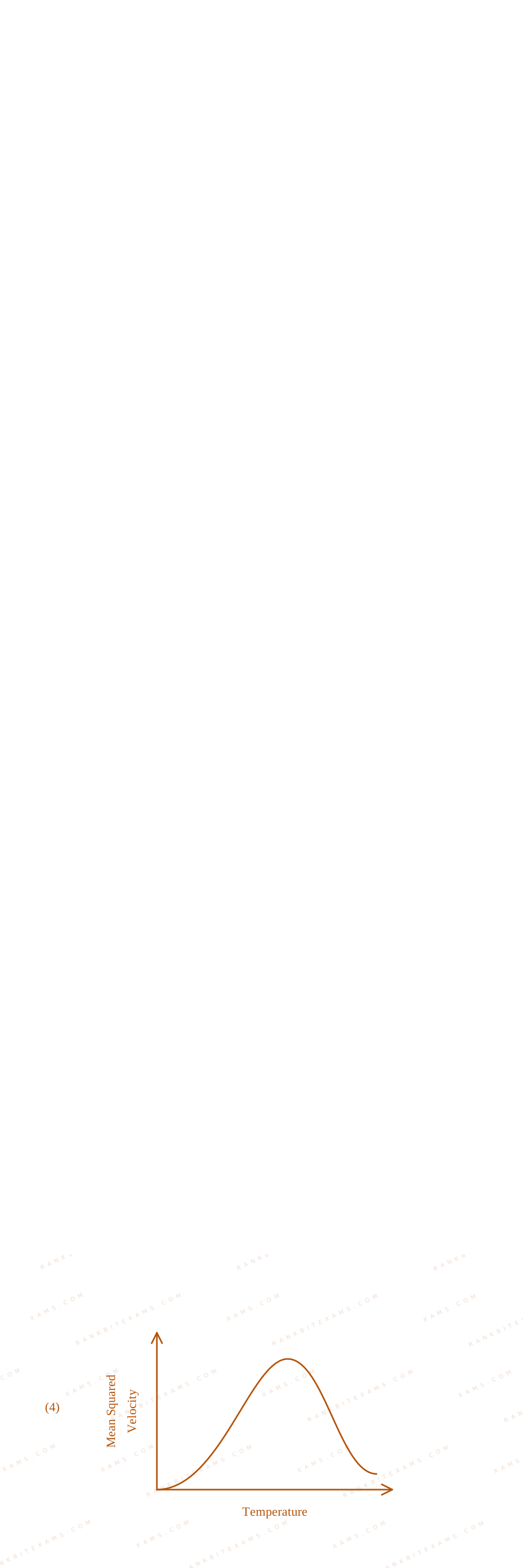
For a particular ideal gas which of the following graphs represents the variation of mean squared velocity of the gas molecules with temperature?

Solution & Explanation

Related Formula
Vrms = 3RTM Vrms² = 3RMT
Core Logic

The parameter asked is the mean squared velocity, which corresponds directly to Vrms².

From the ideal gas kinematics relation, we observe:

Vrms² ∝ T

Comparing this format against standard geometric linear templates (y = mx), the curve must map as a clean straight line originating from absolute zero zero coordinates.

Step 1: Final Conclusion

This linear profile matches Graph (1), selecting option (1).

Pattern Recognition

Watch the vertical ordinate labels carefully: Root-mean-square velocity scales as a sub-linear curve (T), while mean squared metric trends linearly directly (y ∝ x).

Chapter Mix

Class 11 Physics: Kinetic Theory

More Kinetic Theory Previous-Year Questions — Page 2

Q29 jee_main_2026_28_january_evening Mean Free Path
The mean free path of a molecule of diameter 5 × 10⁻¹⁰ m at the temperature 41°C and pressure 1.38 × 10⁵ Pa, is given as ____ m. ( Given~kB = 1.38× 10⁻²³ J / K).
  • A. 2√(2) × 10⁻¹⁰
  • B. 10√(2) × 10⁻⁸
  • C. 2√(2) × 10⁻⁸
  • D. 2 × 10⁻⁸

Solution

Related Formula
λ = kB T√(2) π σ² P

where, λ = mean free path kB = Boltzmann constant T = absolute temperature in Kelvin σ = diameter of the molecule P = pressure of the gas

Step 1: Extract and Convert Given Data

d = σ = 5 × 10⁻¹⁰ m T = 41^ = 273 + 41 = 314 K P = 1.38 × 10⁵ Pa kB = 1.38 × 10⁻²³ J/K

Step 2: Substitution and Calculation
λ = 1.38 × 10⁻²³ × 314√(2) × π × (5 × 10⁻¹⁰)² × 1.38 × 10⁵

Cancel out 1.38 from numerator and denominator:

λ = 10⁻²³ × 314√(2) × 3.14 × 25 × 10⁻²⁰ × 10⁵ λ = 314 × 10⁻²³√(2) × 3.14 × 25 × 10⁻¹⁵ λ = 100 × 10⁻²³√(2) × 25 × 10⁻¹⁵ λ = 4 × 10⁻⁸√(2) = 2√(2) × 10⁻⁸ m
Pattern Recognition

The temperature 314 K and π ≈ 3.14 are intentionally matched to cancel out and give a factor of 100. 1.38 cancels completely. The rest is simply handling powers of 10.

Chapter Mix

Class 11 Physics: Kinetic Theory

Q22 jee_main_2025_02_april_evening Internal Energy of Gas
The internal energy of air in 4m× 4m× 3m sized room at 1 atmospheric pressure will be _ × 10⁶J. (Consider air as diatomic molecule)
Numerical Answer. Answer: 12 to 12

Solution

Related Formula
  • Ideal Gas Law:
  • P V = n R T

  • Internal Energy (U) of a diatomic gas (f = 5 degrees of freedom):
U = n Cv T = n ((5)/(2) R) T = (5)/(2) P V
Core Logic

Given parameters:

  • Dimensions of the room = 4 m × 4 m × 3 m
  • Volume of air in the room V = 4 × 4 × 3 = 48 m³
  • Room pressure P = 1 atm = 10⁵ N/m²
Step 1: Calculate internal energy

Using the thermodynamic relationship:

U = (5)/(2) P V

Substitute the volume and pressure parameters:

U = (5)/(2) × 10⁵ N/m² × 48 m³ U = 5 × 10⁵ × 24 = 120 × 10⁵ J = 12 × 10⁶ J

Thus, the internal energy is 12 × 10⁶ ~J.

Pattern Recognition

Sees: Internal energy of diatomic gas occupying a macroscopic room volume. Trap: Attempting to calculate thermodynamic variables like temperature or density explicitly. Internal energy is completely determined by pressure and volume via degrees of freedom (U = (f)/(2)PV). Shortcut: A diatomic gas has f=5, so U = 2.5 PV. Putting in numbers, U = 2.5 × 10⁵ × 48 = 120 × 10⁵ = 12 × 10⁶ ~J, leaving a coefficient of 12.

Chapter Mix

Class 11 Physics: Kinetic Theory of Gases

Q24 jee_main_2025_02_april_morning Specific Heat Capacities of Gases
γA is the specific heat ratio of monoatomic gas A having 3 translational degrees of freedom. γB is the specific heat ratio of polyatomic gas B having 3 translational, 3 rotational degrees of freedom and 1 vibrational mode. If (γA)/(γB) = (1 + (1)/(n)) then the value of n is
Numerical Answer. Answer: 3 to 3

Solution

Related Formula
γ = 1 + (2)/(f)
Core Logic

Let's find the specific heat ratio for each gas based on degrees of freedom:

  • Monoatomic gas A:
  • Degrees of freedom, fA = 3 (translational only)
γA = 1 + (2)/(3) = (5)/(3)
  • Polyatomic gas B:
  • Translational degrees of freedom = 3
  • Rotational degrees of freedom = 3
  • Vibrational modes = 1.
  • Note: Each active vibrational mode has 2 degrees of freedom (kinetic + potential energy terms). This contributes 2 × 1 = 2 degrees of freedom.

  • Therefore, the total active degrees of freedom is:
fB = 3 + 3 + 2 = 8

The specific heat ratio of B is:

γB = 1 + (2)/(fB) = 1 + (2)/(8) = 1 + (1)/(4) = (5)/(4)

Now, find the ratio of specific heat capacities:

(γA)/(γB) = (5/3)/(5/4) = (4)/(3)

We are given:

(γA)/(γB) = 1 + (1)/(n) (4)/(3) = 1 + (1)/(n) (1)/(n) = (1)/(3) n = 3
Step 1: Final Conclusion

The value of n is 3.

Pattern Recognition

Always remember that each vibrational mode contributes exactly 2 degrees of freedom because it holds both kinetic and potential energy components (fvib = 2 × modes).

Chapter Mix

Class 11 Physics: Kinetic Theory of Gases Class 11 Physics: Thermodynamics

Q17 jee_main_2025_03_april_evening Gas Laws and Temperature Dependency
Pressure of an ideal gas, contained in a closed vessel, is increased by 0.4% when heated by 1°C. Its initial temperature must be :
  • A. 25°C
  • B. 2500 K
  • C. 250 K
  • D. 250°C

Solution

Related Formula

For an ideal gas in a closed container, the volume V remains constant (isochoric process). By Gay-Lussac's Law:

P ∝ T ⇒ (Δ P)/(P) = (Δ T)/(T)

where T must be in Kelvin.

Core Logic

Given parameters:

  • Percent increase in pressure: (Δ P)/(P) × 100 = 0.4% ⇒ (Δ P)/(P) = 0.004
  • Increase in temperature Δ T = 1°C = 1~K
Step 1: Calculate initial temperature (T)

Substitute the values into Gay-Lussac's fractional variance formula:

0.004 = (1)/(T) T = (1)/(0.004) = 250~K
Pattern Recognition

A standard percentage-increase layout. A change of 0.4% means (1)/(250) of the original quantity. Hence, a 1~K rise corresponds to an initial temperature of 250~K directly.

Chapter Mix

Class 11 Physics: Kinetic Theory of Gases

Q jee_main_2025_07_april_morning Specific Heat Capacity
Match the List-I with List-II
List-IList-II
A. Triatomic rigid gasI. CPCV=(5)/(3)
B. Diatomic non-rigid gasII. CPCV=(7)/(5)
C. Monoatomic gasIII. CPCV=(4)/(3)
D. Diatomic rigid gasIV. CPCV=(9)/(7)
Choose the correct answer from the options given below:
  • A. A-III, B-IV, C-I, D-II
  • B. A-III, B-II, C-IV, D-I
  • C. A-II, B-IV, C-I, D-III
  • D. A-IV, B-II, C-III, D-I

Solution

Related Formula

The ratio of specific heats γ is related to degrees of freedom f by:

γ = (CP)/(CV) = 1 + (2)/(f)
Core Logic

Determine the degrees of freedom

Core Logic

Determine the degrees of freedom $ffor each type of gas:

  • Monoatomic gas: Translational only
$
γ = 1 + (2)/(3) = (5)/(3) (Matches C-I)
  • Diatomic rigid gas: Translational (3) + Rotational (2)
$
γ = 1 + (2)/(5) = (7)/(5) (Matches D-II)
Step 1: Check Remaining Categories
  • Diatomic non-rigid gas: Translational (3) + Rotational (2) + Vibrational (2)
$
γ = 1 + (2)/(7) = (9)/(7) (Matches B-IV)
  • Triatomic rigid gas: Translational (3) + Rotational (3)
$
γ = 1 + (2)/(6) = 1 + (1)/(3) = (4)/(3) (Matches A-III)

This yields the matching order: A-III, B-IV, C-I, D-II.

Pattern Recognition

Sees: Degrees of freedom and

This yields the matching order: A-III, B-IV, C-I, D-II.

Pattern Recognition

Sees: Degrees of freedom and $\gammavalues. Shortcut: Lower degrees of freedom result in higher\gammavalues. Order of degrees of freedom: Monoatomic (3) < Diatomic rigid (5) < Triatomic rigid (6) < Diatomic non-rigid (7). Corresponding\gamma:\frac{5}{3} > \frac{7}{5} > \frac{4}{3} > \frac{9}{7}$.

Chapter Mix

Class 11 Physics: Kinetic Theory

More Kinetic Theory Questions — jee_main_2025_28_jan_morning

Practice all Kinetic Theory previous-year questions →

Rankbit System
JEE Physics: Waves (+15.5%) | Electrostatics: Concentric Shells (-29.7%) | Modern Physics: Photoelectric Clones (+34.2%) | Mathematics: Definite Integrals (+18.1%) | Chemistry: Coordination Splitting (-11.4%) | JEE Physics: Waves (+15.5%) | Electrostatics: Concentric Shells (-29.7%) | Modern Physics: Photoelectric Clones (+34.2%) | Mathematics: Definite Integrals (+18.1%) | Chemistry: Coordination Splitting (-11.4%)