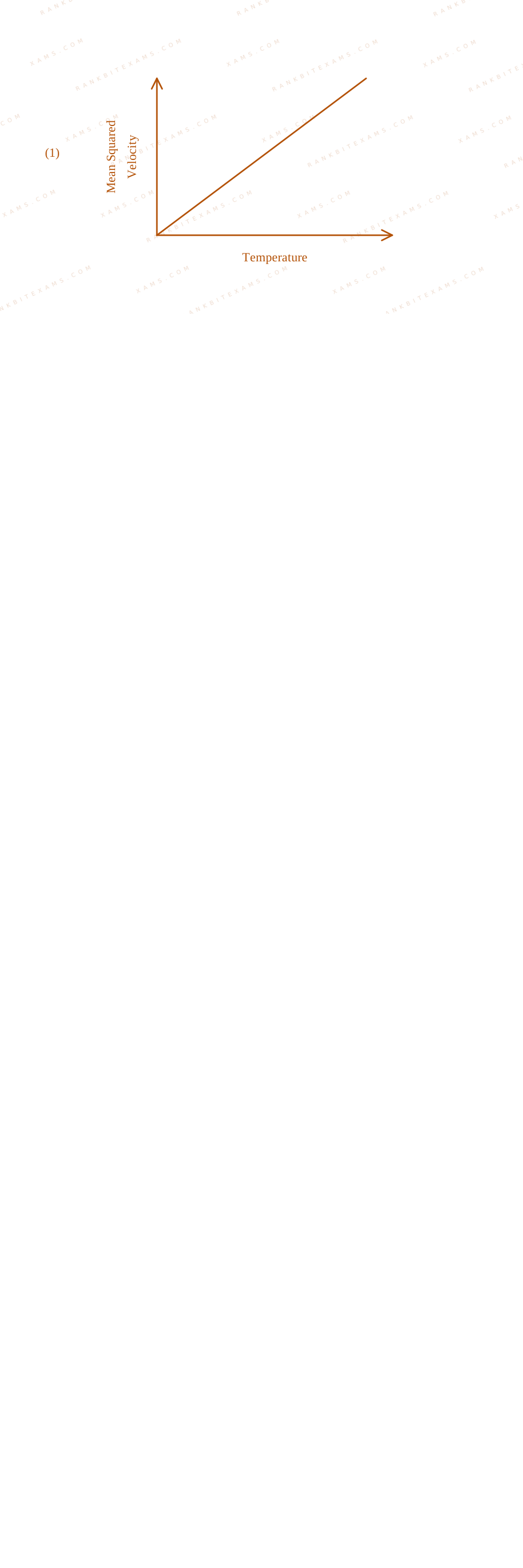
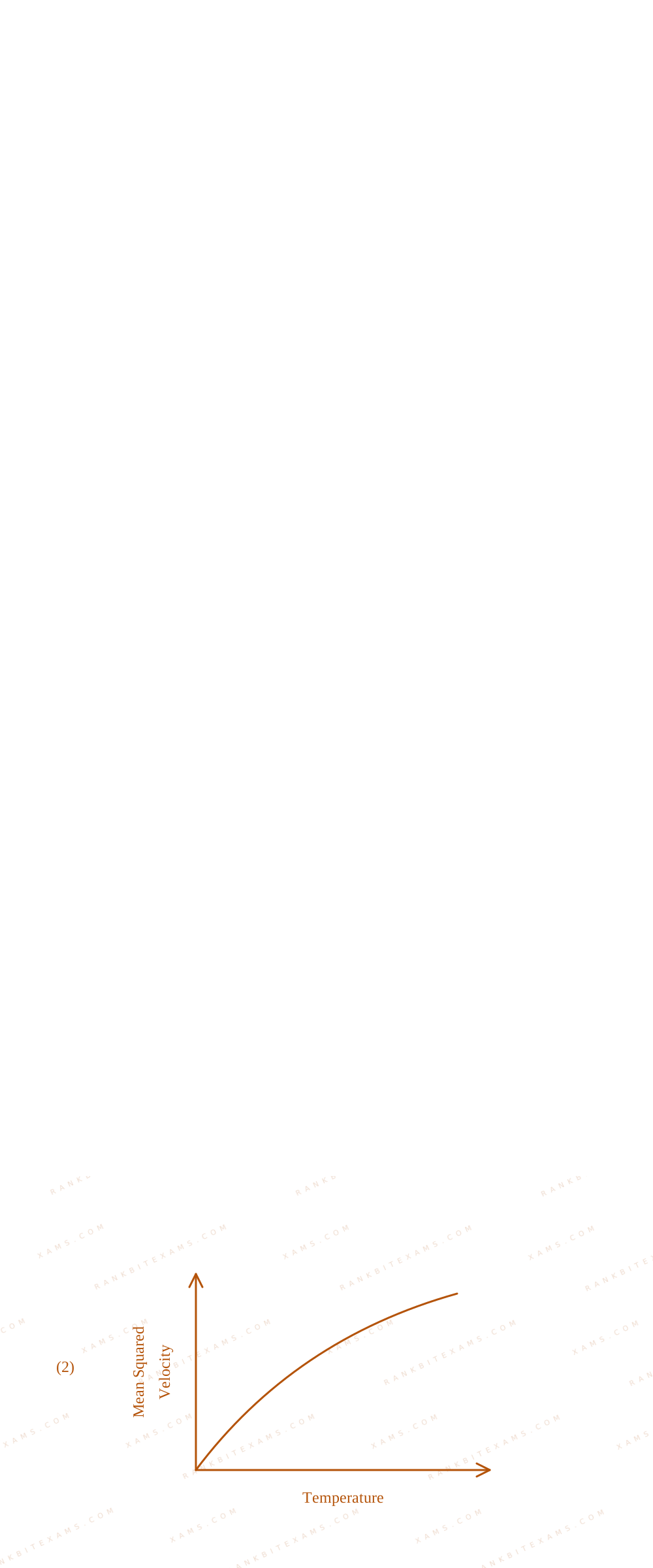

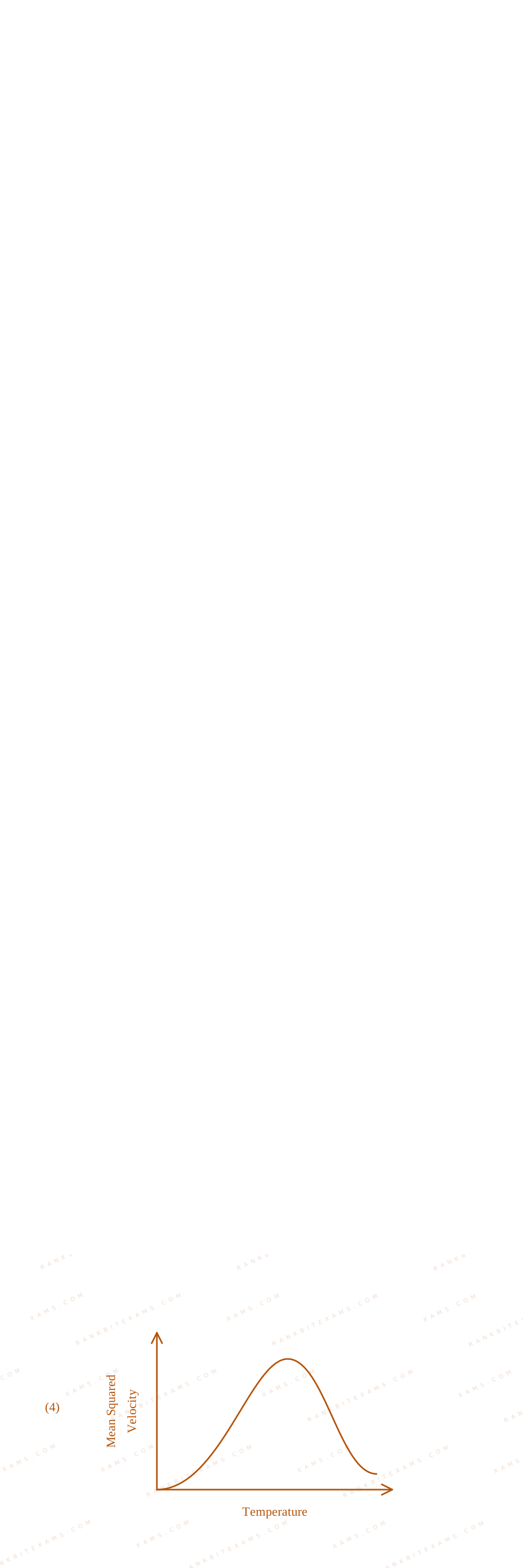
For a particular ideal gas which of the following graphs represents the variation of mean squared velocity of the gas molecules with temperature?

Solution & Explanation

Related Formula
Vrms = 3RTM Vrms² = 3RMT
Core Logic

The parameter asked is the mean squared velocity, which corresponds directly to Vrms².

From the ideal gas kinematics relation, we observe:

Vrms² ∝ T

Comparing this format against standard geometric linear templates (y = mx), the curve must map as a clean straight line originating from absolute zero zero coordinates.

Step 1: Final Conclusion

This linear profile matches Graph (1), selecting option (1).

Pattern Recognition

Watch the vertical ordinate labels carefully: Root-mean-square velocity scales as a sub-linear curve (T), while mean squared metric trends linearly directly (y ∝ x).

Chapter Mix

Class 11 Physics: Kinetic Theory

More Kinetic Theory Previous-Year Questions

Q30 jee_main_2026_21_jan_evening RMS Speed
The r.m.s speed of oxygen molecules at 47°C is equal to that of the hydrogen molecules kept at ________ °C. (Mass of oxygen molecule / mass of hydrogen molecule = 32 / 2)
  • A. -235
  • B. -100
  • C. -253
  • D. -20

Solution

Related Formula
Vrms = √((3RT)/(M))
Core Logic

Given that the RMS speed of oxygen molecules equals the RMS speed of hydrogen molecules:

Vrms(O₂) = Vrms(H₂) 3RTO₂MO₂ = 3RTH₂MH₂

Squaring both sides:

TO₂MO₂ = TH₂MH₂
Step 1: Absolute Temperature Conversion

Temperature of oxygen in Kelvin:

TO₂ = 273 + 47 = 320 K
Step 2: Evaluating for Hydrogen

Substitute the given mass ratio and absolute temperature:

(320)/(32) = TH₂2 10 = TH₂2 TH₂ = 20 K
Step 3: Final Conclusion

Convert back to Celsius:

TH₂ in °C = 20 - 273 = -253°C
Pattern Recognition

Direct proportionality between Temperature and Molecular Mass for equal RMS speeds. T₁/M₁ = T₂/M₂. Always convert to Kelvin before evaluating.

Chapter Mix

Class 11 Physics: Kinetic Theory of Gases
Q37 jee_main_2026_22_january_morning Rotating Gas Cylinder Pressure
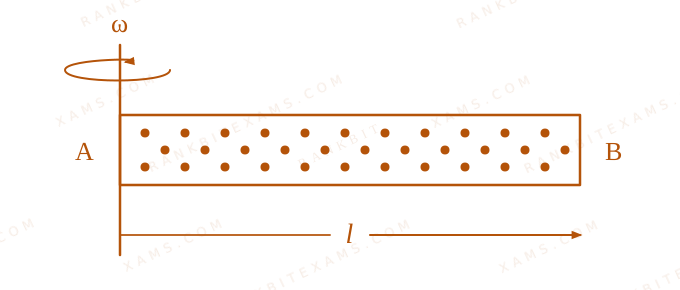
A cylindrical tube AB of length l, closed at both ends contains an ideal gas of 1 mol having molecular weight M. The tube is rotated in a horizontal plane with constant angular velocity ω about an axis perpendicular to AB and passing through the edge at end A, as shown in the figure. If PA and PB are the pressures at A and B respectively, then (Consider the temperature is same at all points in the tube)
Kinetic Theory of Gases diagram for Q37 - JEE Main 2026 January Morning
Cylindrical tube rotating about an axis passing through end A.
  • A. PB = PA (Mω²l² / 2RT)
  • B. PB = PA
  • C. PB = PA (Mω²l² / 3RT)
  • D. PB = PA (Mω²l² / RT)

Solution

Related Formula
dP = ρ ω² x dx, PM = ρ RT
Core Logic

Solution derivation diagram for Q37 - JEE Main 2026 Morning
Cylindrical tube rotating about an axis passing through end A.

Setting up differential pressure equation:

A[(P+dP) - P] = (dm)(ω² x) dP = (dm)/(A) ω² x

Substituting ρ = (PM)/(RT):

∫PAPB (dP)/(P) = (ω² M)/(RT) ∫₀^l x dx ln((PB)/(PA)) = (ω² l² M)/(2RT) PB = PA e(Mω² l²)/(2RT)
Pattern Recognition

Sees: Rotating gas column with centrifugal pressure gradient. Shortcut: Integrate hydrostatic equation with centripetal acceleration term. Check: Matches option (1). ✓

Chapter Mix

Class 11 Physics: Kinetic Theory of Gases

Q28 jee_main_2026_22_january_evening Mean Free Path and Collision Frequency
Consider two boxes containing ideal gases A and B such that their temperatures, pressures and number densities are same. The molecular size of A is half of that of B and mass of molecule A is four times that of B. If the collision frequency in gas B is 32 × 10¹⁸/s then collision frequency in gas A is ____/s.
  • A. 32 × 10⁸
  • B. 4 × 10⁸
  • C. 2 × 10⁸
  • D. 8 × 10⁸

Solution

Related Formula
Z = √(2)π d² N √((8RT)/(π M))

where d is molecular diameter, N is number density, T is temperature, and M is molar mass.

Core Logic

Given that T and N are identical for both gases:

Z ∝ d²√(M)

From the problem statement:

dA = (dB)/(2), MA = 4MB

Calculating the ratio of collision frequencies:

(ZA)/(ZB) = ((dA)/(dB))² × √((MB)/(MA)) = ((1)/(2))² × √((1)/(4)) = (1)/(4) × (1)/(2) = (1)/(8)

Substituting ZB = 32 × 10⁸ /s:

ZA = (32 × 10⁸)/(8) = 4 × 10⁸ /s
Step 1: Final Conclusion

The collision frequency in gas A is 4 × 10⁸ /s.

Pattern Recognition

Proportionality check: Z ∝ d² / √(M). Diameter halved 1/4 factor. Mass quadrupled 1/√(4) = 1/2 factor. Combined factor = 1/4 × 1/2 = 1/8. 32 / 8 = 4.

Chapter Mix

Class 11 Physics: Kinetic Theory of Gases

Q36 jee_main_2026_23_january_evening Gas Laws
An air bubble of volume 2.9 cm³ rises from the bottom of a swimming pool of 5 m deep. At the bottom of the pool water temperature is 17 °C . The volume of the bubble when it reaches the surface, where the water temperature is 27 °C , is ____ cm³ . (g = 10 m/s² , density of water = 10³ kg/m³ , and 1 atm pressure is 10⁵ Pa )
  • A. 4.2
  • B. 2.0
  • C. 3.0
  • D. 4.5

Solution

Related Formula
(P₁ V₁)/(T₁) = (P₂ V₂)/(T₂) P = Patm + ρ g h
Core Logic

Gas Laws diagram for Q36 - JEE Main 2026 Evening

For an air bubble rising in water, the number of moles of gas remains constant. P₁ = Pressure at bottom = Patm + ρ gh T₁ = Temperature at bottom = 17°C = 290 K V₁ = 2.9 cm³

P₂ = Pressure at surface = Patm T₂ = Temperature at surface = 27°C = 300 K

Step 1: Calculate Pressures
P₁ = 10⁵ + (10³ × 10 × 5) = 10⁵ + 50,000 = 1.5 × 10⁵ Pa P₂ = 10⁵ Pa
Step 2: Apply Ideal Gas Law
((1.5 × 10⁵)(2.9))/(290) = ((10⁵)(V₂))/(300) (1.5 × 2.9)/(290) = (V₂)/(300) V₂ = (1.5 × 2.9 × 300)/(290) = 1.5 × 3 = 4.5 cm³
Pattern Recognition

Standard combined gas law application. Always remember to convert Celsius to Kelvin and carefully compute gauge pressure plus atmospheric pressure for the submerged state.

Chapter Mix

Class 11 Physics: Kinetic Theory of Gases Class 11 Physics: Mechanical Properties of Fluids

Q47 jee_main_2026_24_january_morning Ideal Gas Laws
A gas of certain mass filled in a closed cylinder at a pressure of 3.23 kPa has temperature 50°C. The gas is now heated to double its temperature. The modified pressure is ____ Pa.
Numerical Answer. Answer: 3730 to 3730

Solution

Related Formula
P ∝ T (Gay-Lussac's Law for constant V)
Core Logic

Since the gas is filled in a closed cylinder, the volume V remains constant. Therefore, P ∝ T (where T must be in Kelvin). Initial temperature Tᵢ = 50°C = 273 + 50 = 323 K. Final temperature Tf = 100°C = 273 + 100 = 373 K.

Note: The phrasing "double its temperature" is slightly ambiguous (Celsius vs Kelvin). As per standard interpretations in such exams, "double its temperature" given in Celsius means 100°C (which is 373 K). If it meant doubling absolute temperature, final would be 646 K. The official interpretation used here doubles the Celsius scale value.

Step 1: Calculate Final Pressure

Using the relation:

(Pf)/(Pᵢ) = (Tf)/(Tᵢ) (Pf)/(3.23 × 10³) = (373)/(323) Pf = 3.23 × 10³ × (373)/(323) = 3.73 × 10³ Pa Pf = 3730 Pa
Pattern Recognition

Be highly alert to 'double temperature' traps when given in Celsius. The question specifically intends 50^° arrow 100^°, not 323K arrow 646K. Calculating with 373K nicely cancels with the 3.23kPa.

Chapter Mix

Class 11 Physics: Kinetic Theory Class 11 Physics: Thermodynamics

More Kinetic Theory Questions — jee_main_2025_28_jan_morning

Practice all Kinetic Theory previous-year questions →

Rankbit System
JEE Physics: Waves (+15.5%) | Electrostatics: Concentric Shells (-29.7%) | Modern Physics: Photoelectric Clones (+34.2%) | Mathematics: Definite Integrals (+18.1%) | Chemistry: Coordination Splitting (-11.4%) | JEE Physics: Waves (+15.5%) | Electrostatics: Concentric Shells (-29.7%) | Modern Physics: Photoelectric Clones (+34.2%) | Mathematics: Definite Integrals (+18.1%) | Chemistry: Coordination Splitting (-11.4%)