A wire of resistance R$R$ is bent into an equilateral triangle and an identical wire is bent into a square. The ratio of resistance between the two end points of an edge of the triangle to that of the square is
A.9 / 8$9 / 8$
B.8 / 9$8 / 9$
C.27/32
D.32/27
Solution & Explanation
Related Formula
R = ρ A R ∝$$\mathrm{R} = \frac{\rho\ell}{\mathrm{A}} \implies \mathrm{R} \propto \ell$$
Core Logic
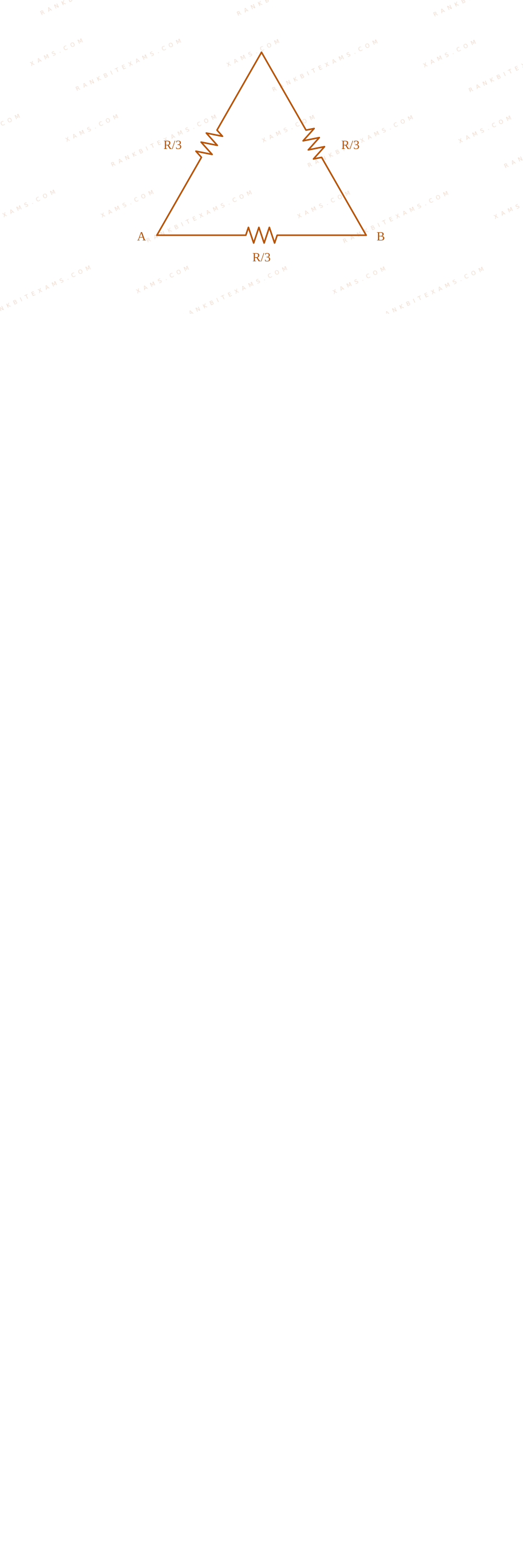
For the equilateral triangle, the total resistance R$\mathrm{R}$ is divided into three equal line parts of value R3$\frac{\mathrm{R}}{3}$ each:
Visual representation of triangle and square edge divisions for Q15
Visual representation of triangle and square edge divisions for Q15
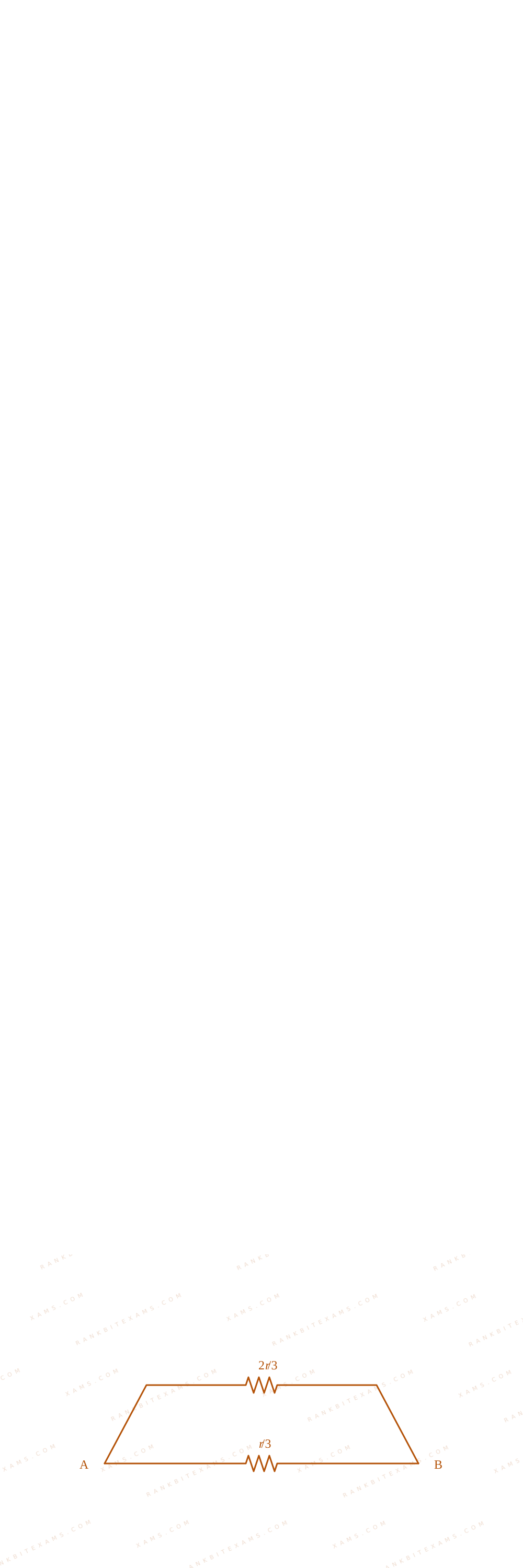
An edge configuration places one part in parallel with the other two series steps:
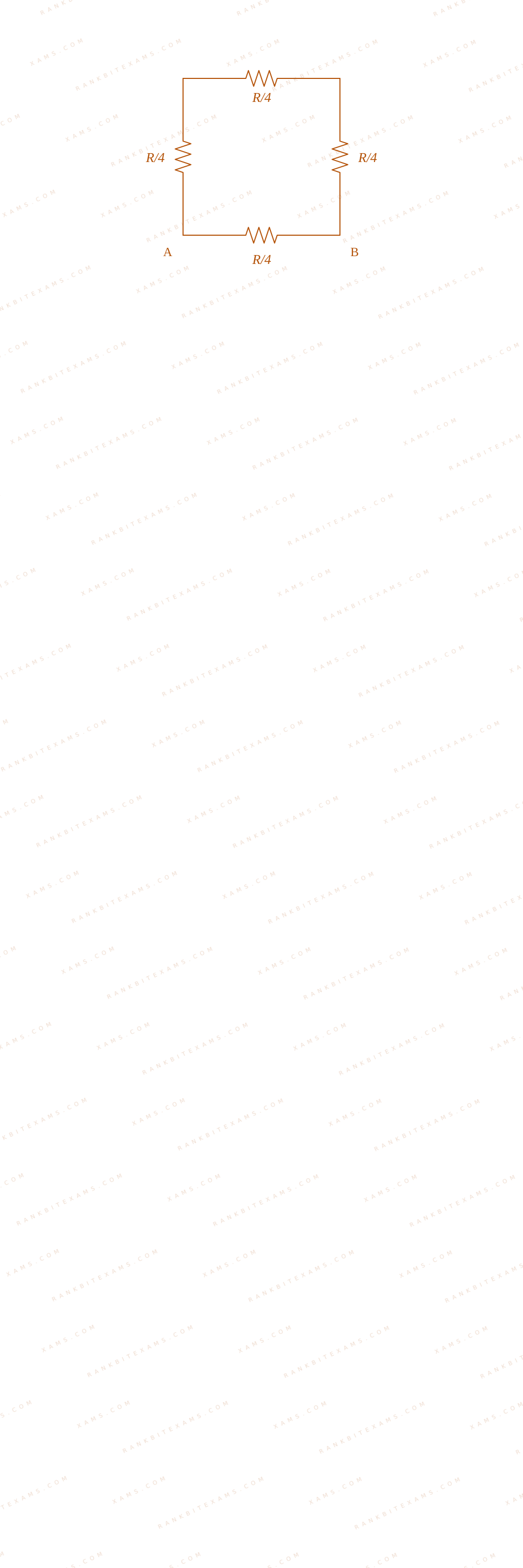
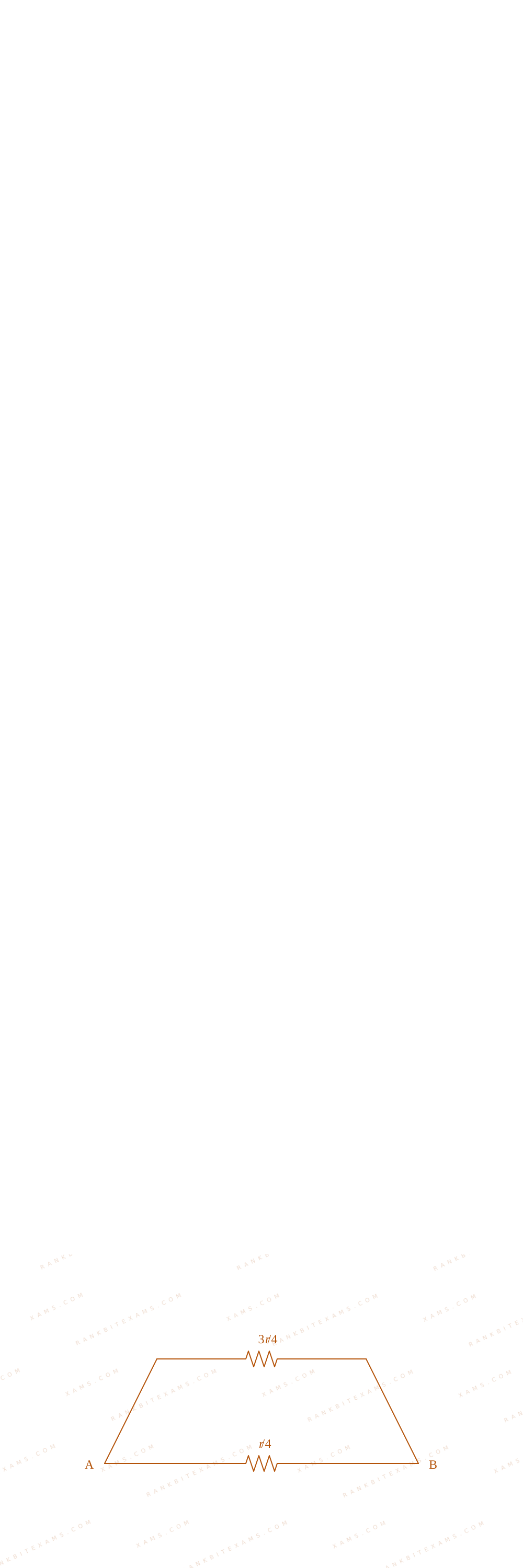
For a regular polygon with N$\mathrm{N}$ identical sides formed from a wire of resistance R$\mathrm{R}$, the resistance across one edge is always given by (N-1)N²R$\frac{(\mathrm{N}-1)}{\mathrm{N}^2}\mathrm{R}$.
Keywords:#wire bent into equilateral triangle and square#JEE Main 2025 Morning Q15#Current Electricity JEE Main 2025#Combination of Resistors JEE Main 2025
More Current Electricity Previous-Year Questions — Page 8
Qjee_main_2024_27_jan_morningCapacitor in DC Circuit
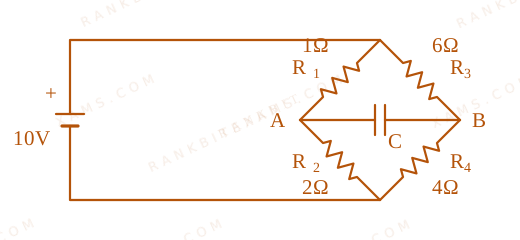
The charge accumulated on the capacitor connected in the following circuit is ______ $\mu\text{C}$. (Given C = 150$C = 150\ \mu\text{F}$).
The layout shows an integrated network of resistors labeled R1 to R4 powered by a 10V DC source loop with a branch housing a 150 uF capacitor element bridging distinct structural potential nodes.
The layout shows an integrated network of resistors labeled R1 to R4 powered by a 10V DC source loop with a branch housing a 150 uF capacitor element bridging distinct structural potential nodes.
Numerical Answer.Answer: 400 to 400
Solution
Related Formula
Q = C · Δ VC$$Q = C \cdot \Delta V_C$$
Core Logic
In steady state, no current flows through the capacitor branch. Analyze potential levels at node loops using standard Kirchhoff mesh values mapped across the core loop resistors:
Steady state capacitor loops act as open electrical cuts, transforming active mesh equations into simple layout node checks.
Chapter Mix
Class 12 Physics: Current Electricity
Q48jee_main_2024_27_jan_morningMeter Bridge and Resistivity
A wire of length 10 cm$10\text{ cm}$ and radius √(7) × 10⁻⁴ m$\sqrt{7} \times 10^{-4}\text{ m}$ is connected across the right gap of a meter bridge. When a resistance of 4.5 Ω$4.5\ \Omega$ is connected on the left gap by using a resistance box, the balance length is found to be at 60 cm$60\text{ cm}$ from the left end.
If the resistivity of the wire is R × 10⁻⁷$R \times 10^{-7}\ \Omega\text{m}$, then the value of R$R$ is:
Given ρ = R × 10⁻⁷$\rho = R \times 10^{-7}$, comparing coefficients gives:
R = 66$R = 66$
Pattern Recognition
Meter bridge balance simplifies directly to simple scalar component checks. The √(7)$\sqrt{7}$ term perfectly neutralizes the fractional (22)/(7)$\frac{22}{7}$ constant in circular area profiles.
Chapter Mix
Class 12 Physics: Current Electricity
Q49jee_main_2024_27_jan_morningCombination of Resistors
A wire of resistance R$R$ and length L$L$ is cut into 5$5$ equal parts. If these parts are joined parallely, then the resultant resistance will be:
A.(1)/(25)R$\frac{1}{25}R$
B.(1)/(5)R$\frac{1}{5}R$
C.25R$25R$
D.5R$5R$
Solution
Core Logic
Resistance is directly proportional to length (R ∝ L$R \propto L$). Cutting the wire into 5 equal pieces reduces the resistance of each segment to:
R' = (R)/(5)$$R' = \frac{R}{5}$$
Step 1: Compute parallel value
Connecting 5 identical resistors R'$R'$ in parallel gives a total equivalent resistance of:
Cutting an item into N$N$ components and grouping them in parallel scales the overall baseline systemic value down cleanly by a factor of N²$N^2$.
Chapter Mix
Class 12 Physics: Current Electricity
Qjee_main_2024_29_jan_morningKirchhoff's Laws and RC Circuits
A 16 Ω$16 \, \Omega$ wire is bend to form a square loop. A 9V battery with internal resistance 1 Ω$1 \, \Omega$ is connected across one of its sides. If a 4 μ F$4 \, \mu \mathrm{F}$ capacitor is connected across one of its diagonals, the energy stored by the capacitor will be (x)/(2) μ J$\frac{x}{2} \, \mu \mathrm{J}$. where x =$x = $ _________.
Numerical Answer.Answer: 81 to 81
Solution
Related Formula
Energy stored (U$U$) by a capacitor of capacitance C$C$ under steady state voltage VC$V_C$:
U = (1)/(2) C VC²$$U = \frac{1}{2} C V_C^2$$
Core Logic
A wire of resistance 16 Ω$16 \, \Omega$ is bent into a square, so each of the 4 sides has a resistance of:
The battery is connected across one side. Let this side have resistance 4 Ω$4 \, \Omega$. The remaining three sides are connected in series, creating a parallel branch with a combined resistance of:
Step 3: Find Potential Difference across the Diagonal
In a steady state, the capacitor acts as an open circuit. Let the diagonal link nodes be A$A$ and B$B$. The path contains two sides of the 12 Ω$12 \, \Omega$ branch (total resistance = 8 Ω$8 \, \Omega$):
Comparing this directly with the expression (x)/(2) μ J$\frac{x}{2} \, \mu \mathrm{J}$:
x = 81$x = 81$
Therefore, the value of x$x$ is 81$81$.
Pattern Recognition
Remember that capacitors act as standard open circuits when reaching steady-state DC conditions. Simply calculate the node potentials across the bridge connection points using standard current distribution laws first, then execute the energy equation.
Chapter Mix
Class 12 Physics: Current Electricity
Class 12 Physics: Electrostatic Potential and Capacitance
Q32jee_main_2024_29_jan_morningElectric Current and Charge
The electric current through a wire varies with time as I = I₀ + β t$I = I_0 + \beta t$, where I₀ = 20 ~A$I_0 = 20 \mathrm{~A}$ and β = 3 ~A / s$\beta = 3 \mathrm{~A / s}$. The amount of electric charge crossed through a section of the wire in 20 ~s$20 \mathrm{~s}$ is:
A.80 ~C$80 \mathrm{~C}$
B.1000 ~C$1000 \mathrm{~C}$
C.800 ~C$800 \mathrm{~C}$
D.1600 ~C$1600 \mathrm{~C}$
Solution
Related Formula
The relationship between current, charge, and time is given by:
I = (dq)/(dt) q = ∫ I dt$$I = \frac{dq}{dt} \implies q = \int I \, dt$$
Core Logic
Given the current variation:
I = I₀ + β t$$I = I_0 + \beta t$$
Substituting the given values, I₀ = 20 ~A$I_0 = 20 \mathrm{~A}$ and β = 3 ~A/s$\beta = 3 \mathrm{~A/s}$:
I = 20 + 3t$I = 20 + 3t$
Thus:
(dq)/(dt) = 20 + 3t$$\frac{dq}{dt} = 20 + 3t$$
Step 1: Integrate to Find Charge
To find the total charge crossing a section of wire from t = 0$t = 0$ to t = 20 ~s$t = 20 \mathrm{~s}$:
Therefore, the charge crossed is 1000 ~C$1000 \mathrm{~C}$.
Pattern Recognition
Whenever current is given as a function of time I(t)$I(t)$, the total charge is simply the area under the I-t$I-t$ curve, which mathematically corresponds to the definite integral ∫t₁t₂ I(t) dt$\int_{t_1}^{t_2} I(t) \, dt$.
Chapter Mix
Class 12 Physics: Current Electricity
More Current Electricity Questions — jee_main_2025_28_jan_morning
Practice past-year questions one chapter at a time. Pick an exam → subject → chapter and get every PYQ for that topic — pulled together from all past papers — with the chapter's key formulas alongside.