JEE Main · Physics → Steady

Current Electricity appeared 50 times across 3 years — 5.8% of Physics. This question is from Combination of Resistors.

Year 2026 2025 2024 Total
Questions 18 13 19 50

A wire of resistance R is bent into an equilateral triangle and an identical wire is bent into a square. The ratio of resistance between the two end points of an edge of the triangle to that of the square is

Solution & Explanation

Related Formula
R = ρ A R ∝
Core Logic

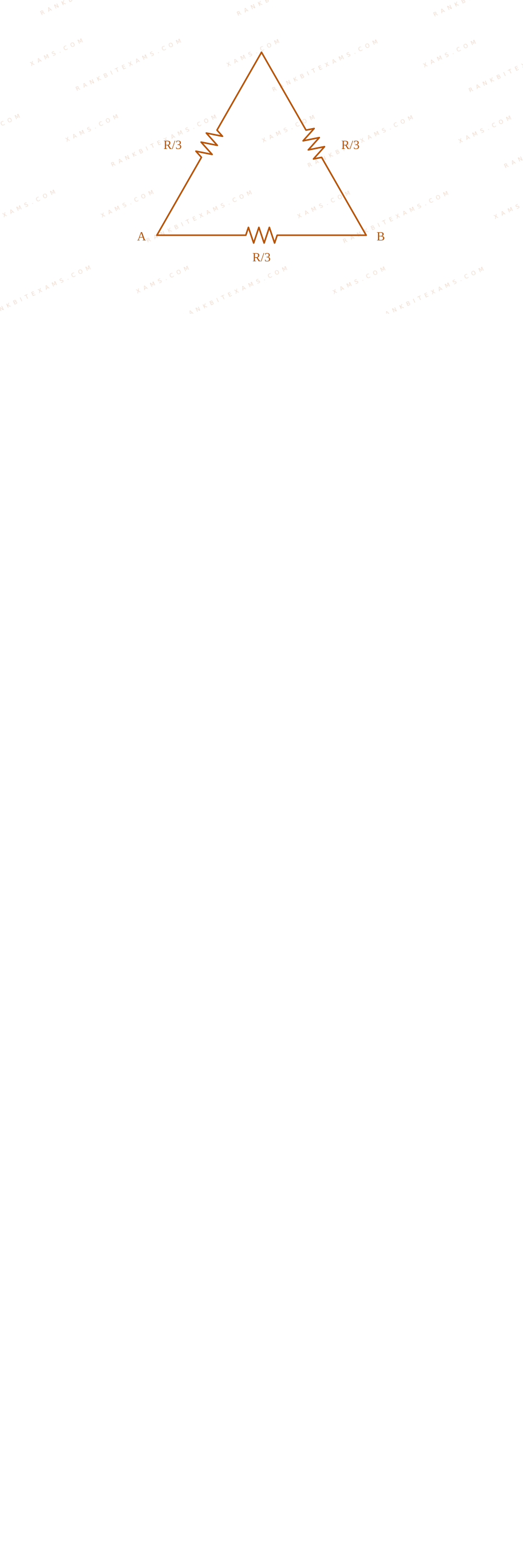
For the equilateral triangle, the total resistance R is divided into three equal line parts of value R3 each:

Visual representation of triangle and square edge divisions for Q15

Visual representation of triangle and square edge divisions for Q15

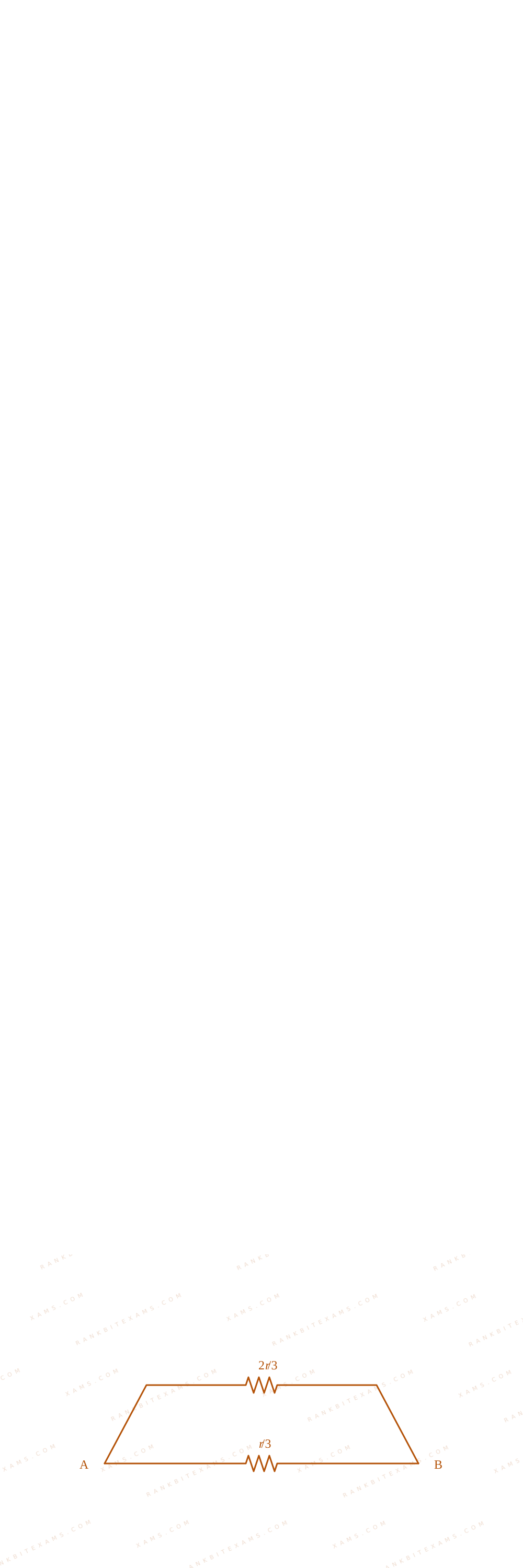
An edge configuration places one part in parallel with the other two series steps:

(Req)₁ = ( 2R3) · ( R3) 2R3 + R3 = (2)/(9)R

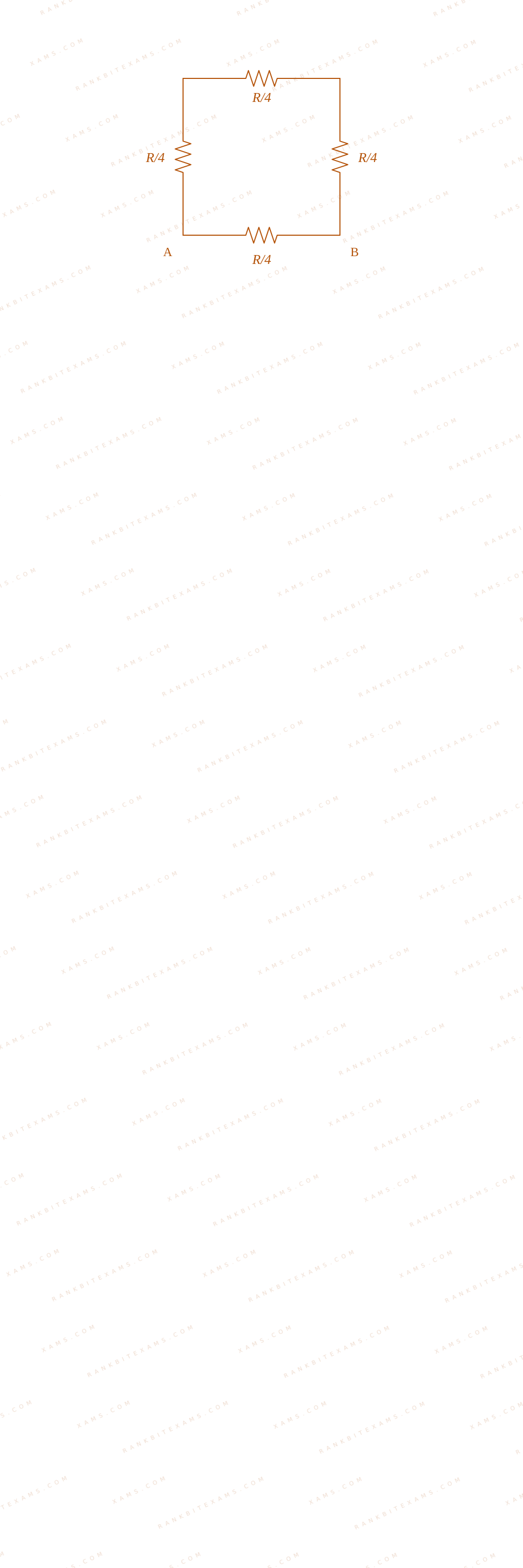
For the square, the wire resistance R divides into four parts of R4 each:

Visual representation of triangle and square edge divisions for Q15

Visual representation of triangle and square edge divisions for Q15

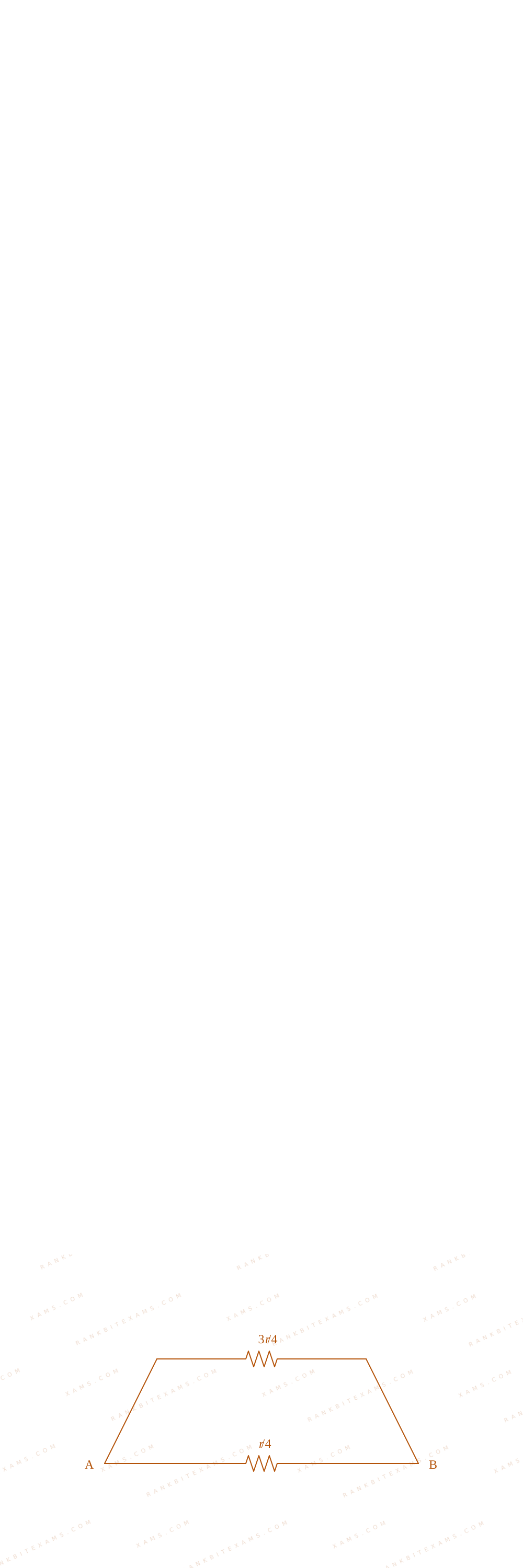
An edge calculation pairs one section in parallel with the remaining three loops in series:

(Req)₂ = ( 3R4) · ( R4) 3R4 + R4 = (3)/(16)R

Taking the ratio between these geometric layouts:

Step 1: Final Ratio Calculation
(Req)₁(Req)₂ = (2)/(9)R(3)/(16)R = (32)/(27)

This selects option (4).

Pattern Recognition

For a regular polygon with N identical sides formed from a wire of resistance R, the resistance across one edge is always given by (N-1)N²R.

Chapter Mix

Class 12 Physics: Current Electricity

Reference Study Guides

More Current Electricity Previous-Year Questions — Page 5

Q3 jee_main_2025_07_april_morning Combination of Resistors
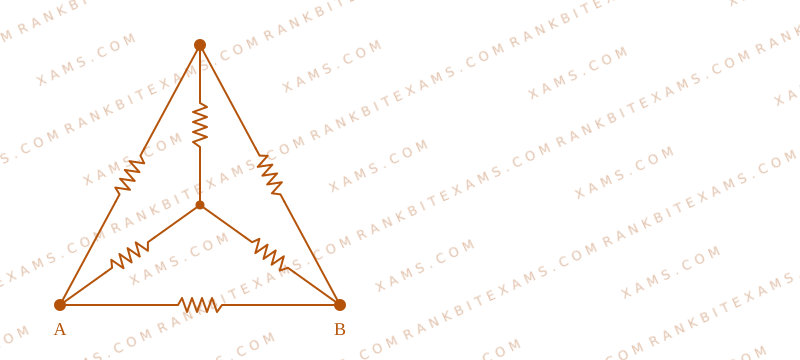
A wire of resistance R is bent into a triangular pyramid as shown in figure with each segment having same length. The resistance between points A and B is R/n. The value of n is :
Triangular pyramid resistor network for Q3 - JEE Main 2025 Morning
A triangular pyramid resistor network with terminals A and B marked, showing symmetry in the layout.
  • A. 16
  • B. 14
  • C. 10
  • D. 12

Solution

Related Formula

For a wire of total resistance R divided into N equal segments, the resistance of each segment r is:

r = (R)/(N)

For a balanced Wheatstone bridge with resistors of resistance r, the central arm can be neglected because no current flows through it.

Core Logic

The triangular pyramid has 6 segments of equal length. Since the total resistance of the wire is R:

r = (R)/(6)

Let the four vertices of the pyramid be A, B, C, and D. Terminals are at A and B.

The segments are:

  • AB (direct path between terminals, resistance r)
  • AC, BC, AD, BD (forming a closed quadrilateral network between A and B with bridge arm CD)
  • CD (bridge arm connecting the midpoints, resistance r)
Step 1: Simplify the Network

By symmetry, the potentials at C and D are equal when a voltage is applied across A and B. Thus, the bridge is balanced, and no current flows through the segment CD.

We can remove segment CD from the calculations:

  • The path A → C → B consists of two resistors in series: r + r = 2r.
  • The path A → D → B also consists of two resistors in series: r + r = 2r.
  • The direct path A → B has a single resistor r.
  • These three parallel branches are connected between A and B.

Step 2: Calculate Equivalent Resistance

The equivalent resistance RAB is:

1RAB = (1)/(2r) + (1)/(2r) + (1)/(r) = (1)/(r) + (1)/(r) = (2)/(r) RAB = (r)/(2)

Substitute r = (R)/(6):

RAB = (R/6)/(2) = (R)/(12)

Comparing with RAB = (R)/(n), we find n = 12.

Pattern Recognition

Sees: Resistor network formed by a 3D pyramid (6 identical edges, 4 nodes). Shortcut: A 6-resistor regular tetrahedron has an equivalent resistance of r/2 across any two vertices. Since the total wire resistance is R and it's cut into 6 pieces, r = R/6 Req = R/12.

Chapter Mix

Class 12 Physics: Current Electricity
Q1 jee_main_2025_29_jan_evening Seebeck Effect and Thermoelectricity
The difference of temperature in a material can convert heat energy into electrical energy. To harvest the heat energy, the material should have:
  • A. low thermal conductivity and low electrical conductivity
  • B. high thermal conductivity and high electrical conductivity
  • C. low thermal conductivity and high electrical conductivity
  • D. high thermal conductivity and low electrical conductivity

Solution

Related Formula
V = S · Δ T

where, V = Thermoelectric voltage (Seebeck voltage) S = Seebeck coefficient Δ T = Temperature difference

Core Logic

To maximize the efficiency of a thermoelectric device harvesting heat energy, two conditions must be fulfilled:

  • Low thermal conductivity: This ensures that the temperature gradient (Δ T) across the material is maintained and heat does not rapidly flow from the hot side to the cold side.
  • High electrical conductivity: This minimizes internal Joule heating losses (I²R) when electrical current is drawn from the material.
  • Therefore, the material should possess low thermal conductivity and high electrical conductivity.

Pattern Recognition

thermoelectric figure of merit is given by Z = (S² σ)/(κ), where σ is electrical conductivity and κ is thermal conductivity. To maximize Z, we inherently need high σ and low κ.

Chapter Mix

Class 12 Physics: Current Electricity Class 11 Physics: Thermal Properties of Matter
Q14 jee_main_2025_28_jan_morning Combination of Resistors
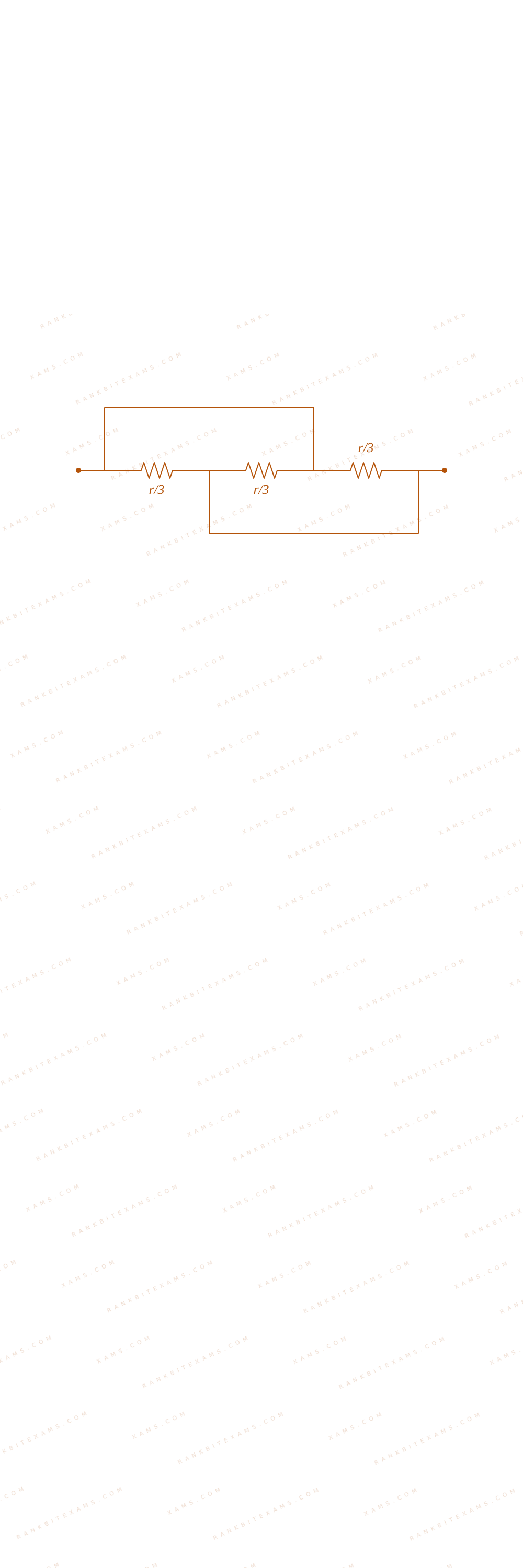
Find the equivalent resistance between two ends of the following circuit.
Combination of Resistors diagram for Q14 - JEE Main 2025 Morning
A complex looking resistive mesh whose node potentials reveal a simple symmetrical pattern.
  • A. r
  • B. r6
  • C. r9
  • D. r3

Solution

Core Logic

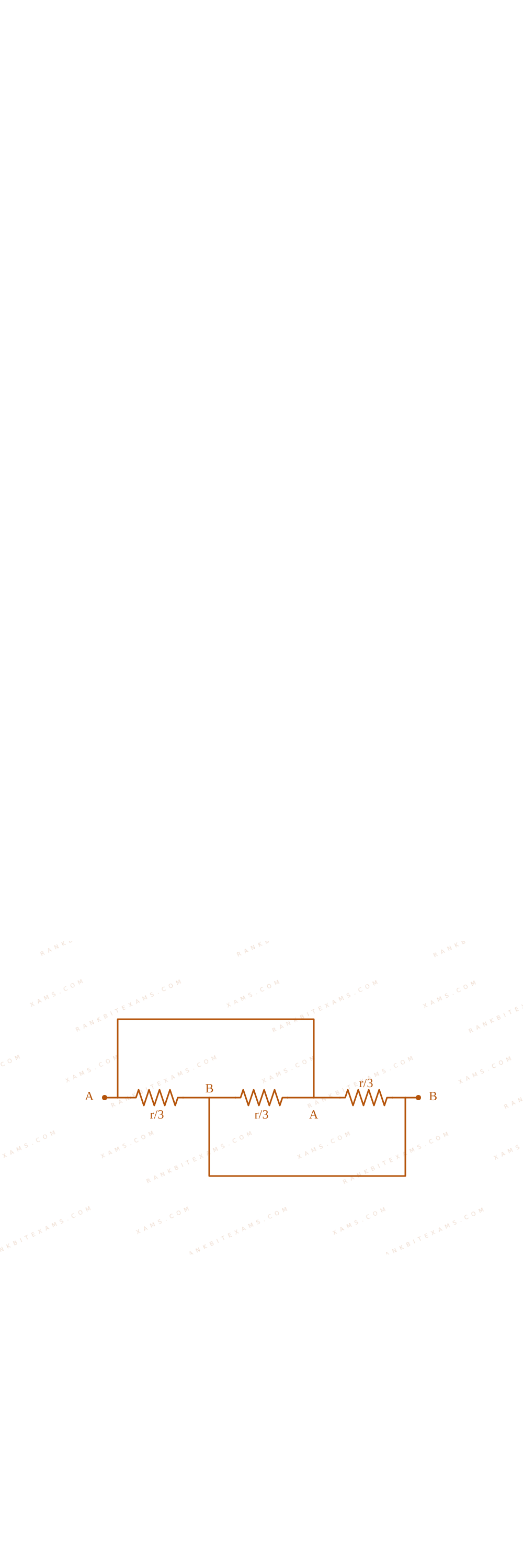
Label the circuit nodes carefully to see how the elements are connected across terminal zones:

Node potential labelling steps for Q14
A complex looking resistive mesh whose node potentials reveal a simple symmetrical pattern.

Node potential labelling steps for Q14
A complex looking resistive mesh whose node potentials reveal a simple symmetrical pattern.

Tracing parallel loops reveals all inner subsets share identical path boundaries.

Req = r/33 = r9
Step 1: Final Expression

The overall simplified system network value equals r9, matching option (3).

Pattern Recognition

Short-circuit tracking lines allow collapsing complex meshes into basic parallel branches. If all nodes connect symmetrically, apply simple division: R/N.

Chapter Mix

Class 12 Physics: Current Electricity

Q5 jee_main_2025_03_april_morning Resistance of a Circular Wire
A wire of length 25~m and cross-sectional area 5~mm² having resistivity of 2× 10⁻⁶Ω~m is bent into a complete circle. The resistance between diametrically opposite points will be:
  • A. 12.5Ω
  • B. 50Ω
  • C. 100Ω
  • D. 25Ω

Solution

Related Formula

Resistance of a uniform wire:

R = (ρ L)/(A)

Equivalent resistance of two identical resistors in parallel:

Req = (R₁ R₂)/(R₁ + R₂) = Rhalf2
Core Logic

First, find the total resistance Rtotal of the straight wire:

  • Length of wire, L = 25~m
  • Area of cross-section, A = 5~mm² = 5 × 10⁻⁶~m²
  • Resistivity, ρ = 2 × 10⁻⁶Ω~m
Rtotal = (ρ L)/(A) = 2 × 10⁻⁶ × 255 × 10⁻⁶ = 10Ω
Step 1: Splitting into Semicircles

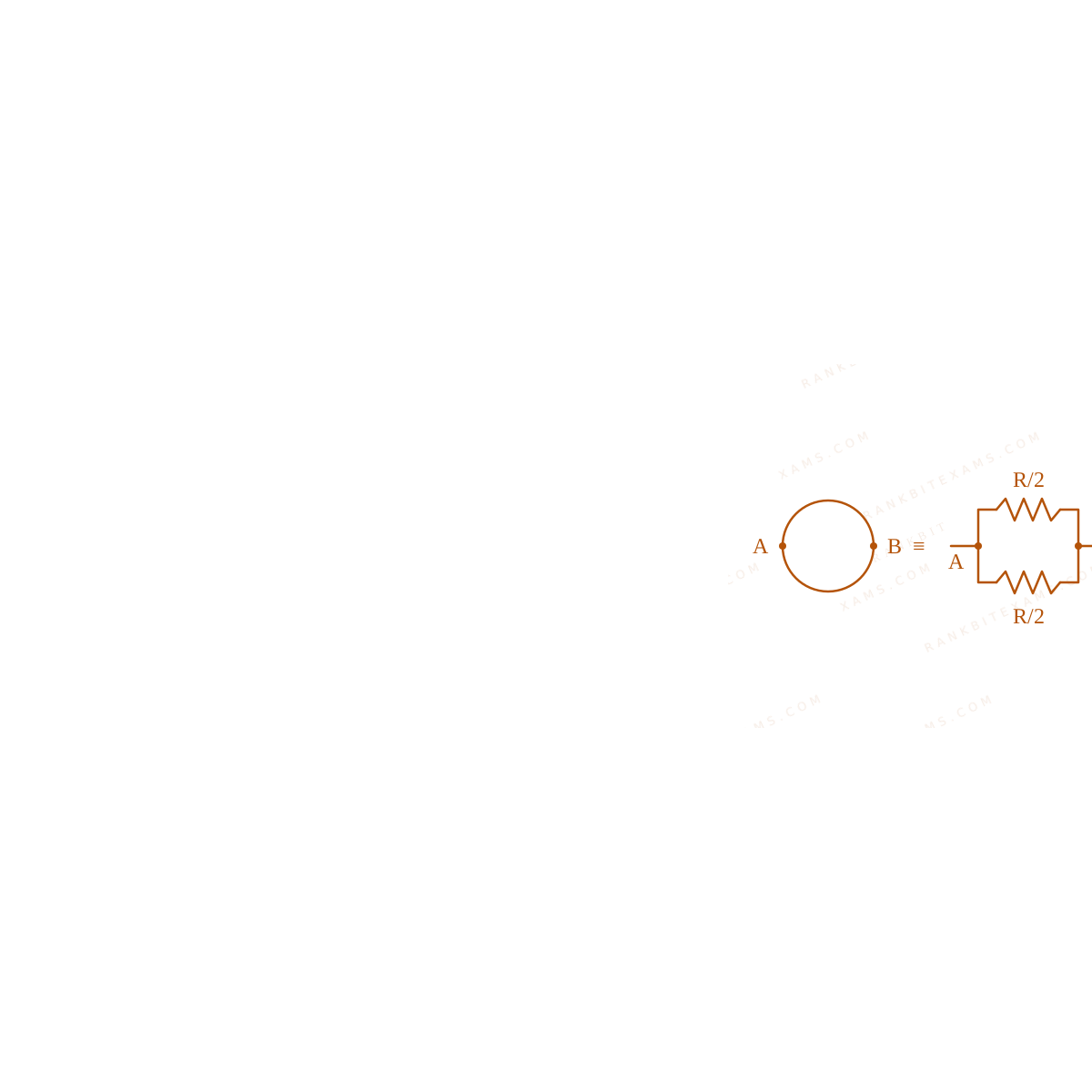
When the wire is bent into a complete circle, measuring the resistance between two diametrically opposite points splits the wire into two parallel halves of equal length.

Each semicircle has a resistance of:

Rsemi = Rtotal2 = (10)/(2) = 5Ω

These two halves are connected in parallel between the diametric terminals:

Req = Rsemi2 = (5)/(2) = 2.5Ω

Circular loop splitting resistance across diameter for Q5

Step 2: Conclusion & Discrepancy

The actual mathematically rigorous answer is 2.5Ω. Since 2.5Ω is not present in the given options, the question is marked as a Bonus question by standard key evaluation guidelines. If forced to choose a theoretical option due to printing mistakes, some keys may relate it to 10Ω / 4 = 2.5Ω, but scientifically it stands as a bonus.

Pattern Recognition

Shortcut: A wire of total resistance R bent into a circle has an effective resistance across its diameter equal to Req = R/4. Memorize this ratio! Here R = 10Ω, so Req = 10/4 = 2.5Ω.

Chapter Mix

Class 12 Physics: Current Electricity
More Current Electricity Questions — jee_main_2025_28_jan_morning

Practice all Current Electricity previous-year questions →

Rankbit System
JEE Physics: Waves (+15.5%) | Electrostatics: Concentric Shells (-29.7%) | Modern Physics: Photoelectric Clones (+34.2%) | Mathematics: Definite Integrals (+18.1%) | Chemistry: Coordination Splitting (-11.4%) | JEE Physics: Waves (+15.5%) | Electrostatics: Concentric Shells (-29.7%) | Modern Physics: Photoelectric Clones (+34.2%) | Mathematics: Definite Integrals (+18.1%) | Chemistry: Coordination Splitting (-11.4%)
