A wire of resistance R$R$ is bent into an equilateral triangle and an identical wire is bent into a square. The ratio of resistance between the two end points of an edge of the triangle to that of the square is
A.9 / 8$9 / 8$
B.8 / 9$8 / 9$
C.27/32
D.32/27
Solution & Explanation
Related Formula
R = ρ A R ∝$$\mathrm{R} = \frac{\rho\ell}{\mathrm{A}} \implies \mathrm{R} \propto \ell$$
Core Logic
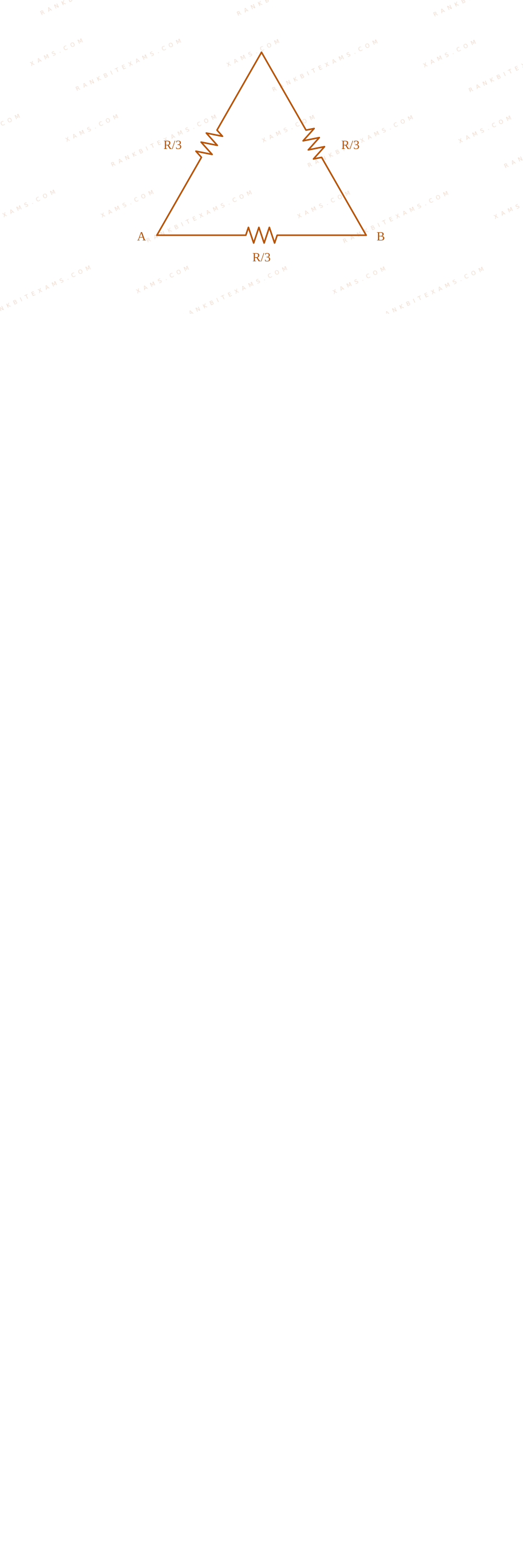
For the equilateral triangle, the total resistance R$\mathrm{R}$ is divided into three equal line parts of value R3$\frac{\mathrm{R}}{3}$ each:
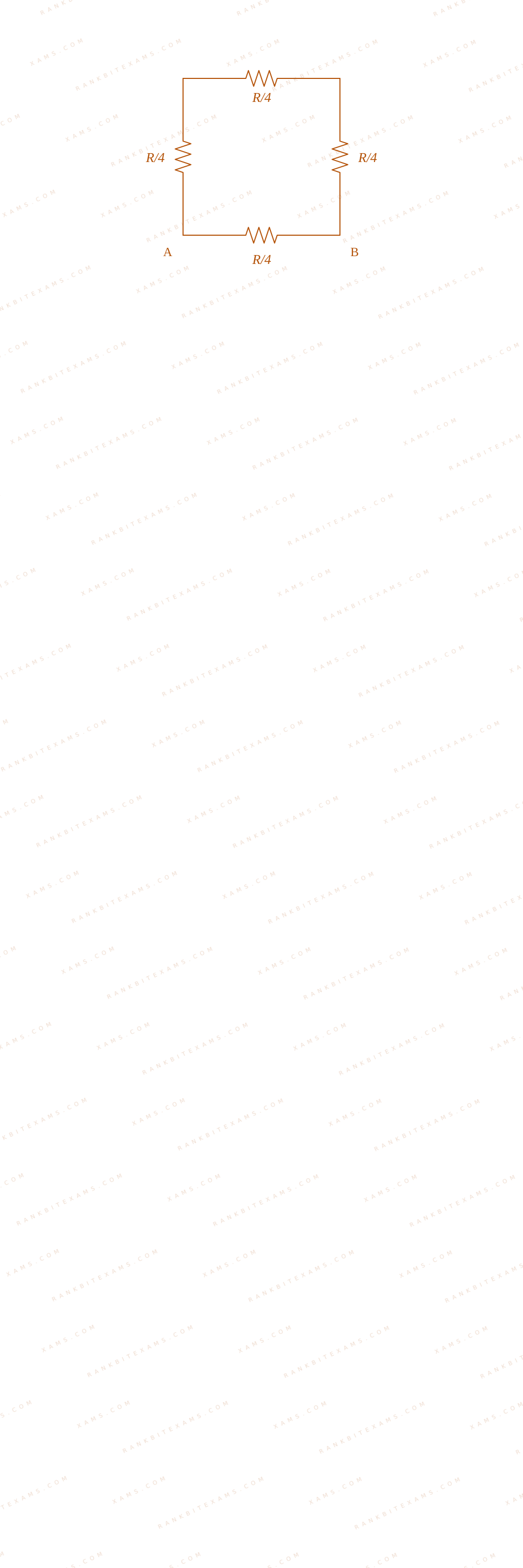
Visual representation of triangle and square edge divisions for Q15
Visual representation of triangle and square edge divisions for Q15
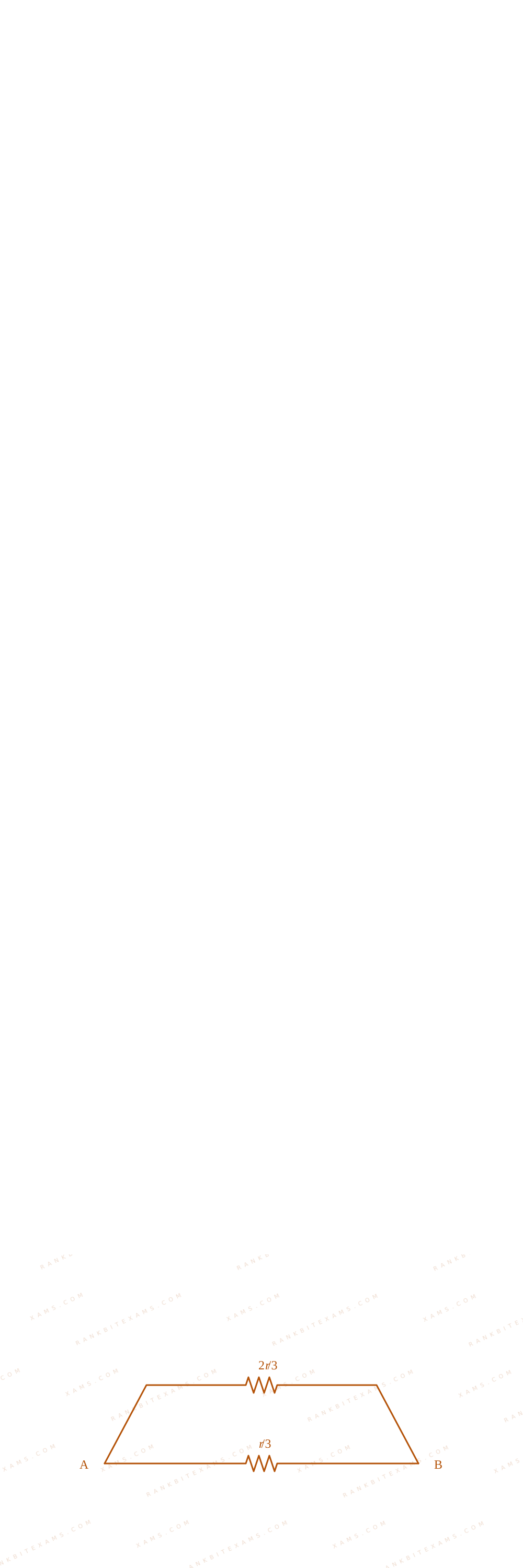
An edge configuration places one part in parallel with the other two series steps:
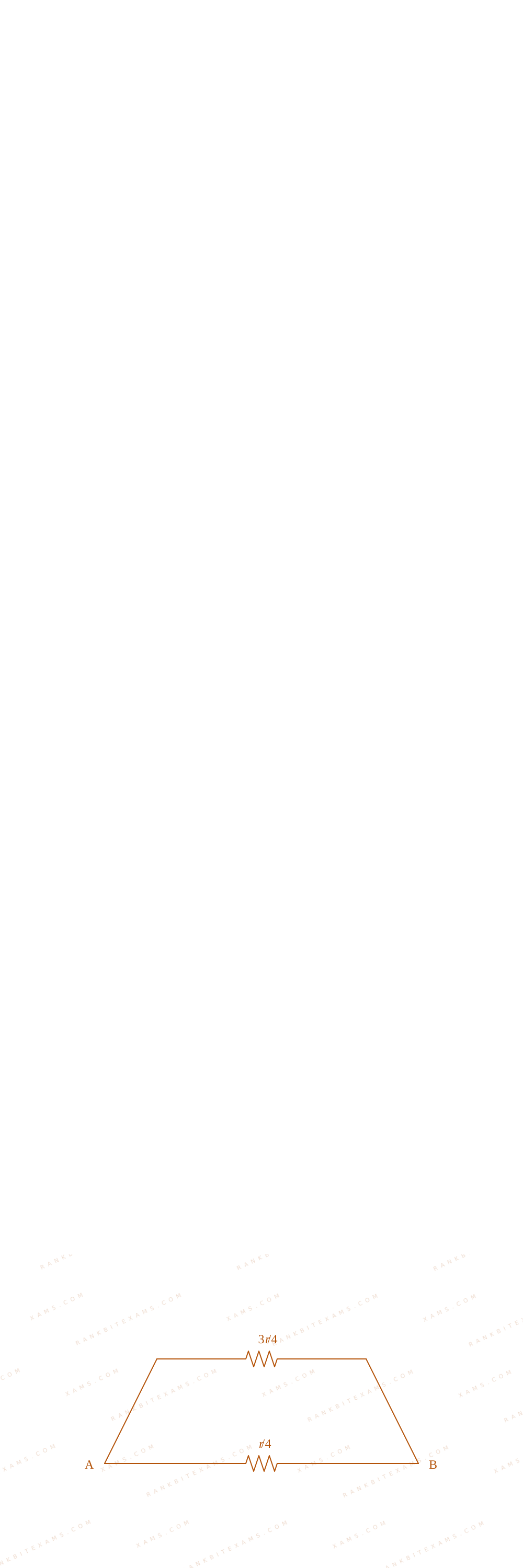
For a regular polygon with N$\mathrm{N}$ identical sides formed from a wire of resistance R$\mathrm{R}$, the resistance across one edge is always given by (N-1)N²R$\frac{(\mathrm{N}-1)}{\mathrm{N}^2}\mathrm{R}$.
Keywords:#wire bent into equilateral triangle and square#JEE Main 2025 Morning Q15#Current Electricity JEE Main 2025#Combination of Resistors JEE Main 2025
More Current Electricity Previous-Year Questions — Page 4
Q38jee_main_2026_28_january_morningCombination of Cells
For the two cells having same EMF E and internal resistance r, the current passing through the external resistor 6 Ω$6 \,\Omega$ is same when both the cells are connected either in parallel or in series. The value of internal resistance r is ____ Ω$\Omega$.
A well-known standard shortcut: If n$n$ identical cells yield the same current in series and parallel across an external resistor R$R$, then r = R$r = R$. Here R = 6$R = 6$, so immediately r = 6$r = 6$.
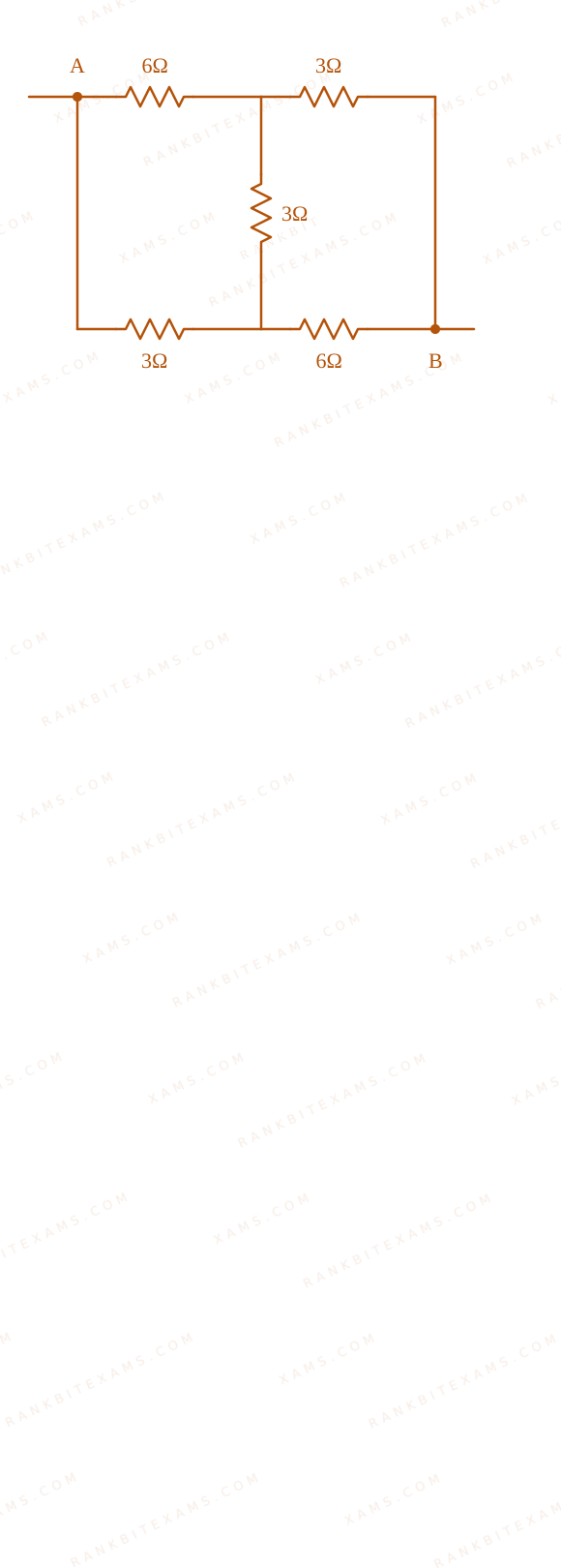
The equivalent resistance between the points A and B in the following circuit is (x)/(5)Ω$\frac{x}{5}\Omega$ . The value of x is
A bridge network with resistors 6 Ohm, 3 Ohm in one path, a central 3 Ohm resistor, and 3 Ohm, 6 Ohm resistors in the other path between points A and B.
Numerical Answer.Answer: 21 to 21
Solution
Related Formula
Kirchhoff's Voltage Law (KVL): Σ V = 0$$\text{Kirchhoff's Voltage Law (KVL): } \sum V = 0$$V = I · Req$$V = I \cdot R_{\text{eq}}$$
Core Logic
This is an unbalanced Wheatstone bridge. We can solve it by connecting an imaginary 1V battery across AB, applying Kirchhoff's laws to find the total current I$I$, and then finding Req = V / I$R_{\text{eq}} = V / I$.
A bridge network with resistors 6 Ohm, 3 Ohm in one path, a central 3 Ohm resistor, and 3 Ohm, 6 Ohm resistors in the other path between points A and B.
Step 1: First KVL Loop
Let total current from the 1V source be i$i$. It splits into i₁$i_1$ through the upper 6 Ω$6\,\Omega$ resistor, and (i - i₁)$(i - i_1)$ through the lower 3 Ω$3\,\Omega$ resistor.
Applying KVL to the upper closed loop of the bridge:
3(i - i₁) + 6(current in next branch) = 1$$3(i - i_1) + 6(\text{current in next branch}) = 1$$
Wait, looking at the node splits in the solution: the current entering B from the bottom resistor is i₁$i_1$, and from top is (i - i₁)$(i - i_1)$ due to symmetry.
Equation from the lower path:
Given Req = (x)/(5) Ω$R_{\text{eq}} = \frac{x}{5} \,\Omega$.
Therefore, x = 21$x = 21$.
Pattern Recognition
For a symmetrical unbalanced bridge (like R₁=6, R₂=3$R_1=6, R_2=3$ and R₃=3, R₄=6$R_3=3, R_4=6$), the currents divide symmetrically. Assuming a 1V source and tracking current i$i$ and i₁$i_1$ is the fastest fail-proof algebraic method.
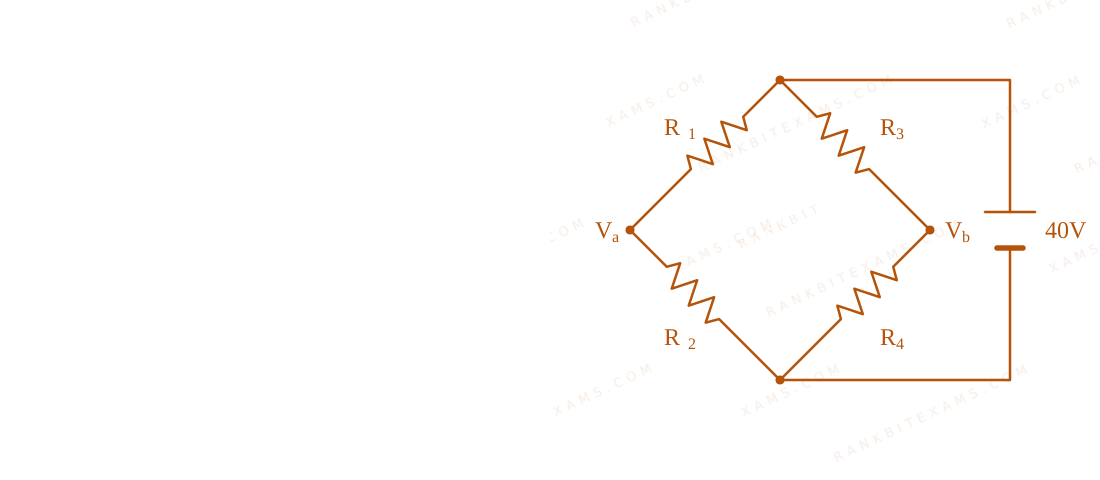
A wheatstone bridge is initially at room temperature and all arms of the bridge have same value of resistances ( R₁ = R₂ = R₃ = R₄$R_{1} = R_{2} = R_{3} = R_{4}$ ). When R₃$R_{3}$ resistance is heated to some temperature, its resistance value has gone up by 10%. The potential difference ( Vₐ - Vb$V_{a} - V_{b}$ ) (after R₃$R_{3}$ is heated) is ____ V.
A standard wheatstone bridge circuit powered by a 40V source.
A.1.05$1.05$
B.0$0$
C.0.95$0.95$
D.2$2$
Solution
Core Logic
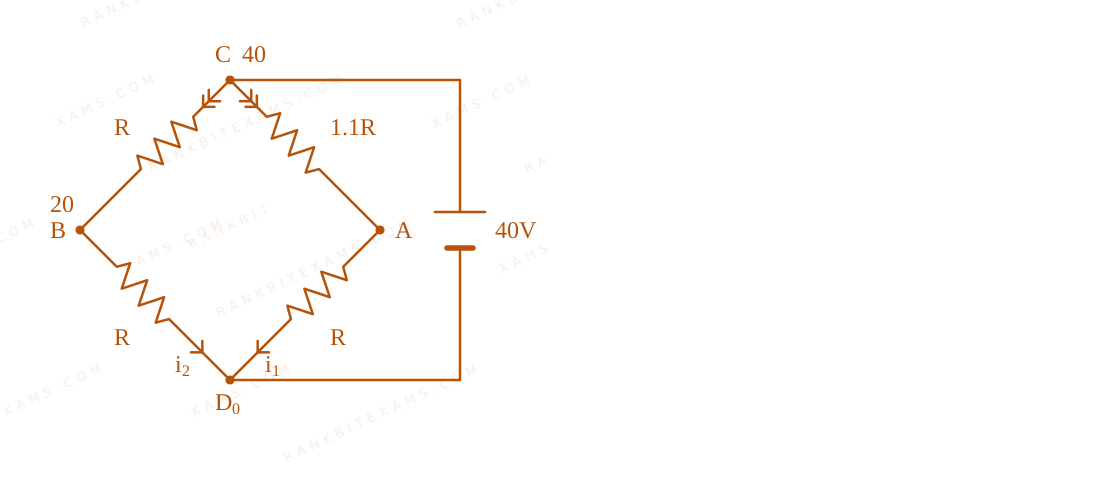
A standard wheatstone bridge circuit powered by a 40V source.
Initially, R₁ = R₂ = R₃ = R₄ = R$R_{1} = R_{2} = R_{3} = R_{4} = R$. The bridge is balanced, and VA = VB$V_A = V_B$.
After heating, R₃$R_3$ increases by 10%, meaning the new R₃' = R + 0.1R = 1.1R$R_3' = R + 0.1R = 1.1R$.
The other arms remain R$R$.
The battery provides a voltage of V = 40 V$V = 40\text{ V}$.
Step 1: Calculate Potentials at nodes A and B
Let the lower node (D) be at 0 V$0\text{ V}$ and the upper node (C) be at 40 V$40\text{ V}$.
The potential at node A (between R₃'$R_3'$ and R₄$R_4$) can be found via the voltage divider rule across the right branch (R₃'$R_3'$ and R₄$R_4$).
Wait, examining the circuit labels carefully:
Assume the branches are: Left branch contains R₁$R_1$ and R₂$R_2$. Right branch contains R₃$R_3$ and R₄$R_4$.
Node B is between R₁$R_1$ and R₂$R_2$. Node A is between R₃$R_3$ and R₄$R_4$.
From the provided solution:
VA = (V)/(2)$$V_A = \frac{V}{2}$$
This implies the branch containing node A consists of two equal resistances R$R$, which contradicts the textual convention if R₃$R_3$ changed. Looking at the provided solution image logic, the branch with B$B$ has the changed resistance 1.1R$1.1R$.
Let's follow the PDF's mathematical layout exactly.
VA = (V)/(2)$$V_A = \frac{V}{2}$$ (Meaning branch A has equal resistors R$R$ and R$R$)
VB = (V)/(R + 1.1R) × R = (V)/(2.1)$$V_B = \frac{V}{R + 1.1R} \times R = \frac{V}{2.1}$$
(Note: The PDF solution computes VB = V / 2.1$V_B = V / 2.1$, implying the resistance below node B is R$R$, and above is 1.1R$1.1R$)
The closest match among the options is 0.95 V$0.95\text{ V}$.
Pattern Recognition
For a slightly unbalanced Wheatstone bridge due to a fractional change Δ R/R = x$\Delta R/R = x$, the potential difference Δ V$\Delta V$ is approximately V · (x)/(4)$V \cdot \frac{x}{4}$ for small x$x$. Here x=0.1$x=0.1$, so Δ V ≈ 40 × 0.1 / 4 = 1 V$\Delta V \approx 40 \times 0.1 / 4 = 1 \text{ V}$. Exact calculation gives 0.95 V$0.95\text{ V}$.
Chapter Mix
Class 12 Physics: Current Electricity
Q8jee_main_2025_02_april_morningElectrical Energy and Power
The battery of a mobile phone is rated as 4.2~V$4.2\mathrm{~V}$, 5800~mAh$5800\mathrm{~mAh}$. How much energy is stored in it when fully charged?
A.43.8~kJ$43.8\mathrm{~kJ}$
B.48.7~kJ$48.7\mathrm{~kJ}$
C.87.7~kJ$87.7\mathrm{~kJ}$
D.24.4~kJ$24.4\mathrm{~kJ}$
Solution
Related Formula
E = V · Q$E = V \cdot Q$
Q = I · t$Q = I \cdot t$
Core Logic
The capacity rating 5800~mAh$5800\mathrm{~mAh}$ represents total electric charge Q$Q$ stored:
Given the voltage is V = 4.2~V$V = 4.2\mathrm{~V}$, the energy stored in Joules is:
E = V · Q = 4.2 × 20880 = 87696~J = 87.696~kJ ≈ 87.7~kJ$$E = V \cdot Q = 4.2 \times 20880 = 87696\mathrm{~J} = 87.696\mathrm{~kJ} \approx 87.7\mathrm{~kJ}$$
Step 1: Final Conclusion
The electrical energy stored in the fully charged battery is 87.7~kJ$87.7\mathrm{~kJ}$.
Pattern Recognition
Always remember: Energy (in Joules) = Voltage (V) × Capacity (Ah) × 3600$\text{Energy (in Joules)} = \text{Voltage (V)} \times \text{Capacity (Ah)} \times 3600$. This directly transforms electrical rating units to standard SI energy units.
Chapter Mix
Class 12 Physics: Current Electricity
Qjee_main_2025_03_april_eveningGrouping of Cells
Two cells of emf 1V and 2V and internal resistance 2Ω$2\Omega$ and 1Ω$1\Omega$, respectively, are connected in series with an external resistance of 6Ω$6\Omega$. The total current in the circuit is I₁$I_{1}$ Now the same two cells in parallel configuration are connected to same external resistance. In this case, the total current drawn is I₂$I_{2}$. The value of ( I₁I₂)$(\frac{I_{1}}{I_{2}})$ is (x)/(3)$\frac{x}{3}$. The value of x is ________.
For cells connected in parallel, the formula for equivalent EMF
$
Pattern Recognition
For cells connected in parallel, the formula for equivalent EMF $
\varepsilon_{\text{eq}}$ can be viewed as a weighted average. Connecting cells in series maximizes EMF but increases internal resistance, while parallel configuration limits EMF to an intermediate value while reducing equivalent internal resistance.
Chapter Mix
Class 12 Physics: Current Electricity
More Current Electricity Questions — jee_main_2025_28_jan_morning
Practice past-year questions one chapter at a time. Pick an exam → subject → chapter and get every PYQ for that topic — pulled together from all past papers — with the chapter's key formulas alongside.

.svg)
.svg)
.svg)
.svg)
