JEE Main · Mathematics ↓ Falling

Conic Sections appeared 76 times across 3 years — 8.8% of Mathematics. This question is from Infinite Series of Ellipses.

Year 2026 2025 2024 Total
Questions 22 38 16 76

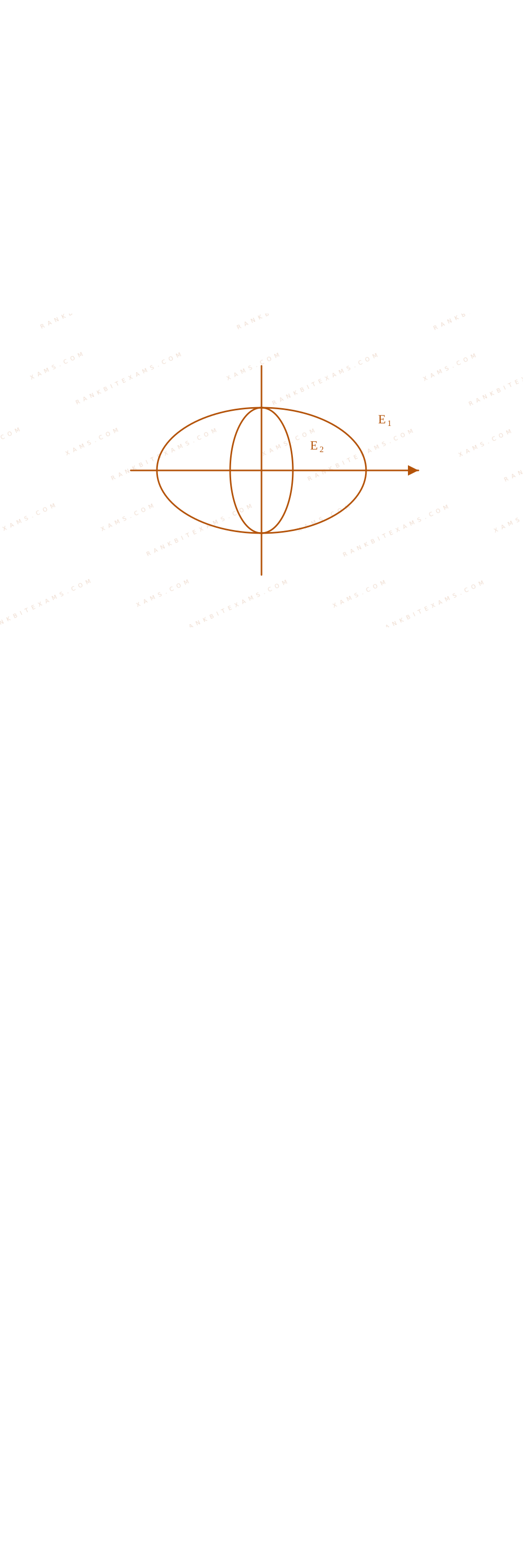
Let E₁: (x²)/(9) + (y²)/(4) = 1 be an ellipse. Ellipses Eᵢ 's are constructed such that their centres and eccentricities are same as that of E₁ , and the length of minor axis of Eᵢ is the length of major axis of Eᵢ₊₁ ( i ≥ 1 ). If Aᵢ is the area of the ellipse Eᵢ , then (5)/(pi) ( Σi=1∞ Aᵢ ) , is equal to ....

Numerical Answer Type:
Enter a numerical value Answer: 54 to 54 +4 marks

Solution & Explanation

Related Formula

Area of an ellipse with semi-axes a and b:

Area = π a b
Core Logic

Calculate the constant eccentricity e from the initial ellipse E₁:

Infinite Series of Ellipses diagram for Q75 - JEE Main 2025 Morning

e = √(1 - (4)/(9)) = √(5)3

For any subsequent ellipse E₂, its major axis equals the minor axis of E₁ (2b₁ = 4 a₂ = 2). Since eccentricity remains constant:

(5)/(9) = 1 - (b₂²)/(a₂²) = 1 - (b₂²)/(4) b₂² = (16)/(9) b₂ = (4)/(3)
Step 1: Finding the Area Sequence Terms

Evaluate the area values for the initial ellipses: A₁ = π · 3 · 2 = 6π A₂ = π · 2 · (4)/(3) = (8π)/(3)

The areas form an infinite geometric progression with a common ratio r = (4)/(9).

Step 2: Summing the Infinite Geometric Series
Σi=1∞ Aᵢ = (6π)/(1 - (4)/(9)) = (6π)/((5)/(9)) = (54π)/(5)

Evaluating the final scaling formula:

(5)/(π) ( (54π)/(5) ) = 54
Pattern Recognition

Iterative dimensional scaling creates geometric progressions where the ratio equals the square of the linear scaling factor.

Chapter Mix

Class 11 Maths: Conic Sections

Reference Study Guides

More Conic Sections Previous-Year Questions — Page 4

Q2 jee_main_2026_24_january_evening Standard Equation of an Ellipse
Let the length of the latus rectum of an ellipse x²a²+ y²b²=1, (a>b), be 30. If its eccentricity is the maximum value of the function f(t)=-(3)/(4)+2t-t², then (a²+b²) is equal to
  • A. 516
  • B. 256
  • C. 496
  • D. 276

Solution

Related Formula
Latus Rectum = 2b²a e² = 1 - b²a² = a²-b²a²
Core Logic

First, find the maximum value of f(t) = -(3)/(4) + 2t - t².

Completing the square or differentiating:

f(t) = -(t² - 2t + (3)/(4)) = -((t-1)² - 1 + (3)/(4)) = (1)/(4) - (t-1)²

The maximum value is (1)/(4). Thus, eccentricity e = (1)/(4).

e² = (1)/(16) a² - b²a² = (1)/(16) (1)
Step 1: Relating a and b

Given latus rectum is 30:

2b²a = 30 b² = 15a (2)
Step 2: Solving for a and b

Substitute (2) into (1):

16(a² - 15a) = a² 15a² - 240a = 0

Since a ≠ 0, we have 15a - 240 = 0 a = 16.

Then, b² = 15(16) = 240. So a² = 256.

Step 3: Final Calculation

We need to find a² + b²:

a² + b² = 256 + 240 = 496
Pattern Recognition

Whenever an ellipse's latus rectum and eccentricity are provided, it generates a standard system of two equations linking a and b². Solve for a first since b² is linear with respect to a via latus rectum.

Chapter Mix

Class 11 Maths: Ellipse Class 12 Maths: Application of Derivatives

Q6 jee_main_2026_24_january_evening Reflection of a Parabola
Let the image of parabola x²=4y, in the line x-y = 1 be (y+α)²=b(x-c), a, b, c in N. Then a+b+c is equal to
  • A. 12
  • B. 4
  • C. 6
  • D. 8

Solution

Related Formula
Image of point (x₁, y₁) in line ax + by + c = 0 is given by: (x - x₁)/(a) = (y - y₁)/(b) = -2 (ax₁ + by₁ + c)/(a² + b²)
Core Logic

Take a general parametric point P on the parabola x² = 4y, which is P(2t, t²).

We find the mirror image Q(h, k) of P with respect to the line x - y - 1 = 0.

Step 1: Finding the Image Coordinates
(h - 2t)/(1) = (k - t²)/(-1) = -2 (2t - t² - 1)/(1² + (-1)²) (h - 2t)/(1) = (k - t²)/(-1) = -(2t - t² - 1) = t² - 2t + 1

Solving for h:

h - 2t = t² - 2t + 1 h = t² + 1

Solving for k:

k - t² = -(t² - 2t + 1) = -t² + 2t - 1 k = 2t - 1
Step 2: Eliminating the Parameter

From k = 2t - 1, we get t = (k + 1)/(2).

Substitute t into h:

h = ((k + 1)/(2))² + 1 h - 1 = ((k + 1)²)/(4) (k + 1)² = 4(h - 1)
Step 3: Finding Target Values

Replacing (h, k) with (x, y), the image parabola is:

(y + 1)² = 4(x - 1)

Comparing this with (y + α)² = b(x - c): α = 1, b = 4, c = 1

a + b + c = 1 + 4 + 1 = 6
Pattern Recognition

To find the image of a conic section across a linear axis, it is almost always computationally cleaner to reflect its general parametric point rather than manipulating the implicit Cartesian equation through coordinate transformations.

Chapter Mix

Class 11 Maths: Parabola Class 11 Maths: Straight Lines

Q22 jee_main_2026_24_january_evening Locus of a Point
Let (h, k) lie on the circle C : x² + y² = 4 and the point (2h + 1, 3k + 2) lie on an ellipse with eccentricity e. Then the value of 5e² is equal to
Numerical Answer. Answer: 9 to 9

Solution

Related Formula
Parametric form of a circle x² + y² = r²: (r θ, r θ) Eccentricity of an ellipse: e² = 1 - (b²)/(a²) (where a > b)
Core Logic

Let the point P(h, k) lie on x² + y² = 4. Using parametric coordinates:

h = 2 θ, k = 2 θ

Let the target point be Q(x, y):

x = 2h + 1 = 2(2 θ) + 1 = 4 θ + 1

y = 3k + 2 = 3(2 θ) + 2 = 6 θ + 2 (Wait, PDF states 3k+2, parametric solution in PDF says 6 θ + 3. Checking exact text: "(2h + 1, 3k + 2) lie on an ellipse..." but solution uses "6 θ + 3". If the question meant 3k+3, that would be a typo in the question paper. However, 3(2 θ)+2 = 6 θ+2. This implies (y-2)/(6) = θ. Either way, the denominators a and b of the resulting ellipse remain 4 and 6, so eccentricity is invariant to the constant offset).

Step 1: Finding the Locus

Isolating θ and θ:

θ = (x - 1)/(4) θ = (y - 2)/(6) (or (y-3)/(6) per the solution)

Using ²θ + ²θ = 1:

( (x - 1)/(4) )² + ( (y - 2)/(6) )² = 1

This is the equation of an ellipse where a = 4 and b = 6 (since b > a, it's a vertical ellipse).

Step 2: Calculating Eccentricity

For a vertical ellipse (b > a), eccentricity is:

e² = 1 - (a²)/(b²) = 1 - (4²)/(6²) = 1 - (16)/(36) e² = (36 - 16)/(36) = (20)/(36) = (5)/(9)
Step 3: Finding Final Target

We need the value of (5)/(e²):

(5)/(e²) = (5)/((5)/(9)) = 9
Pattern Recognition

Affine transformations (ax+b, cy+d) applied to a circle's locus purely stretch its semi-axes to the respective scaling constants (a and c). Translational constants (b and d) shift the center but do not affect the eccentricity.

Chapter Mix

Class 11 Maths: Ellipse Class 11 Maths: Circles
Q22 jee_main_2026_28_january_morning Ellipse and Hyperbola
For some θ in (0, (π)/(2)), let the eccentricity and the length of the latus rectum of the hyperbola x² - y² ² θ = 8 be e₁ and ₁, respectively, and let the eccentricity and the length of the latus rectum of the ellipse x² ² θ + y² = 6 be e₂ and ₂, respectively. If e₁² = e₂² ( ² θ + 1), then (( ₁ ₂)/(e₁ e₂)) ² θ is equal to ____.
Numerical Answer. Answer: 8 to 8

Solution

Core Logic

For the hyperbola (x²)/(8) - (y²)/(8 ²θ) = 1: a² = 8, b² = 8 ²θ Eccentricity e₁ = √(1 + (b²)/(a²)) = √(1 + (8 ²θ)/(8)) = √(1 + ²θ). Latus rectum ₁ = (2b²)/(a) = 2(8 ²θ)2√(2) = 4√(2) ²θ.

For the ellipse (x²)/(6 ²θ) + (y²)/(6) = 1: Here a² = 6 ²θ, b² = 6. Since θ in (0, π/2), 6 > 6 ²θ, so the major axis is along the y-axis. Eccentricity e₂ = √(1 - (a²)/(b²)) = √(1 - (6 ²θ)/(6)) = √(1 - ²θ) = θ. Latus rectum ₂ = (2a²)/(b) = 2(6 ²θ)√(6) = 2√(6) ²θ.

Step 1: Solve for Theta

Given relation: e₁² = e₂² ( ²θ + 1)

1 + ²θ = ²θ (1 + (1)/( ²θ)) 1 + ²θ = ²θ + ²θ

Replace ²θ with 1 - ²θ:

1 + ²θ = 1 - ²θ + ²θ 2 ²θ = ²θ = ( ²θ)/( ²θ) 2 ⁴θ = 1 - ²θ 2 ⁴θ + ²θ - 1 = 0

Factorizing:

(2 ²θ - 1)( ²θ + 1) = 0

Since ²θ + 1 ≠ 0, we have 2 ²θ = 1 ²θ = (1)/(2). Since θ in (0, π/2), θ = (π)/(4).

Step 2: Evaluate All Variables

For θ = π/4: e₁ = √(1 + 1/2) = √(3/2) e₂ = (π/4) = 1/√(2) ₁ = 4√(2)(1/2) = 2√(2) ₂ = 2√(6)(1/2) = √(6) ²θ = 1

Step 3: Final Calculation

Evaluate the target expression:

(( ₁ ₂)/(e₁ e₂)) ² θ = 2√(2) · √(6)√(3/2) · 1/√(2) · 1

Numerator: 2√(12) = 4√(3) Denominator: √(3/4) = √(3)2 Result = 4√(3) √(3)2 = 8

Chapter Mix

Class 11 Mathematics: Conic Sections

Q3 jee_main_2026_28_january_evening Parabola and Triangles
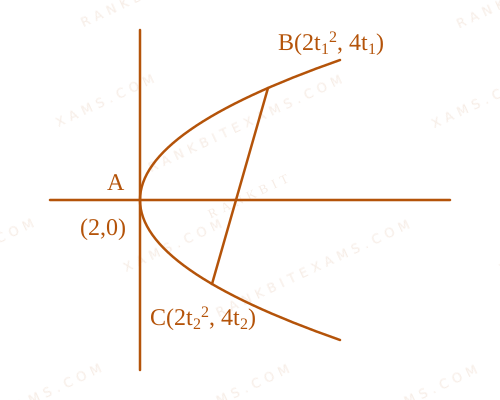
Let A be the focus of the parabola y² = 8x. Let the line y = mx + c intersect the parabola at two distinct points B and C. If the centroid of the triangle ABC is ((7)/(3), (4)/(3)), then (BC)² is equal to :
  • A. 41
  • B. 80
  • C. 89
  • D. 32

Solution

Related Formula
Centroid = ((x₁+x₂+x₃)/(3), (y₁+y₂+y₃)/(3)) D² = (x₂-x₁)² + (y₂-y₁)²
Core Logic

Focus of y² = 8x is A(2, 0) since 4a = 8 ⇒ a=2. Let points on parabola be B(2t₁², 4t₁) and C(2t₂², 4t₂). The centroid of Δ ABC is given as ((7)/(3), (4)/(3)). Equating coordinates:

(2 + 2t₁² + 2t₂²)/(3) = (7)/(3) ⇒ t₁² + t₂² = (5)/(2) (0 + 4t₁ + 4t₂)/(3) = (4)/(3) ⇒ t₁ + t₂ = 1

Parabola points and centroid configuration

Execution

Square the sum equation:

(t₁ + t₂)² = t₁² + t₂² + 2t₁t₂ 1 = (5)/(2) + 2t₁t₂ ⇒ 2t₁t₂ = -(3)/(2) ⇒ t₁t₂ = -(3)/(4)

Find (t₁ - t₂)²:

(t₁ - t₂)² = (t₁ + t₂)² - 4t₁t₂ = 1 - 4(-(3)/(4)) = 4

Calculate distance squared for BC:

(BC)² = (2t₁² - 2t₂²)² + (4t₁ - 4t₂)² (BC)² = 4(t₁ - t₂)²(t₁ + t₂)² + 16(t₁ - t₂)² (BC)² = 4(4)(1) + 16(4) = 16 + 64 = 80
Pattern Recognition

Using parametric coordinates (at², 2at) systematically reduces algebraic complexity when determining intersections or triangle properties on a parabola.

Chapter Mix

Class 11 Maths: Conic Sections

More Conic Sections Questions — jee_main_2025_28_jan_morning

Practice all Conic Sections previous-year questions →

Rankbit System
JEE Physics: Waves (+15.5%) | Electrostatics: Concentric Shells (-29.7%) | Modern Physics: Photoelectric Clones (+34.2%) | Mathematics: Definite Integrals (+18.1%) | Chemistry: Coordination Splitting (-11.4%) | JEE Physics: Waves (+15.5%) | Electrostatics: Concentric Shells (-29.7%) | Modern Physics: Photoelectric Clones (+34.2%) | Mathematics: Definite Integrals (+18.1%) | Chemistry: Coordination Splitting (-11.4%)