JEE Main · Mathematics ↓ Falling

Conic Sections appeared 76 times across 3 years — 8.8% of Mathematics. This question is from Infinite Series of Ellipses.

Year 2026 2025 2024 Total
Questions 22 38 16 76

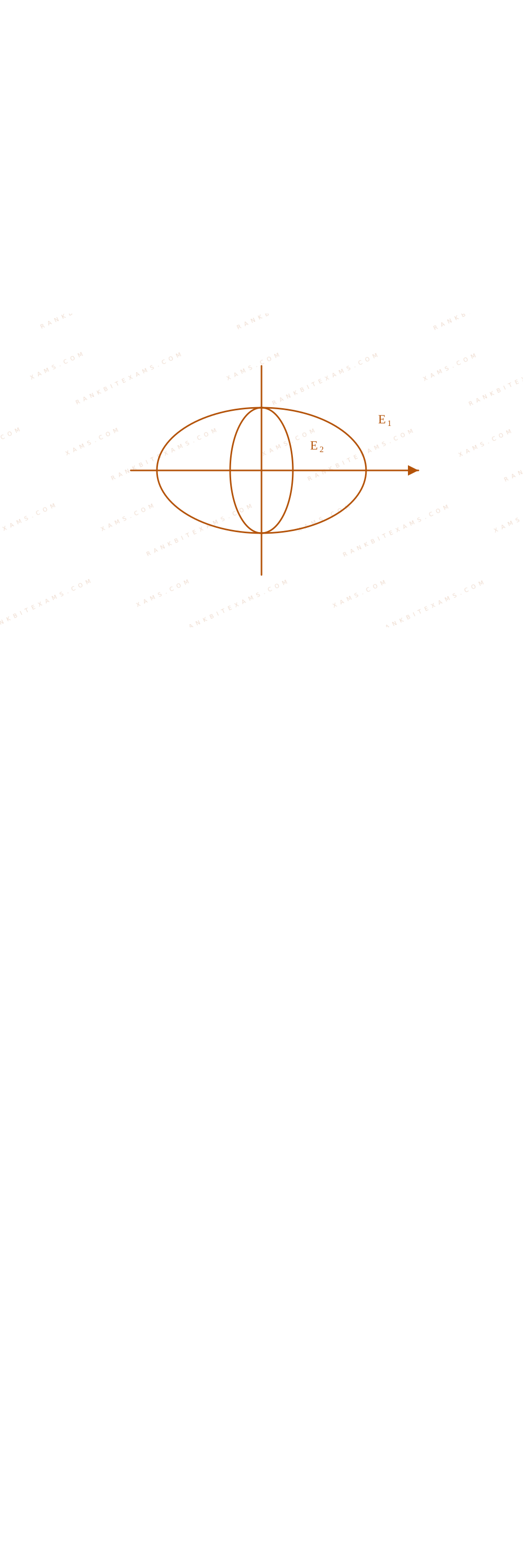
Let E₁: (x²)/(9) + (y²)/(4) = 1 be an ellipse. Ellipses Eᵢ 's are constructed such that their centres and eccentricities are same as that of E₁ , and the length of minor axis of Eᵢ is the length of major axis of Eᵢ₊₁ ( i ≥ 1 ). If Aᵢ is the area of the ellipse Eᵢ , then (5)/(pi) ( Σi=1∞ Aᵢ ) , is equal to ....

Numerical Answer Type:
Enter a numerical value Answer: 54 to 54 +4 marks

Solution & Explanation

Related Formula

Area of an ellipse with semi-axes a and b:

Area = π a b
Core Logic

Calculate the constant eccentricity e from the initial ellipse E₁:

Infinite Series of Ellipses diagram for Q75 - JEE Main 2025 Morning

e = √(1 - (4)/(9)) = √(5)3

For any subsequent ellipse E₂, its major axis equals the minor axis of E₁ (2b₁ = 4 a₂ = 2). Since eccentricity remains constant:

(5)/(9) = 1 - (b₂²)/(a₂²) = 1 - (b₂²)/(4) b₂² = (16)/(9) b₂ = (4)/(3)
Step 1: Finding the Area Sequence Terms

Evaluate the area values for the initial ellipses: A₁ = π · 3 · 2 = 6π A₂ = π · 2 · (4)/(3) = (8π)/(3)

The areas form an infinite geometric progression with a common ratio r = (4)/(9).

Step 2: Summing the Infinite Geometric Series
Σi=1∞ Aᵢ = (6π)/(1 - (4)/(9)) = (6π)/((5)/(9)) = (54π)/(5)

Evaluating the final scaling formula:

(5)/(π) ( (54π)/(5) ) = 54
Pattern Recognition

Iterative dimensional scaling creates geometric progressions where the ratio equals the square of the linear scaling factor.

Chapter Mix

Class 11 Maths: Conic Sections

Reference Study Guides

More Conic Sections Previous-Year Questions — Page 10

Q64 jee_main_2025_04_april_evening Ellipse
Let for two distinct values of p the lines y = x + p touch the ellipse E: (x²)/(4²) + (y²)/(3²) = 1 at the points A and B. Let the line y = x intersect E at the points C and D. Then the area of the quadrilateral ABCD is equal to
  • A. 36
  • B. 24
  • C. 48
  • D. 20

Solution

Related Formula

The condition for a line y = mx + p to be tangent to an ellipse (x²)/(a²) + (y²)/(b²) = 1 is:

p² = a²m² + b²

The coordinate of the point of contact is given by (-(a²m)/(p), (b²)/(p)).

Core Logic

Given the ellipse parameter values a² = 16 and b² = 9, and tangent line slope m = 1:

p² = 16(1)² + 9 = 25 p = ± 5

Thus, the two values of p are 5 and -5. The points of contact A and B are:

  • For p = 5: A = (-(16(1))/(5), (9)/(5)) = (-(16)/(5), (9)/(5))
  • For p = -5: B = (-(16(1))/(-5), (9)/(-5)) = ((16)/(5), -(9)/(5))
Step 1: Intersecting line with Ellipse

The line y = x intersects the ellipse (x²)/(16) + (y²)/(9) = 1:

(x²)/(16) + (x²)/(9) = 1 (25x²)/(144) = 1 x² = (144)/(25) x = ± (12)/(5)

Since y = x, the intersection points C and D are:

C = (-(12)/(5), -(12)/(5)) and D = ((12)/(5), (12)/(5))
Step 2: Calculating Quadrilateral Area

The area of quadrilateral ABCD with vertices mapped symmetrically can be computed using the standard coordinate determinant matrix layout formula:

Area = (1)/(2) vmatrix xA & yA & 1 xB & yB & 1 xC & yC & 1 vmatrix + = 24
Pattern Recognition

Notice that the tangent lines are parallel and symmetric (p = ± 5), and the intersecting line passes through the origin. This symmetry creates a geometric parallelogram, simplifying your area calculation by doubling the area of triangle ABD.

Chapter Mix

Class 11 Mathematics: Conic Sections
Q67 jee_main_2025_04_april_morning Ellipse - Foci and Latus Rectum
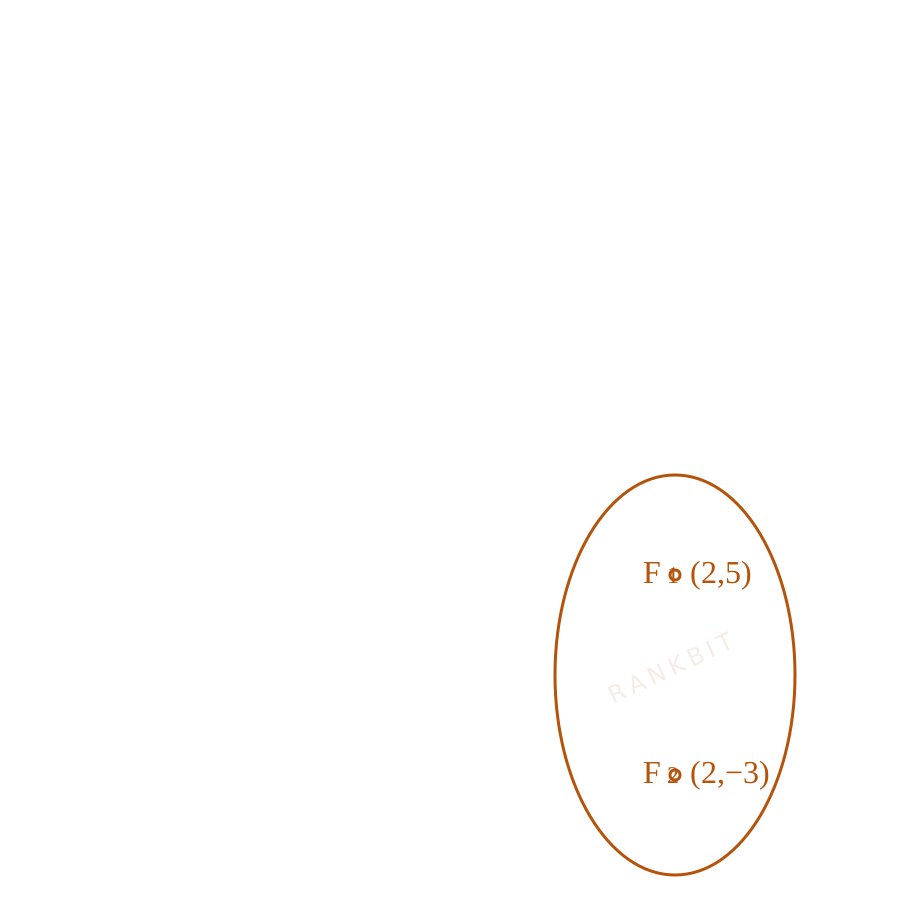
The length of the latus-rectum of the ellipse, whose foci are (2, 5) and (2, -3) and eccentricity is (4)/(5), is
  • A. (6)/(5)
  • B. (50)/(3)
  • C. (10)/(3)
  • D. (18)/(5)

Solution

Related Formula

Distance between foci = 2be (for vertical major axis). Length of Latus Rectum (L.R.) = (2a²)/(b).

Core Logic

Foci are F₁(2,5) and F₂(2,-3). The x-coordinates are identical, indicating a vertical ellipse. Distance between foci:

2be = 5 - (-3) = 8 be = 4

Given eccentricity e = (4)/(5):

b((4)/(5)) = 4 b = 5

Ellipse - Foci and Latus Rectum diagram for Q67 - JEE Main 2025 Morning

Step 1: Calculate Minor Axis length

Use eccentricity relation:

a² = b²(1 - e²) a² = 25(1 - (16)/(25)) = 25 × (9)/(25) = 9 a = 3
Step 2: Evaluate Latus Rectum
L.R. = (2a²)/(b) = (2 × 9)/(5) = (18)/(5)
Pattern Recognition

Always verify axis orientation (horizontal vs vertical) from coordinates before blindly substituting into standard formulas. Symmetrical components match axis lengths parameters directly.

Chapter Mix

Class 11 Mathematics: Conic Sections

Q74 jee_main_2025_04_april_morning Tangents to Conics
Let C be the circle x² + (y - 1)² = 2, E₁ and E₂ be two ellipses whose centres lie at the origin and major axes lie on the x-axis and y-axis respectively. Let the straight line x + y = 3 touch the curves C, E₁ and E₂ at P(x₁, y₁), Q(x₂, y₂) and R(x₃, y₃) respectively. Given that P is the mid-point of the line segment QR and PQ = 2√(2)3, the value of 9(x₁y₁ + x₂y₂ + x₃y₃) is equal to
Numerical Answer. Answer: 46 to 46

Solution

Related Formula

Parametric equation of a straight line:

x = x₁ + r θ, y = y₁ + r θ
Core Logic

Step 1: Find point P(x₁,y₁) on circle C. Equation of tangent at P on x² + y² - 2y - 1 = 0 is xx₁ + y(y₁ - 1) - (y₁ + 1) = 0. Comparing with line x + y = 3 (x₁)/(1) = (y₁ - 1)/(1) = (y₁ + 1)/(3). Solving gives x₁ = 1, y₁ = 2. Thus, P = (1, 2).

Step 1: Use Line Parametrics for Q and R

Line x + y = 3 makes an angle θ = 135° with the positive x-axis. Using parametric distances from P(1,2) with r = PQ = 2√(2)3:

x = 1 ± r (135°) = 1 ∓ r√(2) y = 2 ± r (135°) = 2 ± r√(2)

Substitute r = 2√(2)3: For Q: x₂ = 1 + (2)/(3) = (5)/(3), y₂ = 2 - (2)/(3) = (4)/(3). For R: x₃ = 1 - (2)/(3) = (1)/(3), y₃ = 2 + (2)/(3) = (8)/(3).

Step 2: Evaluate Final Expression

Calculate the products: x₁y₁ = 1 × 2 = 2 x₂y₂ = (5)/(3) × (4)/(3) = (20)/(9) x₃y₃ = (1)/(3) × (8)/(3) = (8)/(9)

9(x₁y₁ + x₂y₂ + x₃y₃) = 9(2 + (20)/(9) + (8)/(9)) = 18 + 20 + 8 = 46
Pattern Recognition

Parametric distance equations are perfect for lines containing midpoints. This approach bypasses calculating the individual ellipse equations a², b² completely.

Chapter Mix

Class 11 Mathematics: Circles Class 11 Mathematics: Conic Sections

Q62 jee_main_2025_07_april_evening Properties of Ellipse
Let the length of a latus rectum of an ellipse (x²)/(a²) + (y²)/(b²) = 1 be 10. If its eccentricity is the minimum value of the function f(t) = t² + t + (11)/(12), t in R, then a² + b² is equal to:
  • A. 125
  • B. 126
  • C. 120
  • D. 115

Solution

Related Formula

Length of latus rectum of an ellipse and its eccentricity relation are:

LR = (2b²)/(a) e² = 1 - (b²)/(a²)
Core Logic

Given length of LR = 10 (2b²)/(a) = 10 b² = 5a (i)

Now, let's find the minimum value of f(t) = t² + t + (11)/(12). Differentiating: f'(t) = 2t + 1 = 0 t = -(1)/(2).

Minimum value e = f(-(1)/(2)) = (-(1)/(2))² + (-(1)/(2)) + (11)/(12) = (1)/(4) - (1)/(2) + (11)/(12) = (3 - 6 + 11)/(12) = (8)/(12) = (2)/(3)
Step 1: Solve for a and b

Using eccentricity formula:

e² = (4)/(9) = 1 - (b²)/(a²) (b²)/(a²) = (5)/(9) b² = (5a²)/(9) (ii)

Equating (i) and (ii):

5a = (5a²)/(9) a = 9

Then from (i):

b² = 5(9) = 45 b = 3√(5)

Hence, a² = 81.

Step 2: Calculate a^2 + b^2
a² + b² = 81 + 45 = 126
Pattern Recognition

A quadratic function at²+bt+c reaches its extreme value at t = -(b)/(2a). Using this layout avoids full calculus derivation steps.

Chapter Mix

Class 11 Mathematics: Conic Sections Class 11 Mathematics: Quadratic Equations

Q68 jee_main_2025_07_april_evening Eccentricity and Foci
Let e₁ and e₂ be the eccentricities of the ellipse x²b² + y²25 = 1 and the hyperbola x²16 - y²b² = 1, respectively. If b < 5 and e₁e₂ = 1, then the eccentricity of the ellipse having its axes along the coordinate axes and passing through all four foci (two of the ellipse and two of the hyperbola) is:
  • A. (4)/(5)
  • B. (3)/(5)
  • C. √(7)4
  • D. √(3)2

Solution

Related Formula

Eccentricity for ellipse (a

e₁² = 1 - (a²)/(b²) e₂² = 1 + (b²)/(a²)
Core Logic

Since b < 5, for the ellipse (x²)/(b²) + (y²)/(25) = 1, the major axis is along the y-axis:

e₁² = 1 - (b²)/(25)

For the hyperbola (x²)/(16) - (y²)/(b²) = 1:

e₂² = 1 + (b²)/(16)

Given e₁² e₂² = 1:

(1 - (b²)/(25))(1 + (b²)/(16)) = 1 1 + (b²)/(16) - (b²)/(25) - (b⁴)/(400) = 1 (9b²)/(400) = (b⁴)/(400) b² = 9
Step 1: Calculate Foci Locations

Substituting b² = 9: Ellipse foci: ae₁ = 5 · √(1 - (9)/(25)) = 5 · (4)/(5) = 4. Foci lie along y-axis: (0, ± 4). Hyperbola foci: ae₂ = 4 · √(1 + (9)/(16)) = 4 · (5)/(4) = 5. Foci lie along x-axis: (± 5, 0).

Step 2: Construct the New Ellipse

The new ellipse passes through (0, ± 4) and (± 5, 0). Thus, its semi-major axis is A = 5 along the x-axis and semi-minor axis is B = 4 along the y-axis:

E = √(1 - (B²)/(A²)) = √(1 - (16)/(25)) = (3)/(5)
Pattern Recognition

When a conic passes through points directly on the axes like (± alpha, 0) and (0, ± β), those points immediately represent the semi-axes values A and B.

Chapter Mix

Class 11 Mathematics: Conic Sections

More Conic Sections Questions — jee_main_2025_28_jan_morning

Practice all Conic Sections previous-year questions →

Rankbit System
JEE Physics: Waves (+15.5%) | Electrostatics: Concentric Shells (-29.7%) | Modern Physics: Photoelectric Clones (+34.2%) | Mathematics: Definite Integrals (+18.1%) | Chemistry: Coordination Splitting (-11.4%) | JEE Physics: Waves (+15.5%) | Electrostatics: Concentric Shells (-29.7%) | Modern Physics: Photoelectric Clones (+34.2%) | Mathematics: Definite Integrals (+18.1%) | Chemistry: Coordination Splitting (-11.4%)