JEE Main · Chemistry ↓ Falling

Organic Chemistry - Some Basic Principles and Techniques appeared 93 times across 3 years — 10.8% of Chemistry. This question is from Acidity of Organic Compounds.

Year 2026 2025 2024 Total
Questions 19 49 25 93

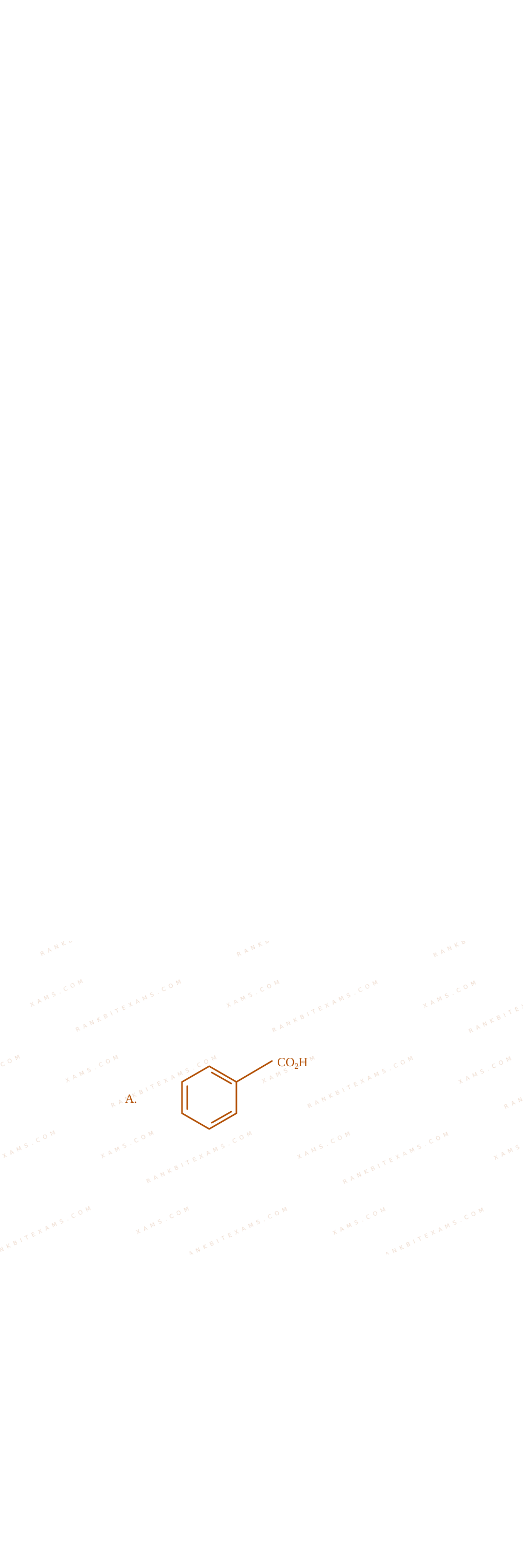
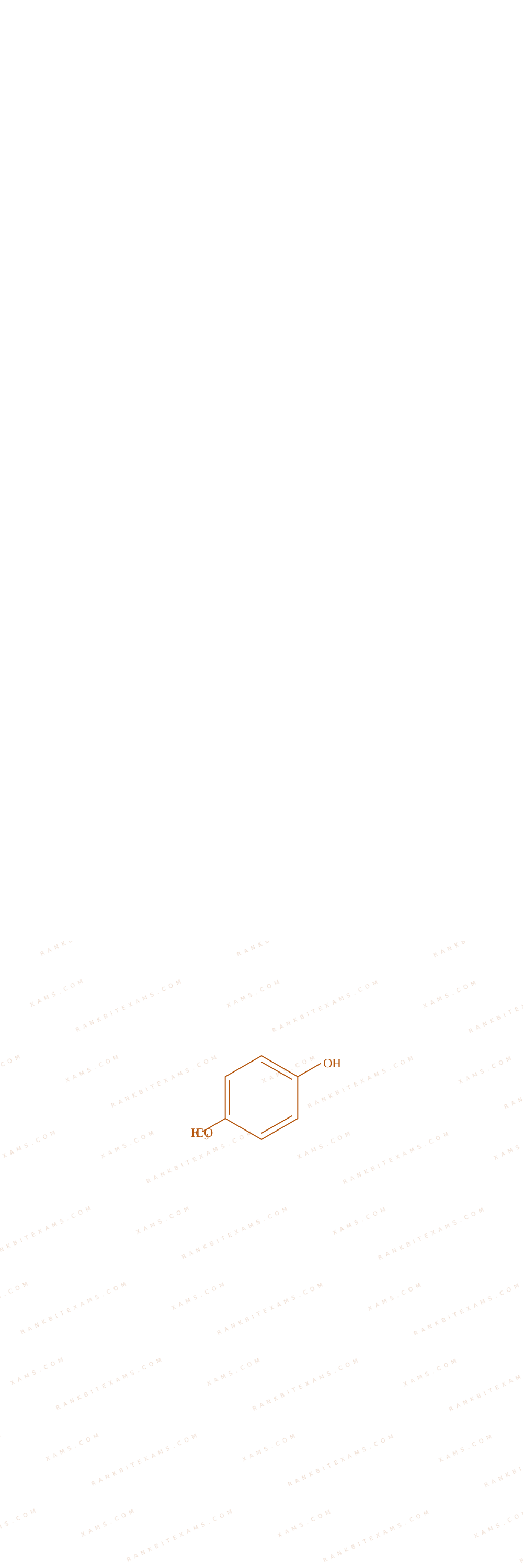
The compounds that produce CO₂ with aqueous NaHCO₃ solution are: A.
Acid structures profile for Q43 - JEE Main 2025 Morning
The prompt lists five structures labeled A through E evaluating structural acidities.
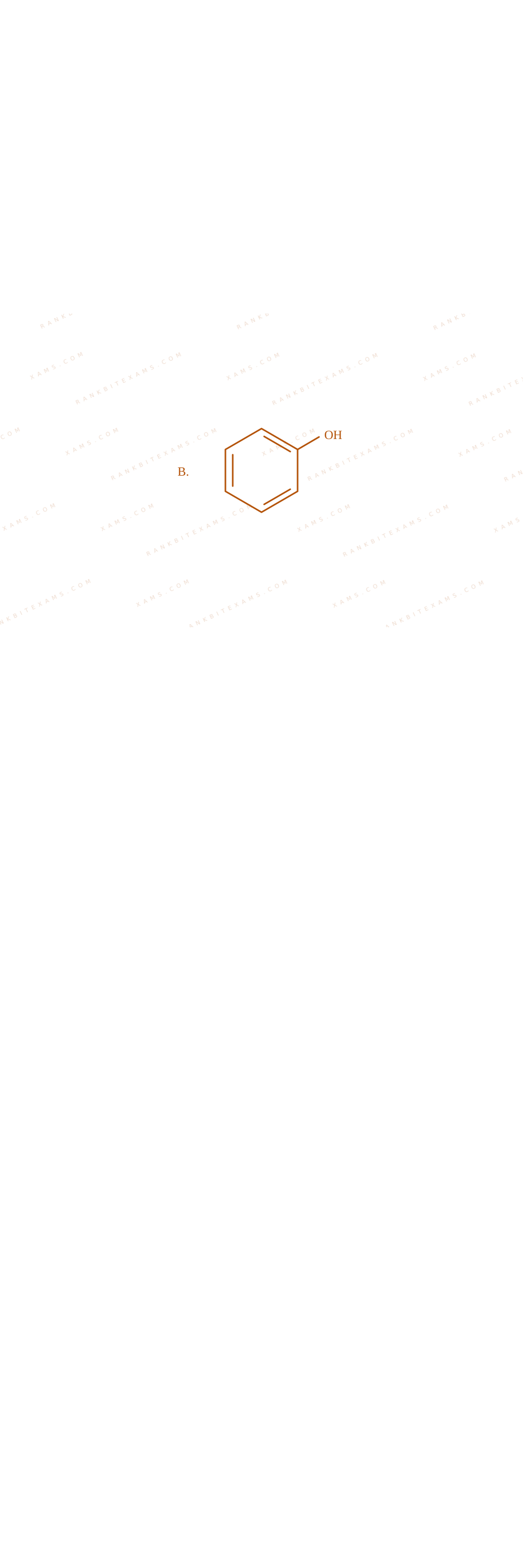
B.
Acid structures profile for Q43 - JEE Main 2025 Morning
The prompt lists five structures labeled A through E evaluating structural acidities.
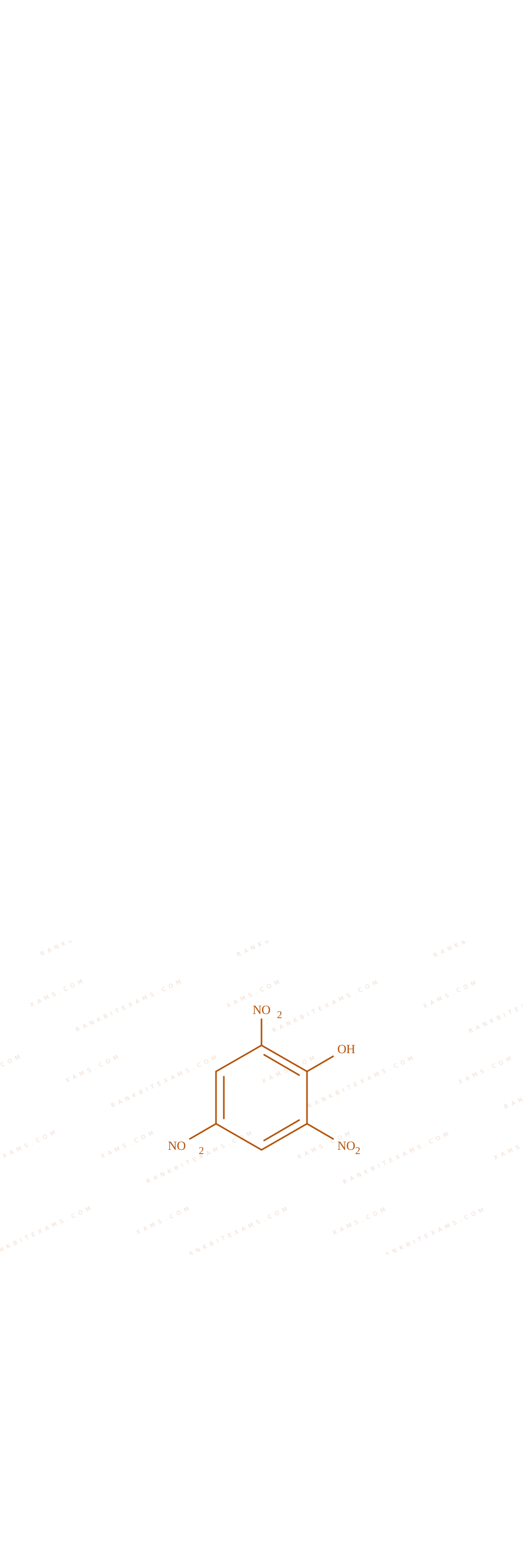
C.
Acid structures profile for Q43 - JEE Main 2025 Morning
The prompt lists five structures labeled A through E evaluating structural acidities.
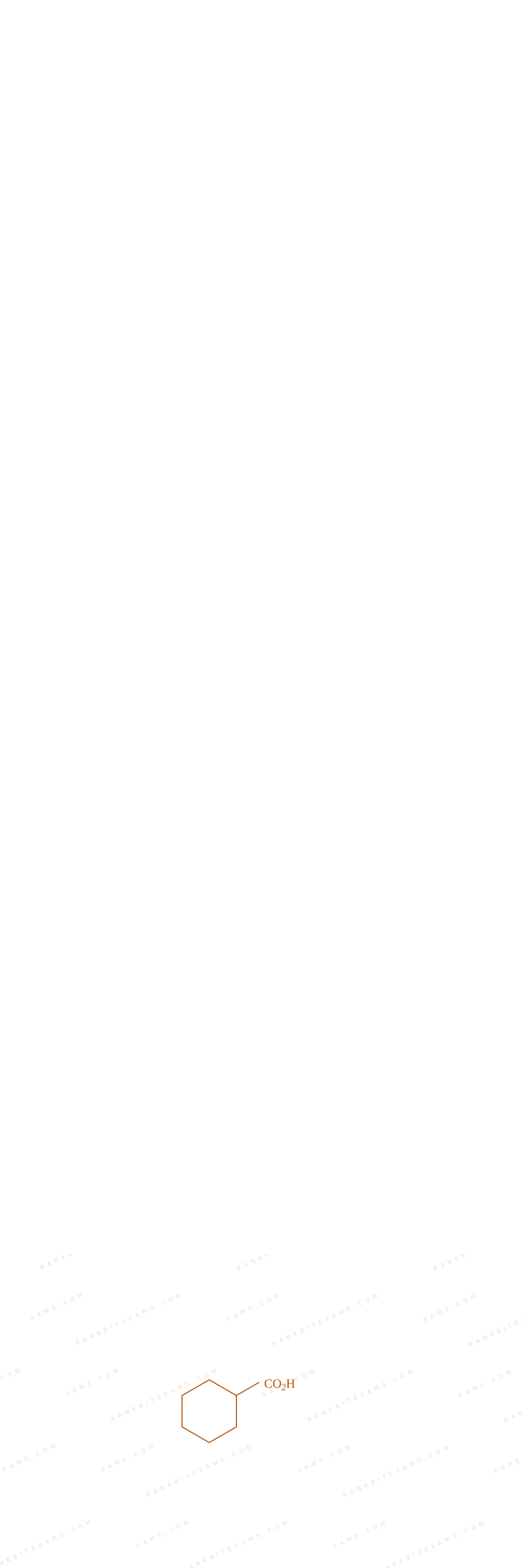
D.
Acid structures profile for Q43 - JEE Main 2025 Morning
The prompt lists five structures labeled A through E evaluating structural acidities.
E.
Acid structures profile for Q43 - JEE Main 2025 Morning
The prompt lists five structures labeled A through E evaluating structural acidities.
Choose the correct answer from the options given below:

Solution & Explanation

Core Logic

Organic compounds react with sodium bicarbonate (NaHCO₃) to liberate CO₂ gas if they are stronger acids than carbonic acid (H₂CO₃). Evaluating the structures:

  • A: Benzoic acid, which is significantly more acidic than carbonic acid.
  • C: Picric acid (2,4,6-trinitrophenol). Due to three strong electron-withdrawing nitro groups, its acidity exceeds typical carboxylic acids and H₂CO₃.
  • D: Benzenesulfonic acid, a highly strong mineral-like organic acid.
  • B & E: Standard phenols or weakly substituted phenols, which are less acidic than carbonic acid and do not liberate CO₂.
  • Therefore, structures A, C, and D give a positive test result.

Pattern Recognition

Sees: Sodium bicarbonate test for organic systems. Shortcut: Only carboxylic acids, sulfonic acids, and highly nitrated phenols like picric acid possess sufficient proton acidity to displace CO₂ from bicarbonate ions.

Chapter Mix

Class 11 Chemistry: Organic Chemistry - Some Basic Principles and Techniques

Reference Study Guides

More Organic Chemistry - Some Basic Principles and Techniques Previous-Year Questions — Page 5

Q jee_main_2025_02_april_evening Methods of Purification of Organic Compounds
Match List-I with List-II: array|l|l| arrayc List-I (Purification technique) array & arrayc List-II (Mixture of organic compounds) array (A) Distillation (simple) & (I) Diesel + Petrol (B) Fractional distillation & (II) Aniline + Water (C) Distillation under reduced pressure & (III) Chloroform + Aniline (D) Steam distillation & (IV) Glycerol + Spent-lye array Choose the correct answer from the options given below:
  • A. (A)-(II), (B)-(III), (C)-(IV), (D)-(I)
  • B. (A)-(II), (B)-(IV), (C)-(I), (D)-(III)
  • C. (A)-(III), (B)-(IV), (C)-(II), (D)-(I)
  • D. (A)-(III), (B)-(I), (C)-(IV), (D)-(II)

Solution

Related Formula
Method Selection = f( Δ Tb, decomposition threshold, volatility with steam )
Core Logic

Let's align each purification technique to its designated mixtures based on NCERT guidelines:

  • (A) Simple distillation: Used for liquids having a significant difference in their boiling points (>30~K or 30^). Chloroform (b.p. 334~K) and aniline (b.p. 457~K) are separated easily using simple distillation arrow (III).
  • (B) Fractional distillation: Used if boiling point differences of the components are very close (less than 25~K). Separation of petrochemical fractions such as diesel and petrol uses this technique arrow (I).
  • (C) Distillation under reduced pressure: Used for liquids that tend to decompose at or below their normal boiling points. Glycerol is separated from spent-lye in soap manufacturing industry using this vacuum method to prevent glycerol decomposition arrow (IV).
  • (D) Steam distillation: Applied to substances which are steam-volatile and completely immiscible in water. Aniline and water are separated using this technique arrow (II).
Step 1: Conclusion

Thus, the correct match is: (A)-(III), (B)-(I), (C)-(IV), (D)-(II) This corresponds perfectly to option (4).

Pattern Recognition

Glycerol from spent-lye is a highly tested practical chemistry concept. Remember that vacuum distillation lowers the boiling point, permitting evaporation without decomposition.

Chapter Mix

Class 11 Chemistry: Organic Chemistry - Some Basic Principles and Techniques

Q jee_main_2025_02_april_evening Quantitative Estimation (Dumas Method)
In Dumas' method for estimation of nitrogen, 0.5 gram of an organic compound gave 60~mL of nitrogen collected at 300K temperature and 715~mmHg pressure. The percentage composition of nitrogen in the compound (Aqueous tension at 300K = 15~mmHg) is
  • A. 1.257
  • B. 20.87
  • C. 18.67
  • D. 12.57

Solution

Related Formula
pN₂ = ptotal - paq nN₂ = pN₂ VR T % N = Mass of nitrogenMass of organic compound × 100
Core Logic

Dumas' method estimates nitrogen by collecting dry nitrogen gas (N₂). We must subtract the aqueous tension (vapor pressure of water) to find the pressure exerted solely by the dry nitrogen gas.

Step 1: Calculate Pressure of Dry Nitrogen
pN₂ = 715~mmHg - 15~mmHg = 700~mmHg

Converting pressure to atmospheres:

pN₂ = (700)/(760)~atm
Step 2: Calculate Moles of Nitrogen Gas

Using the ideal gas law with R = 0.0821~ L~atm~mol⁻¹~K⁻¹, T = 300~K, and V = 60~mL = 60 × 10⁻³~L:

nN₂ = ((700)/(760)) × 60 × 10⁻³0.0821 × 300 nN₂ = (0.92105 × 0.060)/(24.63) ≈ 2.244 × 10⁻³~mol
Step 3: Calculate Mass and Percentage of Nitrogen

The molar mass of N₂ is 28~ g~mol⁻¹:

Mass of N₂ = nN₂ × 28 = 2.244 × 10⁻³ × 28 ≈ 0.06283~g

Now find the percentage in 0.5~g of organic compound:

% N = 0.06283~g0.5~g × 100 = 12.566% ≈ 12.57%
Pattern Recognition

Watch out! Always subtract the aqueous tension from the wet gas pressure first to find the dry gas pressure. Forgetting this step is the most common source of error in Dumas calculations.

Chapter Mix

Class 11 Chemistry: Organic Chemistry - Some Basic Principles and Techniques

Q jee_main_2025_02_april_morning Aromaticity and Huckel's Rule
Designate whether each of the following compounds is aromatic or not aromatic:
Aromaticity and Huckel's Rule diagram for Q26 - JEE Main 2025 Morning
The diagram displays eight different cyclic conjugated hydrocarbon compounds labeled (a) through (h) to evaluate for aromatic character.
Choose the correct answer from the options given below:
  • A. (1) e, g aromatic and a, b, c, d, f, h not aromatic
  • B. (2) b, e, f, g aromatic and a, c, d, h not aromatic
  • C. (3) a, b, c, d aromatic and e, f, g, h not aromatic
  • D. (4) a, c, d, e, h aromatic and b, f, g not aromatic

Solution

Related Formula

According to Huckel's Rule, a planar, monocyclic, completely conjugated system is aromatic if it contains:

(4n + 2)π electrons (where n = 0, 1, 2, )

Aromaticity analysis solutions diagram for Q26
The diagram displays eight different cyclic conjugated hydrocarbon compounds labeled (a) through (h) to evaluate for aromatic character.
Aromaticity analysis solutions diagram for Q26
The diagram displays eight different cyclic conjugated hydrocarbon compounds labeled (a) through (h) to evaluate for aromatic character.

Step 1: Classification

Hence, compounds a, c, d, e, and h follow Huckel's rule and are aromatic, whereas b, f, and g are not aromatic.

Pattern Recognition

Quick check for aromaticity: Count the pairs of localized/delocalized π electrons moving through the continuous loop. Odd number of pairs (1, 3, 5...) means aromatic (2π, 6π, 10π). Even pairs mean anti-aromatic/non-aromatic.

Chapter Mix

Class 11 Chemistry: Organic Chemistry - Some Basic Principles and Techniques Class 11 Chemistry: Hydrocarbons

Q jee_main_2025_02_april_morning Free Radical Stability
Consider the following compound (X) arrayc I H - C ≡ C - C H _ 2 - C H - C H _ 3 I C H _ 3 array The most stable and least stable carbon radicals, respectively, produced by homolytic cleavage of corresponding C - H bond are :
  • A. (1) II, IV
  • B. (2) III, II
  • C. (3) I, IV
  • D. (4) II, I

Solution

Related Formula

Free radical stability structural hierarchy sequence:

Resonance Stabilized (Propargyl/Allyl) > 3^° > 2^° > 1^° > Vinylic/Alkyne Center
Core Logic

Let's analyze individual cleavage points across the carbon backbone skeleton:

  • Position II yields a propargyl intermediate radical directly adjacent to the alkyne bond. This allows strong resonance stabilization across the π system, making it the most stable radical position.
  • Position I places the radical directly on an sp-hybridized carbon center. The high electronegativity of sp orbitals tightly holds the unpaired electron, making homolytic cleavage extremely difficult and rendering this intermediate the least stable radical position.
  • Free Radical Stability
    Free Radical Stability

Step 1: Verdict

Therefore, the most stable and least stable positions are II and I, respectively.

Pattern Recognition

Radicals located on sp carbons (vinylic/alkynic) are highly unstable due to poor orbital overlap, while positions next to triple bonds (propargylic) are exceptionally stable due to active resonance delocalization.

Chapter Mix

Class 11 Chemistry: Organic Chemistry - Some Basic Principles and Techniques

Q jee_main_2025_02_april_morning Nucleophilic Acyl Substitution and Hydrolysis
Consider the following molecules :
Nucleophilic Acyl Substitution and Hydrolysis
The correct order of rate of hydrolysis is :
  • A. (1) r > q > p > s
  • B. (2) q > p > r > s
  • C. (3) p > r > q > s
  • D. (4) p > q > r > s

Solution

Related Formula

The relative rate of nucleophilic acyl substitution follows the leaving group ability:

Rate of Hydrolysis ∝ Leaving Group Ability ∝ 1Basic Strength of Leaving Group

Nucleophilic Acyl Substitution and Hydrolysis

Core Logic

Let's analyze the leaving groups across all choices layout-by-row:

  • For (p), the leaving group is Cl^- (Very weak base, excellent leaving group).
  • For (q), the leaving group is RCOO^- (Resonance stabilized carboxylate, good leaving group).
  • For (r), the leaving group is RO^- (Alkoxide, strong base, poor leaving group).
  • For (s), the leaving group is NH₂^- (Extremely strong base, exceptionally poor leaving group due to nitrogen lone pair resonance into the carbonyl).
  • This structural comparison yields the final sequence: p > q > r > s.

Pattern Recognition

Acyl chlorides (p) are always the most reactive acid derivatives, while amides (s) are consistently the least reactive due to strong amide resonance stabilizing the carbonyl group.

Chapter Mix

Class 11 Chemistry: Organic Chemistry - Some Basic Principles and Techniques Class 12 Chemistry: Aldehydes, Ketones and Carboxylic Acids

More Organic Chemistry - Some Basic Principles and Techniques Questions — jee_main_2025_28_jan_morning

Practice all Organic Chemistry - Some Basic Principles and Techniques previous-year questions →

Rankbit System
JEE Physics: Waves (+15.5%) | Electrostatics: Concentric Shells (-29.7%) | Modern Physics: Photoelectric Clones (+34.2%) | Mathematics: Definite Integrals (+18.1%) | Chemistry: Coordination Splitting (-11.4%) | JEE Physics: Waves (+15.5%) | Electrostatics: Concentric Shells (-29.7%) | Modern Physics: Photoelectric Clones (+34.2%) | Mathematics: Definite Integrals (+18.1%) | Chemistry: Coordination Splitting (-11.4%)
