Q
jee_main_2025_08_april_evening
Preparation and Reactions of Styrene derivatives
Choose the correct set of reagents for the following conversion:
Ethyl benzene 4-bromostyrene
{{Q_IMG1}}
.svg "Aromatic substitution, Side chain bromination, Dehydrohalogenation, Styrene synthesis")

Solution
Core Logic
To synthesize 4-bromostyrene starting from ethyl benzene, we must carry out ring functionalization prior to developing the side-chain double bond:
- Ring Bromination: Treatment of ethylbenzene with Br₂ in the presence of Fe (or FeBr₃) acts via electrophilic aromatic substitution. The ethyl group is an ortho/para director, yielding 1-bromo-4-ethylbenzene as the major product owing to steric mitigation.
- Side-Chain Halogenation: Free radical substitution with Cl₂ under thermal conditions (Δ) or UV light specifically chlorinates the benzylic position because the benzylic radical is exceptionally stable via resonance.
- Elimination: Heating with alcoholic KOH drives an E2 elimination of the benzylic chloride, cleanly synthesizing the terminal alkene linkage of the styrene system.
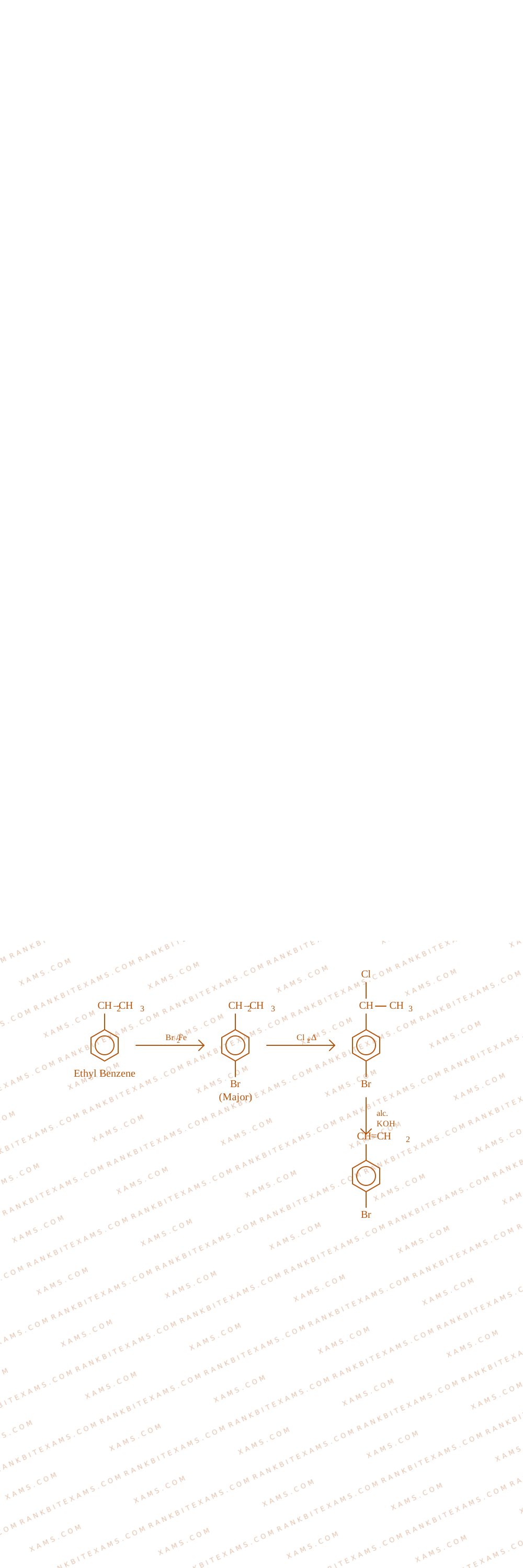
The figure illustrates the multi-step conversion starting from ethylbenzene to yield a brominated styrene derivative.
Pattern Recognition
If you perform side-chain halogenation/alkene generation first, the ring substitution later would lack para-selectivity control and risk reacting across the alkene path. Hence, ring substitution MUST precede double bond creation.
Chapter Mix
Class 12 Chemistry: Haloalkanes and Haloarenes Class 11 Chemistry: Hydrocarbons
)
