JEE Main · Chemistry ↓ Falling

Haloalkanes and Haloarenes appeared 38 times across 3 years — 4.4% of Chemistry. This question is from Alkaline Hydrolysis and NGP.

Year 2026 2025 2024 Total
Questions 11 15 12 38

Given below are two statements : Statement I: Et₂N-CH₂-CH₂-Cl will undergo alkaline hydrolysis at a faster rate than Et₂CH-CH₂-Cl. Statement II: In Et₂N-CH₂-CH₂-Cl, intramolecular substitution takes place first by involving lone pair of electrons on nitrogen. In the light of the above statements, choose the most appropriate answer from the options given below:

Solution & Explanation

Core Logic

Statement I is correct because the nitrogen atom contains a lone pair situated at the β-position relative to the chlorine atom, promoting Neighboring Group Participation (NGP).

Statement II is correct because the lone pair on nitrogen attacks internally to kick out the chloride ion, forming a cyclic aziridinium ion intermediate. This quick intramolecular cyclization leads to an exceptionally rapid hydrolysis rate compared to standard aliphatic substitution.

Pattern Recognition

Sees: Nitrogen with lone pair β to a leaving group. Shortcut: NGP (Neighboring Group Participation) accelerates substitution dramatically via intramolecular assistance.

Chapter Mix

Class 12 Chemistry: Haloalkanes and Haloarenes

Reference Study Guides

More Haloalkanes and Haloarenes Previous-Year Questions — Page 6

Q jee_main_2025_29_jan_morning Nucleophilic Aromatic Substitution
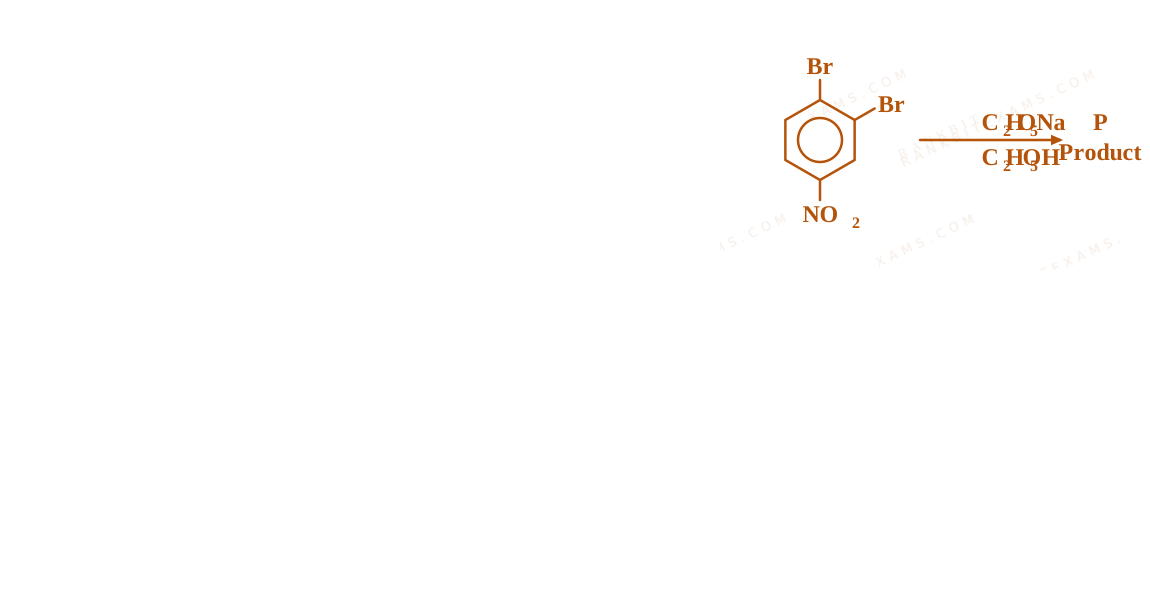
In the following substitution reaction:
Nucleophilic Aromatic Substitution diagram for Q34 - JEE Main 2025 Morning
The structural layout depicts a 1,2-dibromo-4-nitrobenzene reacting with sodium ethoxide.
Product P formed is:
  • A.
  • B.
  • C.
  • D.

Solution

Related Formula

Nucleophilic Aromatic Substitution (SNAr) occurs via a Meisenheimer complex intermediate, where strong electron-withdrawing groups (-NO₂) activate positions strictly ortho and para to themselves.

Core Logic

The reactant is 1,2-dibromo-4-nitrobenzene. Let us evaluate the two bromine positions relative to the nitro group:

  • The bromine at C-1 is para to the strong activating -NO₂ group.
  • The bromine at C-2 is meta to the -NO₂ group.
  • Since the para position facilitates effective negative charge delocalization onto the oxygen atoms of the nitro group during intermediate formation, the para-bromine undergoes substitution exclusively by the ethoxide ion (^-OC₂H₅). This yields the final product shown below:
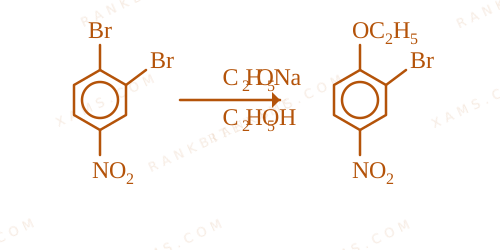
    Nucleophilic Aromatic Substitution diagram for Q34 - JEE Main 2025 Morning
    The structural layout depicts a 1,2-dibromo-4-nitrobenzene reacting with sodium ethoxide.

Pattern Recognition

In aromatic pathways activated by -NO₂, substitution happens exclusively at positions ortho or para relative to the nitro flag; meta positions remain unactivated.

Chapter Mix

Class 12 Chemistry: Haloalkanes and Haloarenes

Q jee_main_2024_01_february_morning Nucleophilic Substitution
Given below are two statements : one is labelled as Assertion (A) and the other is labelled as Reason (R). Assertion (A) : Haloalkanes react with KCN to form alkyl cyanides as a main product while with AgCN form isocyanide as the main product. Reason (R) : KCN and AgCN both are highly ionic compounds. In the light of the above statement, choose the most appropriate answer from the options given below:
  • A. (A) is correct but (R) is not correct
  • B. Both (A) and (R) are correct but (R) is not the correct explanation of (A)
  • C. (A) is not correct but (R) is correct
  • D. Both (A) and (R) are correct and (R) is the correct explanation of (A)

Solution

Core Logic

KCN is predominantly ionic and provides cyanide ions (CN^-) in solution. Although both carbon and nitrogen are in a position to donate electron pairs, the attack takes place mainly through carbon because C-C bond is more stable than C-N bond, forming alkyl cyanides (nitriles) as major product.

KCN + R-X arrow R-CN (Major)

However, AgCN is mainly covalent in nature and nitrogen is free to donate an electron pair forming isocyanide as the main product.

AgCN + R-X arrow R-NC (Major)
Step 1: Final Conclusion

Assertion (A) is correct. Reason (R) states both are highly ionic, which is incorrect because AgCN is largely covalent. Therefore, (A) is correct but (R) is not correct.

Pattern Recognition

Ambidentate nucleophile shortcut: Alkali metal cyanides (KCN, NaCN) are ionic arrow attack from Carbon arrow Cyanide. Heavy metal cyanides (AgCN) are covalent arrow attack from Nitrogen arrow Isocyanide.

Chapter Mix

Class 12 Chemistry: Haloalkanes and Haloarenes

Q jee_main_2024_01_february_morning Optical Isomerism
Number of optical isomers possible for 2-chlorobutane
Numerical Answer. Answer: 2 to 2

Solution

Core Logic

The structure of 2-chlorobutane is CH₃-CH(Cl)-CH₂-CH₃. There is exactly one chiral center in this molecule, which is the carbon atom at position 2 (bonded to H, Cl, CH₃, and CH₂CH₃).

For a molecule with n distinct chiral centers and no plane of symmetry, the number of optical isomers (stereoisomers) is 2ⁿ.

Step 1: Calculate Isomers

Number of chiral centers n = 1. Total optical isomers = 2¹ = 2 (one pair of enantiomers: the (R) and (S) configurations).

Optical Isomerism diagram for Q81 - JEE Main 2024 Morning

Pattern Recognition

1 chiral center always gives 2 optical isomers (a pair of enantiomers).

Chapter Mix

Class 12 Chemistry: Haloalkanes and Haloarenes Class 11 Chemistry: Organic Chemistry Some Basic Principles and Techniques

Q79 jee_main_2024_27_jan_morning Nucleophilic Substitution Mechanisms
The correct statement regarding nucleophilic substitution reaction in a chiral alkyl halide is;
  • A. Retention occurs in SN1 reaction and inversion occurs in SN2 reaction.
  • B. Racemisation occurs in SN1 reaction and retention occurs in SN2 reaction.
  • C. Racemisation occurs in both SN1 and SN2 reactions.
  • D. Racemisation occurs in SN1 reaction and inversion occurs in SN2 reaction.

Solution

Core Logic

In an SN1 pathway, a planar carbocation intermediate is produced. Attack by the nucleophile can take place with equal probability from either side, resulting in complete/partial racemisation. In an SN2 pathway, the nucleophile attacks exclusively from the backside opposite the leaving group, causing an absolute structural inversion (Walden inversion).

Pattern Recognition

SN1 arrow planar intermediate carbocation arrow Racemisation. SN2 arrow direct backside launch arrow Inversion.

Chapter Mix

Class 12 Chemistry: Haloalkanes and Haloarenes

Q jee_main_2024_29_jan_morning Preparation of Haloarenes
Given below are two statements : one is labelled as Assertion A and the other is labelled as Reason R : Assertion A : Aryl halides cannot be prepared by replacement of hydroxyl group of phenol by halogen atom. Reason R : Phenols react with halogen acids violently. In the light of the above statements, choose the most appropriate from the options given below:
  • A. Both A and R are true but R is NOT the correct explanation of A
  • B. A is false but R is true
  • C. A is true but R is false
  • D. Both A and R are true and R is the correct explanation of A

Solution

Core Logic

Assertion (A): In phenols, the C-O bond possesses partial double bond character due to resonance (the lone pair of oxygen delocalizes into the benzene ring). Because of this strong C-O bond, nucleophilic substitution reactions where a halide ion would replace the hydroxyl group do not occur under normal conditions. Thus, aryl halides cannot be prepared directly from phenols by reaction with HX. The statement is True.

Reason (R): Phenols do NOT react violently with halogen acids. In fact, they practically do not react with halogen acids (HX) to form aryl halides because the C-O bond is difficult to break. The statement is False.

Step 1: Visualization

Preparation of Haloarenes diagram for Q70 - JEE Main 2024 Morning

Given reason is false.

Step 2: Conclusion

Assertion (A) is correct but Reason (R) is false.

Chapter Mix

Class 12 Chemistry: Haloalkanes and Haloarenes Class 12 Chemistry: Alcohols Phenols and Ethers

More Haloalkanes and Haloarenes Questions — jee_main_2025_28_jan_morning

Practice all Haloalkanes and Haloarenes previous-year questions →

Rankbit System
JEE Physics: Waves (+15.5%) | Electrostatics: Concentric Shells (-29.7%) | Modern Physics: Photoelectric Clones (+34.2%) | Mathematics: Definite Integrals (+18.1%) | Chemistry: Coordination Splitting (-11.4%) | JEE Physics: Waves (+15.5%) | Electrostatics: Concentric Shells (-29.7%) | Modern Physics: Photoelectric Clones (+34.2%) | Mathematics: Definite Integrals (+18.1%) | Chemistry: Coordination Splitting (-11.4%)