JEE Main · Chemistry ↓ Falling

Haloalkanes and Haloarenes appeared 38 times across 3 years — 4.4% of Chemistry. This question is from Alkaline Hydrolysis and NGP.

Year 2026 2025 2024 Total
Questions 11 15 12 38

Given below are two statements : Statement I: Et₂N-CH₂-CH₂-Cl will undergo alkaline hydrolysis at a faster rate than Et₂CH-CH₂-Cl. Statement II: In Et₂N-CH₂-CH₂-Cl, intramolecular substitution takes place first by involving lone pair of electrons on nitrogen. In the light of the above statements, choose the most appropriate answer from the options given below:

Solution & Explanation

Core Logic

Statement I is correct because the nitrogen atom contains a lone pair situated at the β-position relative to the chlorine atom, promoting Neighboring Group Participation (NGP).

Statement II is correct because the lone pair on nitrogen attacks internally to kick out the chloride ion, forming a cyclic aziridinium ion intermediate. This quick intramolecular cyclization leads to an exceptionally rapid hydrolysis rate compared to standard aliphatic substitution.

Pattern Recognition

Sees: Nitrogen with lone pair β to a leaving group. Shortcut: NGP (Neighboring Group Participation) accelerates substitution dramatically via intramolecular assistance.

Chapter Mix

Class 12 Chemistry: Haloalkanes and Haloarenes

Reference Study Guides

More Haloalkanes and Haloarenes Previous-Year Questions — Page 2

Q69 jee_main_2026_22_january_morning Properties of Halides
As compared with chlorocyclohexane, which of the following statements correctly apply to chlorobenzene? A. The magnitude of negative charge is more on chlorine atoms B. The C – Cl bond has partial double bond character C. C – Cl bond is less polar D. C – Cl bond is longer due to repulsion between delocalised electrons of the aromatic ring and lone pairs of electrons of chlorine. E. The C–Cl bond is formed using sp² hybridised orbital of carbon. Choose the correct answer from the options given below:
  • A. A, C and E only
  • B. B, C and D only
  • C. A, D and E only
  • D. B, C and E only

Solution

Core Logic

Let's analyze each statement regarding chlorobenzene vs. chlorocyclohexane:

A. Magnitude of negative charge: In chlorobenzene, the lone pair of Cl undergoes +M resonance with the ring. This delocalizes electron density into the ring, reducing the net negative charge on chlorine compared to the purely -I withdrawing Cl in chlorocyclohexane. (False) B. C-Cl double bond character: The +M effect (resonance) imparts partial double bond character to the C-Cl bond in chlorobenzene. (True) C. Less polar bond: Because resonance acts opposite to the inductive (-I) effect, the net dipole moment of chlorobenzene (1.5 - 1.6 D) is lower than that of chlorocyclohexane (approx 2.1 D). So the bond is less polar. (True) D. C-Cl bond is longer: Because of the partial double bond character, the C-Cl bond in chlorobenzene is actually shorter (169 pm) than in chlorocyclohexane (177 pm). (False) E. Hybridization: The carbon bonded to Cl in chlorobenzene is sp² hybridized, while in chlorocyclohexane it is sp³ hybridized. (True)

Step 1: Conclusion

The correct statements are B, C, and E only.

Pattern Recognition

Resonance decreases bond length and decreases polarity in aryl halides compared to alkyl halides.

Chapter Mix

Class 12 Chemistry: Haloalkanes and Haloarenes
Q70 jee_main_2026_22_january_evening Dibromo Alkylation and Qualitative Tests
The dibromo compound [P] (molecular formula: C₉H₁₀Br₂) when heated with excess sodamide followed by treatment with dilute HCl gives [Q]. On warming [Q] with mercuric sulphate and dilute sulphuric acid yield [R] which gives positive Iodoform test but negative Tollen's test. The compound [P] is:
  • A.
  • B.
  • C.
  • D.

Solution

Related Formula
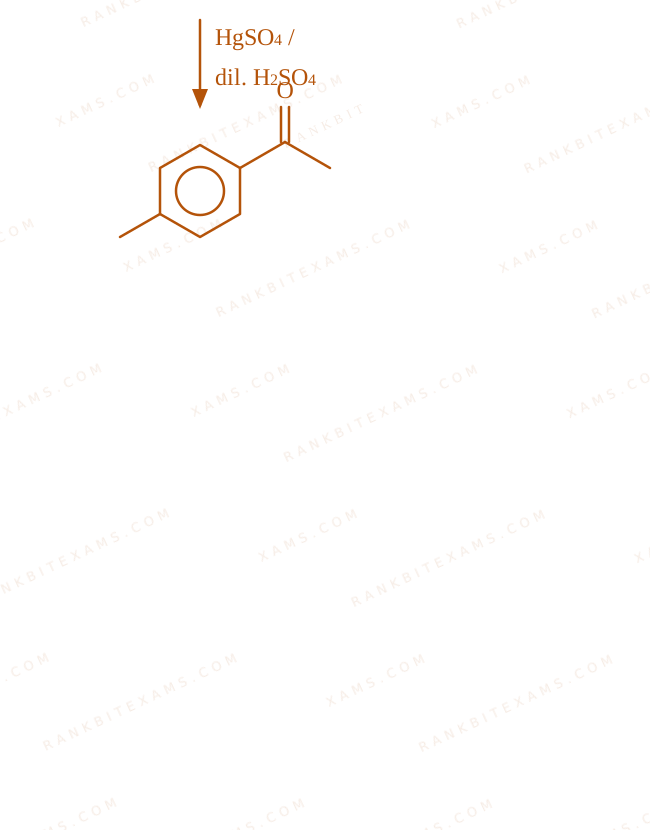
Gem/Vicinal Dibromide [P] excess NaNH₂ Terminal Alkyne [Q] [dil. H₂SO₄]HgSO₄ Methyl Ketone [R]
Core Logic

Step 1: Compound [R] gives positive Iodoform test and negative Tollen's test [R] is a methyl ketone (acetophenone derivative, Ph-CO-CH₃).

Step 2: Hydration of alkyne [Q] gives methyl ketone [R] [Q] is phenylacetylene (Ph-C).

Step 3: Double elimination of [P] using excess NaNH₂ gives phenylacetylene [Q] [P] is geminal dibromide 1,1-dibromo-1-phenylethane (Ph-C(Br)₂CH₃).

Reaction flow of dibromo compound to methyl ketone for Q70 - JEE Main 2026 Evening

Pattern Recognition

Sees: Positive iodoform + negative Tollen's methyl ketone. Shortcut: Oxymercuration of terminal alkyne yields methyl ketone, identifying gem-dibromide at benzylic position.

Chapter Mix

Class 12 Chemistry: Haloalkanes and Haloarenes Class 12 Chemistry: Aldehydes, Ketones and Carboxylic Acids
Q74 jee_main_2026_23_january_morning Structural Isomerism and Optical Activity
Consider all the structural isomers with molecular formula C₅H₁₁Br are separately treated with KOH (aq) to give respective substitution products, without any rearrangement. The number of products which can exhibit optical isomerism from these is ____.
Numerical Answer. Answer: 3 to 3

Solution

Core Logic

First, identify all structural isomers of C₅H₁₁Br. Aqueous KOH will simply replace the -Br with an -OH group via nucleophilic substitution without rearrangement. Then, check which of the resulting C₅H₁₁OH products possess a chiral center.

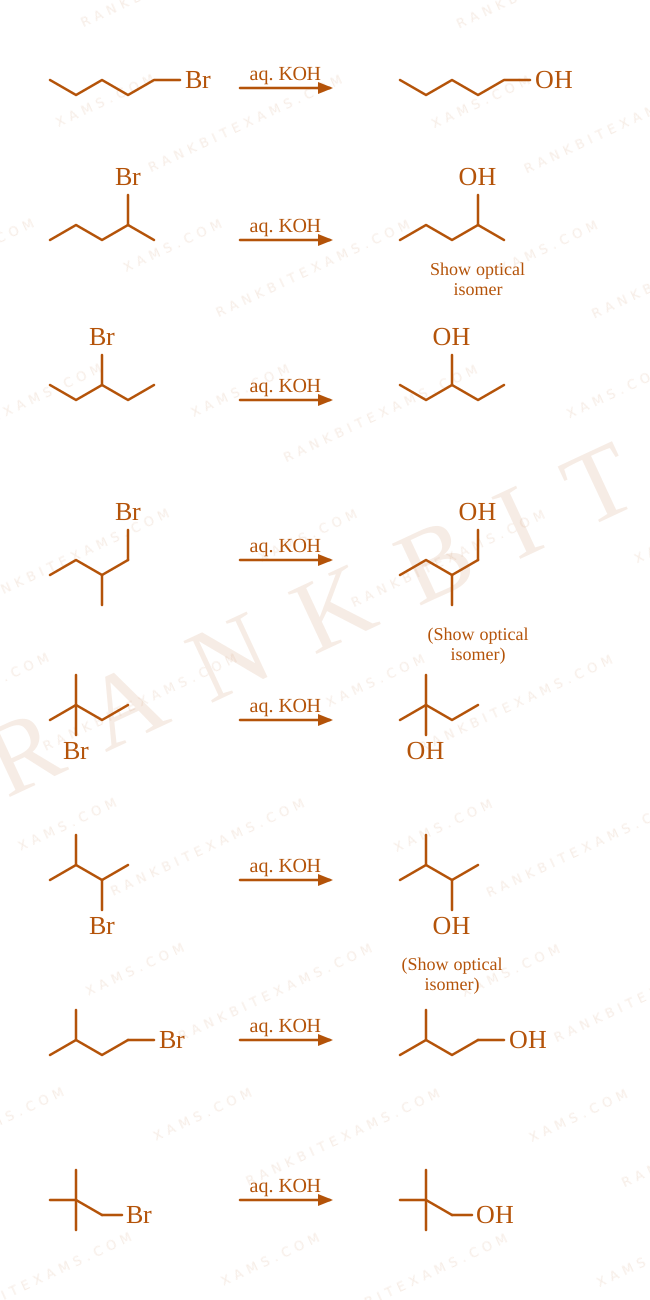
Structural Isomerism and Optical Activity diagram for Q74 - JEE Main 2026 Morning

Step 1: Structural Isomers and Products

Pentyl skeleton isomers:

  • n-pentyl: 1-bromopentane arrow 1-pentanol (Achiral), 2-bromopentane arrow 2-pentanol (Chiral), 3-bromopentane arrow 3-pentanol (Achiral).
  • Isopentyl skeleton: 1-bromo-3-methylbutane arrow 3-methylbutan-1-ol (Achiral), 2-bromo-3-methylbutane arrow 3-methylbutan-2-ol (Chiral), 2-bromo-2-methylbutane arrow 2-methylbutan-2-ol (Achiral), 1-bromo-2-methylbutane arrow 2-methylbutan-1-ol (Chiral).
  • Neopentyl skeleton: 1-bromo-2,2-dimethylpropane arrow 2,2-dimethylpropan-1-ol (Achiral).
Step 2: Counting Optically Active Products

The products exhibiting optical isomerism are:

  • 2-pentanol
  • 3-methylbutan-2-ol
  • 2-methylbutan-1-ol
  • Total structurally distinct products exhibiting optical isomerism is 3.

Pattern Recognition

To quickly spot a chiral center in a standard alkane chain, look for a carbon bonded to -OH, -H, a methyl group, and a longer alkyl chain. Any symmetry kills chirality (like 3-pentanol).

Chapter Mix

Class 12 Chemistry: Haloalkanes and Haloarenes Class 12 Chemistry: Alcohols Phenols and Ethers Class 11 Chemistry: Organic Chemistry Some Basic Principles and Techniques

Q61 jee_main_2026_24_january_morning Nomenclature of Haloalkanes
Match the List-I with List-II
List-I (Chloro derivative)List-II (Example)
A. Vinyl ChlorideI. CH₂=CH-CH₂Cl
B. Benzyl chlorideII. CH₃-CH(Cl)CH₃
C. Alkyl chlorideIII. CH₂=CHCl
D. Allyl chlorideIV.
Benzyl chloride structure
Structure IV shows a benzene ring attached to a CH2Cl group.
Choose the correct answer from the options given below :
  • A. A-IV, B-I, C-III, D-II
  • B. A-III, B-IV, C-I, D-II
  • C. A-III, B-IV, C-II, D-I
  • D. A-I, B-II, C-IV, D-III

Solution

Core Logic

(A) Vinyl Chloride is a haloalkene where chlorine is directly attached to the sp² carbon of a double bond: CH₂=CHCl. So, A matches with III. (B) Benzyl chloride is a compound where chlorine is attached to an sp³ hybridized carbon directly linked to a benzene ring (C₆H₅CH₂Cl). Structure IV represents this. So, B matches with IV. (C) Alkyl chloride represents a standard saturated aliphatic chain attached to a chlorine atom, such as isopropyl chloride: CH₃-CH(Cl)CH₃. So, C matches with II. (D) Allyl chloride features a chlorine attached to an sp³ carbon that is adjacent to a carbon-carbon double bond: CH₂=CH-CH₂Cl. So, D matches with I.

Step 1: Final Conclusion

The correctly matched pairs are A-III, B-IV, C-II, D-I.

Pattern Recognition

Vinyl = directly on double bond. Allyl = one carbon away from double bond. Benzyl = one carbon away from phenyl ring.

Chapter Mix

Class 12 Chemistry: Haloalkanes and Haloarenes
Q67 jee_main_2026_24_january_morning Stereochemistry and Bond Strength
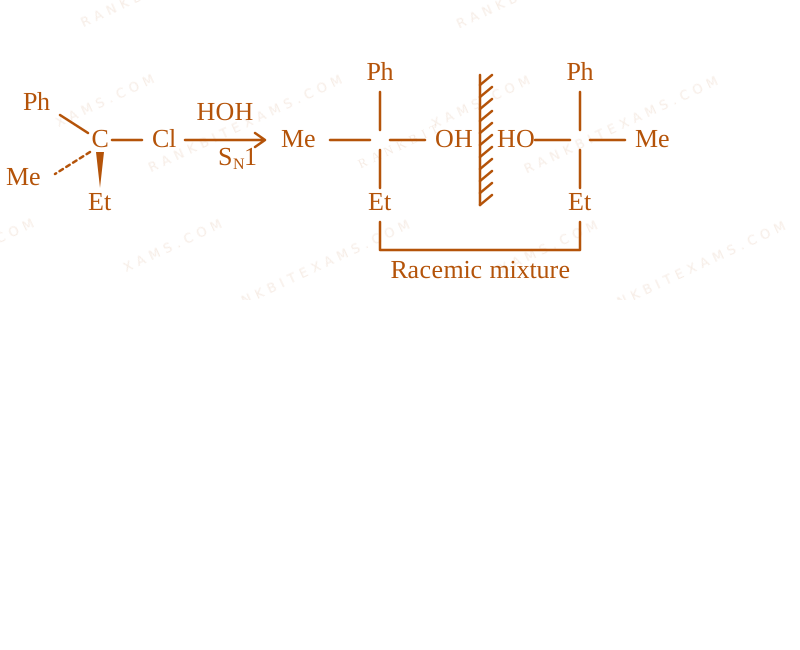
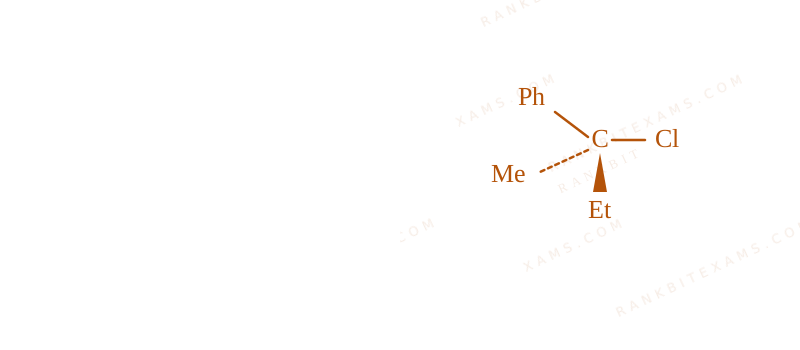
Given below are two statements: Statement I : C-Cl bond is stronger in CH₂=CH-Cl than CH₃-CH₂-Cl Statement II : The given optically active molecule,
Optically active alkyl chloride molecule
A chiral tertiary alkyl chloride with Phenyl, Methyl, Ethyl and Chloro groups attached to the central carbon.
on hydrolysis gives a solution that can rotate the plane polarized light. In the light of the above statements, choose the correct answer from the options given below
  • A. Statement I is false but Statement II is true
  • B. Both Statement I and Statement II are true
  • C. Both Statement I and Statement II are false
  • D. Statement I is true but Statement II is false

Solution

Core Logic

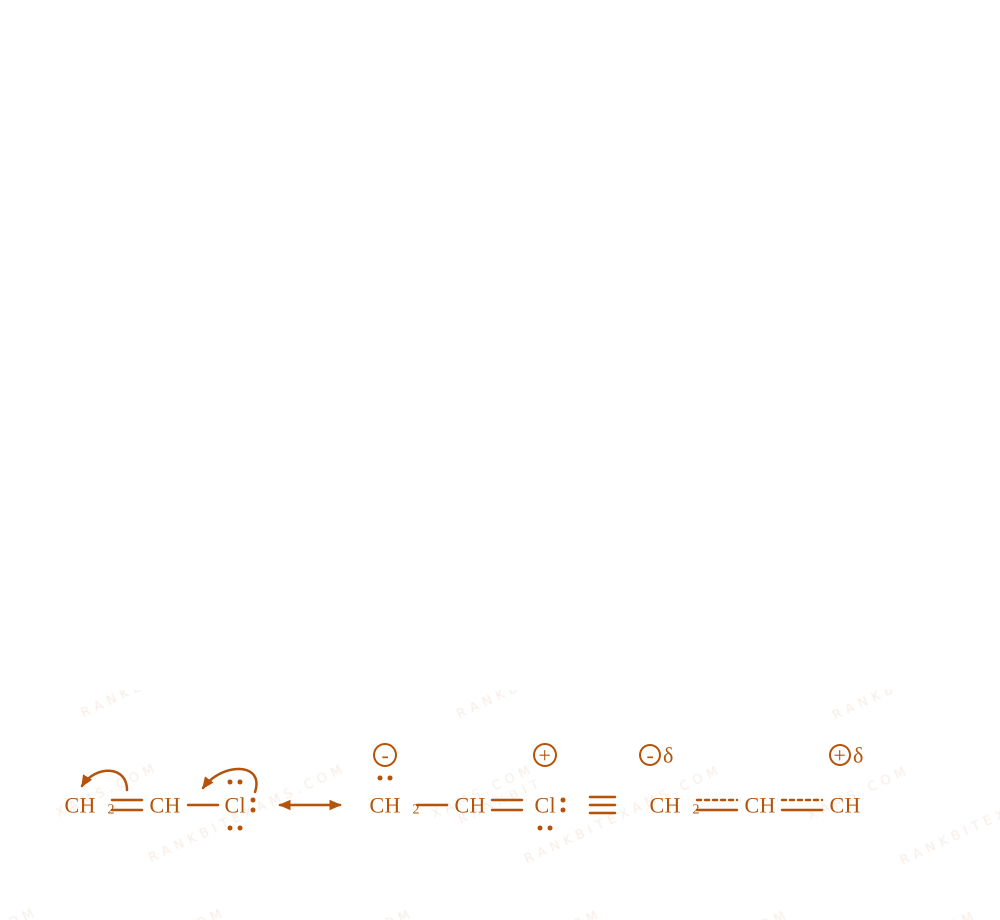
Statement I: CH₂=CH-Cl is vinyl chloride. The lone pair on chlorine participates in resonance with the adjacent double bond. This imparts a partial double bond character to the C-Cl bond, making it shorter and stronger than the pure single C-Cl bond in CH₃-CH₂-Cl (ethyl chloride).

Resonance in vinyl chloride
A chiral tertiary alkyl chloride with Phenyl, Methyl, Ethyl and Chloro groups attached to the central carbon.
Thus, Statement I is true.

Statement II: The given molecule is a chiral, tertiary alkyl chloride. When it undergoes hydrolysis, it follows an SN1 mechanism because the resulting tertiary carbocation (stabilized by resonance from the phenyl ring and hyperconjugation) is very stable. An SN1 reaction proceeds through a planar carbocation intermediate. Attack by water occurs from both faces with near equal probability, resulting in a racemic mixture.

Resonance in vinyl chloride
A chiral tertiary alkyl chloride with Phenyl, Methyl, Ethyl and Chloro groups attached to the central carbon.
A racemic mixture is optically inactive; it cannot rotate plane-polarized light. Therefore, Statement II is false.

Step 1: Final Conclusion

Statement I is true but Statement II is false.

Pattern Recognition

Vinyl and aryl halides have partial double bond character due to resonance. SN1 at a chiral center leads to racemization (optically inactive product mix).

Chapter Mix

Class 12 Chemistry: Haloalkanes and Haloarenes Class 11 Chemistry: Organic Chemistry - Some Basic Principles and Techniques
More Haloalkanes and Haloarenes Questions — jee_main_2025_28_jan_morning

Practice all Haloalkanes and Haloarenes previous-year questions →

Rankbit System
JEE Physics: Waves (+15.5%) | Electrostatics: Concentric Shells (-29.7%) | Modern Physics: Photoelectric Clones (+34.2%) | Mathematics: Definite Integrals (+18.1%) | Chemistry: Coordination Splitting (-11.4%) | JEE Physics: Waves (+15.5%) | Electrostatics: Concentric Shells (-29.7%) | Modern Physics: Photoelectric Clones (+34.2%) | Mathematics: Definite Integrals (+18.1%) | Chemistry: Coordination Splitting (-11.4%)