JEE Main · Chemistry ↑ Rising

Amines appeared 39 times across 3 years — 4.5% of Chemistry. This question is from Yield and Stoichiometric Calculations.

Year 2026 2025 2024 Total
Questions 16 14 9 39

Consider the following sequence of reactions :
Reaction flow pathway for Q49 - JEE Main 2025 Morning
The flowchart tracks a chemical conversion starting from chlorobenzene down to final compound B.
11.25 mg of chlorobenzene will produce x × 10⁻¹ mg of product B. (Consider the reactions result in complete conversion.) [Given molar mass of C, H, O, N and Cl as 12, 1, 16, 14 and 35.5g mol⁻¹ respectively]

Numerical Answer Type:
Enter a numerical value Answer: 93 to 93 +4 marks

Solution & Explanation

Core Logic

The reaction sequence details the functional conversion of chlorobenzene down to product B (aniline, with a molar mass of 93 g mol⁻¹). Following stoichiometric preservation:

moles of chlorobenzene = moles of Aniline (B)

Molar mass of chlorobenzene (C₆H₅Cl) = 112.5 g mol⁻¹.

Molar stoichiometry relation graph for Q49 - JEE Main 2025 Morning
The flowchart tracks a chemical conversion starting from chlorobenzene down to final compound B.

moles = 11.25 × 10⁻³ g112.5 g mol⁻¹ = 10⁻⁴ mol

Mass of product B produced:

Mass = 10⁻⁴ mol × 93 g mol⁻¹ = 9.3 × 10⁻³ g = 9.3 mg

Expressing in the specified format:

9.3 mg = 93 × 10⁻¹ mg ⇒ x = 93
Pattern Recognition

Sees: Conversion sequence preserving a 1:1 mole ratio layout. Shortcut: Directly compute target weight via WB = WA · (MB)/(MA) = 11.25 · (93)/(112.5) = 9.3.

Chapter Mix

Class 12 Chemistry: Amines

Reference Study Guides

More Amines Previous-Year Questions — Page 4

Q66 jee_main_2026_28_january_evening Hinsberg Test
Total number of alkali insoluble solid sulphonamides obtained by reaction of given amines with Hinsberg's reagent is ..... Aniline, N-Methylaniline, Methanamine, N, N-Dimethylmethanamine, N-Methyl methanamine, Phenylmethanamine, N-propylaniline, N-phenylaniline, N, N-Dimethylaniline, Allyl amine, Isopropyl amine
  • A. (1) 4
  • B. (2) 2
  • C. (3) 8
  • D. (4) 5

Solution

Core Logic

Hinsberg reagent (Benzenesulfonyl chloride) reacts with: 1° Amines arrow Forms sulfonamide which is SOLUBLE in alkali. 2° Amines arrow Forms sulfonamide which is INSOLUBLE in alkali. 3° Amines arrow Do not react.

We need to find the total number of 2° amines from the list.

  • Aniline arrow 1°
  • N-Methylaniline arrow 2° (Reacts, insoluble) ✓
  • Methanamine arrow 1°
  • N, N-Dimethylmethanamine arrow 3°
  • N-Methyl methanamine arrow 2° (Reacts, insoluble) ✓
  • Phenylmethanamine arrow 1°
  • N-propylaniline arrow 2° (Reacts, insoluble) ✓
  • N-phenylaniline arrow 2° (Reacts, insoluble) ✓
  • N, N-Dimethylaniline arrow 3°
  • Allyl amine arrow 1°
  • Isopropyl amine arrow 1°
Step 1: Final Conclusion

There are exactly 4 secondary amines: N-Methylaniline, N-Methyl methanamine, N-propylaniline, and N-phenylaniline.

Pattern Recognition

Alkali insoluble sulfonamide = strictly Secondary Amine. Alkali soluble = Primary Amine.

Chapter Mix

Class 12 Chemistry: Amines
Q jee_main_2025_02_april_evening Diazotisation and Coupling Reactions
When a concentrated solution of sulphanilic acid and 1-naphthylamine is treated with nitrous acid (273 K) and acidified with acetic acid, the mass (g) of 0.1 mole of product formed is : Given molar mass in g~mol⁻¹ H:1, C:12, N:14, O:16, S:32
  • A. 343
  • B. 330
  • C. 33
  • D. 66

Solution

Related Formula
Mass (g) = Number of moles × Molar mass ( g~mol⁻¹)
Core Logic

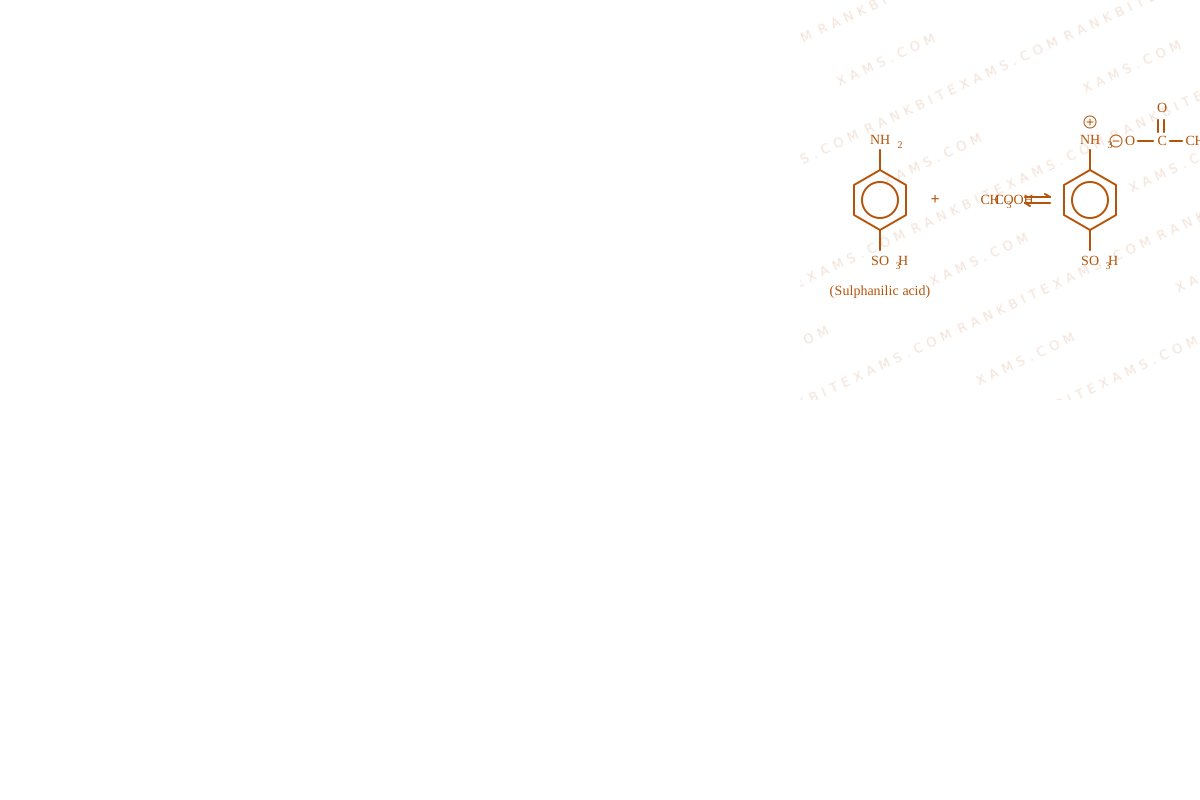
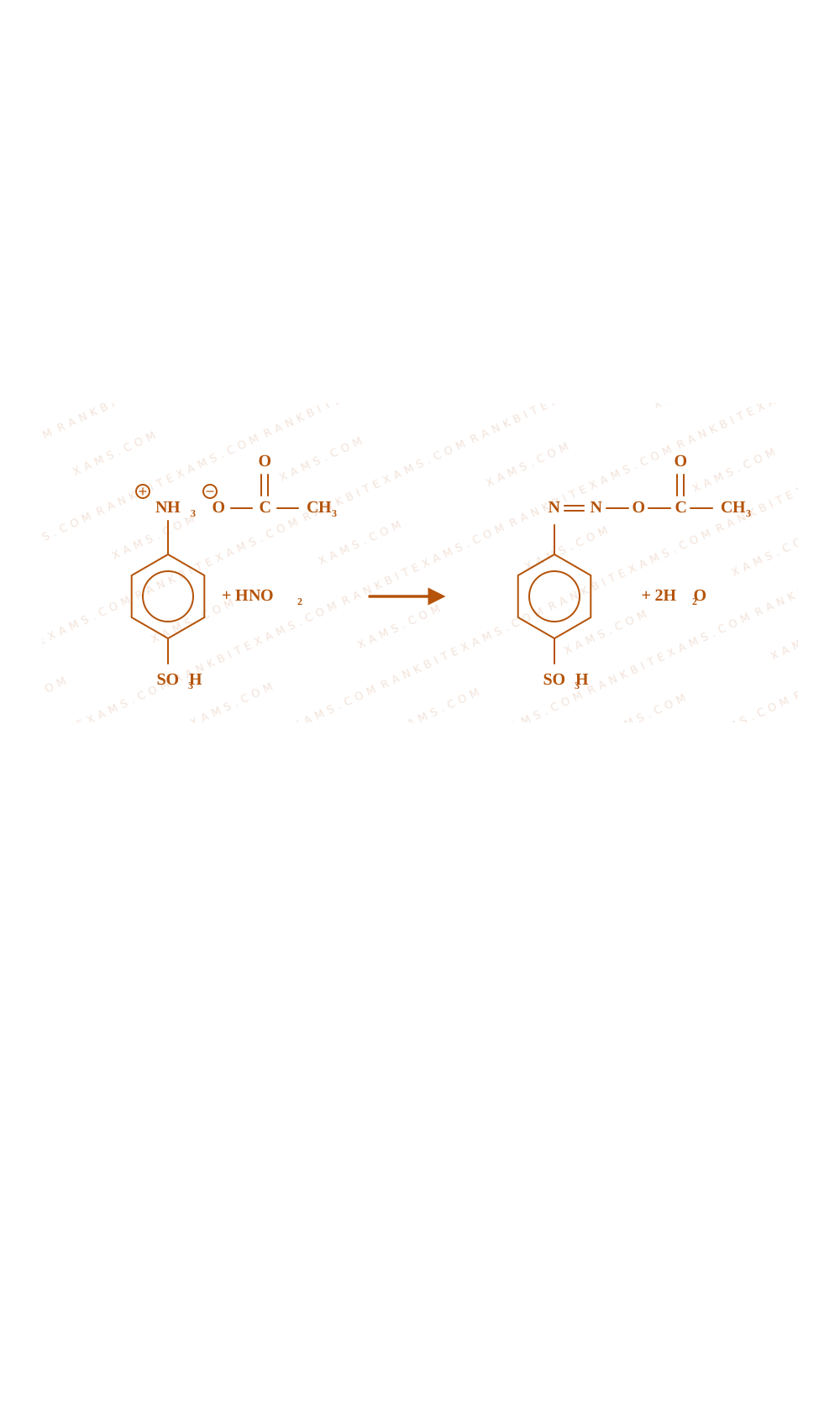
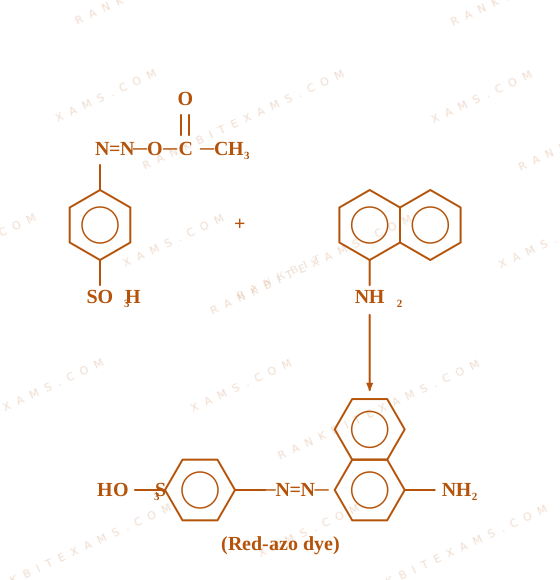
Sulphanilic acid is diazotized under cold conditions (273~K) with nitrous acid to form a diazonium salt intermediate. This diazonium salt undergoes a coupling reaction with 1-naphthylamine to form a red azo dye.

First, sulphanilic acid acts as a zwitterion and undergoes diazotization:

Azo-dye synthesis reaction from diazotized sulphanilic acid and 1-naphthylamine

Nitrous acid reacts with the amine to form the diazonium compound:

Azo-dye synthesis reaction from diazotized sulphanilic acid and 1-naphthylamine

This intermediate couples with 1-naphthylamine at the para-position to give the red azo dye compound:

Azo-dye synthesis reaction from diazotized sulphanilic acid and 1-naphthylamine

Step 1: Calculate the Molar Mass

The molecular formula of the red-azo dye formed is C₁₆H₁₃N₃O₃S. Let's calculate its molar mass using the given atomic masses:

Molar mass = 16(12) + 13(1) + 3(14) + 3(16) + 32 Molar mass = 192 + 13 + 42 + 48 + 32 = 327~ g~mol⁻¹
Step 2: Calculate the Mass of 0.1 Mole

Using the relation for mass:

Mass of 0.1~mole = 0.1 × 327 = 32.7~g ≈ 33~g

Hence, the nearest option is 33~g.

Pattern Recognition

Azo coupling reactions are clean electrophilic aromatic substitution reactions. Diazotized sulphanilic acid has a highly electron-withdrawing sulphonic acid group, making it an excellent electrophile that couples selectively at the para-position of 1-naphthylamine.

Chapter Mix

Class 12 Chemistry: Amines
Q38 jee_main_2025_02_april_morning Basic Strength of Amines
The correct order of basic nature on aqueous solution for the bases NH₃, H₂N-NH₂, CH₃CH₂NH₂, (CH₃CH₂)₂NH and (CH₃CH₂)₃N is:
  • A. (1) NH₃ < H₂N - NH₂ < (CH₃CH₂)₃N < CH₃CH₂NH₂ < (CH₃CH₂)₂NH
  • B. (2) NH₃ < H₂N - NH₂ < CH₃CH₂NH₂ < (CH₃CH₂)₂NH < (CH₃CH₂)₃N
  • C. (3) H₂N - NH₂ < NH₃ < (CH₃CH₂)₃N < CH₃CH₂NH₂ < (CH₃CH₂)₂NH
  • D. (4) NH₂ - NH₂ < NH₃ < CH₃CH₂NH₂ < (CH₃CH₂)₃N < (CH₃CH₂)₂NH

Solution

Related Formula

Basic strength in aqueous medium depends on three combined effects:

Basic Strength ∝ Inductive Effect (+I) + Solvation Energy - Steric Hindrance
Core Logic

Let's list structural elements row-by-row:

  • Ethyl substituted amine trends in aqueous systems uniquely align into a 2° > 3° > 1° configuration due to competing steric and hydration energies:
(Et)₂NH > (Et)₃N > EtNH₂
  • Ammonia (NH₃) is less basic than aliphatic substituted structures due to the absence of electron-donating alkyl clusters.
  • Hydrazine (H₂N-NH₂) is exceptionally weak compared to ammonia because the adjacent electronegative nitrogen creates an electron-withdrawing (-I) effect, while lone-pair repulsions reduce overall stability.
Step 1: Ordering

Assembling the fragments gives the complete verified thermodynamic order:

NH₂-NH₂ < NH₃ < CH₃CH₂NH₂ < (CH₃CH₂)₃N < (CH₃CH₂)₂NH
Pattern Recognition

Remember the standard numeric rules for aliphatic basic strength order in aqueous media:

  • Methyl amines follow: 213
  • Ethyl amines follow: 231
  • This simple sequence trick handles complex ranking items instantly.

Chapter Mix

Class 12 Chemistry: Amines
Q jee_main_2025_03_april_evening Aniline Reactions and Directing Effects
The sequence from the following that would result in giving predominantly 3, 4, 5-Tribromoaniline is :
  • A.
  • B.
  • C.
  • D.

Solution

Related Formula

Directing effects in multi-substituted benzenes:

  • -NH₂ is a strong activating group and ortho/para director.
  • -NO₂ is a strong deactivating, meta-directing group.
  • Diazotization followed by Sandmeyer reaction replaces an -NH₂ group with a halogen.
Core Logic

To prepare 3,4,5-tribromoaniline, we must introduce three bromine atoms adjacent to each other (meta to the final amino group, with one para and two meta). Let's trace the sequence in Option (3) starting from 4-nitroaniline (p-nitroaniline):

Step 1: Bromination of p-nitroaniline

Treatment of 4-nitroaniline with excess Br₂ in acetic acid:

  • The amino group (-NH₂) is a strong activator and directs to its ortho positions (positions 2 and 6).
  • Positions 2 and 6 are meta to the -NO₂ group, which is compatible.
  • This yields 2,6-dibromo-4-nitroaniline.
Step 2: Diazotization and replacement of amino group
  • NaNO₂ + HCl diazotizes the amino group to a diazonium salt:
R-NH₂ arrow R-N₂^+ Cl^-
  • Addition of CuBr (Sandmeyer reaction) replaces the diazonium group with bromine:
R-N₂^+ Cl^- CuBr R-Br

This yields 3,4,5-tribromonitrobenzene.

Step 3: Reduction of nitro group

Reduction of the nitro group using Sn/HCl converts -NO₂ to -NH₂:

R-NO₂ Sn, HCl R-NH₂

This yields 3,4,5-tribromoaniline as the predominant product. Thus, Option (3) is correct.

Pattern Recognition

To brominate meta positions relative to an amino group, use a nitro precursor at the para position. The -NH₂ group activates these positions first, after which the initial amino group is replaced with a halogen, and the nitro group is subsequently reduced back to a primary amine.

Chapter Mix

Class 12 Chemistry: Amines
Q jee_main_2025_07_april_morning Carbylamine Reaction
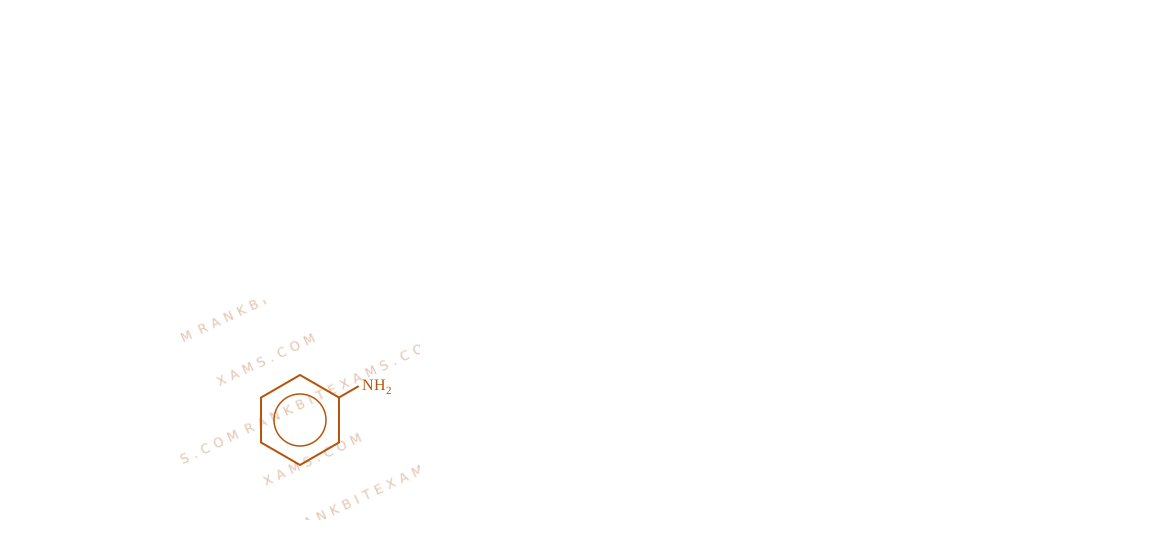
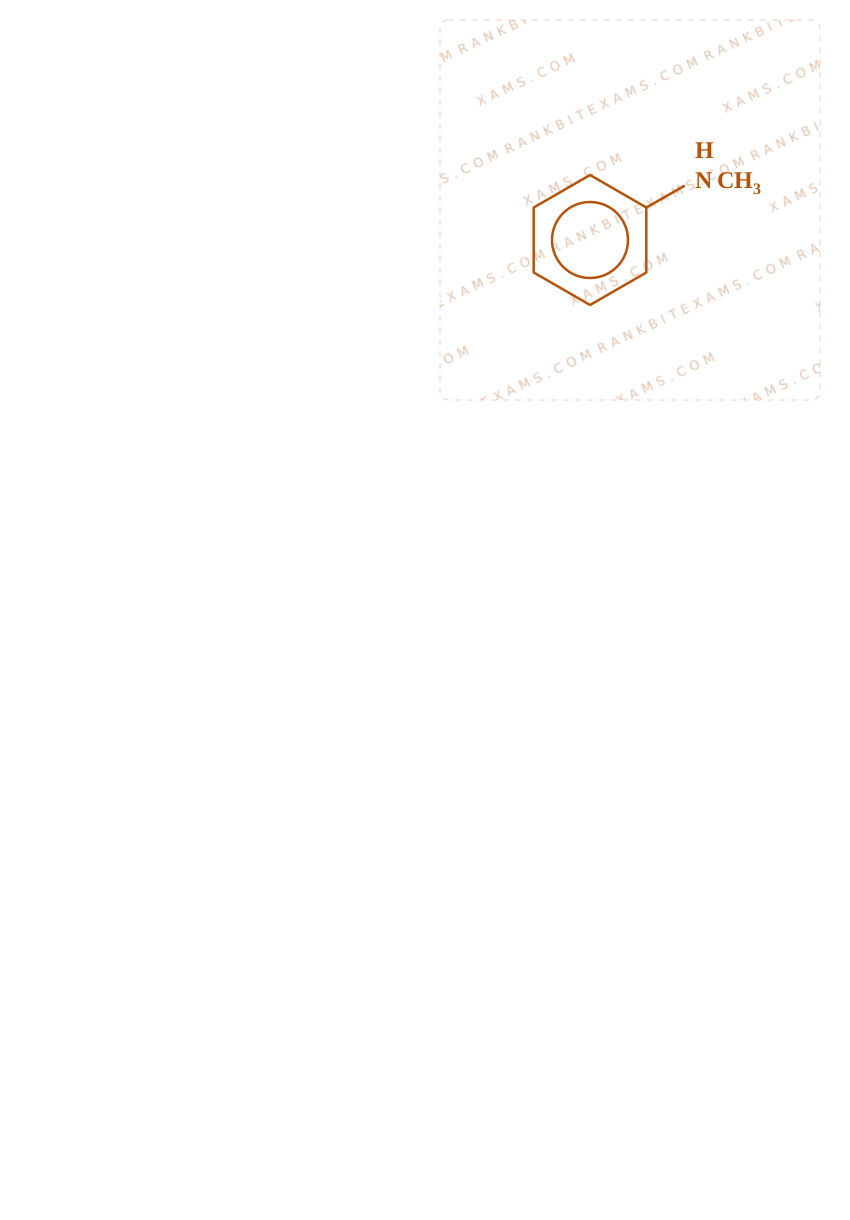
Which of the following amine(s) show(s) positive carbylamine test? A.
Carbylamine reactant aniline diagram for Q27 - JEE Main 2025
The structures depict Aniline (A) and N-Methylaniline (E) to distinguish primary and secondary aromatic amines.
B. (CH₃)₂NH C. CH₃NH₂ D. (CH₃)₃N E.
Carbylamine reactant aniline diagram for Q27 - JEE Main 2025
The structures depict Aniline (A) and N-Methylaniline (E) to distinguish primary and secondary aromatic amines.
Choose the correct answer from the options given below:
  • A. A and E Only
  • B. C Only
  • C. A and C Only
  • D. B, C and D Only

Solution

Related Formula
R-NH₂ + CHCl₃ + 3KOH arrow R-NC + 3KCl + 3H₂O
Core Logic

Only primary (1^°) aliphatic and aromatic amines yield a positive carbylamine test (forming foul-smelling alkyl/aryl isocyanides).

  • A is Aniline (primary aromatic amine) arrow Positive
  • B is Dimethylamine (secondary aliphatic amine) arrow Negative
  • C is Methylamine (primary aliphatic amine) arrow Positive
  • D is Trimethylamine (tertiary aliphatic amine) arrow Negative
  • E is N-Methylaniline (secondary aromatic amine) arrow Negative
  • Thus, only A and C show a positive test.

Pattern Recognition

Shortcut: Look directly for any amine with a plain -NH₂ functional group. Secondary (-NH-) and tertiary (-N-) amines never react.

Chapter Mix

Class 12 Chemistry: Amines
More Amines Questions — jee_main_2025_28_jan_morning

Practice all Amines previous-year questions →

Rankbit System
JEE Physics: Waves (+15.5%) | Electrostatics: Concentric Shells (-29.7%) | Modern Physics: Photoelectric Clones (+34.2%) | Mathematics: Definite Integrals (+18.1%) | Chemistry: Coordination Splitting (-11.4%) | JEE Physics: Waves (+15.5%) | Electrostatics: Concentric Shells (-29.7%) | Modern Physics: Photoelectric Clones (+34.2%) | Mathematics: Definite Integrals (+18.1%) | Chemistry: Coordination Splitting (-11.4%)
