JEE Main · Chemistry ↑ Rising

Amines appeared 39 times across 3 years — 4.5% of Chemistry. This question is from Yield and Stoichiometric Calculations.

Year 2026 2025 2024 Total
Questions 16 14 9 39

Consider the following sequence of reactions :
Reaction flow pathway for Q49 - JEE Main 2025 Morning
The flowchart tracks a chemical conversion starting from chlorobenzene down to final compound B.
11.25 mg of chlorobenzene will produce x × 10⁻¹ mg of product B. (Consider the reactions result in complete conversion.) [Given molar mass of C, H, O, N and Cl as 12, 1, 16, 14 and 35.5g mol⁻¹ respectively]

Numerical Answer Type:
Enter a numerical value Answer: 93 to 93 +4 marks

Solution & Explanation

Core Logic

The reaction sequence details the functional conversion of chlorobenzene down to product B (aniline, with a molar mass of 93 g mol⁻¹). Following stoichiometric preservation:

moles of chlorobenzene = moles of Aniline (B)

Molar mass of chlorobenzene (C₆H₅Cl) = 112.5 g mol⁻¹.

Molar stoichiometry relation graph for Q49 - JEE Main 2025 Morning
The flowchart tracks a chemical conversion starting from chlorobenzene down to final compound B.

moles = 11.25 × 10⁻³ g112.5 g mol⁻¹ = 10⁻⁴ mol

Mass of product B produced:

Mass = 10⁻⁴ mol × 93 g mol⁻¹ = 9.3 × 10⁻³ g = 9.3 mg

Expressing in the specified format:

9.3 mg = 93 × 10⁻¹ mg ⇒ x = 93
Pattern Recognition

Sees: Conversion sequence preserving a 1:1 mole ratio layout. Shortcut: Directly compute target weight via WB = WA · (MB)/(MA) = 11.25 · (93)/(112.5) = 9.3.

Chapter Mix

Class 12 Chemistry: Amines

Reference Study Guides

More Amines Previous-Year Questions — Page 5

Q jee_main_2025_08_april_evening Functional Group Analysis and Identification
An organic compound 'A' undergoes the following sequence of transformations: 'A' [(ii) H₃O^+](i) NaOH 'B' [(ii) H₂SO₄, Δ](i) EtOH 'C' * 'A' shows a positive Lassaigne's test for nitrogen and its molar mass is 121 g mol⁻¹. * 'B' gives effervescence with aqueous NaHCO₃. * 'C' gives a characteristic fruity smell. Identify A, B, and C from the options below:
  • A.
  • B.
  • C.
  • D.

Solution

Core Logic

Let's perform a step-by-step diagnostic analysis:

  • Molar Mass & Nitrogen Test: Compound 'A' has a nitrogen atom and a molar mass of 121 g mol⁻¹. Let's verify Benzamide (C₆H₅CONH₂):
Mass = (7 × 12) + (7 × 1) + 14 + 16 = 84 + 7 + 14 + 16 = 121 g mol⁻¹

This matches perfectly.

  • Alkaline Hydrolysis: Hydrolysis of benzamide under basic conditions yields benzoic acid upon acidification:
C₆H₅CONH₂ [H₃O^+]NaOH C₆H₅COOH (Compound B) + NH₃

Benzoic acid reactively gives effervescence with NaHCO₃ due to the liberation of CO₂ gas.

  • Esterification: Reaction of benzoic acid with ethanol in the presence of acid catalyst results in the creation of ethyl benzoate, an ester with a pleasant fruity smell:
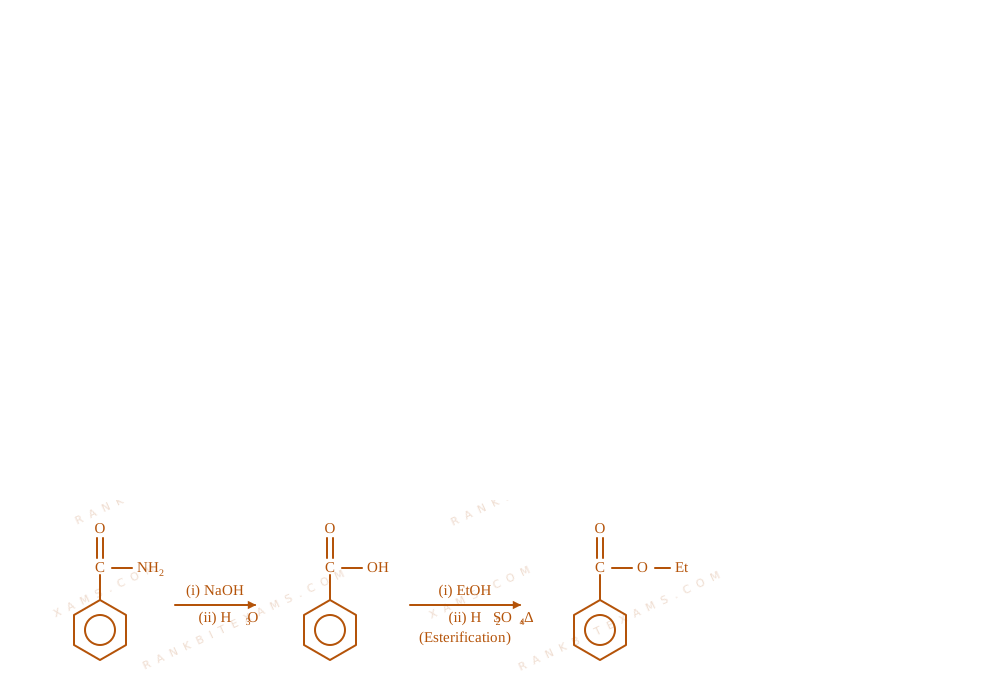
C₆H₅COOH + EtOH H₂SO₄, Δ C₆H₅COOEt (Compound C) + H₂O

Esterification reaction mechanism diagram for Q28

Pattern Recognition

"Fruity smell" is an absolute indicator for an ester product. "Effervescence with NaHCO₃" dictates a carboxylic acid intermediate. Basic hydrolysis converting an organo-nitrogen compound into an acid points directly to an amide or a nitrile—molar mass calculation establishes benzamide over benzonitrile (M = 103).

Chapter Mix

Class 12 Chemistry: Amines Class 12 Chemistry: Aldehydes, Ketones and Carboxylic Acids

Q41 jee_main_2025_29_jan_evening Diazotization and Coupling Reactions
Which one of the following reaction sequences will give an azo dye? (1) Nitrobenzene treated with (i) Sn/HCl, (ii) NaNO₂/HCl, (iii) β-naphthol, NaOH (2) Benzenesulfonic acid treated with (i) SOCl₂, (ii) NH₃, (iii) Benzyl chloride (3) Benzonitrile treated with (i) 70% H₂SO₄, (ii) PCl₅, (iii) Aniline (4) Aniline treated with (i) HCl/NaNO₂, (ii) Toluene
  • A. Reaction sequence (1)
  • B. Reaction sequence (2)
  • C. Reaction sequence (3)
  • D. Reaction sequence (4)

Solution

Core Logic

Let's track sequence (1):

  • Nitrobenzene (Ph-NO₂) is reduced using Sn/HCl to form Aniline (Ph-NH₂).
  • Aniline undergoing diazotization with NaNO₂/HCl at cold temperatures (0-5circC) creates Benzene diazonium chloride (Ph-N₂⁺Cl⁻).
  • The diazonium salt undergoes a coupling reaction with β-naphthol in alkaline conditions (NaOH) to synthesize a highly vibrant red-orange azo dye.
  • Diazotization and Coupling Reactions diagram for Q41 - JEE Main 2025 Evening
    Diazotization and Coupling Reactions diagram for Q41 - JEE Main 2025 Evening

Pattern Recognition

The standard sequence for azo dye preparation is: Aromatic Nitro arrow Primary Amine arrow Diazonium Salt arrow Phenol/Naphthol Coupling.

Chapter Mix

Class 12 Chemistry: Amines

Q jee_main_2025_03_april_morning Diazonium Salts and Reactions
Identify [A], [B], and [C], respectively in the following reaction sequence:
Organic aromatic reaction sequence diagram for Q37 - JEE Main 2025 Morning
The reaction shows Aniline reacting with sodium nitrite and hydrochloric acid to produce intermediate A, followed by treatment with potassium iodide to yield B, which then dimerizes via sodium in dry ether to form C.
Organic aromatic reaction sequence diagram for Q37 - JEE Main 2025 Morning
The reaction shows Aniline reacting with sodium nitrite and hydrochloric acid to produce intermediate A, followed by treatment with potassium iodide to yield B, which then dimerizes via sodium in dry ether to form C.
  • A.
  • B.
  • C.
  • D.

Solution

Core Logic

Let us resolve each structural step sequentially:

  • Step 1: Aniline undergoes diazotization when treated with NaNO₂ + HCl at 273-278 K, forming benzene diazonium chloride [A] (C₆H₅N₂^+Cl^-).
  • Step 2: Warming benzene diazonium chloride with potassium iodide (KI) substitutes the diazonium group with iodine, producing iodobenzene [B] (C₆H₅I).
  • Step 3: Treating iodobenzene with sodium metal in dry ether causes a Fittig coupling reaction, dimerizing two phenyl radicals into biphenyl [C] (C₆H₅-C₆H₅).
    Structural reaction verification mechanism for Q37 - JEE Main 2025 Morning
    The reaction shows Aniline reacting with sodium nitrite and hydrochloric acid to produce intermediate A, followed by treatment with potassium iodide to yield B, which then dimerizes via sodium in dry ether to form C.
    Structural reaction verification mechanism for Q37 - JEE Main 2025 Morning
    The reaction shows Aniline reacting with sodium nitrite and hydrochloric acid to produce intermediate A, followed by treatment with potassium iodide to yield B, which then dimerizes via sodium in dry ether to form C.
Pattern Recognition

Shortcut: Aniline arrow NaNO₂/HCl arrow Diazonium salt arrow KI arrow Iodobenzene. The final sodium metal treatment triggers a symmetrical radical dimer homocoupling (Fittig reaction) to yield a biphenyl product.

Evaluation Rubric / Model Answer

Option (C)

Chapter Mix

Class 12 Chemistry: Amines Class 12 Chemistry: Haloalkanes and Haloarenes

Q jee_main_2025_03_april_morning Reactions of Diazonium Salts
In the following reactions, which one is NOT correct?
  • A.
  • B.
  • C.
  • D.

Solution

Core Logic

When benzene diazonium chloride is treated with ethanol (CH₃CH₂OH), it undergoes a reduction reaction (deamination). Ethanol acts as a reducing agent and gets oxidized to ethanal (CH₃CHO), while the diazonium group is replaced by hydrogen to yield pure benzene, not phenetole (ethoxybenzene).

Deamination chemical verification scheme for Q38 - JEE Main 2025 Morning

Step 1: Review of Alternative Choices

Reactions (2), (3), and (4) show standard correct transformations: hypophosphorous acid reduction to benzene, potassium iodide substitution to iodobenzene, and cuprous cyanide substitution to benzonitrile.

Pattern Recognition

Shortcut: Remember that H₃PO₂ and CH₃CH₂OH are standard classic reducing agents that reduce ArN₂^+Cl^- directly down to ArH (benzene). They do not undergo nucleophilic ether substitution paths.

Chapter Mix

Class 12 Chemistry: Amines

More Amines Questions — jee_main_2025_28_jan_morning

Practice all Amines previous-year questions →

Rankbit System
JEE Physics: Waves (+15.5%) | Electrostatics: Concentric Shells (-29.7%) | Modern Physics: Photoelectric Clones (+34.2%) | Mathematics: Definite Integrals (+18.1%) | Chemistry: Coordination Splitting (-11.4%) | JEE Physics: Waves (+15.5%) | Electrostatics: Concentric Shells (-29.7%) | Modern Physics: Photoelectric Clones (+34.2%) | Mathematics: Definite Integrals (+18.1%) | Chemistry: Coordination Splitting (-11.4%)
