Identify correct statements:
(A) Primary amines do not give diazonium salts when treated with NaNO₃$NaNO_{3}$ in acidic condition.
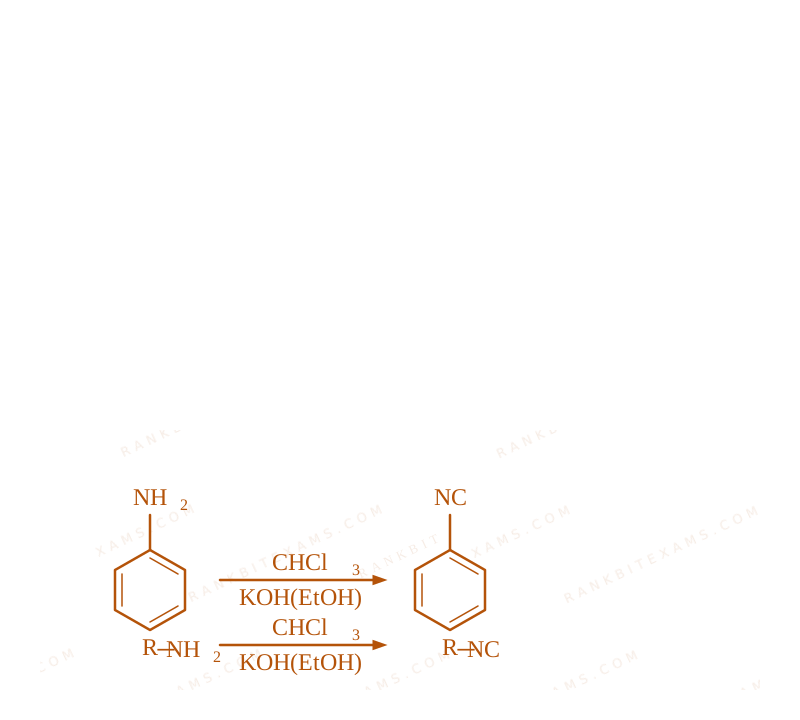
(B) Aliphatic and aromatic primary amines on heating with CHCl₃$CHCl_{3}$ and ethanolic KOH form carbylamines.
(C) Secondary and tertiary amines also give carbylamine test.
(D) Benzenesulfonyl chloride is known as Hinsberg's reagent.
(E) Tertiary amines reacts with benzenesulfonyl chloride very easily.
Choose the correct answer from the options given below :
A.(B) and (D) only
B.(A) and (B) only
C.(D) and (E) only
D.(B) and (C) only
Solution & Explanation
Related Formula
The Carbylamine reaction is specific to primary amines:
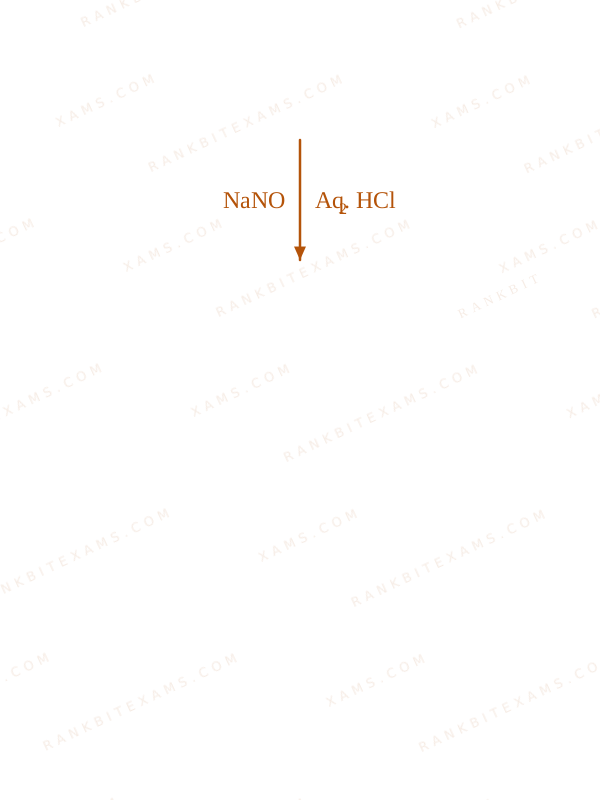
(A) Primary aromatic amines form stable diazonium salts with NaNO₂/HCl$NaNO_2/HCl$ at low temperatures, making this statement false.
(B) Both aliphatic and aromatic primary amines undergo the carbylamine test to produce foul-smelling isocyanides. This is correct.
(C) Secondary and tertiary amines do not undergo the carbylamine reaction, making this statement false.
(D) Benzenesulfonyl chloride (C₆H₅SO₂Cl$C_6H_5SO_2Cl$) is the definition of Hinsberg's reagent. This is correct.
(E) Tertiary amines do not possess an acidic hydrogen on nitrogen and do not react with Hinsberg's reagent under standard analytical testing conditions, making this statement false.
Step 1: Selecting Correct Entries
Statements (B) and (D) are verified as true.
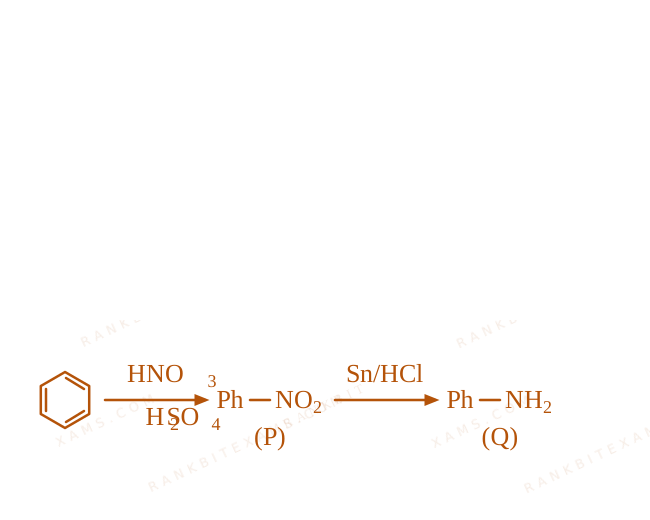
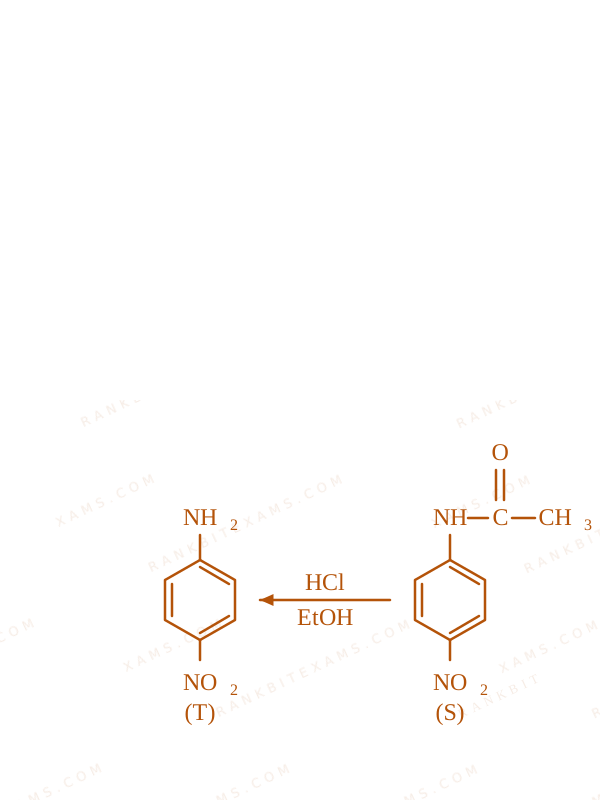
Reaction equations summary for primary amine classification
Pattern Recognition
Hinsberg's reagent and the carbylamine test are key analytical methods used to differentiate primary, secondary, and tertiary amines. The carbylamine test is strictly positive only for primary (1^°$1^\circ$) amine groups.
Keywords:#Carbylamine test primary amines#JEE Main 2025 Evening Q43#Hinsberg reagent chemical definition#Amine analytical identification steps
More Amines Previous-Year Questions
Q60jee_main_2026_21_jan_morningPreparation of Amines
An organic compound (P) on treatment with aqueous ammonia under hot condition forms compound (Q) which on heating with Br₂$Br_{2}$ and KOH forms compound (R) having molecular formula C₉H₇N$C_{9}H_{7}N$. Names of P, Q and R respectively are.
The reaction of an amide with Br₂$Br_2$ and KOH is Hoffmann bromamide degradation. It steps down the carbon chain by one carbonyl carbon to form a primary amine.
Let's analyze the options and molecular formula. The question says (R) has molecular formula C₉H₇N$C_9H_7N$. Wait, looking at the standard solutions for this type of problem, aniline is C₆H₇N$C_6H_7N$. The PDF says C₉H₇N$C_9H_7N$ which is likely a typo in the original paper for C₆H₇N$C_6H_7N$, since option (1) gives Aniline (C₆H₇N$C_6H_7N$). Let's assume the standard sequence:
Electrophilic Substitution Reactions diagram for Q74 - JEE Main 2026 Morning
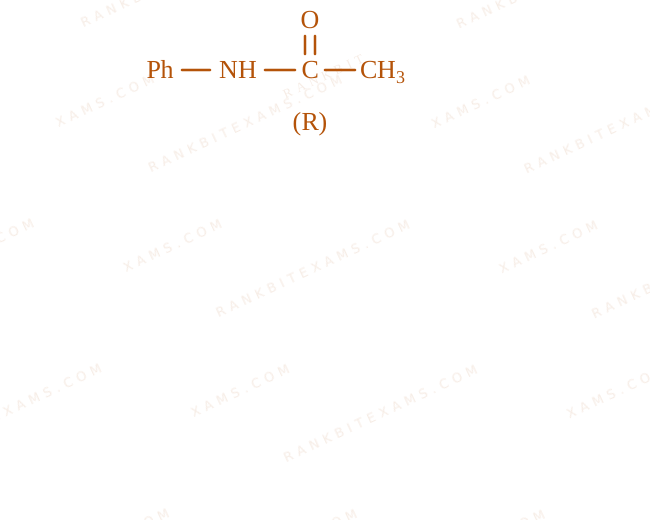
Step 3: Acetylation of aniline with acetic anhydride gives acetanilide (R). This protects the amino group to prevent oxidation and polysubstitution in the next step.
Qjee_main_2026_21_jan_eveningChemical Reactions of Amines and Halogenation
Consider the above sequence of reactions.
(1) Br₂ / FeBr₃ / Δ$\text{Br}_2 / \text{FeBr}_3 / \Delta$
(2) Sn / HCl / Δ$\text{Sn} / \text{HCl} / \Delta$
(3) pH neutralisation arrow Major Product (P)$\text{pH neutralisation} \rightarrow \text{Major Product (P)}$
(4) Br₂ / H₂O$\text{Br}_2 / \text{H}_2\text{O}$
(5) NaNO₂ / HBr, 0-5°C$\text{NaNO}_2 / \text{HBr}, 0-5^{\circ}\text{C}$
(6) CuBr / NaBr$\text{CuBr} / \text{NaBr}$
The number of bromine atom(s) in the final product (P) will be:
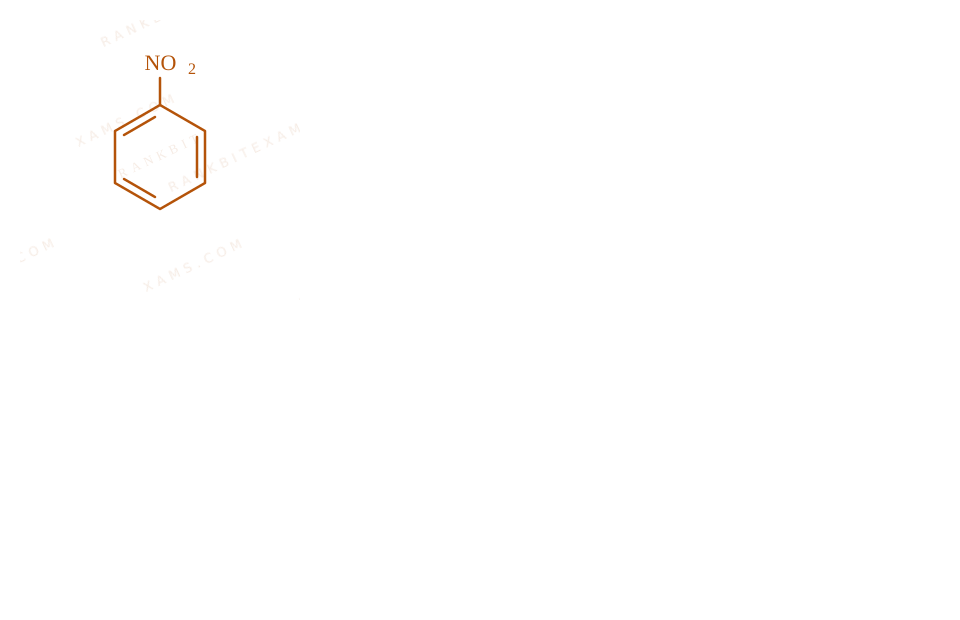
Reaction sequence diagram showing starting material and reagents for synthesis of product P.
A.(1) 1$(1) \ 1$
B.(2) 6$(2) \ 6$
C.(3) 5$(3) \ 5$
D.(4) 3$(4) \ 3$
Solution
Core Logic
Tracing the steps through nitration/bromination, reduction to amine via Sn/HCl$\text{Sn/HCl}$, subsequent extensive bromination with Br₂/H₂O$\text{Br}_2/\text{H}_2\text{O}$, diazotization, and Sandmeyer bromination (CuBr/NaBr$\text{CuBr/NaBr}$), we get substitution at multiple positions leading to 5 bromine atoms in the final product structure.
Step 1: Final Calculation
Number of Br atoms in major product (P) = 5.
Pattern Recognition
Sees: Multi-step aromatic conversion involving halogenation and diazotization.
Trap: Counting substituent groups incorrectly after Sandmeyer reaction.
'A' is a neutral organic compound (M. F : C₈H₉ON$C_{8}H_{9}ON$). On treatment with aqueous Br₂/HO(-)$Br_{2}/HO^{(-)}$, 'A' forms a compound 'B' which is soluble in dilute acid. 'B' on treatment with aqueous NaNO₂/HCl(0-5°C)$NaNO_{2}/HCl(0-5^{\circ}C)$ produces a compound 'C' which on treatment with CuCN/NaCN produces 'D' Hydrolysis of 'D' produces 'E' which is also obtainable from the hydrolysis of 'A'. 'E' on treatment with acidified KMnO₄$KMnO_{4}$ produces 'F'. 'F' contains two different types of hydrogen atoms. The structure of 'A' is
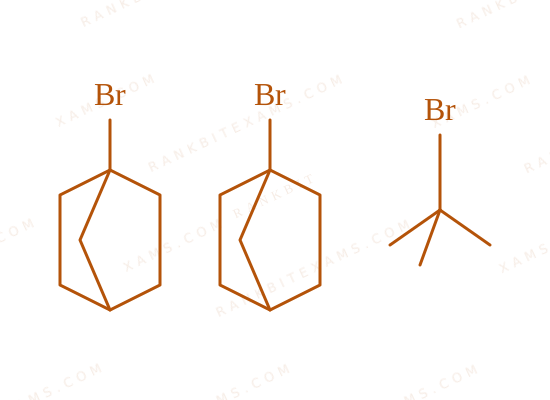
A.Structure 1$\text{Structure 1}$
B.Structure 2$\text{Structure 2}$
C.Structure 3$\text{Structure 3}$
D.Structure 4$\text{Structure 4}$
Solution
Core Logic
Let's trace the sequence:
A (C₈H₉ON$C_8H_9ON$) is neutral and reacts with Br₂/OH^-$Br_2/OH^-$ (Hofmann Bromamide Degradation). This means A is a primary amide.
Product B is soluble in dilute acid, meaning it is a primary amine (Ar-NH₂$Ar-NH_2$ or alkyl amine).
B reacts with NaNO₂/HCl$NaNO_2/HCl$ at 0-5°C$0-5^{\circ}C$ to form C. Since C undergoes Sandmeyer with CuCN to form D, B must be an aromatic primary amine, and C is a diazonium salt.
D is an aryl cyanide (Ar-CN$Ar-CN$). Hydrolysis of D yields E (Ar-COOH$Ar-COOH$).
Crucially, E is also obtainable from the direct hydrolysis of A. This confirms A is an aryl amide of the form Ar-CONH₂$Ar-CONH_2$.
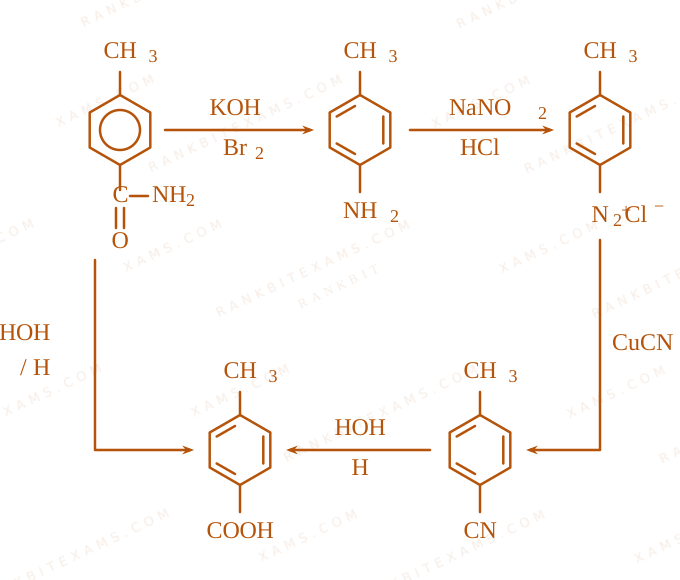
Sequence of reactions for identifying Compound A
Let's analyze the formula C₈H₉ON$C_8H_9ON$. The amide group is -CONH₂$-CONH_2$. Removing -CONH₂$-CONH_2$ leaves C₇H₇$C_7H_7$. A benzene ring with one methyl group is a tolyl group. So A is a methylbenzamide (CH₃-C₆H₄-CONH₂$CH_3-C_6H_4-CONH_2$).
E is methylbenzoic acid (CH₃-C₆H₄-COOH$CH_3-C_6H_4-COOH$).
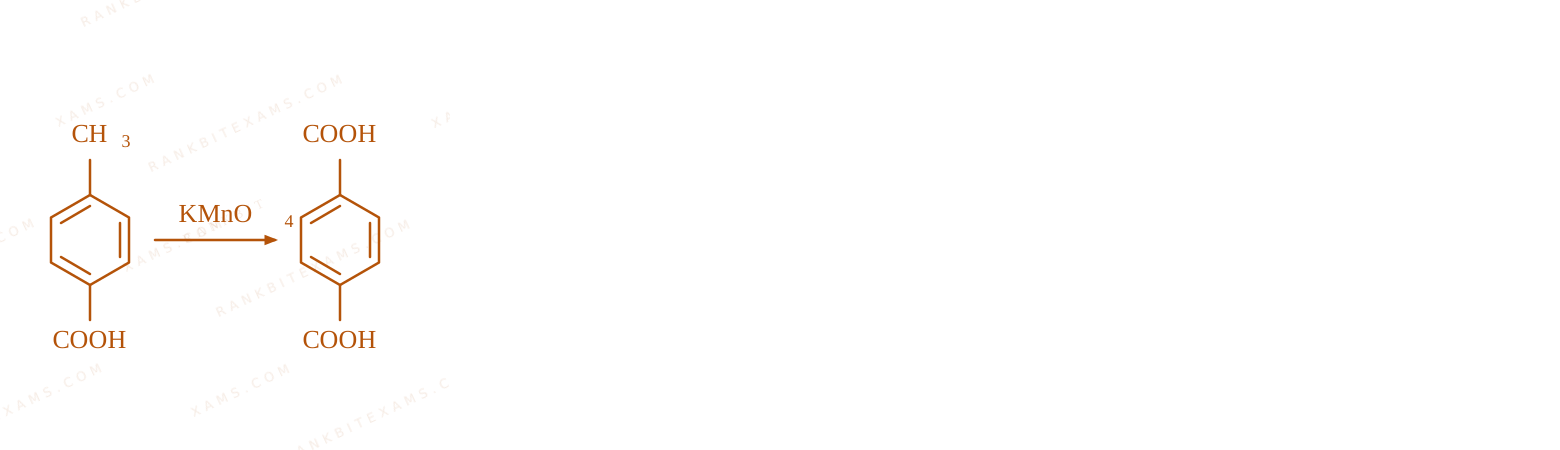
E is oxidized by acidified KMnO₄$KMnO_4$ to F. The methyl group on the benzene ring oxidizes to -COOH$-COOH$. Thus, F is a benzenedicarboxylic acid (HOOC-C₆H₄-COOH$HOOC-C_6H_4-COOH$).
Sequence of reactions for identifying Compound A
The problem states that F contains two different types of hydrogen atoms. Let's check the isomers of benzenedicarboxylic acid:
Phthalic acid (ortho): Contains 2 types of aromatic hydrogens + 1 type of COOH hydrogen = 3 types.
Isophthalic acid (meta): Contains 3 types of aromatic hydrogens + 1 type of COOH hydrogen = 4 types.
Terephthalic acid (para): Due to symmetry, all 4 aromatic hydrogens are equivalent. So it contains 1 type of aromatic hydrogen + 1 type of COOH hydrogen = 2 types.
Sequence of reactions for identifying Compound A
Since F has only two types of hydrogens, F must be terephthalic acid (para isomer). Thus, E is p-methylbenzoic acid, and A is p-methylbenzamide.
Step 1: Final Identification
Compound A is p-methylbenzamide. This corresponds to the structure in option (3).
Pattern Recognition
A classic sequence linking Hofmann bromamide, Sandmeyer, and side-chain oxidation. Symmetrical molecules like para-isomers minimize the number of unique proton environments (critical for NMR or simple counting).
Chapter Mix
Class 12 Chemistry: Amines
Class 12 Chemistry: Aldehydes Ketones and Carboxylic Acids
Q55jee_main_2026_22_january_eveningBenzoylation and Reduction of Amides
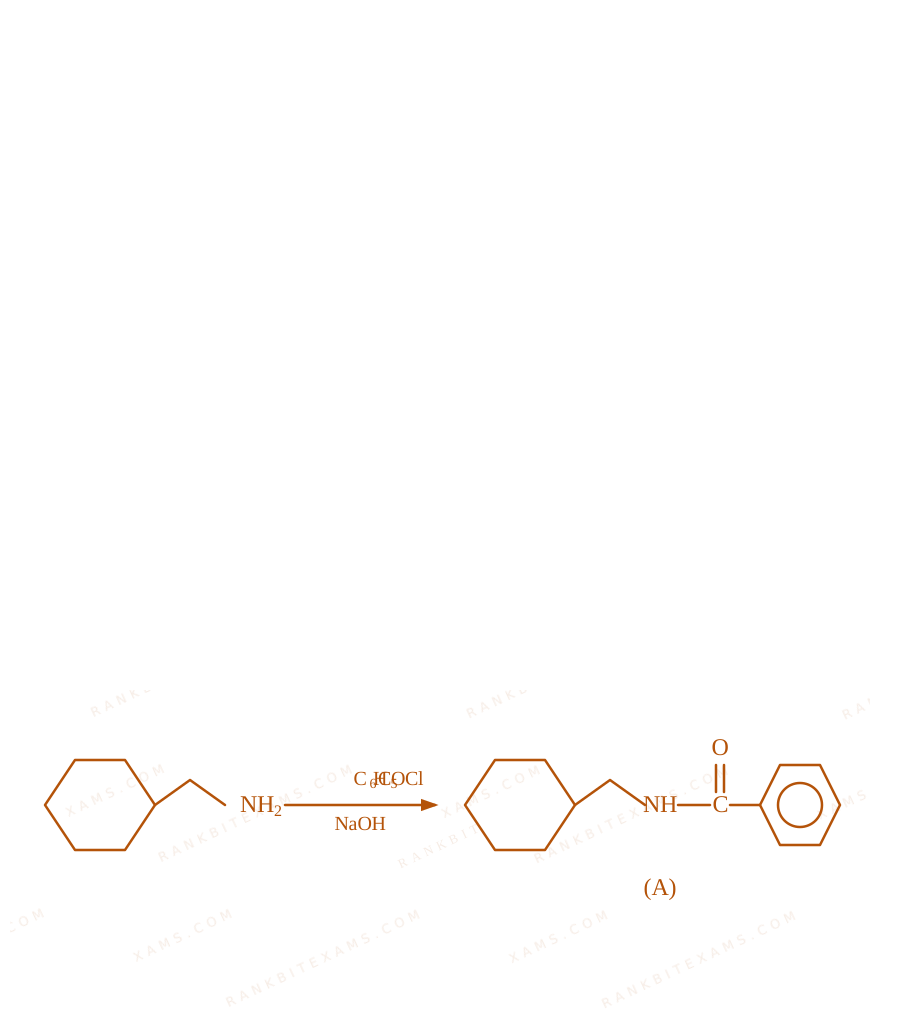
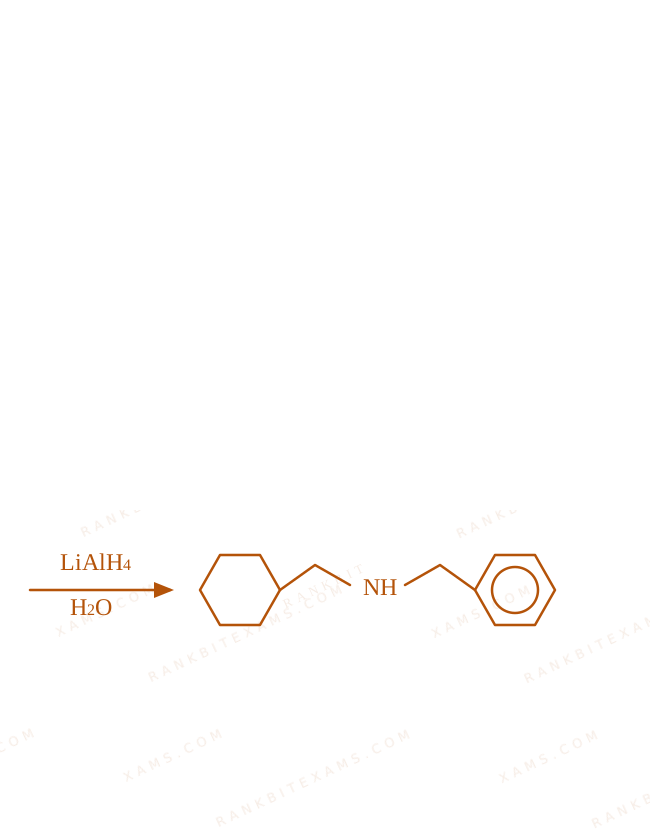
C₆H₅NH₂ [NaOH]C₆H₅COCl [A] [H₂O]LiAlH₄ [B]$$\mathrm{C}_6\mathrm{H}_5\mathrm{NH}_2 \xrightarrow[\mathrm{NaOH}]{\mathrm{C}_6\mathrm{H}_5\mathrm{COCl}} [\mathrm{A}] \xrightarrow[\mathrm{H}_2\mathrm{O}]{\mathrm{LiAlH}_4} [\mathrm{B}]$$
The final product [B] is:
Step 1: Reaction of aniline with benzoyl chloride (PhCOCl$\text{PhCOCl}$) in basic medium yields benzanilide (Ph-NH-CO-Ph$\text{Ph-NH-CO-Ph}$) as intermediate [A]$[A]$.
Step 2: Reduction of benzanilide using LiAlH₄$\text{LiAlH}_4$ converts the carbonyl group -C(=O)-$-\text{C}(=\text{O})-$ into a methylene group -CH₂-$-\text{CH}_2-$, forming dibenzylamine (Ph-NH-CH₂-Ph$\text{Ph-NH-CH}_2\text{-Ph}$) as final product [B]$[B]$.
Reaction flow of Benzoylation and reduction for Q55 - JEE Main 2026 Evening
Reaction flow of Benzoylation and reduction for Q55 - JEE Main 2026 Evening
Reaction flow of Benzoylation and reduction for Q55 - JEE Main 2026 Evening
Pattern Recognition
Sees: Acylation followed by LiAlH₄$\text{LiAlH}_4$ reduction.
Shortcut: Amide carbonyl group reduces directly to -CH₂-$-\text{CH}_2-$, resulting in secondary amine structure (option 3).
Chapter Mix
Class 12 Chemistry: Amines
More Amines Questions — jee_main_2025_28_jan_evening
Practice past-year questions one chapter at a time. Pick an exam → subject → chapter and get every PYQ for that topic — pulled together from all past papers — with the chapter's key formulas alongside.