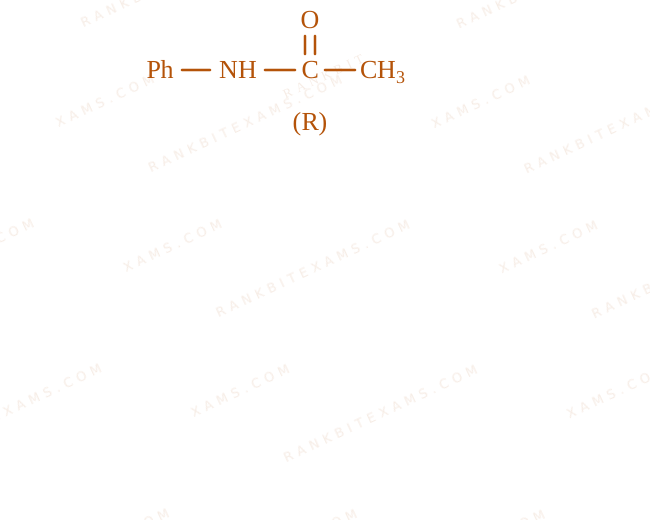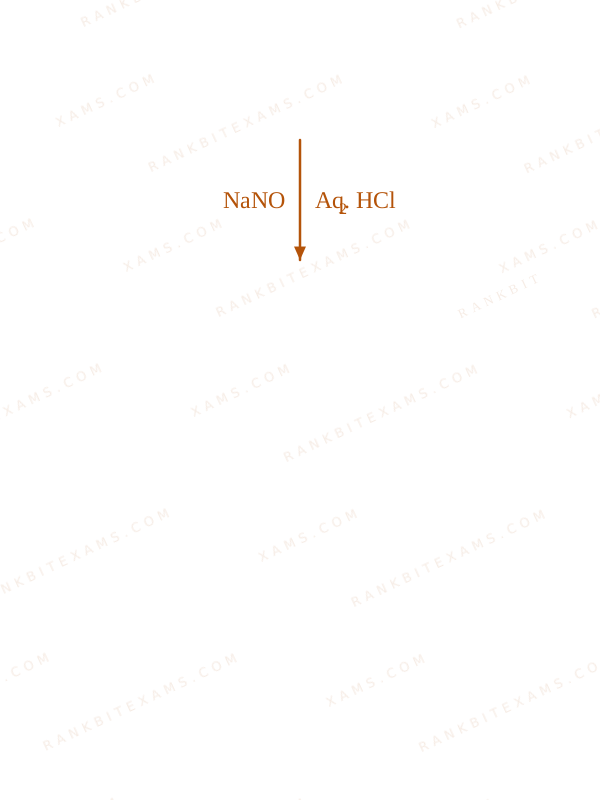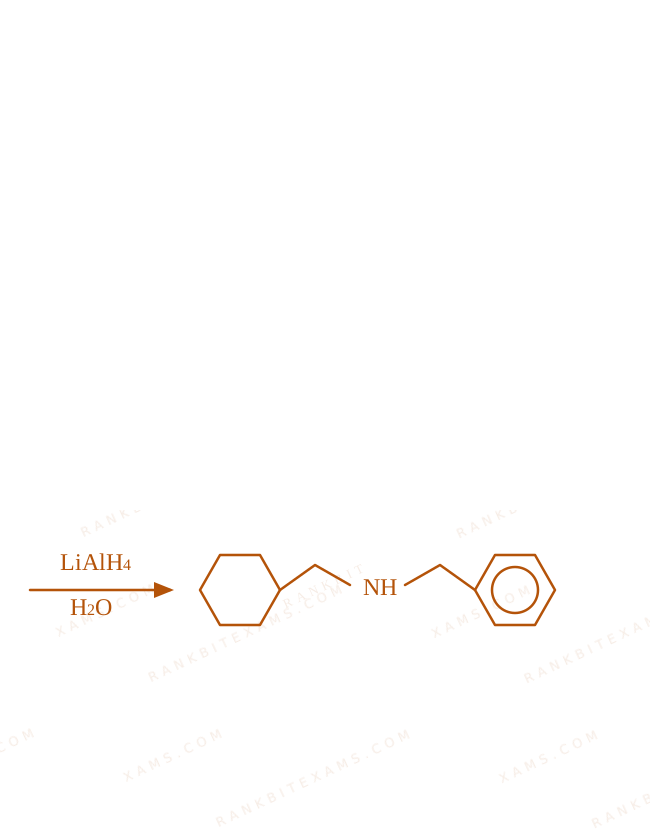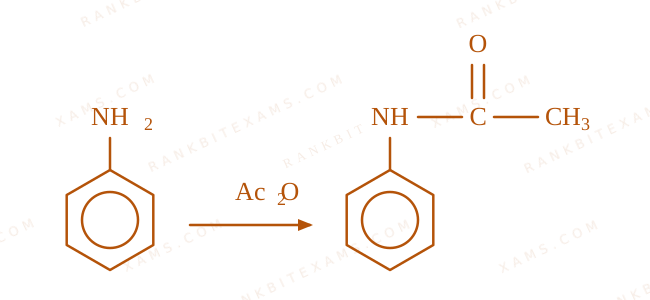
A student has planned to prepare acetanilide from aniline using acetic anhydride. The student has started from 9.3g of aniline. However, the student has managed to obtain 11 g of dry acetanilide. The % yield of this reaction is :-

Solution & Explanation

### Related Formula \%text yield = fractextActual Moles ProducedtextTheoretical Moles Expected times 100 ### Core Logic
Acylation of Amines diagram for Q59 - JEE Main 2026 Evening
Given mass of aniline (C_6H_5NH_2) = 9.3 gm Molar mass of aniline (MW) = 93 g/mol Moles of aniline (n_texttheoretical) = frac9.393 = 0.1 text moles Given mass of dry acetanilide (C_6H_5NHCOCH_3) obtained = 11 gm Molar mass of acetanilide (MW) = 135 g/mol Moles of acetanilide obtained (n_textactual) = frac11135 simeq 0.08148 text moles ### Step 1: Calculate Percentage Yield \% text yield = frac0.081480.1 times 100 = 81.48\% simeq 81.5\% ### Pattern Recognition A 1:1 molar ratio dictates that theoretical yield in moles of product directly matches moles of starting material. Converting experimental mass to moles removes the need to calculate theoretical mass, speeding up the final ratio. ### Evaluation Rubric / Model Answer null ### Chapter Mix Class 12 Chemistry: Amines Class 11 Chemistry: Some Basic Concepts of Chemistry

Reference Study Guides

More Amines Previous-Year Questions

Q60 jee_main_2026_21_jan_morning Preparation of Amines
An organic compound (P) on treatment with aqueous ammonia under hot condition forms compound (Q) which on heating with Br_2 and KOH forms compound (R) having molecular formula C_9H_7N. Names of P, Q and R respectively are.
  • A. textBenzoic acid, benzamide, aniline
  • B. textToluic acid, methylbenzamide, 2-methylaniline
  • C. textBenzoic acid,4-methylbenzamide,4-methylaniline.
  • D. textPhenylethanoic acid, phenylethanamide, benzamine

Solution

### Core Logic The reaction of an amide with Br_2 and KOH is Hoffmann bromamide degradation. It steps down the carbon chain by one carbonyl carbon to form a primary amine. Let's analyze the options and molecular formula. The question says (R) has molecular formula C_9H_7N. Wait, looking at the standard solutions for this type of problem, aniline is C_6H_7N. The PDF says C_9H_7N which is likely a typo in the original paper for C_6H_7N, since option (1) gives Aniline (C_6H_7N). Let's assume the standard sequence: 1. mathrmPh-COOH xrightarrowmathrmNH_3, Delta mathrmPh-CO-NH_2 (Benzoic acid to Benzamide) 2. mathrmPh-CO-NH_2 xrightarrowmathrmBr_2/mathrmKOH mathrmPh-NH_2 (Benzamide to Aniline) Aniline is C_6H_5NH_2 = C_6H_7N. So P is Benzoic acid, Q is Benzamide, R is Aniline. ### Pattern Recognition Reaction sequence: Carboxylic\ Acid xrightarrowNH_3, Delta Amide xrightarrowBr_2/KOH Amine. The Br_2/KOH step is Hoffmann bromamide reaction. ### Evaluation Rubric / Model Answer null ### Chapter Mix Class 12 Chemistry: Amines Class 12 Chemistry: Aldehydes, Ketones and Carboxylic Acids
Q74 jee_main_2026_21_jan_morning Electrophilic Substitution Reactions
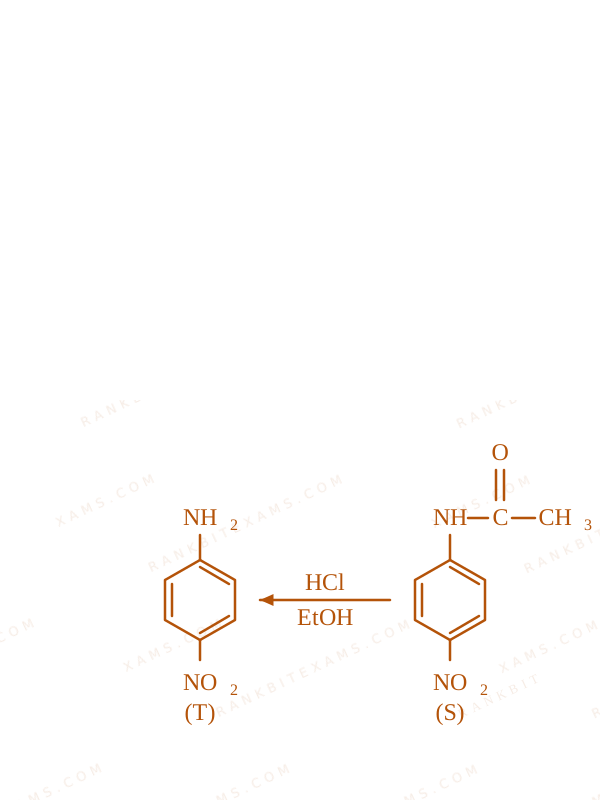
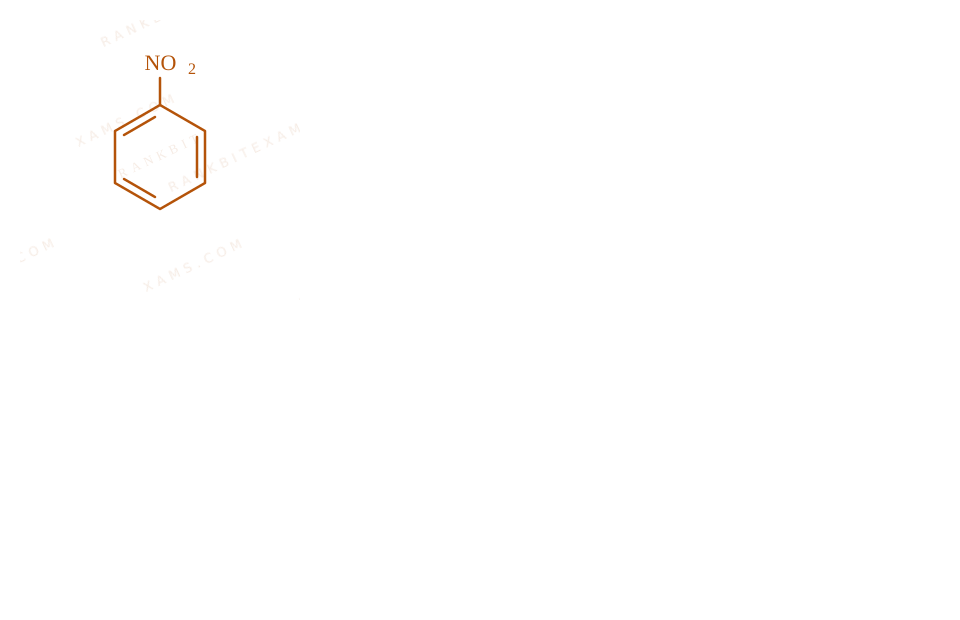
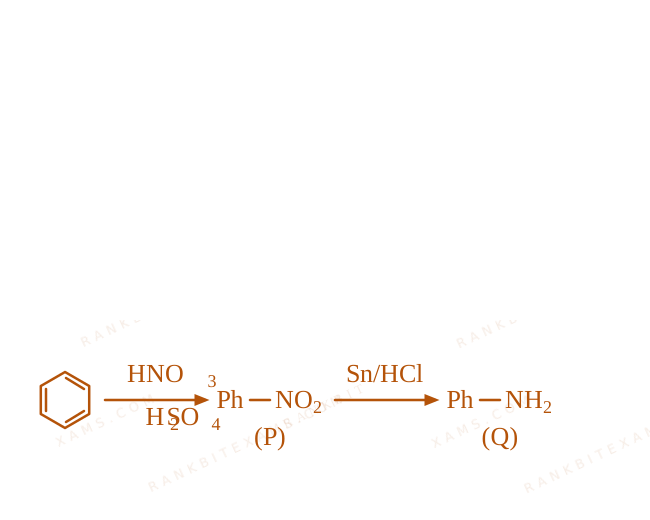
Consider the following reaction sequence Benzene xrightarrowtextconc. HNO_3 + textconc. H_2SO_4, 333text K textP xrightarrow1.text Sn/HCl/Delta quad 2.text pH neutralised textQ xrightarrow(mathrmCH_3mathrmCO)_2mathrmO textR xrightarrow1.text conc. HNO_3 + text conc. H_2SO_4 quad 2.text pH neutralised (major product) textS xrightarrowmathrmHCl / mathrmEtOH / Delta textT The percentage of nitrogen in product ‘T’ formed is ____%. (Nearest integer) (Given molar mass in mathrmg\ mol^-1 H:1, C:12, N:14, O:16)
Numerical Answer. Answer: 20 to 20

Solution

### Core Logic Step 1: Nitration of benzene gives nitrobenzene (P). mathrmPh-H xrightarrowHNO_3/H_2SO_4 mathrmPh-NO_2 quad text(P)
Electrophilic Substitution Reactions diagram for Q74 - JEE Main 2026 Morning
Step 2: Reduction of nitrobenzene with Sn/HCl gives aniline (Q). mathrmPh-NO_2 xrightarrowSn/HCl mathrmPh-NH_2 quad text(Q)
Electrophilic Substitution Reactions diagram for Q74 - JEE Main 2026 Morning
Step 3: Acetylation of aniline with acetic anhydride gives acetanilide (R). This protects the amino group to prevent oxidation and polysubstitution in the next step. mathrmPh-NH_2 xrightarrow(CH_3CO)_2O mathrmPh-NH-CO-CH_3 quad text(R)
Electrophilic Substitution Reactions diagram for Q74 - JEE Main 2026 Morning
Step 4: Nitration of acetanilide gives predominantly p-nitroacetanilide (S) due to steric hindrance at ortho position. mathrmPh-NH-CO-CH_3 xrightarrowHNO_3/H_2SO_4 ptext-NO_2text-C_6textH_4text-NH-CO-CH_3 quad text(S) Step 5: Acidic hydrolysis of the amide linkage yields p-nitroaniline (T). ptext-NO_2text-C_6textH_4text-NH-CO-CH_3 xrightarrowHCl/EtOH/Delta ptext-NO_2text-C_6textH_4text-NH_2 quad text(T)
Electrophilic Substitution Reactions diagram for Q74 - JEE Main 2026 Morning
Molecular formula of p-nitroaniline (T) is C_6H_6N_2O_2. Molar mass = (6 times 12) + (6 times 1) + (2 times 14) + (2 times 16) = 72 + 6 + 28 + 32 = 138text g/mol. Total mass of Nitrogen = 2 times 14 = 28text g. Percentage of Nitrogen = frac28138 times 100 approx 20.29\%. ### Step 1: Final Conclusion Nearest integer is 20. ### Evaluation Rubric / Model Answer null ### Chapter Mix Class 12 Chemistry: Amines
Q jee_main_2026_21_jan_evening Chemical Reactions of Amines and Halogenation
Consider the above sequence of reactions. (1) textBr_2 / textFeBr_3 / Delta (2) textSn / textHCl / Delta (3) textpH neutralisation rightarrow textMajor Product (P) (4) textBr_2 / textH_2textO (5) textNaNO_2 / textHBr, 0-5^circtextC (6) textCuBr / textNaBr The number of bromine atom(s) in the final product (P) will be:
Reaction sequence diagram for Q53 - JEE Main 2026 Evening
Reaction sequence diagram showing starting material and reagents for synthesis of product P.
  • A. (1) \ 1
  • B. (2) \ 6
  • C. (3) \ 5
  • D. (4) \ 3

Solution

### Core Logic Tracing the steps through nitration/bromination, reduction to amine via textSn/HCl, subsequent extensive bromination with textBr_2/textH_2textO, diazotization, and Sandmeyer bromination (textCuBr/NaBr), we get substitution at multiple positions leading to 5 bromine atoms in the final product structure. ### Step 1: Final Calculation Number of Br atoms in major product (P) = 5. ### Pattern Recognition Sees: Multi-step aromatic conversion involving halogenation and diazotization. Trap: Counting substituent groups incorrectly after Sandmeyer reaction. ### Chapter Mix Class 12 Chemistry: Amines
Q66 jee_main_2026_22_january_morning Hofmann Bromamide Degradation
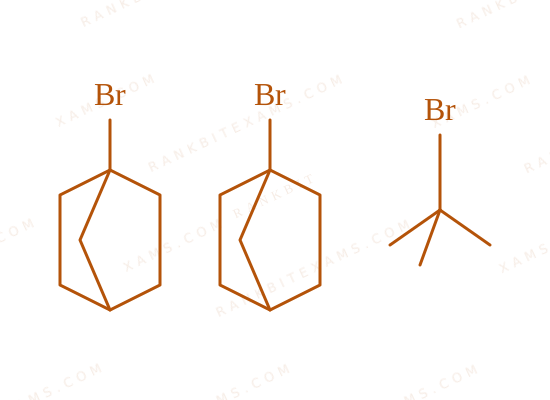
'A' is a neutral organic compound (M. F : C_8H_9ON). On treatment with aqueous Br_2/HO^(-), 'A' forms a compound 'B' which is soluble in dilute acid. 'B' on treatment with aqueous NaNO_2/HCl(0-5^circC) produces a compound 'C' which on treatment with CuCN/NaCN produces 'D' Hydrolysis of 'D' produces 'E' which is also obtainable from the hydrolysis of 'A'. 'E' on treatment with acidified KMnO_4 produces 'F'. 'F' contains two different types of hydrogen atoms. The structure of 'A' is
  • A. textStructure 1
  • B. textStructure 2
  • C. textStructure 3
  • D. textStructure 4

Solution

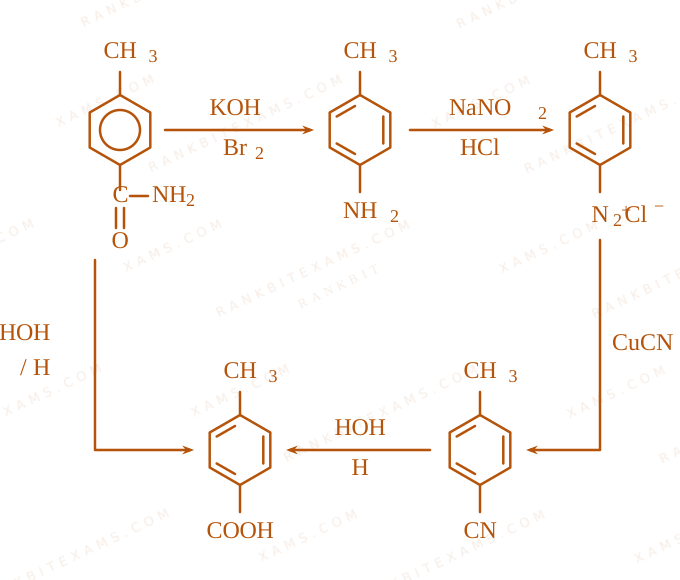
### Core Logic Let's trace the sequence: 1. A (C_8H_9ON) is neutral and reacts with Br_2/OH^- (Hofmann Bromamide Degradation). This means A is a primary amide. 2. Product B is soluble in dilute acid, meaning it is a primary amine (Ar-NH_2 or alkyl amine). 3. B reacts with NaNO_2/HCl at 0-5^circC to form C. Since C undergoes Sandmeyer with CuCN to form D, B must be an aromatic primary amine, and C is a diazonium salt. 4. D is an aryl cyanide (Ar-CN). Hydrolysis of D yields E (Ar-COOH). 5. Crucially, E is also obtainable from the direct hydrolysis of A. This confirms A is an aryl amide of the form Ar-CONH_2.
Sequence of reactions for identifying Compound A
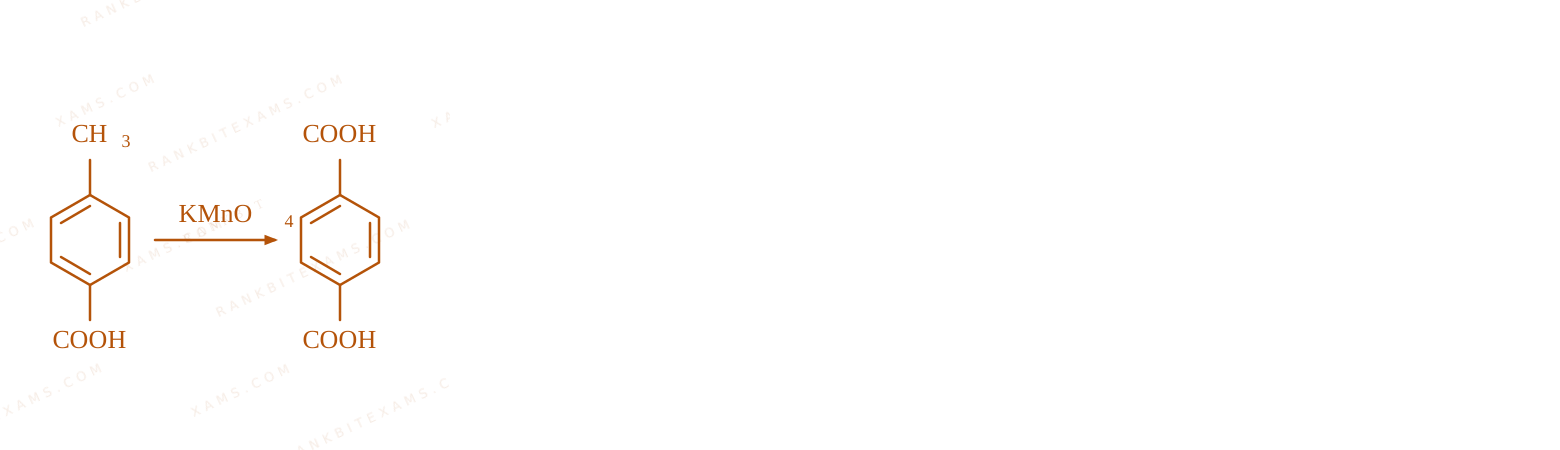
6. Let's analyze the formula C_8H_9ON. The amide group is -CONH_2. Removing -CONH_2 leaves C_7H_7. A benzene ring with one methyl group is a tolyl group. So A is a methylbenzamide (CH_3-C_6H_4-CONH_2). 7. E is methylbenzoic acid (CH_3-C_6H_4-COOH). 8. E is oxidized by acidified KMnO_4 to F. The methyl group on the benzene ring oxidizes to -COOH. Thus, F is a benzenedicarboxylic acid (HOOC-C_6H_4-COOH).
Sequence of reactions for identifying Compound A
9. The problem states that F contains two different types of hydrogen atoms. Let's check the isomers of benzenedicarboxylic acid: - Phthalic acid (ortho): Contains 2 types of aromatic hydrogens + 1 type of COOH hydrogen = 3 types. - Isophthalic acid (meta): Contains 3 types of aromatic hydrogens + 1 type of COOH hydrogen = 4 types. - Terephthalic acid (para): Due to symmetry, all 4 aromatic hydrogens are equivalent. So it contains 1 type of aromatic hydrogen + 1 type of COOH hydrogen = 2 types.
Sequence of reactions for identifying Compound A
Since F has only two types of hydrogens, F must be terephthalic acid (para isomer). Thus, E is p-methylbenzoic acid, and A is p-methylbenzamide. ### Step 1: Final Identification Compound A is p-methylbenzamide. This corresponds to the structure in option (3). ### Pattern Recognition A classic sequence linking Hofmann bromamide, Sandmeyer, and side-chain oxidation. Symmetrical molecules like para-isomers minimize the number of unique proton environments (critical for NMR or simple counting). ### Evaluation Rubric / Model Answer null ### Chapter Mix Class 12 Chemistry: Amines Class 12 Chemistry: Aldehydes Ketones and Carboxylic Acids
Q55 jee_main_2026_22_january_evening Benzoylation and Reduction of Amides
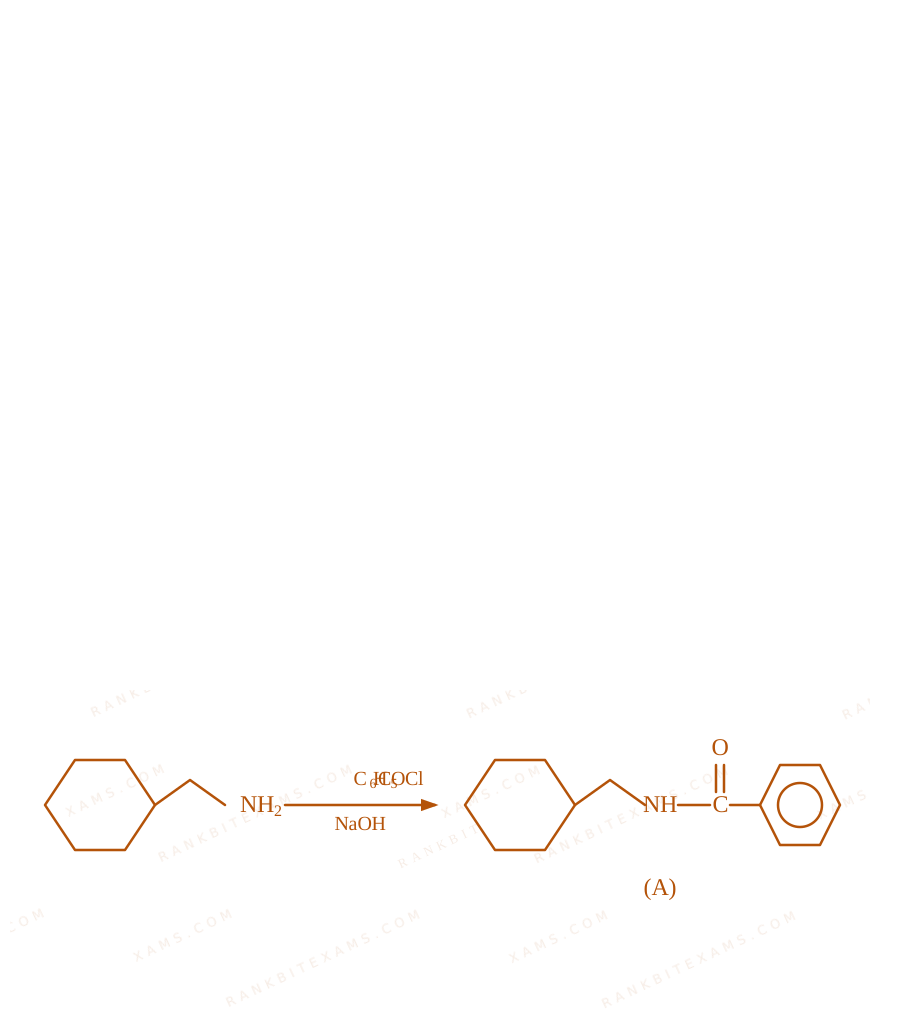
mathrmC_6mathrmH_5mathrmNH_2 xrightarrow[mathrmNaOH]mathrmC_6mathrmH_5mathrmCOCl [mathrmA] xrightarrow[mathrmH_2mathrmO]mathrmLiAlH_4 [mathrmB] The final product [B] is:
  • A.
  • B.
  • C.
  • D.

Solution

### Related Formula textAniline + textBenzoyl Chloride xrightarrowtextSchotten-Baumann textBenzanilide [A] textAmide [A] xrightarrowtextLiAlH_4 textSecondary Amine [B] ### Core Logic Step 1: Reaction of aniline with benzoyl chloride (textPhCOCl) in basic medium yields benzanilide (textPh-NH-CO-Ph) as intermediate [A]. Step 2: Reduction of benzanilide using textLiAlH_4 converts the carbonyl group -textC(=textO)- into a methylene group -textCH_2-, forming dibenzylamine (textPh-NH-CH_2text-Ph) as final product [B].
Reaction flow of Benzoylation and reduction for Q55 - JEE Main 2026 Evening
### Pattern Recognition Sees: Acylation followed by textLiAlH_4 reduction. Shortcut: Amide carbonyl group reduces directly to -textCH_2-, resulting in secondary amine structure (option 3). ### Evaluation Rubric / Model Answer null ### Chapter Mix Class 12 Chemistry: Amines

More Amines Questions — jee_main_2026_24_january_evening

Practice all Amines previous-year questions →

Rankbit System
JEE Physics: Waves (+15.5%) | Electrostatics: Concentric Shells (-29.7%) | Modern Physics: Photoelectric Clones (+34.2%) | Mathematics: Definite Integrals (+18.1%) | Chemistry: Coordination Splitting (-11.4%) | JEE Physics: Waves (+15.5%) | Electrostatics: Concentric Shells (-29.7%) | Modern Physics: Photoelectric Clones (+34.2%) | Mathematics: Definite Integrals (+18.1%) | Chemistry: Coordination Splitting (-11.4%)