JEE Main · Chemistry ↑ Rising

Amines appeared 39 times across 3 years — 4.5% of Chemistry. This question is from Yield and Stoichiometric Calculations.

Year 2026 2025 2024 Total
Questions 16 14 9 39

Consider the following sequence of reactions :
Reaction flow pathway for Q49 - JEE Main 2025 Morning
The flowchart tracks a chemical conversion starting from chlorobenzene down to final compound B.
11.25 mg of chlorobenzene will produce x × 10⁻¹ mg of product B. (Consider the reactions result in complete conversion.) [Given molar mass of C, H, O, N and Cl as 12, 1, 16, 14 and 35.5g mol⁻¹ respectively]

Numerical Answer Type:
Enter a numerical value Answer: 93 to 93 +4 marks

Solution & Explanation

Core Logic

The reaction sequence details the functional conversion of chlorobenzene down to product B (aniline, with a molar mass of 93 g mol⁻¹). Following stoichiometric preservation:

moles of chlorobenzene = moles of Aniline (B)

Molar mass of chlorobenzene (C₆H₅Cl) = 112.5 g mol⁻¹.

Molar stoichiometry relation graph for Q49 - JEE Main 2025 Morning
The flowchart tracks a chemical conversion starting from chlorobenzene down to final compound B.

moles = 11.25 × 10⁻³ g112.5 g mol⁻¹ = 10⁻⁴ mol

Mass of product B produced:

Mass = 10⁻⁴ mol × 93 g mol⁻¹ = 9.3 × 10⁻³ g = 9.3 mg

Expressing in the specified format:

9.3 mg = 93 × 10⁻¹ mg ⇒ x = 93
Pattern Recognition

Sees: Conversion sequence preserving a 1:1 mole ratio layout. Shortcut: Directly compute target weight via WB = WA · (MB)/(MA) = 11.25 · (93)/(112.5) = 9.3.

Chapter Mix

Class 12 Chemistry: Amines

Reference Study Guides

More Amines Previous-Year Questions — Page 3

Q57 jee_main_2026_24_january_morning Stability of Diazonium Salts
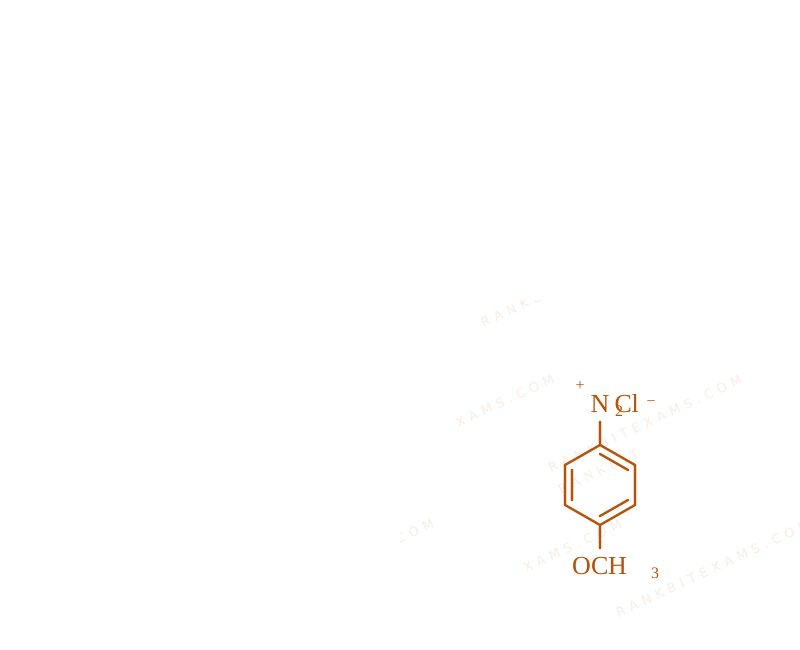
The correct stability order of the following diazonium salts is (A)
Diazonium salt structures
Four para-substituted benzenediazonium salts are given: plain, -OCH3, -NO2, -CN.
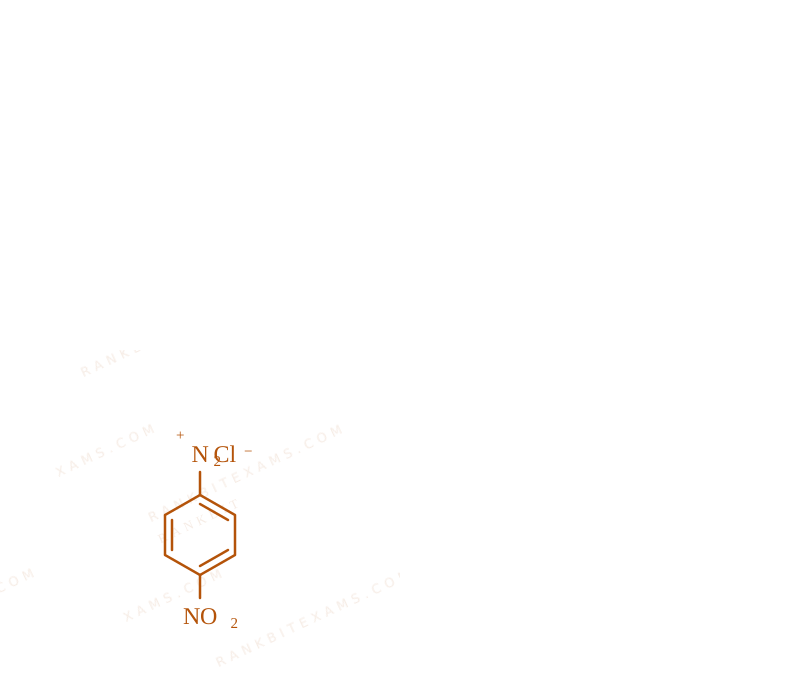
(B)
Diazonium salt structures
Four para-substituted benzenediazonium salts are given: plain, -OCH3, -NO2, -CN.
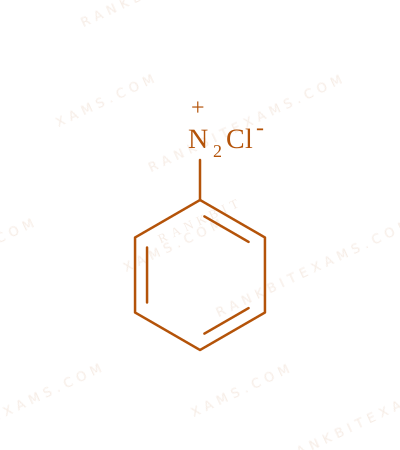
(C)
Diazonium salt structures
Four para-substituted benzenediazonium salts are given: plain, -OCH3, -NO2, -CN.
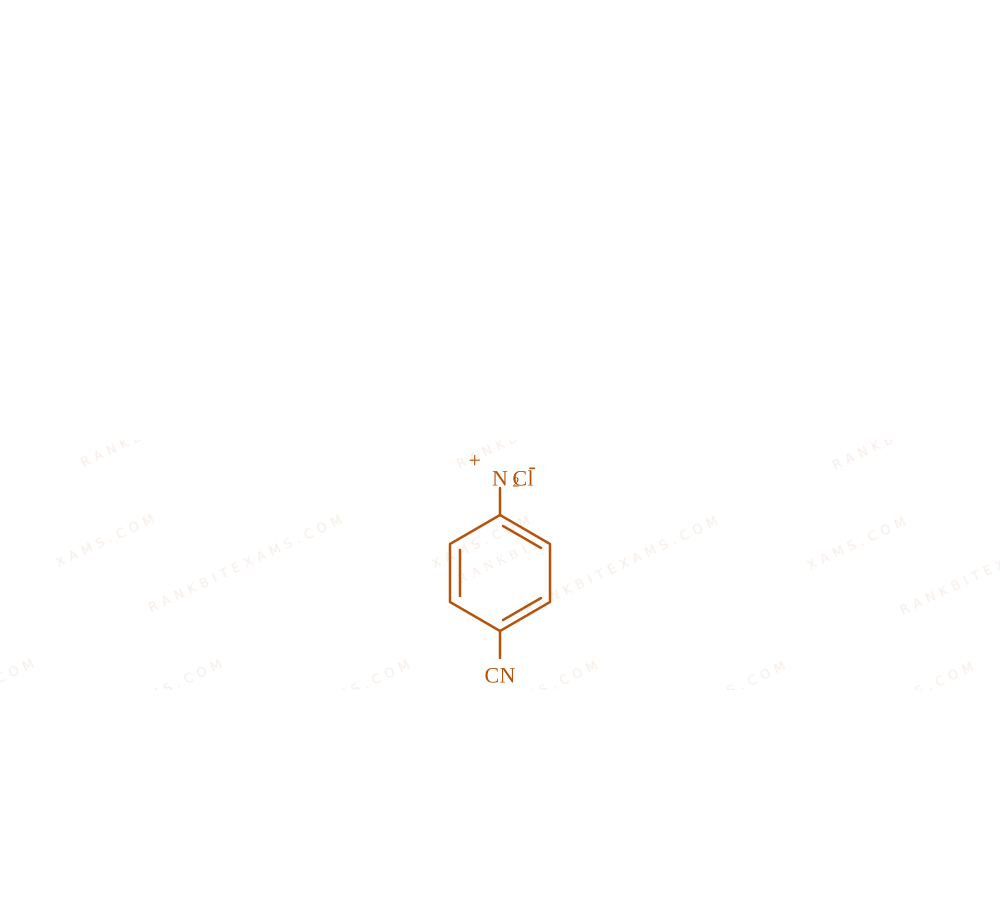
(D)
Diazonium salt structures
Four para-substituted benzenediazonium salts are given: plain, -OCH3, -NO2, -CN.
  • A. A > B > C > D
  • B. C > D > B > A
  • C. A > C > D > B
  • D. C > A > D > B

Solution

Core Logic

The stability of arenediazonium salts is dictated by the ability of substituents on the benzene ring to disperse the positive charge on the diazonium group (-N₂^+).

Electron-donating groups (EDG) increase the stability by resonance (+M effect) and inductive (+I) effects, dispersing the positive charge. Electron-withdrawing groups (EWG) decrease the stability by intensifying the positive charge (-M, -I effects).

Let's evaluate the given substituents at the para position: (A) -OCH₃: Strong +M effect. Highly stabilizing. (C) Plain benzene ring: Neutral baseline. (D) -CN: Strong -M and -I effect. Destabilizing. (B) -NO₂: Very strong -M and -I effect. Most destabilizing.

Step 1: Final Conclusion

Arranging them in decreasing order of stability: (A) -OCH₃ (+M) > (C) Baseline > (D) -CN (-M) > (B) -NO₂ (Stronger -M). Thus, the correct order is A > C > D > B.

Pattern Recognition

Stability of carbocations and diazonium ions follows: +M > +I > no effect > -I > -M. Look directly at the para group to rank.

Chapter Mix

Class 12 Chemistry: Amines Class 11 Chemistry: Organic Chemistry - Some Basic Principles and Techniques
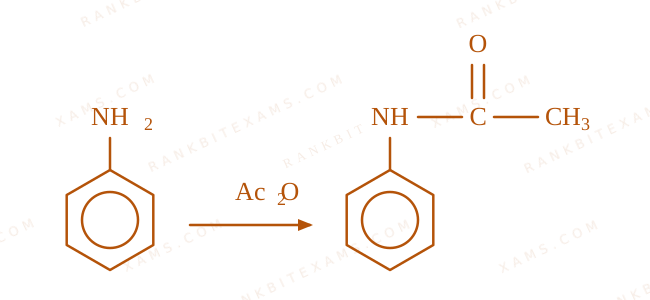
Q59 jee_main_2026_24_january_evening Acylation of Amines
A student has planned to prepare acetanilide from aniline using acetic anhydride. The student has started from 9.3g of aniline. However, the student has managed to obtain 11 g of dry acetanilide. The % yield of this reaction is :-
  • A. 81.5%
  • B. 97.5%
  • C. 59.5%
  • D. 72.5%

Solution

Related Formula
% yield = Actual Moles ProducedTheoretical Moles Expected × 100
Core Logic

Acylation of Amines diagram for Q59 - JEE Main 2026 Evening

Given mass of aniline (C₆H₅NH₂) = 9.3 gm Molar mass of aniline (MW) = 93 g/mol Moles of aniline (ntheoretical) = (9.3)/(93) = 0.1 moles

Given mass of dry acetanilide (C₆H₅NHCOCH₃) obtained = 11 gm Molar mass of acetanilide (MW) = 135 g/mol Moles of acetanilide obtained (nactual) = (11)/(135) 0.08148 moles

Step 1: Calculate Percentage Yield
% yield = (0.08148)/(0.1) × 100 = 81.48% 81.5%
Pattern Recognition

A 1:1 molar ratio dictates that theoretical yield in moles of product directly matches moles of starting material. Converting experimental mass to moles removes the need to calculate theoretical mass, speeding up the final ratio.

Chapter Mix

Class 12 Chemistry: Amines Class 11 Chemistry: Some Basic Concepts of Chemistry

Q65 jee_main_2026_24_january_evening Cyanides and Isocyanides
Given below are two statements : Statement I : The dipole moment of R-CN is greater than R-NC and R-NC can undergo hydrolysis under acidic medium to produce arrayc O ∥ R-C-OH. array Statement II : R-CN hydrolyses under acidic medium to produce a compound which on treatment with SOCl₂ , followed by the addition of NH₃ gives another compound(x). This compound (x) on treatment with NaOCl/NaOH gives a product, that on treatment with CHCl₃/KOH/Δ produces R-NC In the light of the above statements, choose the correct answer from the options given below :
  • A. Both Statement I and Statement II are false
  • B. Both Statement I and Statement II are true
  • C. Statement I is true but Statement II is false
  • D. Statement I is false but Statement II is true

Solution

Core Logic

Statement I: While it is true that the dipole moment of R-CN is greater than R-NC, the hydrolysis of isocyanide (R-NC) under acidic conditions yields a primary amine and formic acid, not a carboxylic acid (R-COOH) with the same alkyl chain intact. Reaction: R-NC H₃O^+ R-NH₂ + HCOOH Thus, Statement I is False.

Statement II:

  • Hydrolysis of Cyanide: R-CN H₃O^+ R-COOH
  • With SOCl₂: R-COOH SOCl₂ R-COCl
  • With NH₃: R-COCl NH₃ R-CONH₂ (Compound x)
  • Hoffmann Bromamide / Hypochlorite degradation: R-CONH₂ NaOCl/NaOH R-NH₂
  • Carbylamine Reaction: R-NH₂ CHCl₃ + KOH R-NC
  • The sequence correctly produces R-NC. Thus, Statement II is True.

Step 1: Final Conclusion

Statement I is false but Statement II is true.

Pattern Recognition

Isocyanide hydrolysis breaks the N-C bond, leaving the R group attached to Nitrogen (forming a 1° amine). The remaining C becomes formic acid.

Chapter Mix

Class 12 Chemistry: Amines

Q63 jee_main_2026_28_january_morning Hoffmann Bromamide Degradation
Consider the following reactions giving major product. Identify the correct reaction.
  • A.
  • B.
  • C.
  • D.

Solution

Step 1: Evaluate Reaction (1)

Nitration of acetanilide produces primarily the para-isomer because the -NHCOCH₃ group is strongly ortho/para directing and sterically hinders the ortho position. The option incorrectly suggests the meta product. (Incorrect)

Step 2: Evaluate Reaction (2)

Gabriel phthalimide synthesis does not work with aryl halides because aryl halides do not readily undergo nucleophilic substitution. Thus, bromobenzene cannot form aniline this way. (Incorrect)

Step 3: Evaluate Reaction (3)

Reaction of secondary amine with CHCl₃/KOH does NOT yield an isocyanide. The carbylamine test is strictly for primary amines. (Incorrect)

Step 4: Evaluate Reaction (4)

Hoffmann bromamide degradation: H₃C-CH₂-CO-NH₂ + Br₂ + 4KOH Δ H₃C-CH₂-NH₂ + 2KBr + K₂CO₃ + 2H₂O This cleanly forms ethylamine, completely accurately represented. (Correct)

Pattern Recognition

Carbylamine test = 1° amines only. Gabriel Phthalimide = aliphatic 1° amines only (no aryl halides). Hoffmann degradation strictly lowers carbon chain by 1 (CO removal).

Chapter Mix

Class 12 Chemistry: Amines

Q63 jee_main_2026_28_january_evening Reactions Of Amines
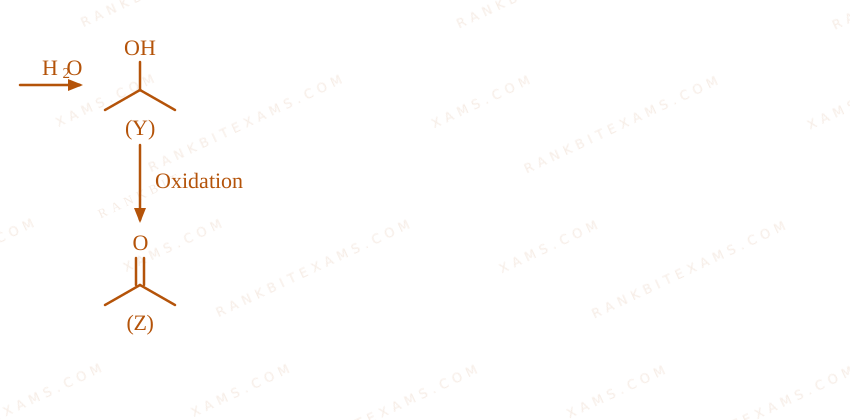
A student performed analysis of aliphatic organic compound 'X' which on analysis gave C = 61.01%, H = 15.25%, N = 23.74%. This compound, on treatment with HNO₂/H₂O produced another compound 'Y' which did not contain any nitrogen atom. However, the compound 'Y' upon controlled oxidation produced another compound 'Z' that responded to iodoform test. The structure of 'X' is:
  • A. (1) CH₃CH₂CH₂NH₂
  • B. (2) Ph-CH(CH₃)-NH₂
  • C. (3) (CH₃)₂CH-NH₂
  • D. (4)

Solution

Core Logic

Step 1: Empirical Formula calculation: Moles of C = (61.01)/(12) ≈ 5.08 Moles of H = (15.25)/(1) ≈ 15.25 Moles of N = (23.74)/(14) ≈ 1.69 Ratio C : H : N = (5.08)/(1.69) : (15.25)/(1.69) : (1.69)/(1.69) ≈ 3 : 9 : 1 Empirical formula = C₃H₉N.

Step 2: Chemical tests deduction. The compound is treated with HNO₂/H₂O and produces a nitrogen-free compound Y. This implies X is a primary aliphatic amine (C₃H₇NH₂), giving an alcohol Y (C₃H₇OH).

Compound Y upon controlled oxidation forms Z, which gives positive iodoform test. For Z to give an iodoform test, it must be a methyl ketone. Thus Z is acetone (CH₃COCH₃).

For Y to oxidize to acetone, Y must be Isopropyl alcohol (CH₃CH(OH)CH₃). Therefore, X must be Isopropylamine: (CH₃)₂CHNH₂.

Step 1: Reaction Sequence

Reactions Of Amines diagram for Q63 - JEE Main 2026 Evening
(CH₃)₂CHNH₂ HNO₂ (CH₃)₂CH-N₂^+ -N₂ (CH₃)₂CH^+ H₂O (CH₃)₂CHOH (Y) (CH₃)₂CHOH Oxidation CH₃COCH₃ (Z) CH₃COCH₃ responds to the iodoform test.

Step 2: Final Conclusion

The structure of 'X' is Isopropylamine.

Pattern Recognition

Iodoform test on an oxidized alcohol means the alcohol was a secondary alcohol with a terminal methyl group. Combining this with HNO₂ reacting with primary amines gives the exact functional groups.

Chapter Mix

Class 11 Chemistry: Organic Chemistry - Some Basic Principles and Techniques Class 12 Chemistry: Amines Class 12 Chemistry: Aldehydes, Ketones and Carboxylic Acids

More Amines Questions — jee_main_2025_28_jan_morning

Practice all Amines previous-year questions →

Rankbit System
JEE Physics: Waves (+15.5%) | Electrostatics: Concentric Shells (-29.7%) | Modern Physics: Photoelectric Clones (+34.2%) | Mathematics: Definite Integrals (+18.1%) | Chemistry: Coordination Splitting (-11.4%) | JEE Physics: Waves (+15.5%) | Electrostatics: Concentric Shells (-29.7%) | Modern Physics: Photoelectric Clones (+34.2%) | Mathematics: Definite Integrals (+18.1%) | Chemistry: Coordination Splitting (-11.4%)