JEE Main · Physics ↓ Falling

Laws of Motion appeared 34 times across 3 years — 3.9% of Physics. This question is from Newton Second Law Applications.

Year 2026 2025 2024 Total
Questions 9 10 15 34

A balloon and its content having mass M is moving up with an acceleration 'a'. The mass that must be released from the content so that the balloon starts moving up with an acceleration '3a' will be : (Take 'g' as acceleration due to gravity) [cite: 174, 175]

Solution & Explanation

Related Formula

By Newton's second law of motion, the net upward force acting on an accelerating balloon system is given by:

Fbuoyant - mtotal g = mtotal a
Core Logic

Let F be the constant buoyant force acting upward on the balloon.

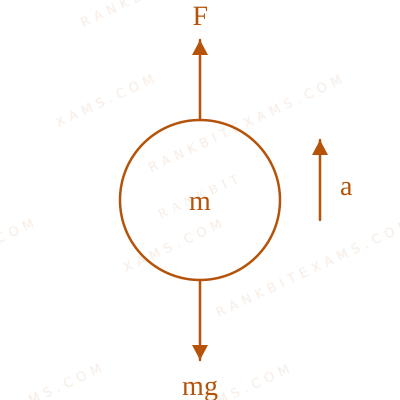
Case 1 (Initial upward acceleration) :

F - M g = M a F = M(g + a)

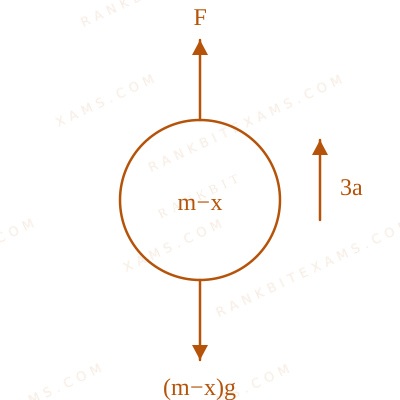
Case 2 (After releasing mass x) : The new total mass becomes (M - x), and its acceleration increases to 3a:

F - (M - x)g = (M - x)3a

Substitute the value of F from Case 1 into Case 2 [cite: 836, 839]:

M(g + a) - (M - x)g = (M - x)3a M g + M a - M g + x g = 3 M a - 3 x a M a + x g = 3 M a - 3 x a x(g + 3a) = 2 M a x = (2 M a)/(3a + g)
Step 1: Visual Context

The free-body force layout for both accelerating phases is shown below:

Newton Second Law Applications free body diagrams for Q20

Newton Second Law Applications free body diagrams for Q20

Pattern Recognition

Since the upward buoyant force is completely determined by the balloon's volume, it remains constant. Expressing this constant force in terms of the initial conditions allows you to quickly solve for mass changes when acceleration states vary.

Chapter Mix

Class 11 Physics: Laws of Motion

Reference Study Guides

More Laws of Motion Previous-Year Questions — Page 2

Q40 jee_main_2026_24_january_evening Equilibrium of Forces
A flexible chain of mass m hangs between two fixed points at the same level. The inclination of the chain with the horizontal at the two points of support is 30° . Considering the equilibrium of each half of the chain, the tension of the chain at the lowest point is ____.
  • A. √(3)2 m g
  • B. (1)/(2) m g
  • C. m g
  • D. √(3) m g

Solution

Related Formula
Σ Fy = 0 T θ = (mg)/(2) Σ Fₓ = 0 T θ = T₀
Core Logic

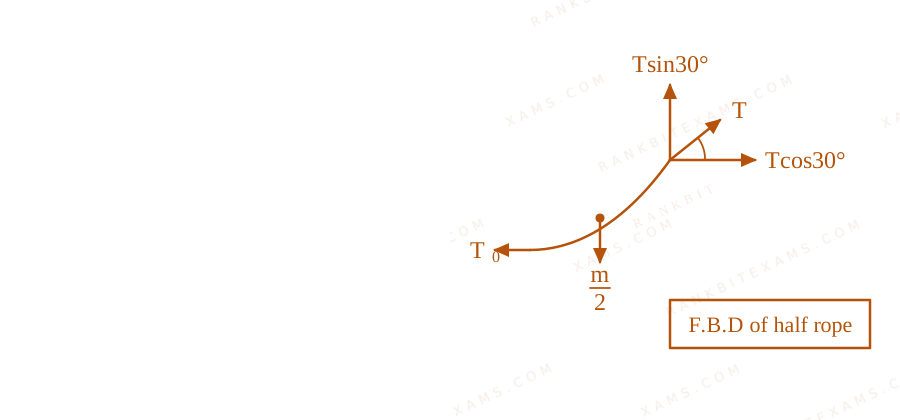
Equilibrium of Forces diagram for Q40 - JEE Main 2026 Evening

Draw the Free Body Diagram (F.B.D) of half of the rope. The forces acting on half the rope (mass m/2) are:

  • Weight (mg)/(2) acting downwards.
  • Tension T at the support point acting at 30° to the horizontal.
  • Horizontal tension T₀ at the lowest point.
Step 1: Equilibrium Equations

For vertical equilibrium:

T 30° = (m)/(2) g

For horizontal equilibrium:

T 30° = T₀
Step 2: Solve for T_0

Dividing the vertical equation by the horizontal equation:

30° = (mg / 2)/(T₀) T₀ = mg2 30° T₀ = mg2 (1/√(3)) = √(3)2 mg
Pattern Recognition

When dealing with symmetrical hanging chains, always cut the chain at the lowest point. The tension at the lowest point is purely horizontal and is given by T₀ = (W/2) / θ, where θ is the angle at the supports.

Chapter Mix

Class 11 Physics: Laws of Motion
Q40 jee_main_2026_28_january_morning Friction on an Inclined Plane
A block of mass 5 kg is moving on an inclined plane which makes an angle of 30° with the horizontal. Friction coefficient between the block and inclined plane surface is √(3)2 . The force to be applied on the block so that the block will move down without acceleration is ____ N.
  • A. 25
  • B. 12.5
  • C. 7.5
  • D. 15

Solution

Related Formula
fk = μk N = μk mg θ Fdown = mg θ

Net force = 0 for constant velocity

Core Logic

For the block to move down at a constant velocity (zero acceleration), the sum of forces parallel to the incline must be zero.

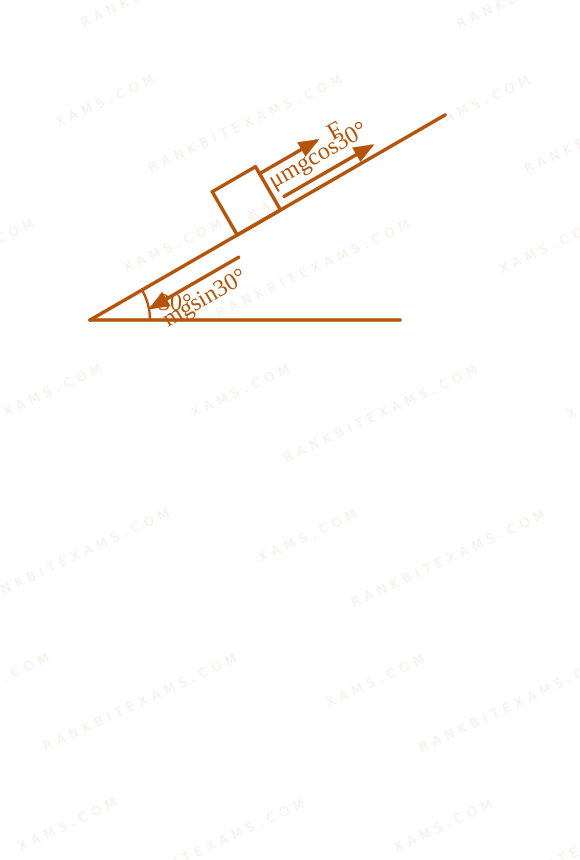
Free body diagram of block on an incline

Step 1: Force Balance Equation

Force pulling it down the incline = mg (30°) Friction acting up the incline (since block moves down) = μ mg (30°)

Let external force F act down the incline.

mg (30°) + F = μ mg (30°)
Step 2: Value Substitution
F = μ mg (30°) - mg (30°) F = ( √(3)2 ) (5 × 10) ( √(3)2 ) - (5 × 10) ( (1)/(2) )
Step 3: Final Calculation
F = 50 × (3)/(4) - 50 × (1)/(2) F = 37.5 - 25 = 12.5 ~N

Note: The PDF solution calculates this with F assigned up the incline and gets F = -12.5N. The magnitude is 12.5N downward on the incline.

Pattern Recognition

If μ > θ (here √(3)2 = 0.866 and 30^° = 1√(3) ≈ 0.577), friction is stronger than gravity's pull. You must actively pull it down to keep it moving.

Chapter Mix

Class 11 Physics: Laws of Motion
Q45 jee_main_2026_28_january_morning Motion with Drag Force
A particle of mass m falls from rest through a resistive medium having resistive force, F = -kv, where v is the velocity of the particle and k is a constant. Which of the following graphs represents velocity (v) versus time(t)?
  • A. Graph 1
  • B. Graph 2
  • C. Graph 3
  • D. Graph 4

Solution

Related Formula
Fₙₑₜ = ma mg - kv = m(dv)/(dt)
Core Logic

Integrate the differential equation of motion to find how velocity depends on time. Initially, acceleration is g. As velocity increases, the resistive force kv increases, reducing acceleration until it reaches zero (terminal velocity).

Step 1: Setting up Integration
m · (dv)/(dt) = mg - kv ∫₀v (dv)/(mg - kv) = ∫₀t (dt)/(m)
Step 2: Performing Integration
[ -(1)/(k) ln(mg - kv) ]₀^v = (t)/(m) -(1)/(k) ln((mg - kv)/(mg)) = (t)/(m) ln(1 - (kv)/(mg)) = -(kt)/(m)
Step 3: Final Velocity Equation
1 - (kv)/(mg) = e-kt/m v = (mg)/(k) (1 - e-kt/m)

This shows an exponential increase that asymptotically approaches a terminal velocity vterminal = mg/k. Option (2) represents this curve.

Pattern Recognition

The equation 1 - e-t always produces a curve starting at origin and flattening out horizontally (asymptotic approach to a limit).

Chapter Mix

Class 11 Physics: Laws of Motion

Q40 jee_main_2026_28_january_evening Pseudo Force and Inclined Plane
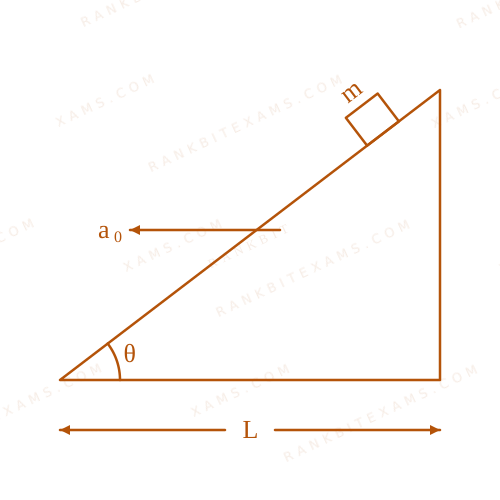
A small block of mass m slides down from the top of a frictionless inclined surface, while the inclined plane is moving towards left with constant acceleration a₀ . The angle between the inclined plane and ground is θ and its base length is L. Assuming that initially the small block is at the top of the inclined plane, the time it takes to reach the lowest point of the inclined plane is ____.
Pseudo Force and Inclined Plane diagram for Q40 - JEE Main 2026 Evening
A mass m on an inclined plane of base L, accelerating to the left with a0.
  • A. √((2L)/(g 2θ - a₀(1 + 2θ)))
  • B. √((4L)/(g 2θ - a₀(1 + 2θ)))
  • C. √((4L)/(g ²θ - a₀ θ θ))
  • D. √((2L)/(g θ - a₀ θ))

Solution

Related Formula
s = ut + (1)/(2)at² Fpseudo = m a₀
Core Logic

Solution for Pseudo Force and Inclined Plane
A mass m on an inclined plane of base L, accelerating to the left with a0.
We solve the problem from the non-inertial frame of reference of the inclined plane. A pseudo force m a₀ acts on the block towards the right. Forces acting parallel to the incline (downward positive):

  • Component of gravity: mg θ
  • Component of pseudo force (pointing up the incline): -ma₀ θ
Step 1: Calculate Effective Acceleration

Net force down the incline:

Fₙₑₜ = mg θ - m a₀ θ

Thus, the acceleration relative to the incline is:

a = g θ - a₀ θ
Step 2: Distance Travelled

The base length of the incline is L. Thus, the total length of the inclined surface is:

S = (L)/( θ)
Step 3: Calculate Time

Using the second equation of motion (u=0):

S = (1)/(2) a t² (L)/( θ) = (1)/(2) (g θ - a₀ θ) t² t² = (2L)/( θ (g θ - a₀ θ)) t = √( (2L)/(g θ θ - a₀ ² θ) )
Step 4: Trigonometric Identity Substitution

Multiply numerator and denominator by 2 inside the square root:

t = √( (4L)/(2g θ θ - 2a₀ ² θ) )

Using 2θ = 2 θ θ and 2 ²θ = 1 + 2θ:

t = √( (4L)/(g 2θ - a₀(1 + 2θ)) )
Pattern Recognition

Whenever an inclined plane accelerates horizontally, resolve the pseudo force ma₀ parallel and perpendicular to the incline. Multiply by 2 inside the root to simplify into double-angle formats if options demand it.

Chapter Mix

Class 11 Physics: Laws of Motion Class 11 Physics: Kinematics
Q16 jee_main_2025_02_april_evening Equilibrium of Forces
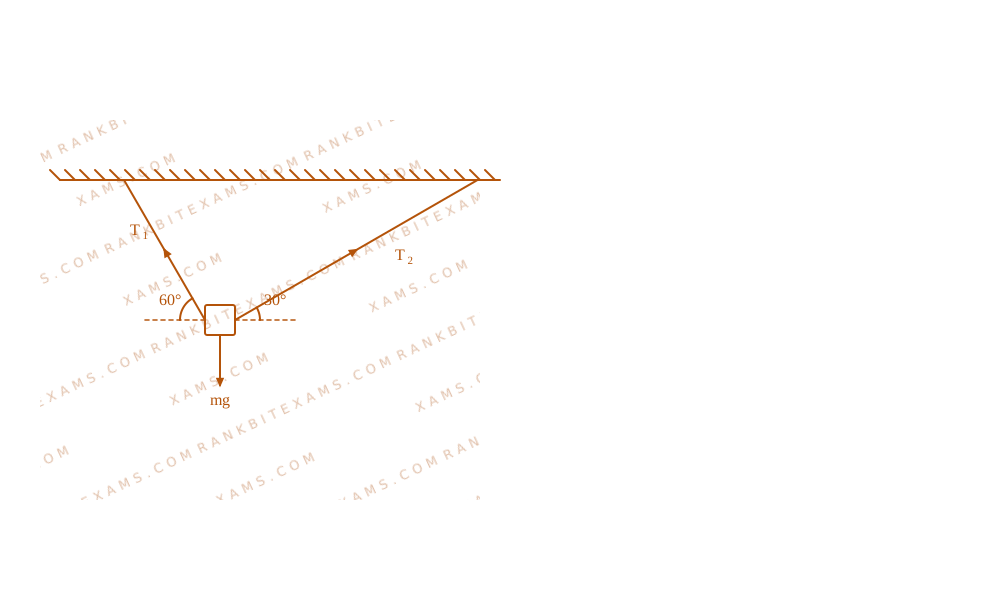
A body of mass 1kg is suspended with the help of two strings making angles as shown in figure. Magnitude of tensions T₁ and T₂ , respectively, are (in N):
Suspended mass equilibrium with two angled strings
The diagram shows a suspended mass of 1 kg held by two strings making angles of 60 and 30 degrees with the horizontal.
  • A. 5, 5√(3)
  • B. 5√(3), 5
  • C. 5√(3), 5√(3)
  • D. 5, 5

Solution

Related Formula

For a system in static equilibrium:

Σ Fₓ = 0 and Σ Fy = 0
Core Logic

Let's resolve the tension forces T₁ and T₂ into horizontal and vertical components:

  • T₁ makes 60^° with the horizontal.
  • T₂ makes 30^° with the horizontal.
  • Downward gravitational force: W = m g = 1 × 10 = 10 N.
  • Horizontal Equilibrium (Σ Fₓ = 0):
T₁ 60^° = T₂ 30^° T₁ · (1)/(2) = T₂ · √(3)2 T₁ = T₂ √(3)
  • Vertical Equilibrium (Σ Fy = 0):
T₁ 60^° + T₂ 30^° = m g = 10 T₁ · √(3)2 + T₂ · (1)/(2) = 10
Step 1: Solve for Tensions

Substitute T₁ = T₂ √(3) into the vertical equilibrium equation:

(T₂ √(3)) √(3)2 + (T₂)/(2) = 10 (3 T₂)/(2) + (T₂)/(2) = 10 2 T₂ = 10 T₂ = 5 N

Substitute T₂ back to obtain T₁:

T₁ = 5 √(3) N

Thus, the tension magnitudes are T₁ = 5√(3) N and T₂ = 5 N.

Pattern Recognition

Sees: Suspending particle static equilibrium with asymmetric strings. Trap: Associating components with incorrect trigonometry axes or swapping T₁ and T₂ in options. Shortcut: Since the incline of T₁ (60^°) is steeper than that of T₂ (30^°), T₁ must carry a larger portion of the load, meaning T₁ > T₂. From the choices, only (2) satisfies this hierarchy.

Chapter Mix

Class 11 Physics: Laws of Motion

More Laws of Motion Questions — jee_main_2025_28_jan_evening

Practice all Laws of Motion previous-year questions →

Rankbit System
JEE Physics: Waves (+15.5%) | Electrostatics: Concentric Shells (-29.7%) | Modern Physics: Photoelectric Clones (+34.2%) | Mathematics: Definite Integrals (+18.1%) | Chemistry: Coordination Splitting (-11.4%) | JEE Physics: Waves (+15.5%) | Electrostatics: Concentric Shells (-29.7%) | Modern Physics: Photoelectric Clones (+34.2%) | Mathematics: Definite Integrals (+18.1%) | Chemistry: Coordination Splitting (-11.4%)