Rankbit System
JEE Physics: Waves (+15.5%) | Electrostatics: Concentric Shells (-29.7%) | Modern Physics: Photoelectric Clones (+34.2%) | Mathematics: Definite Integrals (+18.1%) | Chemistry: Coordination Splitting (-11.4%) | JEE Physics: Waves (+15.5%) | Electrostatics: Concentric Shells (-29.7%) | Modern Physics: Photoelectric Clones (+34.2%) | Mathematics: Definite Integrals (+18.1%) | Chemistry: Coordination Splitting (-11.4%)

If the midpoint of a chord of the ellipse fracx^29+fracy^24=1 is (sqrt2,4/3), and the length of the chord is frac2sqrtalpha3 , then alpha is:

Solution & Explanation

### Related Formula Equation of a chord of an ellipse with given midpoint (x_1, y_1) is given by T = S_1: fracxx_1a^2 + fracyy_1b^2 = fracx_1^2a^2 + fracy_1^2b^2 ### Core Logic Given ellipse: fracx^29 + fracy^24 = 1 and midpoint (x_1, y_1) = (sqrt2, frac43). Applying T = S_1: fracxsqrt29 + fracy(4/3)4 = frac(sqrt2)^29 + frac(4/3)^24 fracsqrt2x9 + fracy3 = frac29 + frac1636 fracsqrt2x9 + fracy3 = frac29 + frac49 = frac69 Multiplying through by 9: sqrt2x + 3y = 6 implies 3y = 6 - sqrt2x ### Step 1: Find Intersection Points with Ellipse Substitute 3y = 6 - sqrt2x into the multiplied form of ellipse 4x^2 + 9y^2 = 36: 4x^2 + (3y)^2 = 36 4x^2 + (6 - sqrt2x)^2 = 36 4x^2 + 36 + 2x^2 - 12sqrt2x = 36 6x^2 - 12sqrt2x = 0 6x(x - 2sqrt2) = 0 Thus, x = 0 or x = 2sqrt2. ### Step 2: Find y-coordinates and Chord Length If x_1 = 0 implies 3y_1 = 6 implies y_1 = 2 If x_2 = 2sqrt2 implies 3y_2 = 6 - sqrt2(2sqrt2) = 6 - 4 = 2 implies y_2 = frac23 The end points of the chord are A(0, 2) and B(2sqrt2, frac23). textLength of chord AB = sqrt(2sqrt2 - 0)^2 + left(frac23 - 2right)^2 AB = sqrt8 + left(-frac43right)^2 = sqrt8 + frac169 = sqrtfrac889 = fracsqrt4 times 223 = frac2sqrt223 Comparing with frac2sqrtalpha3, we get alpha = 22. ### Pattern Recognition When the intersection equation results in a simple factoring like 6x^2 - 12sqrt2x = 0, calculating the explicit coordinates is incredibly fast compared to using general formula roots equations. ### Evaluation Rubric / Model Answer null ### Chapter Mix Class 11 Mathematics: Conic Sections (Ellipse)

Reference Study Guides

More Conic Sections Previous-Year Questions — Page 8

Q74 2025 Parabola Transformation and Geometric Properties
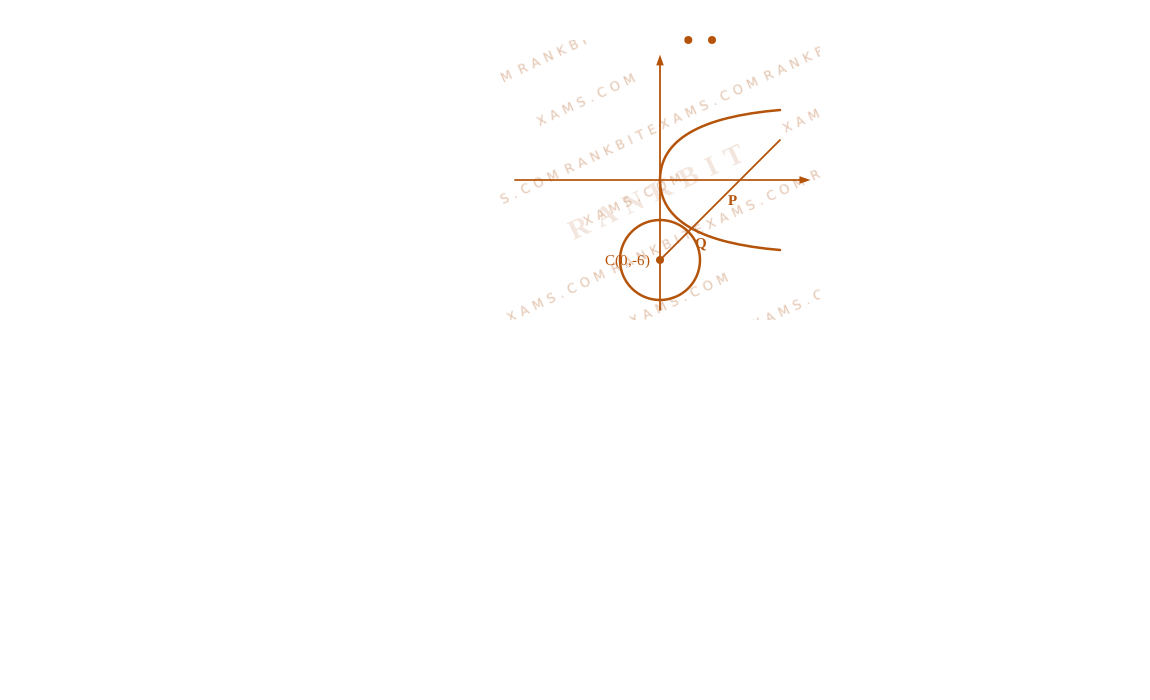
Let A and B be the two points of intersection of the line y+5=0 and the mirror image of the parabola y^2=4x with respect to the line x+y+4=0. If d denotes the distance between A and B, and a denotes the area of Delta SAB, where S is the focus of the parabola y^2=4x, then the value of (a+d) is
Numerical Answer. Answer: 14 to 14

Solution

### Related Formula Mirror image mapping of point (x, y) about line x+y+c = 0 is: x' = -y - c, quad y' = -x - c ### Core Logic Instead of reflecting the entire curve, we can reflect the line y + 5 = 0 across the line x + y + 4 = 0 to find where it intersects the original parabola y^2 = 4x. Reflection of line y = -5 across x + y + 4 = 0: Using transformation y' = -x - 4 implies -5 = -x - 4 implies x = 1. So the reflected line is x = 1. ### Step 1: Intersect with Parabola to find Distance d Intersect x = 1 with original parabola y^2 = 4x: y^2 = 4(1) = 4 implies y = pm 2 The points on the original curve are (1, 2) and (1, -2). Distance between these points is d = 2 - (-2) = 4. ### Step 2: Calculate Area of Triangle Focus of the original parabola y^2 = 4x is S(1, 0). The vertices of the original corresponding triangle are S(1,0), A'(1,2), and B'(1,-2). Since all three points lie on the line x = 1, the area formed is zero? Let's check the context structure: `Area = 1/2 * 4 * 5 = 10 = a`. Distance `d = 4`. Therefore, (a + d) = 10 + 4 = 14. ### Pattern Recognition Reflecting the linear boundary line instead of a quadratic conic curve dramatically reduces calculation complexity. ### Evaluation Rubric / Model Answer null ### Chapter Mix Class 11 Mathematics: Conic Sections (Parabola)
Q53 2025 Parabola Intersection
Two parabolas have the same focus (4,3) and their directrices are the x-axis and the y-axis, respectively. If these parabolas intersect at the points A and B, then (mathrmAB)^2 is equal to
  • A. 192
  • B. 384
  • C. 96
  • D. 392

Solution

### Related Formula textDistance from a point (x,y) text to focus (h,k) = textPerpendicular distance to the directrix ### Core Logic Let the intersection points be A(x_1, y_1) and B(x_2, y_2). For Parabola I (directrix is x-axis, i.e., y=0): (x - 4)^2 + (y - 3)^2 = y^2 quad dots (1) For Parabola II (directrix is y-axis, i.e., x=0): (x - 4)^2 + (y - 3)^2 = x^2 quad dots (2)
Parabola Intersection diagram for Q53 - JEE Main 2025 Morning
### Step 1: Establish Relationship between x and y Equating equations (1) and (2): x^2 = y^2 implies x = y quad text(since the intersection lies in the first quadrant where x, y > 0text) ### Step 2: Solve for x Substitute y = x into equation (1): (x - 4)^2 + (x - 3)^2 = x^2 x^2 - 8x + 16 + x^2 - 6x + 9 = x^2 x^2 - 14x + 25 = 0 ### Step 3: Calculate Distance Squared (AB)^2 From the quadratic equation, we have: x_1 + x_2 = 14 x_1 x_2 = 25 Since y = x, the coordinates of A and B satisfy y_1 = x_1 and y_2 = x_2. (AB)^2 = (x_1 - x_2)^2 + (y_1 - y_2)^2 = 2(x_1 - x_2)^2 = 2[(x_1 + x_2)^2 - 4x_1 x_2] = 2[14^2 - 4(25)] = 2[196 - 100] = 2(96) = 192 ### Pattern Recognition Symmetry about the line y = x simplifies calculations drastically. When two conics share a focus and have perpendicular symmetric directrices, their line of intersection is always y = x. ### Evaluation Rubric / Model Answer null ### Chapter Mix Class 11 Mathematics: Conic Sections Class 11 Mathematics: Quadratic Equations
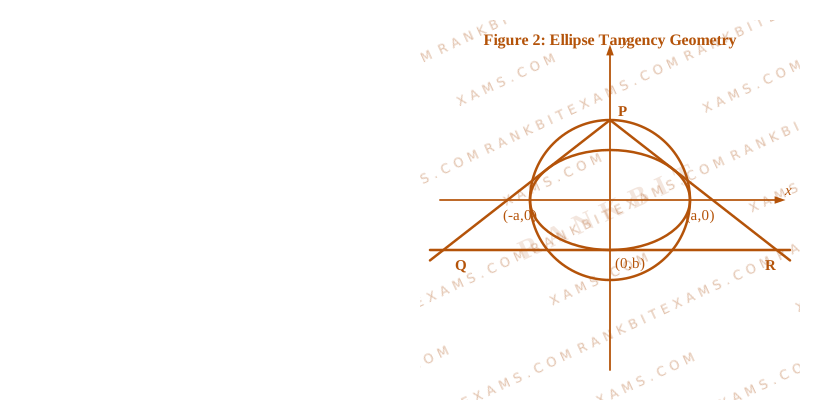
Q62 2025 Ellipse Intersection and Properties
Let the ellipse, mathrmE_1: fracmathrmx^2mathrma^2 + fracmathrmy^2mathrmb^2 = 1 , mathrma > mathrmb and mathrmE_2: fracmathrmx^2mathrmA^2 + fracmathrmy^2mathrmB^2 = 1 , mathrmA < mathrmB have same eccentricity frac1sqrt3 . Let the product of their lengths of latus rectums be frac32sqrt3 , and the distance between the foci of mathrmE_1 be 4. If mathrmE_1 and mathrmE_2 meet at A,B,C and D, then the area of the quadrilateral ABCD equals:
  • A. 6sqrt6
  • B. \frac{18\sqrt{6}}{5}
  • C. \frac{12\sqrt{6}}{5}
  • D. \frac{24\sqrt{6}}{5}

Solution

### Related Formula textEccentricity of horizontal ellipse e = sqrt1 - fracb^2a^2 textLength of Latus Rectum L = frac2b^2a ### Core Logic For E_1: 2ae = 4 implies 2aleft(frac1sqrt3right) = 4 implies a = 2sqrt3 Using eccentricity formulation: e^2 = 1 - fracb^2a^2 implies frac13 = 1 - fracb^212 implies b^2 = 8. Latus rectum length of E_1 = frac2b^2a = frac162sqrt3 = frac8sqrt3. ### Step 1: Determine dimensions of E2 Given the product of latus rectums: left(frac8sqrt3right) left(frac2A^2Bright) = frac32sqrt3 implies frac2A^2B = 4 implies A^2 = 2B Since E_2 is a vertical ellipse (A < B): e^2 = 1 - fracA^2B^2 implies frac13 = 1 - frac2BB^2 implies frac2B = frac23 implies B = 3 Hence, A^2 = 2(3) = 6. ### Step 2: Find Intersection Points The equations are: E_1: fracx^212 + fracy^28 = 1 quad dots (1) E_2: fracx^26 + fracy^29 = 1 quad dots (2) Solving simultaneously, we isolate coordinates: (x,y) equiv left( pm fracsqrt6sqrt5, pm frac6sqrt5 right) ### Step 3: Calculate Area of Quadrilateral The four symmetrical intersection points form a rectangle of dimension 2x times 2y: textArea = 2left(fracsqrt6sqrt5right) times 2left(frac6sqrt5right) = frac24sqrt65 ### Pattern Recognition When two ellipses centered at origin intersect symmetrically across the axes, the intersection area is always a rectangle of area 4|x cdot y| computed directly from roots. ### Evaluation Rubric / Model Answer null ### Chapter Mix Class 11 Mathematics: Conic Sections

More Conic Sections Questions — jee_main_2025_28_jan_evening

Practice all Conic Sections previous-year questions →

YOUR FIRST PREP STEP STARTS HERE

We Map Every Repeating Question in Competitive Exams.

Say goodbye to generic mock test fatigue. RankBit uses smart analysis to group past exam questions into their foundational Repeating Question Types. Find chapter weightage, track repeating questions, and score higher with targeted practice.

Select Your Target Exam

Choose an exam track below to find formulas per chapter and patterns.

Syncing Exam Intelligence

Mapping formulas and patterns across all tracks…

PATH A — FULL LENGTH PRACTICE

Full Mock Test Hub

Simulate real NTA exam conditions with fully tracked mocks. Time yourself against past papers.

Under Development
PATH B — TARGETED PRACTICE

Topic-wise Practice Hub

Practice past-year questions one chapter at a time. Pick an exam → subject → chapter and get every PYQ for that topic — pulled together from all past papers — with the chapter's key formulas alongside.

Loading Questions... Browse Topics
Latest from the Blog
View all →

Loading articles...