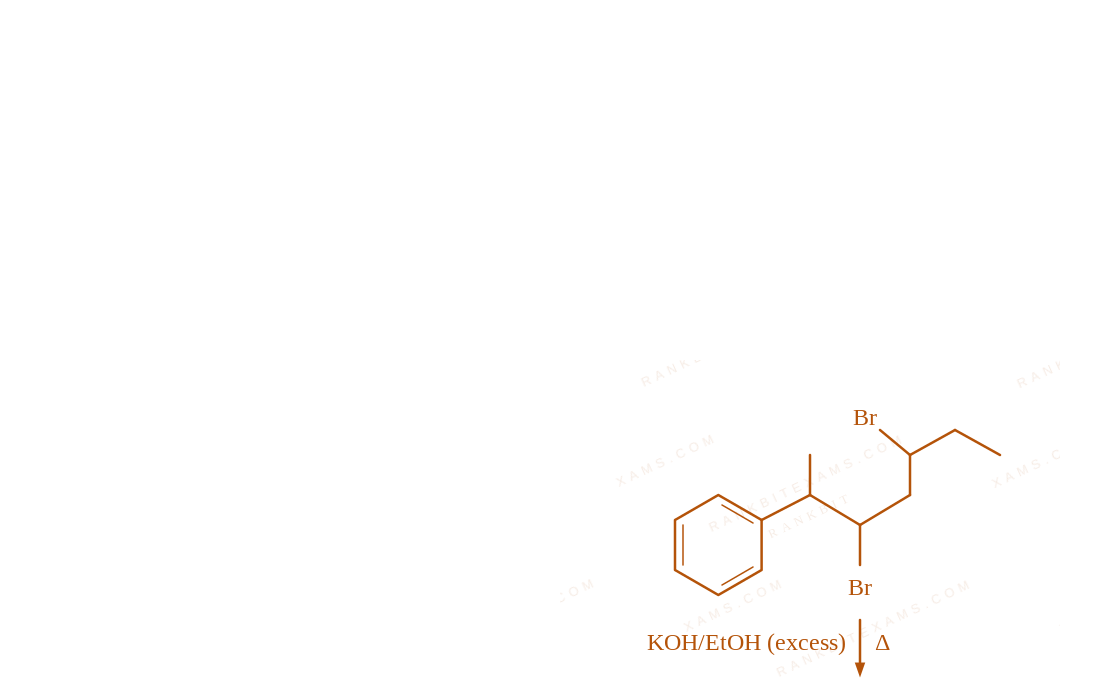
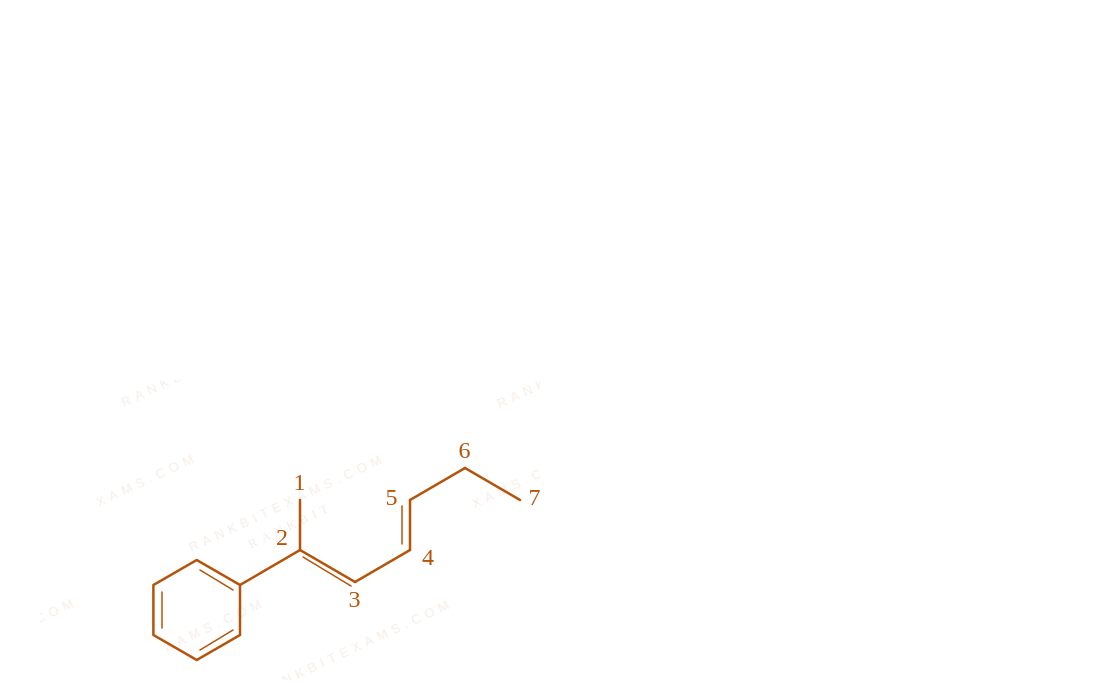
The major product of the following reaction is:
The image details a multi-halogenated hydrocarbon chain reacting with excess ethanolic potassium hydroxide under heating conditions.
A.6-Phenylhepta-2,4-diene
B.2-Phenylhepta-2,5-diene
C.6-Phenylhepta-3,5-diene
D.2-Phenylhepta-2,4-diene
Solution & Explanation
Related Formula
Base-induced dehydrohalogenation follows the Zaitsev rule to maximize thermodynamic stability via conjugated double bond networks:
The reactant is a dihalide containing a phenyl substitution. Treating with excess alcoholic KOH$KOH$ and heat induces double dehydrohalogenation via successive E2$E2$ elimination pathways.
The eliminations occur to yield the most stable, highly conjugated product where the double bonds are conjugated with each other and, if possible, with the aromatic phenyl ring system.
Step 1: Eliminating and Tracking Conjugation
Eliminating the first and second equivalents of HBr$HBr$ sets up a conjugated diene system along the heptadiene chain.
Tracing carbon numbers correctly from the end closest to the phenyl ring reveals that the conjugated diene centers sit across carbons 2 and 4, producing 2-Phenylhepta-2,4-diene.
The image details a multi-halogenated hydrocarbon chain reacting with excess ethanolic potassium hydroxide under heating conditions.
Pattern Recognition
When dealing with excess elimination agents on dihalides, look for options that form a continuous conjugated diene structure (alternating double-single-double bonds). This conjugation offers significant thermodynamic stability, especially when directly extended from a phenyl group.
Chapter Mix
Class 12 Chemistry: Haloalkanes and Haloarenes
The image details a multi-halogenated hydrocarbon chain reacting with excess ethanolic potassium hydroxide under heating conditions.
More Haloalkanes and Haloarenes Previous-Year Questions — Page 8
Q74jee_main_2024_30_jan_morningClassification
Given below are two statement one is labeled as Assertion (A) and the other is labeled as Reason (R).
Assertion (A): CH₂=CH-CH₂-Cl$CH_2=CH-CH_2-Cl$ is an example of allyl halide
Reason (R): Allyl halides are the compounds in which the halogen atom is attached to sp²$sp^2$ hybridised carbon atom.
In the light of the two above statements, choose the most appropriate answer from the options given below:
A.(A) is true but (R) is false$\text{(A) is true but (R) is false}$
B.Both (A) and (R) are true but (R) is not the correct explanation of (A)$\text{Both (A) and (R) are true but (R) is not the correct explanation of (A)}$
C.(A) is false but (R) is true$\text{(A) is false but (R) is true}$
D.Both (A) and (R) are true and (R) is the correct explanation of (A)$\text{Both (A) and (R) are true and (R) is the correct explanation of (A)}$
Solution
Core Logic
Assertion (A): CH₂=CH-CH₂-Cl$CH_2=CH-CH_2-Cl$ is an allyl halide. This statement is True. The halogen is attached to the carbon adjacent to the double bond (allylic position).
Reason (R): Allyl halides are compounds in which the halogen atom is attached to an sp²$sp^2$ hybridized carbon atom. This statement is False. In allyl halides, the halogen is attached to an sp³$sp^3$ hybridized carbon atom which is next to an sp²$sp^2$ hybridized carbon (C=C double bond).
Step 1: Conclusion
Therefore, (A) is true but (R) is false.
Pattern Recognition
Allylic = sp³$sp^3$ C adjacent to C=C.
Vinylic = sp²$sp^2$ C of the C=C itself.
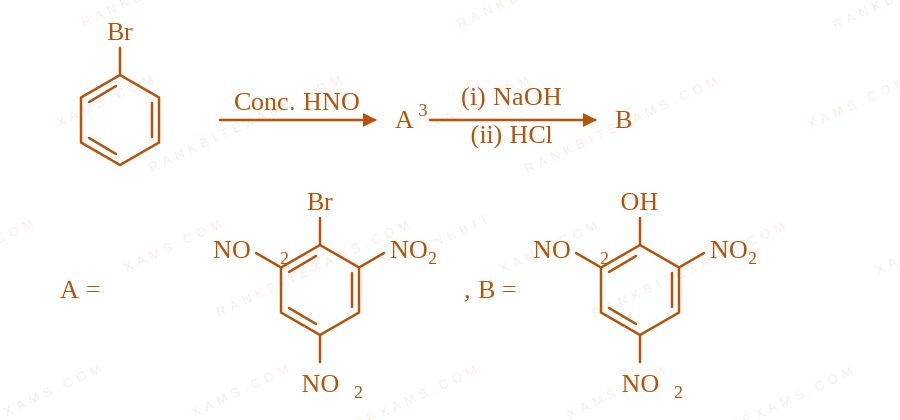
Identify A and B in the following reaction sequence.
The image shows a reaction scheme starting from bromobenzene undergoing nitration followed by substitution.
A.
B.
C.
D.
Solution
Core Logic
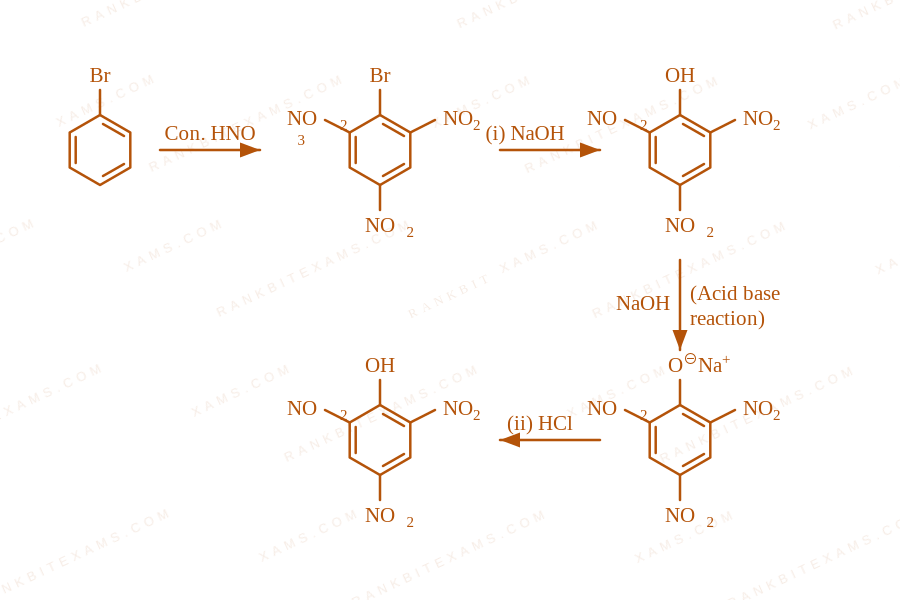
When bromobenzene reacts with concentrated HNO₃$HNO_3$ (nitration), the bromine atom is ortho/para directing. However, under drastic conditions with excess concentrated nitrating mixture, 1-bromo-2,4,6-trinitrobenzene is formed (Compound A).
When 1-bromo-2,4,6-trinitrobenzene (Compound A) is treated with NaOH$NaOH$, the presence of three strong electron-withdrawing -NO₂$-NO_2$ groups activates the aromatic ring toward Nucleophilic Aromatic Substitution (SNAr$S_NAr$). The -Br$-Br$ is easily replaced by -OH$-OH$ to form 2,4,6-trinitrophenol (picric acid).
Subsequent acidification with HCl$HCl$ yields the neutral picric acid (Compound B).
The image shows a reaction scheme starting from bromobenzene undergoing nitration followed by substitution.
Pattern Recognition
Multiple NO₂$NO_2$ groups drastically increase the susceptibility of halobenzenes to SNAr$S_NAr$. Bromine is replaced completely by OH^-$OH^-$ under alkaline conditions.
Chapter Mix
Class 12 Chemistry: Haloalkanes and Haloarenes
Class 12 Chemistry: Alcohols, Phenols and Ethers
Qjee_main_2024_31_jan_eveningIUPAC Nomenclature of Haloalkanes
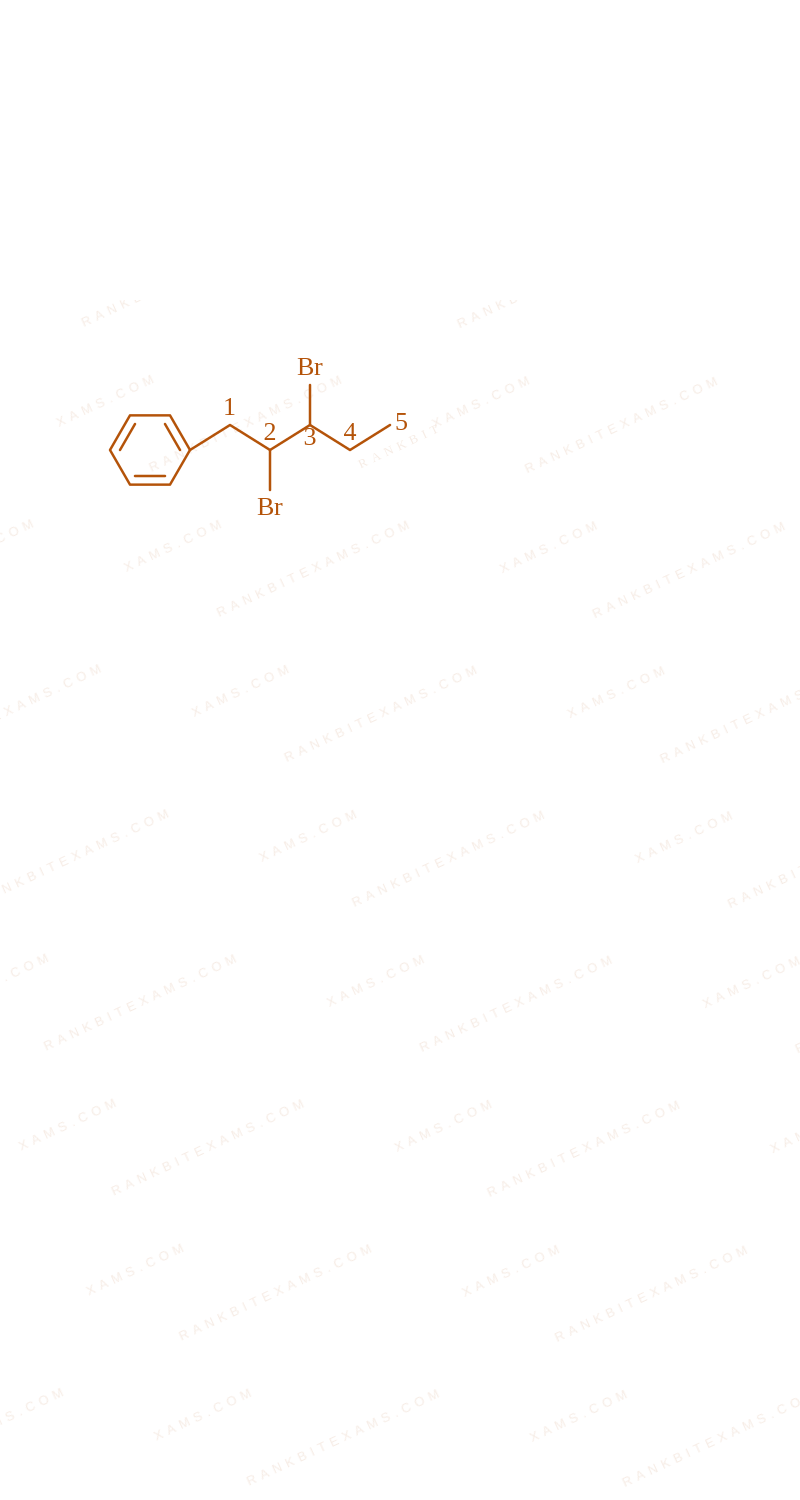
Identify structure of 2,3-dibromo-1-phenylpentane.
A.
B.
C.
D.
Solution
Core Logic
Decode the IUPAC name: 2,3-dibromo-1-phenylpentane.
Parent chain is pentane (5 carbon chain: C1-C2-C3-C4-C5).
Substituents:
Phenyl group at position 1.
Bromo groups at positions 2 and 3.
Option (3) correctly displays a 5-carbon straight chain. The first carbon attaches to the benzene ring (phenyl group), and the second and third carbons each hold a bromine atom.
IUPAC Nomenclature of Haloalkanes diagram for Q67 - JEE Main 2024 Evening
Chapter Mix
Class 12 Chemistry: Haloalkanes and Haloarenes
Qjee_main_2024_31_jan_morningElimination and Addition Reactions
The product (C) in the below mentioned reaction is:
CH₃-CH₂-CH₂-Br [Δ]KOH(alc) A [Δ]HBr B [Δ]KOH(aq) C$$CH_3-CH_2-CH_2-Br \xrightarrow[\Delta]{KOH_{(alc)}} A \xrightarrow[\Delta]{HBr} B \xrightarrow[\Delta]{KOH_{(aq)}} C$$
Q86jee_main_2024_31_jan_morningElimination and Substitution
CH₃CH₂Br + NaOH arrow Product A$$CH_3CH_2Br + NaOH \rightarrow \text{Product A}$$CH₃CH₂Br + NaOH / H₂O arrow Product B$$CH_3CH_2Br + NaOH / H_2O \rightarrow \text{Product B}$$
The total number of hydrogen atoms in product A and product B is
Numerical Answer.Answer: 10 to 10
Solution
Core Logic
Reaction 1:
If the reagent is alcoholic NaOH (implied due to formation of a distinct product A to contrast B), elimination occurs:
Practice past-year questions one chapter at a time. Pick an exam → subject → chapter and get every PYQ for that topic — pulled together from all past papers — with the chapter's key formulas alongside.
