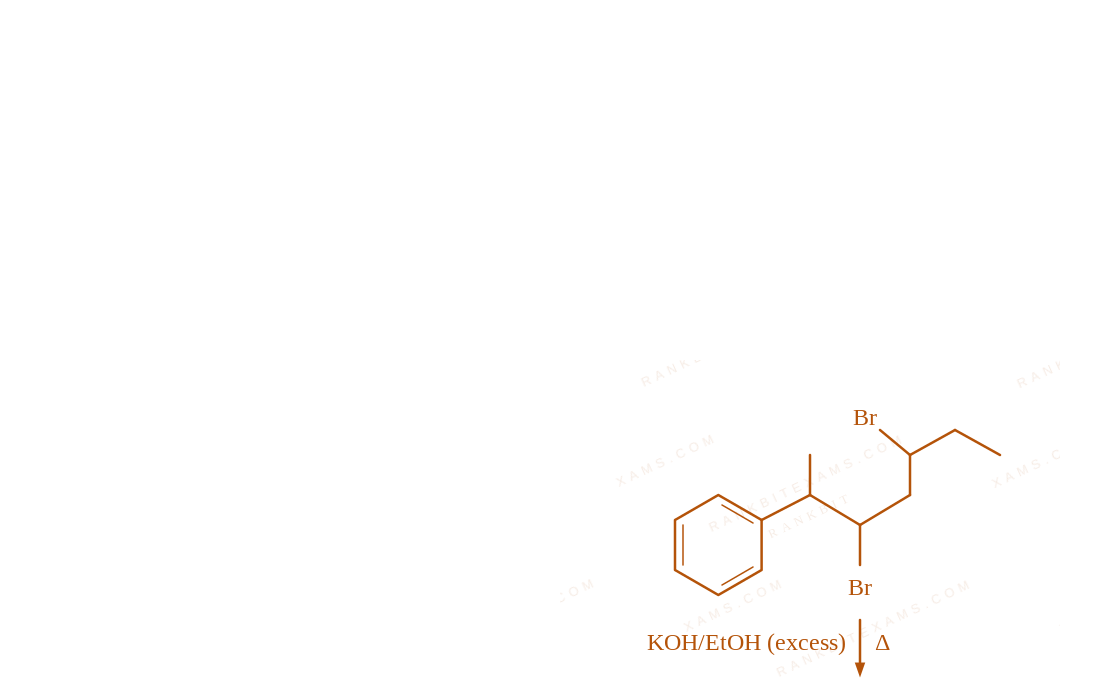
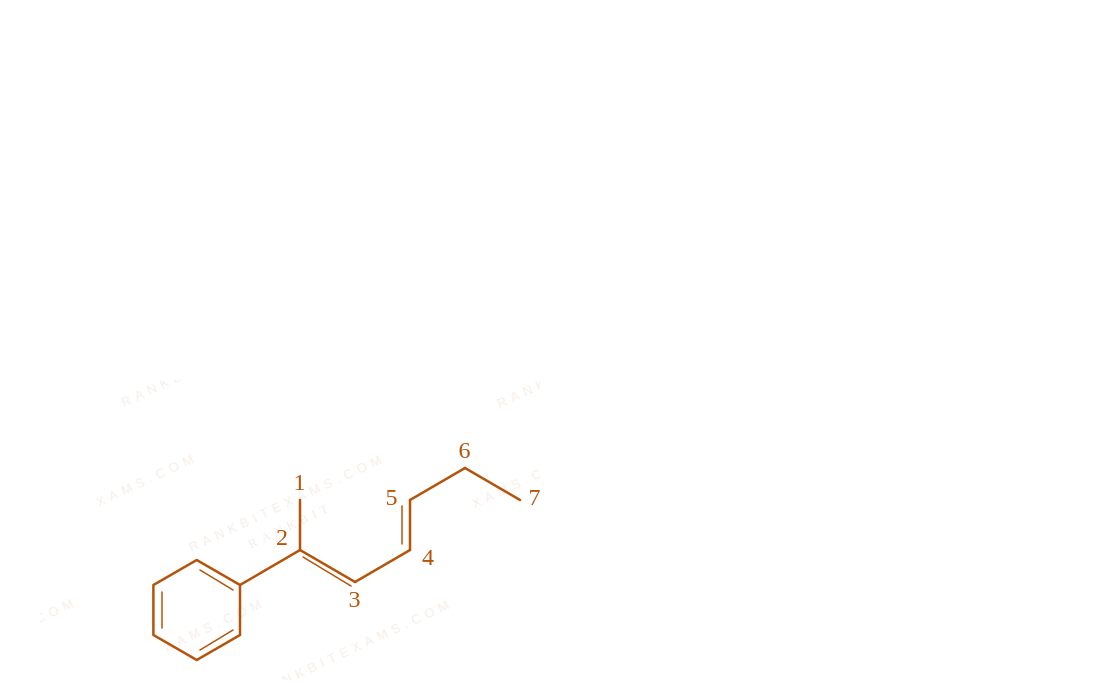
The major product of the following reaction is:
The image details a multi-halogenated hydrocarbon chain reacting with excess ethanolic potassium hydroxide under heating conditions.
A.6-Phenylhepta-2,4-diene
B.2-Phenylhepta-2,5-diene
C.6-Phenylhepta-3,5-diene
D.2-Phenylhepta-2,4-diene
Solution & Explanation
Related Formula
Base-induced dehydrohalogenation follows the Zaitsev rule to maximize thermodynamic stability via conjugated double bond networks:
The reactant is a dihalide containing a phenyl substitution. Treating with excess alcoholic KOH$KOH$ and heat induces double dehydrohalogenation via successive E2$E2$ elimination pathways.
The eliminations occur to yield the most stable, highly conjugated product where the double bonds are conjugated with each other and, if possible, with the aromatic phenyl ring system.
Step 1: Eliminating and Tracking Conjugation
Eliminating the first and second equivalents of HBr$HBr$ sets up a conjugated diene system along the heptadiene chain.
Tracing carbon numbers correctly from the end closest to the phenyl ring reveals that the conjugated diene centers sit across carbons 2 and 4, producing 2-Phenylhepta-2,4-diene.
The image details a multi-halogenated hydrocarbon chain reacting with excess ethanolic potassium hydroxide under heating conditions.
Pattern Recognition
When dealing with excess elimination agents on dihalides, look for options that form a continuous conjugated diene structure (alternating double-single-double bonds). This conjugation offers significant thermodynamic stability, especially when directly extended from a phenyl group.
Chapter Mix
Class 12 Chemistry: Haloalkanes and Haloarenes

The image details a multi-halogenated hydrocarbon chain reacting with excess ethanolic potassium hydroxide under heating conditions.
The correct statement regarding nucleophilic substitution reaction in a chiral alkyl halide is;
A. Retention occurs in SN1$S_N1$ reaction and inversion occurs in SN2$S_N2$ reaction.
B. Racemisation occurs in SN1$S_N1$ reaction and retention occurs in SN2$S_N2$ reaction.
C. Racemisation occurs in both SN1$S_N1$ and SN2$S_N2$ reactions.
D. Racemisation occurs in SN1$S_N1$ reaction and inversion occurs in SN2$S_N2$ reaction.
Solution
Core Logic
In an SN1$\text{S}_\text{N}1$ pathway, a planar carbocation intermediate is produced. Attack by the nucleophile can take place with equal probability from either side, resulting in complete/partial racemisation.
In an SN2$\text{S}_\text{N}2$ pathway, the nucleophile attacks exclusively from the backside opposite the leaving group, causing an absolute structural inversion (Walden inversion).
Qjee_main_2024_29_jan_morningPreparation of Haloarenes
Given below are two statements : one is labelled as Assertion A and the other is labelled as Reason R :
Assertion A : Aryl halides cannot be prepared by replacement of hydroxyl group of phenol by halogen atom.
Reason R : Phenols react with halogen acids violently.
In the light of the above statements, choose the most appropriate from the options given below:
A.Both A and R are true but R is NOT the correct explanation of A$\text{Both A and R are true but R is NOT the correct explanation of A}$
B.A is false but R is true$\text{A is false but R is true}$
C.A is true but R is false$\text{A is true but R is false}$
D.Both A and R are true and R is the correct explanation of A$\text{Both A and R are true and R is the correct explanation of A}$
Solution
Core Logic
Assertion (A): In phenols, the C-O$C-O$ bond possesses partial double bond character due to resonance (the lone pair of oxygen delocalizes into the benzene ring). Because of this strong C-O$C-O$ bond, nucleophilic substitution reactions where a halide ion would replace the hydroxyl group do not occur under normal conditions. Thus, aryl halides cannot be prepared directly from phenols by reaction with HX$HX$. The statement is True.
Reason (R): Phenols do NOT react violently with halogen acids. In fact, they practically do not react with halogen acids (HX$HX$) to form aryl halides because the C-O$C-O$ bond is difficult to break. The statement is False.
Step 1: Visualization
Preparation of Haloarenes diagram for Q70 - JEE Main 2024 Morning
Given reason is false.
Step 2: Conclusion
Assertion (A) is correct but Reason (R) is false.
Chapter Mix
Class 12 Chemistry: Haloalkanes and Haloarenes
Class 12 Chemistry: Alcohols Phenols and Ethers
Qjee_main_2024_30_january_eveningStereochemistry of Halogenation
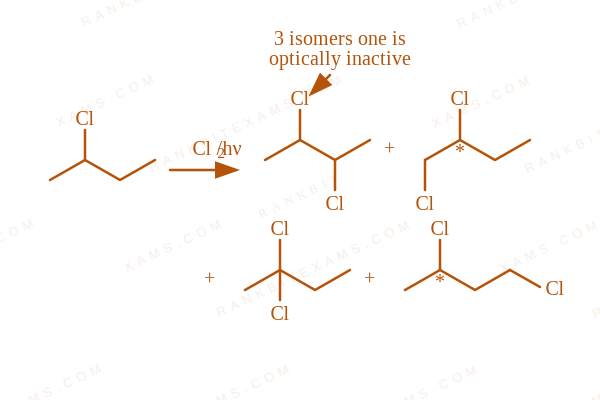
2-chlorobutane + Cl₂ arrow C₄H₈Cl₂ (isomers)$\text{2-chlorobutane} + Cl_2 \rightarrow C_4H_8Cl_2 \text{ (isomers)}$
Total number of optically active isomers shown by C₄H₈Cl₂$C_4H_8Cl_2$, obtained in the above reaction is
Numerical Answer.Answer: 6 to 6
Solution
Core Logic
Free radical chlorination of 2-chlorobutane yields different constitutional isomers of dichlorobutane, each potentially existing as various stereoisomers.
Substrate: CH₃-CH(Cl)-CH₂-CH₃$CH_3-CH(Cl)-CH_2-CH_3$ (exists as 2 enantiomers: d$d$ and l$l$)
Chlorination can occur at 4 different carbons:
At C1: CH₂(Cl)-CH(Cl)-CH₂-CH₃$CH_2(Cl)-CH(Cl)-CH_2-CH_3$ (1,2-dichlorobutane) arrow$\rightarrow$ Two chiral centers, unsymmetrical. Forms 4 optically active isomers (2 pairs of enantiomers).
At C2: CH₃-C(Cl)₂-CH₂-CH₃$CH_3-C(Cl)_2-CH_2-CH_3$ (2,2-dichlorobutane) arrow$\rightarrow$ No chiral center. Achiral (0 optically active).
At C3: CH₃-CH(Cl)-CH(Cl)-CH₃$CH_3-CH(Cl)-CH(Cl)-CH_3$ (2,3-dichlorobutane) arrow$\rightarrow$ Symmetrical with 2 chiral centers. Forms 3 stereoisomers: 1 meso (achiral) and 2 optically active (1 enantiomeric pair).
At C4: CH₃-CH(Cl)-CH₂-CH₂(Cl)$CH_3-CH(Cl)-CH_2-CH_2(Cl)$ (1,3-dichlorobutane, numbering from other end) arrow$\rightarrow$ One chiral center. Forms 2 optically active isomers (1 enantiomeric pair).
Optically active isomers of dichlorobutane diagram for Q89 - JEE Main 2024 Evening
Step 1: Sum the Optically Active Isomers
Total optically active isomers = 4 (from 1,2-dichloro) + 2 (from 2,3-dichloro) + 2 (from 1,3-dichloro) = 8.
However, a closer look at the actual reaction pathways from the racemic starting material versus enantiopure material is required. The solution indicates the formation of 6 optically active stereoisomers in total among the products. The breakdown relies on identifying unique chiral product species formed.
Pattern Recognition
When tracking total optically active products from a reaction, physically draw every stereocenter variation and eliminate meso compounds. Meso compounds have a plane of symmetry and are optically inactive.
Chapter Mix
Class 12 Chemistry: Haloalkanes and Haloarenes
Class 11 Chemistry: Organic Chemistry Some Basic Principles and Techniques
Given below are two statements:
Statement I: High concentration of strong nucleophilic reagent with secondary alkyl halides which do not have bulky substituents will follow SN2$S_N2$ mechanism.
Statement II: A secondary alkyl halide when treated with a large excess of ethanol follows SN1$S_N1$ mechanism.
In the light of the above statements, choose the most appropriate from the questions given below:
A.Statement I is true but Statement II is false.$\text{Statement I is true but Statement II is false.}$
B.Statement I is false but Statement II is true.$\text{Statement I is false but Statement II is true.}$
C.Both statement I and Statement II are false.$\text{Both statement I and Statement II are false.}$
D.Both statement I and Statement II are true.$\text{Both statement I and Statement II are true.}$
Solution
Core Logic
Statement I: Rate of SN2 ∝ [R-X][Nu^-]$S_N2 \propto [R-X][Nu^-]$. Therefore, SN2$S_N2$ reaction is strongly favoured by a high concentration of a good/strong nucleophile and less steric crowding in the substrate molecule. Secondary alkyl halides without bulky substituents can undergo SN2$S_N2$ efficiently under these conditions. Thus, Statement I is true.
Statement II: Ethanol is a weak nucleophile and a polar protic solvent. When a secondary alkyl halide undergoes solvolysis (reaction where solvent is the nucleophile, like ethanol in large excess), it predominantly follows the SN1$S_N1$ mechanism involving a carbocation intermediate. Thus, Statement II is also true.
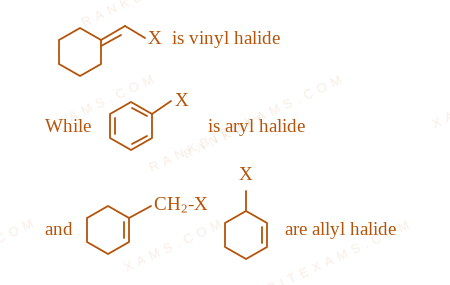
A vinylic halide is a compound where the halogen atom is directly bonded to an sp²$sp^2$ hybridized carbon of an aliphatic double bond (C=C).
Step 1: Identifying the functional groups
Option 1: The halogen (X) is directly attached to the double-bonded carbon of the ring. This is a vinyl halide.
Classification solution diagram for Q69 - JEE Main 2024 Morning
Option 2: The halogen is attached to an aromatic ring directly. This is an aryl halide.
Classification solution diagram for Q69 - JEE Main 2024 Morning
Options 3 & 4: The halogen is attached to an sp³$sp^3$ hybridized carbon adjacent to a C=C double bond. These are allylic halides.
Classification solution diagram for Q69 - JEE Main 2024 Morning
Chapter Mix
Class 12 Chemistry: Haloalkanes and Haloarenes

More Haloalkanes and Haloarenes Questions — jee_main_2025_28_jan_evening
Practice past-year questions one chapter at a time. Pick an exam → subject → chapter and get every PYQ for that topic — pulled together from all past papers — with the chapter's key formulas alongside.